

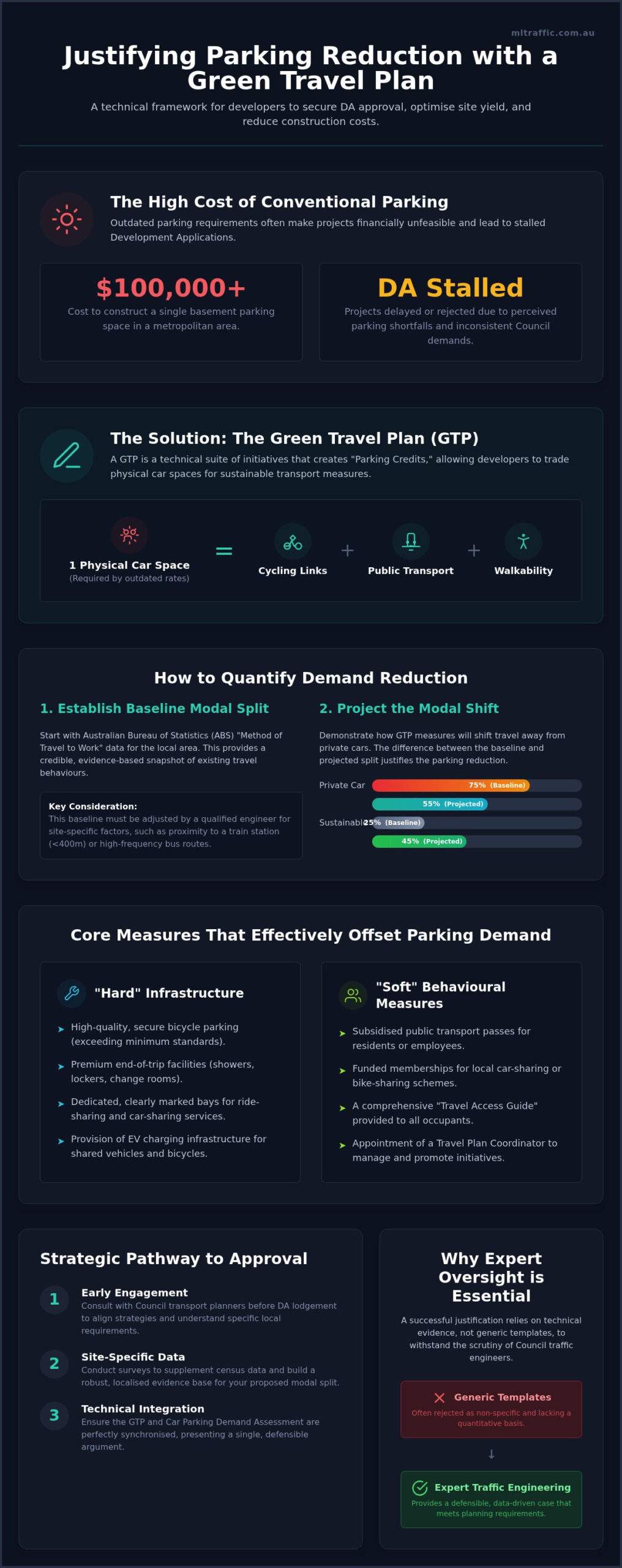
A single basement parking space in a metropolitan Australian development can now cost upwards of $100,000 to excavate and construct. For many developers, these rigid requirements don’t just eat into profit margins; they often make a project completely unfeasible. You’re likely familiar with the frustration of a DA stalling because of a perceived parking shortfall or the inconsistent demands of local Councils. This article provides the technical framework for justifying parking reduction with a green travel plan to secure approval without sacrificing your site’s potential.
You’ll learn how to transform a standard sustainability document into a defensible planning tool that offsets physical car parking with evidence-based demand management. We will examine the specific traffic engineering assessments and modal shift strategies required to optimise your yield. By following this professional framework, you can navigate the planning process with confidence and avoid the need for expensive basement redesigns or unnecessary excavation costs. The result is a streamlined approval process that relies on technical data rather than subjective negotiations.
Key Takeaways
- Define the Green Travel Plan (GTP) as a technical suite of site-specific initiatives that function as “parking credits” to offset physical car parking requirements.
- Learn how to use modal split data and local census statistics to establish a quantitative, defensible baseline for transport demand reduction.
- Identify high-impact “hard” infrastructure and “soft” behavioural measures that Australian Councils recognise as valid substitutes for on-site parking.
- Discover the strategic importance of early engagement with Council transport planners and site-specific surveys when justifying parking reduction with a green travel plan.
- Understand why expert traffic engineering oversight is required to ensure your DA is supported by technical evidence rather than generic templates.
The Strategic Role of a Green Travel Plan in Parking Justification
A Green Travel Plan (GTP) is a site-specific suite of technical initiatives designed to manage and reduce the transport footprint of a new development. Unlike generic sustainability statements, a formal Travel Plan provides a quantitative framework that Councils use to evaluate how a project will function with fewer physical car spaces. It serves as the primary evidence base within a Traffic Impact Assessment (TIA), demonstrating that the proposed parking provision meets actual demand rather than arbitrary statutory minimums. Using a technical evidence base is the most effective method for justifying parking reduction with a green travel plan during the initial DA lodgement.
Many Australian local government areas now recognise the concept of “Parking Credits” or “Demand Offsets”. This technical approach allows developers to trade physical parking spots for high-quality sustainable transport infrastructure or operational commitments. Statutory parking rates in many planning schemes are frequently outdated. They are often based on peak car ownership data from several decades ago, which doesn’t reflect the reality of modern urban living. In transit-oriented developments, these rates fail to account for the rise of ride-sharing, improved cycling networks, and high-frequency public transport access.
To better understand this concept, watch this helpful video:
Why Councils Favour GTPs Over Excess Parking
State-level transport strategies across Australia increasingly prioritise reduced private vehicle dependency to meet long-term infrastructure and environmental goals. Councils favour GTPs because they facilitate “unbundled parking”, where parking spaces are sold or leased separately from the actual building units. This strategy reduces the baseline cost of development and discourages unnecessary car ownership. By managing demand at the source, a GTP directly addresses local road network congestion. This is a critical factor for planning panels, as it demonstrates a proactive approach to traffic management rather than a passive reliance on over-supplying car parks.
GTP vs. Car Parking Demand Assessment
It is vital to clarify that a GTP does not replace a formal Car Parking Demand Assessment. Instead, the two documents work in tandem to create a defensible planning argument. The Demand Assessment establishes the empirical baseline of how many spots are required based on land use, while the GTP provides the justification for lowering that number through alternative transport solutions. Consistency between these reports is essential. Any discrepancy in mode share data or projected trip generation can lead to significant DA delays. When justifying parking reduction with a green travel plan, the technical arguments must be perfectly synchronised to withstand the scrutiny of a Council transport planner or a senior traffic engineer.
Quantifying the Shift: How to Calculate Demand Reduction
To move beyond subjective negotiations with Council, developers must provide a quantified bridge between their proposed initiatives and the actual reduction in car parking demand. This involves calculating the “Modal Split”, which is the percentage of future occupants expected to use various transport modes such as cycling, walking, or public transport. By applying specific “Reduction Factors” to statutory rates, you create a technical argument for justifying parking reduction with a green travel plan that is based on data rather than assumptions.
Establishing the Baseline Modal Split
The first step in this technical process is establishing a credible baseline using Australian Bureau of Statistics (ABS) “Method of Travel to Work” data. This data provides a snapshot of existing travel behaviours within the local statistical area. However, a raw census figure is rarely enough. A qualified engineer must adjust this baseline for site-specific factors, such as a location within 400 metres of a heavy rail station or a high-frequency bus interchange. Identifying the “Residual Demand” is the final part of this step. This represents the actual number of car spaces required after accounting for the surrounding infrastructure and current local trends.
Calculating the Impact of Sustainable Initiatives
Once the baseline is set, we apply credits for the specific measures proposed in the GTP. “Hard Measures” refer to physical infrastructure like on-site car-share pods, dedicated electric vehicle (EV) charging stations, or high-quality end-of-trip facilities. These are often weighted more heavily by Councils because they are permanent fixtures. “Soft Measures”, such as travel information packs, carpooling programmes, or subsidised transit vouchers, are also factored in but may require ongoing monitoring to maintain their “Parking Credit” status. Effective Parking and Transportation Demand Management strategies rely on these weighted variables to prove that the development will not overspill into the local street network.
A 10% shift in modal split can mathematically justify a 10% reduction in statutory parking rates. To ensure these calculations meet regulatory standards, it is advisable to engage an expert for a formal Car Parking Demand Assessment that integrates these GTP offsets. Using empirical evidence from similar developments in high-density Australian corridors further strengthens the claim. This provides the “proof of concept” that planning panels require to approve reduced parking provision without requesting costly basement redesigns.
Core Measures that Effectively Offset Parking Demand
Effective Green Travel Plans categorise transport initiatives into “Hard” and “Soft” measures. Councils generally prioritise hard measures because they involve permanent physical infrastructure that remains with the development for its entire lifespan. According to the Institute for Sensible Transport, Green Travel Plans are increasingly used to secure planning permits by providing a strategic alternative to traditional parking over-supply. When justifying parking reduction with a green travel plan, selecting the right combination of these measures is essential to satisfy the technical requirements of local planning panels.
High-Impact Infrastructure (Hard Measures)
Infrastructure-based offsets provide the most significant “parking credits” during the DA process. Dedicated car-share spaces, operated by providers such as GoGet or Flexicar, are highly valued. In many high-density Australian corridors, a single car-share pod can offset between 7 and 10 private parking spaces, depending on the specific Council’s policy. Enhanced bicycle parking is another critical pillar. To secure a reduction, developers should provide end-of-trip facilities, including showers and lockers, that exceed the minimum requirements set by the local planning scheme. All physical parking and access infrastructure, including bicycle rails and car-share bays, must strictly adhere to AS 2890.1 standards to ensure safety and functionality. Electric vehicle (EV) charging stations also function as a demand management tool, as they encourage the transition to shared or smaller-footprint transport options within the site.
Behavioural Initiatives (Soft Measures)
Soft measures focus on influencing the travel habits of residents and tenants. While these are often viewed as supplementary to hard infrastructure, they are vital for proving that the modal shift targets are achievable. Common initiatives include providing pre-loaded public transport smart cards, such as Opal or Myki, to initial occupants to encourage immediate use of local transit networks. For commercial or industrial developments, implementing a formal Carpooling Programme can significantly reduce the peak demand for staff parking. Many modern developments also include site-specific digital portals that offer real-time transport information, such as live bus and train timetables or car-share availability. To ensure these behavioural shifts are maintained, Councils often require the appointment of a Travel Plan Coordinator. This individual is responsible for the ongoing commitment to the plan, including the monitoring and reporting of travel patterns back to the local authority at agreed intervals.
Step-by-Step: Presenting the Justification to Council
Securing a DA approval for reduced parking requires more than a simple request. It demands a methodical presentation of technical evidence. A structured five-step process ensures that the argument for justifying parking reduction with a green travel plan is robust enough to withstand rigorous Council scrutiny. This approach focuses on data integrity and professional accountability.
- Step 1: Initiate early engagement with Council transport planners. This occurs during the pre-DA phase to identify any non-negotiable “red lines” regarding parking minimums.
- Step 2: Conduct a site-specific parking survey. This provides empirical proof of existing on-site capacity or local street availability to support your claims.
- Step 3: Integrate the GTP findings into the formal Traffic Impact Assessment. The TIA must reference the GTP as a primary demand management tool.
- Step 4: Develop data-backed rebuttals for potential objections. Anticipate concerns regarding traffic generation and local amenity with specific technical responses.
- Step 5: Finalise the Statement of Environmental Effects (SEE). Ensure the traffic expert’s endorsement is clearly stated to provide the necessary professional weight for Panel hearings.
The Pre-DA Consultation Phase
Never submit a parking reduction proposal without prior discussion with Council authorities. A “Preliminary Traffic Statement” is a valuable tool during this stage to test the waters. It allows the development team to gauge the Council’s appetite for a reduction before investing in full technical reports. This phase is critical for identifying the specific parking minimums that the Council views as absolute. Knowing these “red lines” early prevents the need for major redesigns after the DA has been lodged. Engaging early builds a professional rapport with the transport planners who will ultimately assess your application.
Addressing the “Spill-Over” Concern
A primary concern for most Australian Councils is the potential for “spill-over” parking into neighbouring residential streets. To mitigate this fear, we perform a specialised “Parking Stress Survey”. This assessment measures the current occupancy of street parking within a 200 to 400-metre radius of the site across various times of the day. If the survey proves that surrounding streets have sufficient capacity to handle minor overflow during peak periods, the Council is more likely to accept a lower on-site rate. Proposing “Parking Management Plans” also acts as a secondary safeguard. These plans provide a clear framework for how the development will monitor and control parking usage once the building is operational.
If your project requires a defensible technical argument for a parking shortfall, contact our senior principals to discuss your site-specific requirements.
Why Expert Traffic Engineering is Essential for Approval
A Green Travel Plan is more than a supplementary sustainability document; it is a piece of expert evidence. Councils are increasingly sophisticated in their review processes and can easily distinguish between a generic template and a report backed by empirical site data. A qualified traffic engineer from ML Traffic Engineers Australia provides the professional weight required to defend parking reductions, particularly when a project moves to a Planning Panel or a court hearing. The document must be defensible under cross-examination, meaning every modal shift assumption must be supported by verifiable local transport context and existing infrastructure capacity.
Avoiding the “Cookie-Cutter” Trap
Councils frequently reject Green Travel Plans that fail to reflect the nuances of the local area. A “cookie-cutter” approach often includes irrelevant initiatives that don’t address the specific constraints of the site or the demographic of the future occupants. For a GTP to be successful in justifying parking reduction with a green travel plan, it must contain SMART targets: Specific, Measurable, Achievable, Relevant, and Time-bound. If the goals are not tailored to the project’s specific land use and location, the plan is viewed as a “box-ticking” exercise rather than an actionable management tool. This lack of specificity is a common reason for DA delays and extensive requests for further information (RFI).
ML Traffic Engineers Australia: Your Partners in Approval
ML Traffic Engineers Australia brings over 15 years of professional experience in navigating the complex regulatory standards of Australian local government. We specialise in providing the defensible evidence needed to secure approvals for developments with parking shortfalls. Our firm operates on a “Personnel Continuity” promise. The senior principal who initiates your project and understands your commercial objectives is the same expert who performs the technical work and writes the final report. This ensures that the technical justification remains consistent and robust throughout the entire planning process, from pre-DA consultation to final approval.
Direct access to senior leadership ensures that complex parking negotiations are handled with meticulous detail and professional accountability. This hands-on approach distinguishes our consultancy from larger, more impersonal firms where work is often delegated to junior staff. Contact the team today to request a fee proposal on your next project and ensure your parking justification is supported by seasoned expertise.
Optimise Your Development Yield with Professional Traffic Justification
A Green Travel Plan is a technical tool that transforms sustainability initiatives into measurable parking demand offsets. Success in justifying parking reduction with a green travel plan depends on replacing assumptions with site-specific data and professional engineering oversight. By integrating modal split calculations and high-impact infrastructure measures into your DA, you can secure approval without the prohibitive costs of excess basement excavation or unnecessary redesigns.
ML Traffic Engineers Australia provides the technical expertise required to navigate inconsistent Council requirements across all Australian jurisdictions. With over 15 years of experience, we ensure your project is supported by a defensible evidence base that withstands rigorous planning review. Our senior principals remain directly involved in every report, ensuring consistency and accountability from the pre-DA phase through to final approval. This hands-on approach provides the professional weight needed for Panel hearings and complex negotiations.
Don’t allow outdated parking minimums to compromise your site’s potential. Get a Professional Traffic Assessment for Your DA Approval and move forward with a project that is both compliant and commercially viable.
Frequently Asked Questions
Is a Green Travel Plan mandatory for all parking reductions in Australia?
It is not always a legal requirement, but a Green Travel Plan is the standard technical expectation for most metropolitan Councils when a developer seeks to deviate from statutory parking rates. While minor shortfalls might be justified through a simple Demand Assessment, larger reductions almost always necessitate a formal GTP. This document provides the legal and technical framework for justifying parking reduction with a green travel plan by proving that alternative transport measures will effectively manage site demand.
How much parking can I realistically cut by using a GTP?
Reductions typically range from 10% to 30%, though this depends entirely on the site’s accessibility and the quality of the proposed measures. In high-density urban centres with excellent transit links, some Councils may even support car-free developments for specific residential uses. A qualified traffic engineer must determine the exact percentage by calculating modal split shifts and applying weighted credits for infrastructure like car-share pods, electric vehicle charging stations, or enhanced cycling facilities.
What happens if the targets in the Green Travel Plan are not met after construction?
Councils often include monitoring and enforcement clauses within the DA conditions. If post-occupancy surveys indicate that modal shift targets are not being met, the developer or owners’ corporation may be required to implement additional behavioural measures, such as increased travel subsidies or improved information dissemination. In some jurisdictions, failure to comply with the management strategies outlined in the plan can lead to planning infringements or the requirement to submit a revised Traffic Management Plan.
Do I need a separate GTP for residential and commercial components of a mixed-use site?
A single, integrated document is usually preferred, but it must clearly distinguish between the different user groups. The travel patterns of a residential tenant differ significantly from those of a commercial office worker or a retail customer. Your GTP should include specific sections for each land use, detailing tailored initiatives like end-of-trip facilities for staff and car-share access for residents. This ensures the technical argument for justifying parking reduction with a green travel plan is comprehensive across the entire mixed-use project.
Can a car-share pod replace a specific number of private parking spaces?
Yes, many Australian Councils have formalised offset ratios where one car-share space can replace multiple private bays. While ratios vary between local government areas, a common benchmark is one car-share pod replacing between seven and ten private spaces. This is a highly effective infrastructure measure because it provides a permanent, on-site alternative to private vehicle ownership, which traffic planners recognise as a significant demand management tool during the initial DA assessment.
Will Council accept a GTP if my site is not near a train station?
Council may still accept a GTP, but the justification relies more heavily on on-site infrastructure rather than external transit links. If heavy rail is not accessible, the plan must focus on high-frequency bus networks, car-share pods, and superior cycling infrastructure. The goal is to prove that the development can function with reduced parking by providing viable, site-specific alternatives that suit the local transport context, regardless of the distance to a major rail interchange.
How much does it cost to have a professional GTP prepared for a DA?
The cost of a professional Green Travel Plan varies based on the project’s scale, the complexity of the land use, and the specific requirements of the local Council. Factors such as the need for site-specific parking surveys or complex modal split calculations will influence the final fee. Developers should request a tailored fee proposal from a qualified traffic engineering firm to ensure the document meets all regulatory standards and provides a defensible argument for planning approval.
Who is responsible for monitoring the GTP once the building is occupied?
Responsibility typically falls to the building manager or an appointed Travel Plan Coordinator. Most DA conditions require periodic monitoring reports to be submitted to Council for a set period, often three to five years post-occupation. These reports use resident or tenant surveys to verify that the transport initiatives are achieving the intended modal shift. Ongoing accountability ensures the plan remains an active management tool rather than just a document used for initial planning approval.

Disclaimer
The content on www.mltraffic.com.au, including all technical articles, guides, and resources, is provided for general informational and educational purposes only. It is not intended to constitute professional advice in traffic engineering, transportation planning, development approvals, or any other technical or legal field.
While ML Traffic Engineers makes every reasonable effort to ensure the accuracy, completeness, and timeliness of the information published, we do not provide any warranties or representations (express or implied) regarding its reliability, suitability, or availability for any particular purpose. Any reliance you place on the content is strictly at your own risk.
In no event shall ML Traffic Engineers, its directors, employees, authors, or affiliates be liable for any direct, indirect, incidental, special, consequential, or punitive damages (including, without limitation, loss of profits, data, or business opportunities) arising out of or in connection with the use of, or inability to use, any information provided on this website.
The articles and guides on this site are not a substitute for engaging a qualified, registered professional traffic engineer (such as an NPER or RPEQ engineer) to assess your specific project requirements. For tailored advice, compliance assessments, or traffic engineering services, please contact a competent professional.
This disclaimer may be updated from time to time without notice. By accessing or using this website, you agree to be bound by the most current version of this disclaimer.
