
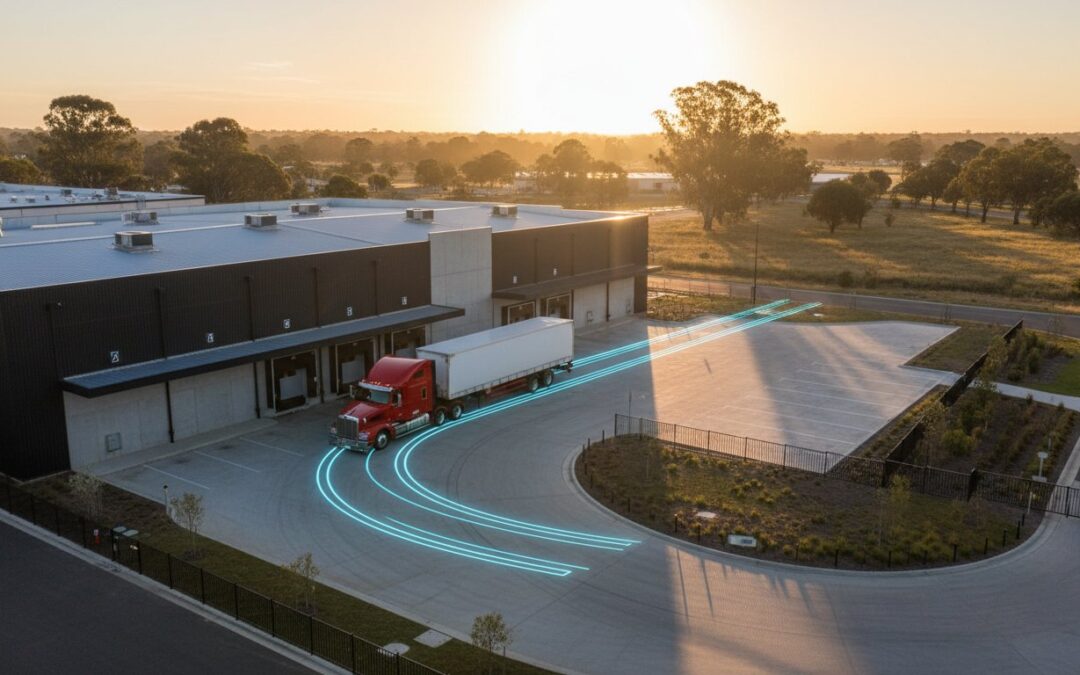
Last Tuesday, a developer in Western Sydney watched their $4.2 million warehouse project stall because a single 19-meter semi-trailer couldn’t clear the entry gate without mounting the curb. It’s a costly mistake, considering that roughly 35% of industrial development applications face significant delays or outright rejections due to poor site layouts. You likely already know that getting your vehicle access design for industrial sites right is the difference between a high-performing asset and a logistical nightmare. It’s a high-stakes balancing act where every square meter of over-engineered concrete represents thousands in lost revenue and wasted storage capacity.
You deserve a site that works as hard as your business does. This guide provides the technical requirements and design principles you need to ensure operational efficiency and total council compliance. We’ll show you how to master swept path assessments and driveway gradients to satisfy AS 2890.2 standards without sacrificing valuable floor space. From optimizing heavy vehicle flow to securing a seamless DA approval, we are breaking down the exact steps to transform your industrial layout into a model of engineering precision.
Key Takeaways
-
Understand how integrating heavy vehicle requirements with site constraints prevents structural damage and costly operational delays.
-
Master the technical requirements of AS 2890.2 to ensure your site correctly accommodates everything from SRVs to B-doubles.
-
Learn why swept path analysis is mandatory for industrial DAs and how software simulations ensure safe, real-world vehicle movement.
-
Follow a practical five-step guide to vehicle access design for industrial sites to streamline your path to Council approval.
-
Discover how professional traffic engineering expertise replaces "cookie-cutter" designs with reliable, site-specific solutions.
Table of Contents
-
Why Vehicle Access Design for Industrial Sites is the Backbone of Your Project
-
Navigating Australian Standards: AS 2890.2 for Heavy Vehicles
Why Vehicle Access Design for Industrial Sites is the Backbone of Your Project
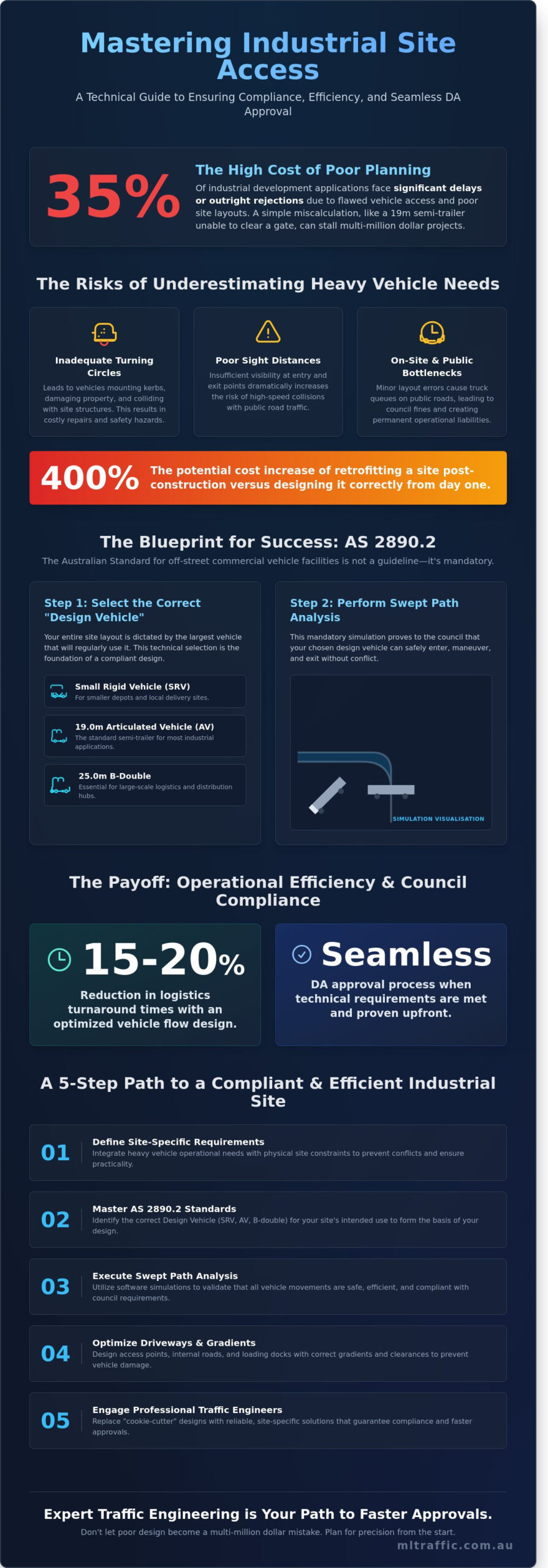
Vehicle access design for industrial sites is the technical process of integrating heavy vehicle requirements with physical site constraints. It ensures every truck, from a standard delivery van to a 25.0m B-double, can enter, maneuver, and exit your facility without causing structural damage or safety hazards. Unlike residential driveways where aesthetics often take priority, industrial design focuses on load-bearing capacity, clearance, and swept paths. If you ignore these technicalities during the planning phase, you’re looking at inevitable Development Application (DA) rejections and costly operational delays. At ML Traffic Engineers, we’ve seen that roughly 30% of industrial projects face significant setbacks due to inadequate traffic planning at the start.
To better understand how specialized design impacts heavy vehicle movement and site longevity, watch this helpful video:
The intersection of safety, compliance, and commercial efficiency is where a project succeeds or fails. Poorly planned access leads to cracked pavements and damaged gateposts, which are expensive to repair. Efficient vehicle access design for industrial sites relies on the geometric design of roads to ensure curves and gradients accommodate heavy loads without compromising the safety of staff or the public.
Operational Efficiency vs. Council Compliance
Balancing operational speed with local council regulations is a constant challenge for developers. Efficient access can reduce turnaround times for logistics by 15% to 20%, which directly impacts your bottom line. You can’t simply "make it fit" anymore; modern warehouses require precise assessments to prove to authorities that the layout works. Our specialized traffic services help bridge this gap. We use our 30 plus years of experience to ensure your site meets Australian Standards (AS 2890.2) while remaining commercially viable. The traffic consultant who provides the quote, does the work, ensuring no technical detail is lost during the DA process.
The Risks of Underestimating Heavy Vehicle Requirements
Underestimating the space required for heavy vehicles is a recipe for a financial nightmare. Common mistakes include:
-
Inadequate turning circles: This leads to vehicles mounting kerbs or colliding with structures.
-
Poor sight distances: Inadequate visibility at entry points increases the risk of high-speed collisions.
-
Bottlenecks: Small errors in layout can cause trucks to queue on public roads, leading to council fines.
Retrofitting a site after construction is finished can cost 400% more than getting the design right during the initial drafting phase. If a driver has to reverse into a busy street because a driveway is too narrow, you’ve created a permanent liability. Meticulous planning prevents these bottlenecks before the first load of concrete is poured.
Navigating Australian Standards: AS 2890.2 for Heavy Vehicles
AS 2890.2:2018 is the mandatory framework for off-street commercial vehicle facilities in Australia. It dictates every dimension from the curb to the loading dock. Successful vehicle access design for industrial sites depends on identifying the "Design Vehicle" during the preliminary planning phase. This isn’t a guess. It’s a technical selection based on the 19.0-meter articulated vehicle (AV) or the 25.0-meter B-double for larger logistics hubs.
Industrial sites often share boundaries with high-speed public roads or narrow local streets. Following FHWA access management guidelines ensures that the transition from public corridors to private driveways remains safe and efficient. Your design must account for the swept path of the largest expected vehicle to prevent "curb-hopping" or collisions with fixed infrastructure like gate posts and fire hydrants.
Choosing the Correct Design Vehicle
Selecting between a 6.4-meter Small Rigid Vehicle (SRV) and a 19.0-meter Articulated Vehicle (AV) changes your site layout entirely. You must also account for the "Check Vehicle." This is usually a Heavy Rigid Vehicle (HRV) like a 10.5-meter waste collection truck or a fire appliance. If your design doesn’t accommodate their 12.5-meter turning radius, the local council will likely reject your Development Application. We justify these selections in your Traffic Impact Assessment to ensure 100% compliance with local government requirements.
Driveway and Ramp Grade Compliance
Ramp grades are where many industrial designs fail. AS 2890.2 limits maximum gradients to 15% for heavy vehicles, but even a 10% slope can cause issues for low-clearance trailers. You need a 2.0-meter transition zone at the top and bottom of ramps to prevent "hang-ups" or scraping. Precise vehicle access design for industrial sites requires vertical cross-sections to verify the following metrics:
-
Vertical Clearance: A minimum of 4.5 meters is required for heavy vehicle areas, though 4.8 meters is preferred for high-clearance loads.
-
Driveway Width: Minimum widths range from 3.5 meters for SRVs to over 15 meters for B-double entries with dual-lane requirements.
-
Gradient Limits: Keep main circulating roadways under 10% to ensure traction and safety in wet conditions.
If you’re unsure which vehicle class applies to your project, our team can provide a detailed Vehicle Swept Path Assessment to confirm your site’s capacity and compliance.
The Power of Swept Path Analysis in Industrial Design
Swept path analysis (SPA) is the technical backbone of effective vehicle access design for industrial sites. It isn’t just a recommendation; it’s a mandatory requirement for almost every industrial Development Application (DA) across Australia. We use AutoTURN software to map the exact footprint of a vehicle as it maneuvers through a site. This process moves beyond basic geometry to account for the "overhang" of a chassis and the "cut-in" of trailers during a turn. Without this data, you risk constructing a facility where a 19-meter semi-trailer physically cannot reach the loading dock without hitting a curb or a gate post.
-
Compliance: Satisfies Council requirements by proving vehicles can enter and exit in a forward direction.
-
Safety: Identifies potential collision points with infrastructure or pedestrian zones.
-
Profitability: Locates underutilized land that can be converted into storage.
Using digital simulations allows us to test "what-if" scenarios. If a gate is moved 2 meters to the left, does it suddenly allow for a B-double instead of just a heavy rigid vehicle? We answer these questions during the design phase, long before any concrete is poured. This foresight prevents expensive retrofitting and ensures the site remains functional as tenant needs evolve over time.
Visualising Maneuverability
A theoretical turning circle often fails in reality because it ignores the vehicle’s body width and steering lock limitations. Our simulations include a 300mm to 600mm safety margin to account for driver error and varying operational conditions. Providing 2D and 3D simulations is the most efficient way to satisfy Council engineering departments. It eliminates guesswork. When we submit a plan, the Council sees a frame-by-frame movement of the design vehicle, ensuring total compliance with AS 2890.2 standards.
Loading Dock and Service Area Optimization
Efficiency in an industrial yard relies on a ‘reverse-in, drive-out’ flow. This setup minimizes the time a vehicle spends in a vulnerable position and maximizes site safety. We look for specific clearances around structural columns and parked vehicles to prevent costly collisions. ML Traffic’s experience across more than 10,000 sites since 2005 shows that precise modeling often uncovers "dead space." By identifying areas the vehicle never enters, we’ve helped clients reclaim up to 12% of their yard area for additional pallet storage or equipment housing. This turns a mandatory compliance exercise into a direct spatial gain for the facility operator.
5 Steps to Designing a Compliant Industrial Access Point
Designing a site isn’t just about drawing lines. It’s about engineering for the heavy-duty reality of industrial logistics. Follow these five steps to ensure your vehicle access design for industrial sites moves from concept to construction without hitting a regulatory wall.
-
Step 1: Identify the Design Vehicle. You can’t design for a standard truck if a 26-meter B-double needs to enter. Define the largest vehicle requiring access immediately to set your turning radii.
-
Step 2: Map Entry and Exit Points. Position your driveways to minimize disruption to the existing road network. This involves analyzing traffic volumes on the public road to find the safest insertion point.
-
Step 3: Conduct a Swept Path Analysis. Use software like AutoTURN to simulate every critical maneuver. This proves that your design vehicle can enter and exit in a forward direction without hitting curbs or encroaching on opposing lanes.
-
Step 4: Verify Compliance. Cross-reference your layout with AS 2890.2 and local council codes. These standards dictate everything from driveway widths to maximum ramp grades.
-
Step 5: Document in a TIA. Compile your findings into a professional Traffic Impact Assessment. This document serves as your formal evidence that the design is safe and functional.
Integrating Access with the Road Network
Analyzing how your site entry impacts public traffic flow is a non-negotiable part of the process. You need to ensure that heavy vehicles slowing down to enter don’t create a safety hazard. Sight-line assessments are vital here. For a road with a 60km/h limit, you typically need 115 meters of clear visibility at the exit point. If your site generates more than 50 heavy vehicle movements per day, Council might mandate left-in/left-out restrictions to prevent dangerous right-hand turns across traffic lanes.
Documenting for DA Success
Council planners look for precision and clarity. They want to see 1:200 scale diagrams that clearly show the swept paths of your design vehicle. Providing high-quality documentation can reduce Requests for Further Information (RFIs) by as much as 40%. When your plans are construction-ready and technically sound, you build trust with the assessing officers. This meticulous approach is one of the most critical components of vehicle access design for industrial sites.
Ready to secure your development approval? Our team has handled over 10,000 sites and can provide a professional Traffic Impact Assessment tailored to your project needs.
Expert Traffic Engineering: Your Path to Faster Approvals
Designing for heavy vehicles isn’t a task for generalists. Engaging a professional traffic engineer during the initial concept phase saves thousands in redesign costs. Most Council refusals stem from "cookie-cutter" templates that ignore the specific spatial requirements of B-doubles or semi-trailers. Every local government area in Australia maintains unique Development Control Plan (DCP) requirements. A design that works in Western Sydney might be rejected in Brisbane due to different sight-line or setback standards.
ML Traffic Engineers eliminates the middleman. We provide direct access to senior experts like Michael Lee and Benny Chen. Our "Quote to Completion" promise is simple: the engineer who quotes your job is the one who performs the technical analysis and writes the report. You won’t be passed off to a junior graduate or a project manager. This accountability ensures that the complex nuances of your vehicle access design for industrial sites are handled by someone with decades of experience.
Why Experience Matters in Industrial Planning
Navigating the bureaucracy of over 500 different Councils requires more than just a textbook understanding of traffic flow. With over 15 years of specialization and experience across 10,000 sites, ML Traffic understands how to pre-empt Council objections before they occur. By combining technical mastery of AS 2890.2 with practical software simulation, ML Traffic ensures your industrial site is both compliant and operationally superior. This level of detail reduces the risk of costly Requests for Information (RFIs) during the DA process.
Get Started on Your Industrial Site Design
Don’t lock in your building footprint before verifying your heavy vehicle swept paths. A preliminary assessment can identify if a driveway is too narrow or a turning circle is insufficient while the design is still fluid. This proactive approach prevents expensive structural changes later. If you’re planning a new warehouse, factory, or distribution center, we can provide a fixed-fee quote within 24 hours. Ready to move forward? Contact ML Traffic Engineers today to discuss your site access needs and ensure your vehicle access design for industrial sites meets every regulatory hurdle.
Secure Your Project Approval with Precise Engineering
Mastering vehicle access design for industrial sites isn’t just about drawing lines on a plan; it’s about ensuring heavy vehicles move safely and legally. You’ve seen how critical AS 2890.2 compliance and AutoTURN analysis are to your site’s operational efficiency. Without these technical foundations, your development application risks being stalled by council or facing costly redesigns later. It’s about getting the technical details right the first time so your project stays on schedule.
ML Traffic Engineers has successfully assessed over 10,000 sites nationwide. When you work with us, you don’t deal with junior staff or gatekeepers. You get direct access to senior engineers who each bring 30+ years of experience to your project. We’re specialists in AS 2890.2 compliance and high-level AutoTURN swept path analysis, ensuring your design is both functional and ready for approval. Our hands-on approach means the consultant who quotes your job is the one who does the work.
Get a professional Traffic Impact Assessment for your industrial site from ML Traffic Engineers. Let’s get your project moving today.
Frequently Asked Questions
What is the minimum driveway width for an industrial site in Australia?
Standard industrial driveways require a minimum width of 6.0 metres to allow for two-way heavy vehicle movements. If you’re designing for a single-unit truck, 3.5 metres might suffice for a one-way path. However, most councils demand widths between 6.0 and 15.0 metres depending on the specific vehicle access design for industrial sites and the volume of daily truck movements.
Do I need a swept path analysis for a small warehouse development?
You definitely need a swept path analysis for any warehouse development, regardless of its size. Local councils in NSW and QLD require these diagrams to prove that your largest expected vehicle can enter, turn, and exit in a forward direction. We use specialized software like AutoTURN to simulate these movements and ensure your layout doesn’t result in property damage or traffic blockages.
How does AS 2890.2 differ from AS 2890.1?
AS 2890.1 focuses on off-street car parking for light vehicles, while AS 2890.2 dictates the requirements for commercial vehicle facilities. You’ll find that AS 2890.2 uses much larger design templates and stricter ramp grades to accommodate heavy trucks. Mixing these up during the design phase often leads to expensive reconstruction costs when a truck can’t physically negotiate a car-centric curve.
Can a B-double access a standard industrial driveway?
A standard driveway designed for a 12.5-metre Heavy Rigid Vehicle won’t accommodate a 26-metre B-double. These larger vehicles require a minimum turning radius of 12.5 to 15.0 metres and significantly wider entry gates to avoid clipping curbs. If your site plan hasn’t been specifically verified for B-double swept paths, you’ll likely face a DA refusal from the transport authority.
What happens if my industrial site design doesn’t meet Australian Standards?
Failing to meet Australian Standards usually results in a formal Request for Information or an outright DA refusal from your local council. Beyond the paperwork, poor vehicle access design for industrial sites creates safety hazards that increase your insurance premiums. If an accident occurs on a non-compliant driveway, the property owner often carries 100% of the legal liability for damages and injuries.
How much does a vehicle access assessment cost for an industrial DA?
A professional vehicle access assessment typically costs between $1,500 and $4,500 for a standard industrial DA. This price covers the technical swept path diagrams, sight-line checks, and the formal report signed by an experienced traffic engineer. Investing this amount early prevents the $20,000 plus costs associated with redesigning a concrete slab that’s already been poured incorrectly.
Is a Traffic Impact Assessment required for all industrial developments?
Not every development needs a full TIA, but 85% of industrial projects require at least a Traffic Impact Statement. If your site generates more than 50 vehicle trips during peak hours, councils will demand a comprehensive TIA to evaluate local intersection performance. Smaller warehouses might only need a basic access and parking assessment to satisfy the current 2024 planning requirements.
What is a ‘Design Vehicle’ and how do I choose the right one?
A design vehicle is the largest truck model expected to regularly access your site, such as a 19-metre Articulated Vehicle. You choose this based on your operational requirements and the specific zoning of the industrial precinct. Selecting an 8.8-metre Medium Rigid Vehicle when your tenants actually use semi-trailers will lead to operational failure and potential structural damage to your facility.
Which areas do you cover?
We are traffic engineers servicing Melbourne, Sydney, Brisbane, Gold Coast, Hobart, Perth, Adelaide, Darwin, Canberra and surrounding areas.
Disclaimer
The content on www.mltraffic.com.au, including all technical articles, guides, and resources, is provided for general informational and educational purposes only. It is not intended to constitute professional advice in traffic engineering, transportation planning, development approvals, or any other technical or legal field.
While ML Traffic Engineers makes every reasonable effort to ensure the accuracy, completeness, and timeliness of the information published, we do not provide any warranties or representations (express or implied) regarding its reliability, suitability, or availability for any particular purpose. Any reliance you place on the content is strictly at your own risk.
In no event shall ML Traffic Engineers, its directors, employees, authors, or affiliates be liable for any direct, indirect, incidental, special, consequential, or punitive damages (including, without limitation, loss of profits, data, or business opportunities) arising out of or in connection with the use of, or inability to use, any information provided on this website.
The articles and guides on this site are not a substitute for engaging a qualified, registered professional traffic engineer (such as an NPER or RPEQ engineer) to assess your specific project requirements. For tailored advice, compliance assessments, or traffic engineering services, please contact a competent professional.
This disclaimer may be updated from time to time without notice. By accessing or using this website, you agree to be bound by the most current version of this disclaimer.
