

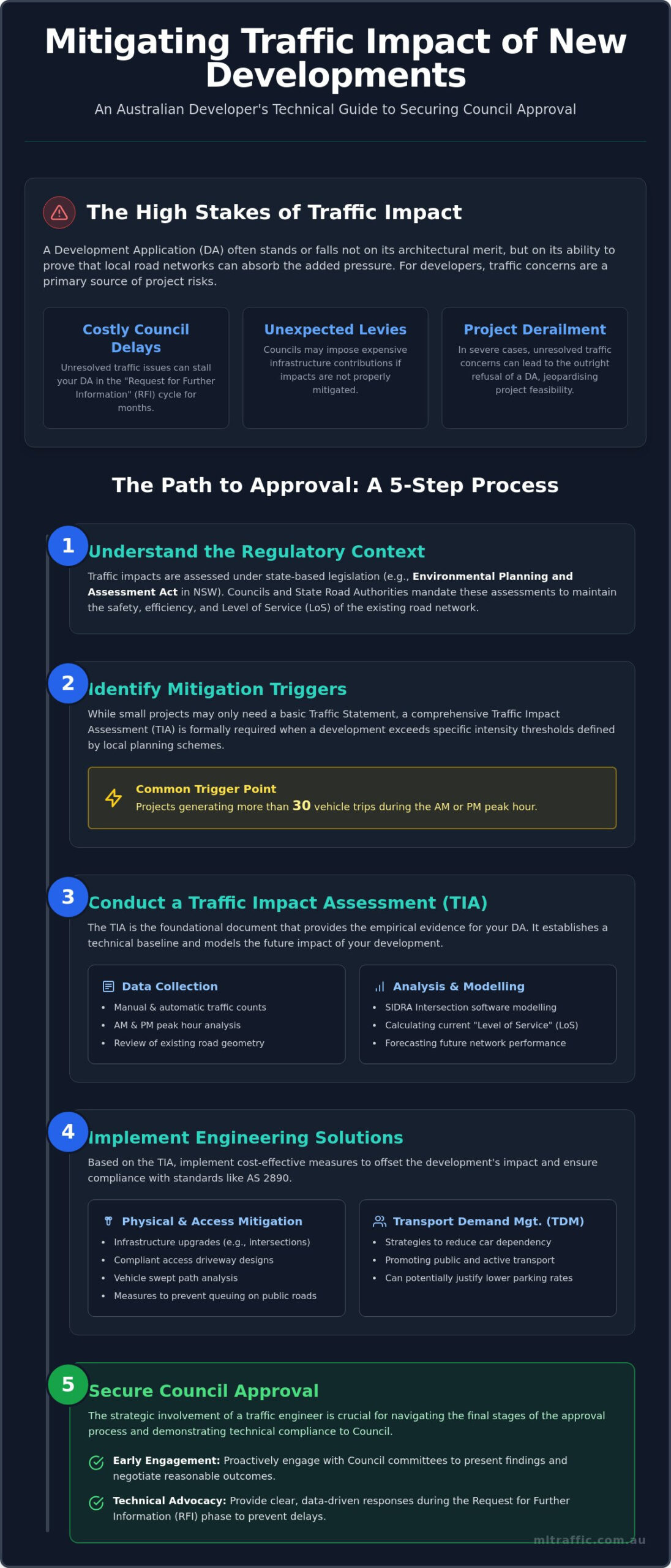
A Development Application often stands or falls not on its architectural merit, but on its ability to prove that local road networks can absorb the added pressure. For many Australian developers, traffic concerns are the primary source of costly Council delays and unexpected infrastructure levies that can derail a project’s feasibility. Understanding how to mitigate traffic impact of new development is a technical necessity that requires more than just a basic assessment; it demands a precise engineering strategy.
We recognise the frustration of facing non-compliance issues with AS 2890 or deciphering complex jargon in engineering reports. This guide provides the technical strategies and engineering solutions required to address traffic impacts and secure Council approval for your next project. You will learn about cost-effective mitigation measures, from vehicle swept path analysis to car parking demand assessments, ensuring your development meets regulatory standards without unnecessary expenditure.
Key Takeaways
- Understand the regulatory framework and why Australian Councils mandate traffic impact mitigation to maintain road network performance.
- Identify specific site constraints through a Traffic Impact Assessment (TIA), using peak hour analysis and traffic counts to establishing a technical baseline.
- Discover how to mitigate traffic impact of new development through physical infrastructure upgrades and compliant access designs that prevent queuing on public roads.
- Implement Transport Demand Management (TDM) strategies to reduce car dependency and potentially justify lower parking rates for your project.
- Leverage the expertise of a traffic engineer for early engagement with Council committees and technical advocacy during the Request for Further Information (RFI) phase.
Understanding Traffic Impact Mitigation in the Australian Planning Context
Traffic impact mitigation refers to the technical and physical measures used to offset additional vehicle movements generated by a new land use. Local Councils and State Road Authorities mandate these assessments to ensure the existing road network maintains its safety and efficiency levels. The scale of required mitigation is directly proportional to site yield. High-density residential towers or large industrial warehouses require more intensive interventions than small commercial fit-outs.
Proactive planning is essential for developers to avoid costly retrospective roadworks or total site redesigns. Addressing transport issues early in the design phase allows you to integrate solutions like traffic calming measures or improved access points directly into the project budget. This prevents the “Request for Further Information” (RFI) cycle from stalling your Development Application (DA). Engineering precision is required to prove that a development can coexist with existing infrastructure.
To better understand how authorities weigh these impacts, watch this video:
The Legal and Regulatory Framework
Traffic impacts are assessed under state-based planning legislation, such as the Environmental Planning and Assessment Act in NSW or the Planning and Environment Act in Victoria. A Statement of Environmental Effects (SEE) typically identifies initial traffic concerns, but major projects often require “concurrence” from state road authorities. This concurrence is frequently the most significant hurdle for developers. Authorities prioritise regional network performance, focusing on Level of Service (LoS) and Degree of Saturation at nearby intersections. Failure to meet these criteria often results in the refusal of the DA or the imposition of expensive infrastructure contributions.
When is Mitigation Formally Required?
Formal mitigation strategies are triggered when a development exceeds specific intensity thresholds defined by local planning schemes. Small-scale projects might only need a basic Traffic Statement to confirm minimal impact. However, a comprehensive Traffic Impact Assessment (TIA) is necessary for increased density, changes of land use, or sites fronting high-volume arterial roads. Understanding how to mitigate traffic impact of new development involves identifying these triggers during the feasibility stage. Common triggers include projects that add more than 30 vehicle trips per hour to the network or developments that require new signalised intersections. Engineers use this data to negotiate with Council, ensuring that any required upgrades are both necessary and proportionate to the project’s scale.
Identifying Site-Specific Impacts through a Traffic Impact Assessment (TIA)
A Traffic Impact Assessment (TIA) is the foundational document for any development application. It provides the empirical evidence required to determine how to mitigate traffic impact of new development. The process begins with rigorous data collection. This includes manual and automatic traffic counts, analysis of AM and PM peak hours, and a review of existing road geometry. Without this technical baseline, any proposed mitigation strategy lacks merit and will likely be challenged by Council during the assessment phase.
Engineers use this data to populate SIDRA Intersection software. This tool models current and future “Level of Service” (LoS), providing a clear picture of how a project influences the surrounding network. Identifying how to mitigate traffic impact of new development effectively requires a deep dive into these performance metrics. If you require technical precision for your next project, you can contact our senior principals for a direct consultation.
Trip Generation and Distribution Modelling
Calculating the volume of new traffic is a precise exercise. Engineers determine the number of daily and peak-hour trips by applying rates from state-specific guidelines, such as Transport for NSW (TfNSW) or VicRoads. These rates vary significantly based on land-use type, whether residential, commercial, or industrial. Accurate forecasting prevents the over-engineering of intersections while ensuring safety standards are met.
Once the volume is established, we model “directional distribution”. This process identifies where vehicles actually go after leaving the site. By reviewing the Travel Demand Management Guidelines provided by Austroads, engineers can forecast how new trips will interact with the broader regional network. This ensures that mitigation measures are targeted where they are most needed.
Intersection Performance and Level of Service (LoS)
The Level of Service (LoS) is a qualitative measure ranging from A (excellent) to F (failing). Most Australian Councils require a minimum LoS of D for urban intersections. A skilled traffic engineer identifies the “tipping point” where a development pushes an intersection from an acceptable grade to a failing one.
This analysis highlights existing congestion points or safety “black spots” that your project might exacerbate. Mitigation becomes mandatory when the modelling shows a significant increase in delays or queue lengths. By identifying these specific impacts early, developers can negotiate more favourable outcomes and avoid the “Request for Further Information” (RFI) cycle that often stalls progress. Defensible data is your strongest asset during these technical negotiations.
Engineering Solutions: Physical Infrastructure and Access Mitigation
Physical infrastructure upgrades represent the most direct method to address network deficiencies. When considering how to mitigate traffic impact of new development, engineering solutions must move beyond theoretical modelling to practical roadwork design. Compliant access points are essential to prevent vehicle queuing on public roads, which is a common cause of DA refusal. An efficient internal site layout reduces external traffic friction by ensuring that on-site movements do not spill over into the surrounding street network.
Intersection and Road Network Upgrades
Council often mandates specific physical changes to the road network to maintain safety and throughput. Common requirements include the installation of dedicated turn lanes, signalisation of existing priority intersections, or the construction of new roundabouts. For works on public roads, developers must typically enter into a Work Authorisation Deed (WAD) or a similar legal agreement with the relevant road authority. While these upgrades are significant capital expenses, developers can often manage costs through developer contributions under Section 7.11 or 7.12 of the Environmental Planning and Assessment Act. These contributions ensure that the financial burden of regional infrastructure is shared proportionally across multiple developments.
Compliant Car Park and Access Design
Technical compliance with Australian Standards is non-negotiable for securing approval. All light vehicle parking and access points must adhere to AS 2890.1, while heavy vehicle areas must meet AS 2890.2. A primary goal is to mitigate on-street parking pressure. This is achieved through accurate Car Parking Demand Assessments that justify the proposed supply. Additionally, the design of driveway ramps and grades must be meticulously calculated to prevent vehicles from bottoming out. Poor ramp design causes slow entry speeds, leading to dangerous traffic delays at the property boundary.
Swept Path Analysis for Operational Safety
A critical component of how to mitigate traffic impact of new development is proving that the site can handle its operational requirements safely. We use AutoTURN software to conduct a Swept Path Analysis for various vehicles, including waste trucks, delivery vans, and emergency services. Most Australian Councils require that all vehicles enter and exit the site in a forward direction to minimise risk to pedestrians and other road users. This analysis also confirms that sight distances at the property boundary meet the required safety standards, ensuring that drivers have a clear line of sight before merging into traffic.
Demand Management and Sustainable Transport Strategies
Transport Demand Management (TDM) serves as a strategic “soft” alternative to heavy engineering. It focuses on changing commuter behaviour rather than just expanding road capacity. When evaluating how to mitigate traffic impact of new development, TDM allows developers to argue for a reduction in required physical upgrades by lowering the actual trip generation of the site. This approach is particularly effective in high-density urban environments where road widening is physically impossible or prohibitively expensive. High proximity to public transport hubs acts as a natural mitigation factor, providing residents and employees with viable alternatives to private vehicle use. Integrating active transport infrastructure, such as dedicated walking paths and cycleways, further reduces the peak-hour burden on the local road network.
Developing a Green Travel Plan (GTP)
A Green Travel Plan (GTP) is a formal document that outlines specific measures to encourage sustainable transport. It’s often a mandatory requirement for large-scale developments. A comprehensive GTP typically includes:
- Car-pooling schemes and ride-share incentives for employees.
- End-of-trip facilities, including secure bike storage, showers, and lockers.
- Subsidised transit passes or real-time public transport information displays in common areas.
For larger commercial or industrial projects, a GTP acts as a binding commitment to Council. It ensures trip numbers remain below a negotiated threshold through measurable outcomes. Some authorities require ongoing monitoring and annual reporting to verify that these targets are met. This data-driven approach provides Council with the assurance that the development won’t exceed the capacity of the existing infrastructure. If you need a technical strategy to support your application, you can review our full range of traffic engineering services.
Parking Provision and “Unbundling”
Many urban centres are shifting from “minimum” parking requirements to “maximum” limits. This shift reflects a broader policy goal to reduce urban congestion and prioritise public transport. Developers can leverage this trend by “unbundling” parking from property sales or leases, treating car spaces as a separate commodity. This strategy reduces the overall car dependency of the site by making the cost of car ownership more transparent.
The inclusion of car-sharing pods, such as GoGet, provides another effective way to mitigate the impact of reduced on-site parking. One car-share vehicle can often replace the need for several private spaces, according to various local government studies. Additionally, mechanical parking systems like car stackers or automated parking modules allow for the optimisation of space without increasing the building’s physical footprint. These technical solutions demonstrate how to mitigate traffic impact of new development by managing demand at the source and reducing the physical impact of car-centric design.
Securing Council Approval: The Strategic Role of a Traffic Engineer
The traffic engineer functions as your primary technical advocate throughout the assessment process. When local authorities issue a Request for Further Information (RFI), a seasoned engineer defends the project’s technical merit with empirical data. This negotiation phase is critical for resolving complex objections from Council or State Road Authorities. Early engagement with traffic committees ensures that potential “deal-breakers” are identified before you commit to a final site layout. A major component of how to mitigate traffic impact of new development involves justifying merit-based departures from the Development Control Plan (DCP). Standard DCP requirements are often rigid, but a qualified engineer can demonstrate that an alternative design achieves the same safety and efficiency outcomes. Professional certification of all traffic and parking designs is mandatory to ensure compliance and reduce project risk.
The Path to DA Approval
Securing approval requires a structured approach to technical documentation. We follow a specific sequence to ensure every requirement is met and every potential objection is anticipated:
- Step 1: Pre-DA Consultation: Engage with Council officers early to identify site-specific constraints and authority expectations before formal submission.
- Step 2: Technical Documentation: Prepare the Traffic Impact Assessment (TIA) and Vehicle Swept Path Analysis using industry-standard modelling software.
- Step 3: Objection Management: Respond to formal objections from Council or transport departments with data-backed solutions that address safety and network performance.
- Step 4: Operational Readiness: Finalise the Traffic Management Plan (TMP) for the construction phase to satisfy final consent conditions and manage on-site logistics.
Why Senior Expertise Matters
The quality of your traffic representation directly influences the speed and cost of your approval. We maintain a philosophy where the same expert who initiates the relationship performs the technical work. This continuity ensures that every detail of the TIA is understood and defensible under intense scrutiny. Meticulous adherence to Australian Standards, specifically the AS 2890 series, builds long-term trust with Council officers, which frequently leads to more favourable outcomes during the RFI stage.
If a DA is refused on traffic grounds, a senior principal provides the expert witness testimony required for Land and Environment Court or equivalent state appeals. Understanding how to mitigate traffic impact of new development requires this level of accountability and deep-seated expertise to navigate the complex bureaucratic hurdles of the Australian planning system. Senior leadership involvement in every project ensures that technical strategies are both cost-effective and regulator-ready.
Secure Your Development Approval Through Technical Excellence
Successful DA approval depends on a technical negotiation where engineered precision proves a development’s viability. By integrating a comprehensive Traffic Impact Assessment and adhering to Australian Standards, you eliminate the guesswork that often leads to Council delays. We’ve demonstrated that how to mitigate traffic impact of new development requires a strategic combination of physical infrastructure upgrades, demand management, and defensible modelling. ML Traffic Engineers provides the senior expertise necessary to navigate these complex regulatory hurdles effectively.
With over 15 years of experience in Australian traffic consultancy, we offer direct access to senior principals for every project. Our firm maintains a proven track record with complex Council DA approvals, ensuring your project remains on schedule and within budget. Professional traffic engineering isn’t just about compliance; it’s about project feasibility and long-term success. Contact ML Traffic Engineers for an authoritative Traffic Impact Assessment today and ensure your next project is built on a foundation of technical excellence. We look forward to helping you achieve a seamless approval process.
Frequently Asked Questions
What is the most effective way to mitigate traffic impact for a small development?
The most effective strategy for small developments involves optimising internal access design and providing a robust car parking demand assessment. This demonstrates how to mitigate traffic impact of new development by ensuring all vehicle movements occur on-site without causing queuing on public roads. A basic Traffic Statement often suffices for minor projects to confirm that the existing network can absorb the small increase in trips.
Does every new development require a Traffic Impact Assessment (TIA)?
Not every project necessitates a full TIA. Small-scale developments with minimal trip generation often only require a basic Traffic Statement or a parking assessment. However, a comprehensive TIA is mandatory for projects that increase density, change the land use, or are located on high-volume arterial roads where network capacity is a concern.
How much do intersection upgrades usually cost a developer?
Costs for intersection upgrades depend entirely on the scope of works required by the road authority, such as installing traffic signals or roundabouts. Developers typically meet these obligations through state-based contribution schemes. For example, the NSW Housing and Productivity Contribution (HPC) rates for residential subdivisions in Greater Sydney are approximately $12,000 per new dwelling lot as of July 2026.
Can a Green Travel Plan really help get my DA approved?
A Green Travel Plan is a powerful tool that shows how to mitigate traffic impact of new development by reducing forecast trip generation rates. By committing to sustainable transport measures like car-pooling or end-of-trip facilities, developers can often justify a reduction in the required physical road upgrades or parking numbers. Council sees this as a binding commitment to minimise the project’s long-term impact.
What happens if my development cannot meet the parking requirements of AS 2890.1?
If a design cannot strictly meet AS 2890.1 requirements, a merit-based justification from a senior traffic engineer is necessary. We must prove that the departure doesn’t compromise safety or the functional movement of vehicles. This often involves using technical data to show that the proposed design performs as well as, or better than, the standard requirement.
How does a swept path analysis help mitigate traffic risks?
Swept path analysis uses specialised software to simulate the movement of specific vehicles, such as waste trucks or emergency services, through a site. It mitigates traffic risks by proving that these vehicles can enter and exit in a forward direction without hitting infrastructure or crossing the property boundary dangerously. This provides Council with technical certainty regarding operational safety.
What is the difference between a Traffic Management Plan and a Traffic Impact Assessment?
A TIA is a planning document used during the DA phase to assess the long-term impact of the finished development on the road network. A Traffic Management Plan (TMP) is an operational document that focuses on managing vehicle and pedestrian safety during the construction phase or for specific logistics after the project is complete.
Will Council accept a reduction in parking if my site is near a train station?
Councils frequently accept lower parking rates for sites located within a short walking distance, typically 400 to 800 metres, of high-frequency public transport hubs. This aligns with state-wide planning goals to reduce car dependency in urban centres. A car parking demand assessment is still required to prove that the reduction won’t lead to excessive overspill onto local streets.

Disclaimer
The content on www.mltraffic.com.au, including all technical articles, guides, and resources, is provided for general informational and educational purposes only. It is not intended to constitute professional advice in traffic engineering, transportation planning, development approvals, or any other technical or legal field. While ML Traffic Engineers makes every reasonable effort to ensure the accuracy, completeness, and timeliness of the information published, we do not provide any warranties or representations (express or implied) regarding its reliability, suitability, or availability for any particular purpose. Any reliance you place on the content is strictly at your own risk. In no event shall ML Traffic Engineers, its directors, employees, authors, or affiliates be liable for any direct, indirect, incidental, special, consequential, or punitive damages (including, without limitation, loss of profits, data, or business opportunities) arising out of or in connection with the use of, or inability to use, any information provided on this website. The articles and guides on this site are not a substitute for engaging a qualified, registered professional traffic engineer (such as an NPER or RPEQ engineer) to assess your specific project requirements. For tailored advice, compliance assessments, or traffic engineering services, please contact a competent professional. This disclaimer may be updated from time to time without notice. By accessing or using this website, you agree to be bound by the most current version of this disclaimer.
