

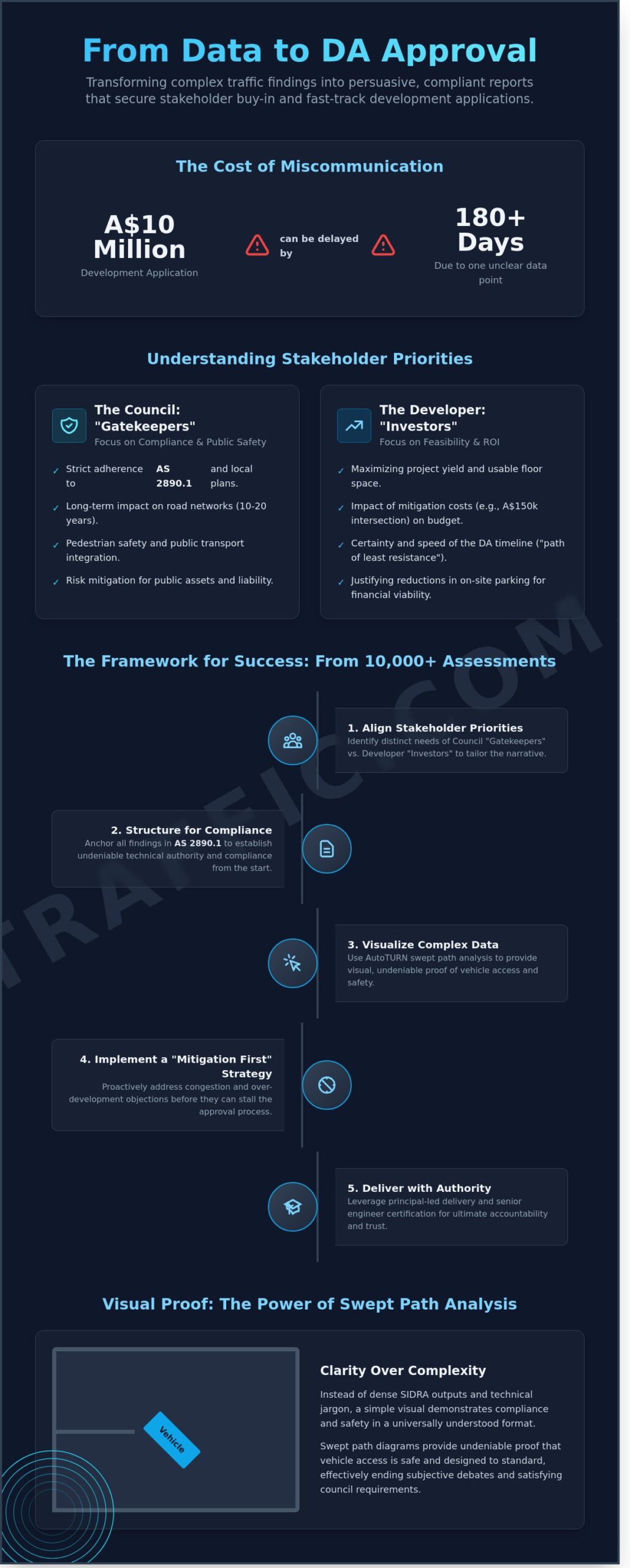
A single misunderstood data point in a Traffic Impact Statement can delay a A$10 million development application by more than 180 days. You’ve likely experienced the frustration of a Council rejection not because the engineering was flawed, but because the presentation lacked clarity. Mastering how to present traffic findings to stakeholders is the critical difference between a project that stalls in committee and one that moves straight to construction.
We agree that dense technical jargon often creates a barrier between your engineering expertise and the commercial goals of developers. This professional guide will show you how to transform complex data, such as Vehicle Swept Path Assessments and sight-line requirements, into persuasive and compliant reports. You’ll learn to secure stakeholder buy-in and streamline the DA process by focusing on exactly what Council officers need to see. We’re detailing the specific framework used to manage over 10,000 site assessments across Australia to ensure your professional authority remains unquestioned in every meeting.
Key Takeaways
-
Identify the distinct priorities of Council "Gatekeepers" and developer "Investors" to align your technical findings with their specific decision-making criteria.
-
Structure your Traffic Impact Assessment (TIA) around AS 2890.1 to establish a foundation of technical compliance and professional authority.
-
Learn how to present traffic findings to stakeholders by using AutoTURN swept path analysis to provide visual, undeniable proof of vehicle access and safety.
-
Implement a "Mitigation First" strategy to proactively address congestion and over-development objections before they can stall the approval process.
-
Leverage principal-led delivery and senior engineer certification to ensure the accountability and professional sign-off required for successful Council outcomes.
Table of Contents
-
Structuring Findings Around Australian Standards and Compliance
-
Visualising Complex Data: Swept Paths and Intersection Performance
-
Final Delivery: Ensuring Professional Authority and Accountability
Identifying Your Traffic Stakeholders and Their Priorities
To master how to present traffic findings to stakeholders, you must first categorize who is in the room. In the Australian engineering landscape, stakeholders typically include local Council planners, private developers, and community interest groups. Successful stakeholder engagement requires recognizing that each party evaluates a Traffic Impact Statement (TIS) through a different lens. You aren’t just delivering data; you’re facilitating a decision-making process.
To better understand this concept, watch this helpful video:
The traffic engineer acts as the technical bridge between complex datasets and project approval. You aren’t simply providing a dump of SIDRA outputs or vehicle swept paths. Instead, you’re translating raw numbers into a narrative that supports a Development Application (DA). Understanding how to present traffic findings to stakeholders involves balancing the "Gatekeeper" against the "Investor." If you treat these competing interests with a generic, one-size-fits-all report, you’ll likely face delays or requests for further information (RFI).
Councils act as gatekeepers. They protect public assets and safety. Developers are investors. They prioritize capital returns and construction schedules. A professional traffic consultant must address both without compromising technical integrity. This requires a meticulous approach to data presentation that highlights compliance while acknowledging commercial realities.
The Council Perspective: Compliance and Public Safety
Councils prioritize strict adherence to local planning schemes and Australian Standards, specifically AS 2890.1 for parking facilities. Their focus remains on the 10 to 20 year impact on the existing road network. They need proof that pedestrian safety and public transport integration aren’t afterthoughts. A professional assessment must demonstrate that the development won’t degrade the current Level of Service (LoS) for local residents. It’s about risk mitigation and long-term liability for the public purse.
The Developer Perspective: Feasibility and ROI
For the developer, traffic engineering is a tool for project value. You must explain how a Car Parking Demand Assessment justifies a reduction in onsite spots. This directly increases usable floor space and project yield. They need to know how traffic mitigation costs, such as a new A$150,000 signalized intersection, impact their total budget. Providing certainty for the DA timeline is their primary concern. They want to know the "path of least resistance" to approval without sacrificing the project’s financial viability.
-
Councils: Focus on AS 2890.1 compliance and public safety.
-
Developers: Focus on yield, floor space, and construction budgets.
-
Community: Focus on local amenity and traffic congestion.
Structuring Findings Around Australian Standards and Compliance
Compliance is the foundation of every successful development application in Australia. When determining how to present traffic findings to stakeholders, you must lead with regulatory adherence. Stakeholders, particularly developers and council assessors, prioritize risk mitigation and legal certainty. By framing your findings within the context of AS 2890.1, you demonstrate that the project meets the mandatory safety and operational requirements for off-street parking and access.
Organize the Traffic Impact Assessment (TIA) into clear, digestible modules rather than a single, dense technical block. Break the report into sections covering existing road conditions, trip generation, and parking demand. This modular approach allows time-poor decision-makers to locate specific data points quickly. Every finding must link back to a specific regulatory requirement or council DCP (Development Control Plan) clause to ensure the argument remains objective and evidence-based.
The Executive Summary is the most critical component for high-level stakeholders. preparing for stakeholder meetings involves distilling complex SIDRA modeling and swept path analysis into three or four key takeaways. If the data shows a 15% increase in peak hour movements, the summary should immediately state why the existing infrastructure can absorb this volume without exceeding capacity thresholds. This directness builds confidence and reduces the likelihood of protracted questioning during the presentation.
Navigating AS 2890 and Parking Requirements
Presenting car park design findings requires a focus on functional compliance. We use professional demand assessments to justify parking shortfalls, citing empirical data from similar land-use types rather than relying on generic estimates. AS 2890.1 provides the technical specifications for off-street car parking to ensure safe and accessible vehicle movements for all users. If a design deviates from standard bay dimensions, you must provide a technical justification that maintains safety standards while meeting the client’s yield requirements.
The Traffic Impact Statement (TIS) Framework
A professional TIS follows a logical narrative: existing conditions, proposed development, and net impact. You must use hard data to prove the development will not adversely affect local traffic flow or intersection performance. Referencing ML Traffic Engineers’ services demonstrates the level of detail required, from swept path assessments to detailed SIDRA analysis. How to present traffic findings to stakeholders effectively involves showing that every potential bottleneck has been identified and mitigated through sound engineering principles. For complex sites, ensure your traffic consultant provides a clear statement of impact that addresses both local council concerns and the developer’s objectives.
Visualising Complex Data: Swept Paths and Intersection Performance
Professional engineers know that a spreadsheet rarely wins an argument at a council meeting. Visual evidence provides the clarity needed to resolve disputes over vehicle access or congestion. When determining how to present traffic findings to stakeholders, you must prioritise high-quality diagrams over dense tables. We use industry-standard software like AutoTURN to generate swept path overlays. This provides undeniable proof that a specific vehicle can navigate a site safely, removing the guesswork for developers and planning authorities. Since our firm began in 2005, we’ve found that a well-executed diagram can prevent costly redesigns by proving compliance with AS 2890.1 standards from the outset.
The Power of Swept Path Analysis Visuals
Presenting vehicle maneuvers is critical for developments featuring complex loading docks or tight parking layouts. We use color-coding to differentiate vehicle types to ensure stakeholders don’t misinterpret the data. For example, a blue path might represent a B99 car while a red path indicates an 8.8m Medium Rigid Vehicle (MRV). This visual distinction allows stakeholders to immediately see where clearance issues might occur. Detailed visuals are a core component of a Swept Path Analysis: A Complete Guide for Australian Developments, ensuring all parties understand the physical constraints of the site. Effective communication here follows the principles found in the U.S. Department of Transportation guide, which emphasizes meaningful involvement through clear data presentation. By showing the actual wheel paths and body swings, you provide a level of transparency that raw dimensions cannot match.
Mapping Traffic Flow and Capacity
SIDRA modelling is our primary tool for assessing intersection performance. Instead of just listing degrees of saturation, we use flow diagrams to show Level of Service (LoS) changes. A transition from LoS B to LoS D during a morning peak is easier to grasp when shown on a color-coded diagram. Heat maps can also illustrate where a 15% increase in traffic volume will impact local road networks. It’s essential that all visual scales and legends remain legible for non-technical stakeholders. If a council officer or a local resident can’t read the legend, the data loses its authority. We ensure every diagram is uncluttered, focusing only on the metrics that drive the decision-making process. This clarity is vital when explaining how to present traffic findings to stakeholders who may be skeptical of technical jargon. Clear visuals build the confidence needed to move a project toward approval.
Handling Objections and Proposing Mitigation Strategies
Understanding how to present traffic findings to stakeholders requires a proactive stance on potential friction points. Stakeholders, particularly local councils and community groups, often approach new developments with concerns about localized congestion and over-development. A professional presentation doesn’t just report data; it anticipates these objections and addresses them before they’re even voiced. This "Mitigation First" approach demonstrates that the project is technically sound and socially responsible.
Effective presentations align traffic data with the Statement of Environmental Effects (SEE). By showing how traffic volumes impact noise levels or air quality, you provide a holistic view of the project’s footprint. If the data indicates a "No," professional engineers use design amendments to pivot toward a "Yes." This might involve altering access points or implementing a Traffic Guidance Scheme (TGS) to manage flow during specific peak periods. Most objections disappear when you replace speculation with empirical evidence and clear engineering solutions.
Addressing Community and Council Concerns
Community objections often center on parking spillover. You should counter these concerns using empirical demand data, such as 85th percentile occupancy rates, to prove that the proposed onsite parking meets or exceeds actual requirements. Safety complaints regarding visibility are equally common. Presenting a formal sight distance assessment, conducted according to AS 2890.1, provides a factual rebuttal to subjective fears. A professional traffic engineer manages public safety concerns during presentations by applying rigorous technical standards and historical safety data to mitigate perceived risks. This technical authority shifts the conversation from emotion to compliance.
Developing Actionable Mitigation Plans
Mitigation strategies fall into two categories: physical road upgrades and management-based solutions. Physical upgrades might include a new right-turn lane or a roundabout, which can cost upwards of A$150,000 depending on the scale. When physical changes aren’t feasible, management solutions become the primary tool. A Construction Traffic Management Plan (TMP) is essential for managing heavy vehicle movements and site safety during the build phase. You should link your findings to a comprehensive Traffic Management Plan guide to provide stakeholders with the technical depth they need for approval. This documentation ensures that every projected impact has a corresponding, actionable solution.
Ensure your project meets all regulatory requirements with expert traffic engineering support. View our full range of traffic assessment services to secure your development approval.
Final Delivery: Ensuring Professional Authority and Accountability
The final delivery of your traffic report is the most critical stage of the development application process. It’s the point where technical data must be translated into actionable insights for Council members and developers. Knowing how to present traffic findings to stakeholders involves more than just reading from a report. It requires the authority to defend every calculation, from driveway ramp grades to parking demand assessments. Professional accountability ensures that the findings aren’t just numbers on a page but certified conclusions that meet Australian Standards like AS 2890.1.
Finalizing the report requires a meticulous review of all site data. Every Traffic Impact Statement (TIS) or Traffic Management Plan (TMP) must undergo a rigorous certification process before submission. This professional sign-off acts as a guarantee of accuracy. It provides the assurance that the proposed development won’t adversely impact local road networks or safety. When you’re in the room with stakeholders, your preparation for the Q&A session is what establishes you as the expert. You must be ready to address concerns regarding vehicle swept paths or peak hour volumes with immediate, fact-based answers.
The Value of Senior Engineering Oversight
Having a senior engineer present during the delivery phase adds significant weight to your findings. Experience matters when negotiating with Council or state authorities. Our principals bring between 30 and 40 years of experience to every project. We operate on a clear principle: the consultant who quotes for the work is the one who does the work. This hands-on approach removes the risk of junior staff making errors in complex assessments. You can learn more about our senior team and how their decades of industry knowledge provide a distinct advantage for private clients.
Next Steps After the Presentation
The work doesn’t end when the presentation finishes. Coordination with town planners and architects is essential to integrate traffic findings into the final DA submission. This ensures that the physical design of the site, including car park layouts and entry points, aligns perfectly with the engineering report. We also archive all data meticulously. This allows for easy retrieval during future site audits or if the development requires modifications in the coming years. For projects requiring high-level representation, you can contact ML Traffic Engineers to secure expert advocacy at your next stakeholder meeting. We provide the technical backing needed to navigate the bureaucratic requirements of any Australian jurisdiction.
Secure Approval with Professional Technical Reporting
Successful traffic reporting requires more than just data collection. It demands a rigorous focus on Australian Standards, specifically AS 2890.1, and the ability to translate technicalities into actionable insights. Mastering how to present traffic findings to stakeholders ensures that visual tools like vehicle swept path assessments drive decision-making rather than confusion. When you provide clear mitigation strategies for potential objections, you maintain project momentum and professional accountability.
ML Traffic Engineers brings over 20 years of trading history and a track record of assessing over 10,000 sites across Australia. You’ll work directly with our principals, Michael Lee and Benny Chen, who each possess between 30 and 40 years of industry experience. We operate on a simple principle: the traffic consultant who provides the quote, does the work. It’s an approach that eliminates bureaucracy and ensures senior expertise is applied to every assessment.
Your project deserves the clarity and technical weight that only decades of specialized experience can provide.
Frequently Asked Questions
What are the most common mistakes when presenting traffic data to Councils?
The most common mistake is failing to address specific clauses in the Council’s Development Control Plan (DCP). Technical reports often focus on broad traffic theory while ignoring the 10 or 12 local parking requirements that assessors prioritise. You must provide specific data from SIDRA intersection modelling to prove that the Level of Service (LoS) remains at a ‘C’ or better. Vague assumptions lead to delays in the DA process.
How much detail should be included in a traffic presentation for a developer?
A presentation for a developer should focus on yield, site efficiency, and compliance with AS 2890.1. Developers need to know if the 2.4m parking space widths and 5.8m aisle widths are met to maximise the number of bays. We provide a summary of the Traffic Impact Statement (TIS) that highlights cost-saving measures. This includes identifying where shared parking arrangements can reduce the total requirement by 15% or more.
Do I need a traffic engineer to present findings at a community consultation?
You should always have a senior traffic engineer present during community consultations to maintain professional authority. Residents often raise subjective concerns about safety or noise that only an experienced consultant can answer with empirical data. We’ve managed consultations for sites with over 100 residential units, where technical expertise was the only way to satisfy community concerns regarding the 200 daily vehicle movements expected.
How do you explain a parking shortfall to stakeholders without losing buy-in?
Address a parking shortfall by presenting a Car Parking Demand Assessment based on empirical evidence from similar land uses. If the statutory requirement is 50 spaces but your data shows a peak demand of only 42, you must explain the 16% reduction using local surveys. This approach demonstrates how to present traffic findings to stakeholders by prioritising actual usage patterns over rigid, often outdated, local government codes.
What software is best for creating traffic visualisations for stakeholders?
SIDRA Intersection 9.1 and AutoTURN are the gold standard for creating traffic visualisations in Australia. These tools allow us to show stakeholders exactly how a 12.5m Heavy Rigid Vehicle (HRV) navigates a site. Using these industry-recognised programs ensures that your findings are defensible during a Land and Environment Court appeal. They provide the technical rigour required for every professional traffic presentation.
What happens if stakeholders disagree with the traffic impact findings?
If stakeholders disagree, we provide a supplementary technical note that addresses each specific objection with updated field data. We rely on the 30 to 40 years of experience our principals bring to every project to negotiate with Council officers. If a disagreement persists, we use the 10,000 sites we’ve assessed as a benchmark to prove the proposed traffic impact is within acceptable Australian Standards.
Can a Swept Path Analysis be used as primary evidence in a DA meeting?
A Swept Path Analysis is essential primary evidence, particularly for demonstrating compliance with AS 2890.2 for service vehicles. It proves that a B99 vehicle or a waste collection truck can enter and exit the site in a forward direction. This visualisation is often the deciding factor in DA meetings for narrow 6m driveways. It removes all ambiguity about whether the design is functional for heavy vehicles.
How long should a traffic findings presentation typically last?
A professional traffic findings presentation should last exactly 15 to 20 minutes. You should allocate 5 minutes to the core findings of the Traffic Impact Assessment (TIA) and 15 minutes for technical questions from the panel. This structure respects the time of Council officers and stakeholders while ensuring all 4 or 5 critical safety and volume points are covered thoroughly. Long presentations often lose the audience’s attention.
Which areas do you cover?
We are traffic engineers servicing Melbourne, Sydney, Brisbane, Gold Coast, Hobart, Perth, Adelaide, Darwin, Canberra and surrounding areas.
Disclaimer
The content on www.mltraffic.com.au, including all technical articles, guides, and resources, is provided for general informational and educational purposes only. It is not intended to constitute professional advice in traffic engineering, transportation planning, development approvals, or any other technical or legal field.
While ML Traffic Engineers makes every reasonable effort to ensure the accuracy, completeness, and timeliness of the information published, we do not provide any warranties or representations (express or implied) regarding its reliability, suitability, or availability for any particular purpose. Any reliance you place on the content is strictly at your own risk.
In no event shall ML Traffic Engineers, its directors, employees, authors, or affiliates be liable for any direct, indirect, incidental, special, consequential, or punitive damages (including, without limitation, loss of profits, data, or business opportunities) arising out of or in connection with the use of, or inability to use, any information provided on this website.
The articles and guides on this site are not a substitute for engaging a qualified, registered professional traffic engineer (such as an NPER or RPEQ engineer) to assess your specific project requirements. For tailored advice, compliance assessments, or traffic engineering services, please contact a competent professional.
This disclaimer may be updated from time to time without notice. By accessing or using this website, you agree to be bound by the most current version of this disclaimer.
