

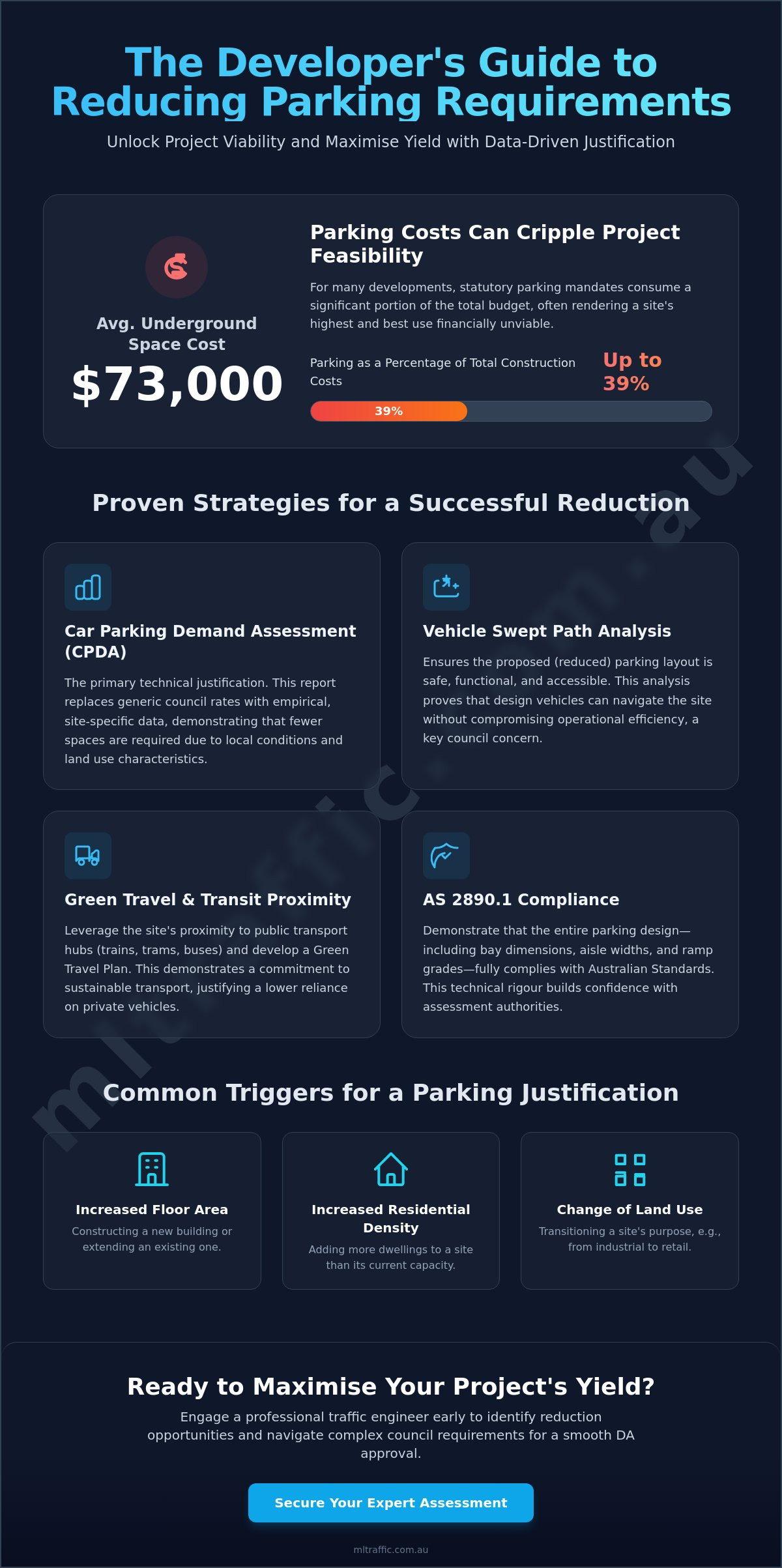
In 2026, the average cost of constructing a single underground parking space has reached $73,000. For many commercial and residential projects, these statutory mandates consume up to 39% of total construction costs, often rendering a site’s highest and best use financially unviable. This significant capital outlay makes it essential for developers to master how to reduce parking requirements for a development through rigorous technical justification. Relying on generic policy appeals is no longer sufficient to overcome rigid local planning schemes or complex site constraints.
You’re likely aware that high basement excavation costs and limited site areas frequently clash with conflicting Council requirements. This guide provides the professional strategies and assessment frameworks you need to successfully justify a reduction in car parking for your next project. We’ll detail how a data-driven Car Parking Demand Assessment and precise Vehicle Swept Path Analysis provide the empirical evidence required for a smooth DA approval process. You’ll learn to leverage current standards, such as AS/NZS 2890.1:2004, to minimize your parking footprint, satisfy regulatory bodies, and maximize your project’s total yield.
Key Takeaways
- Identify the technical triggers within local planning schemes that allow for a reduction in statutory parking rates through evidence-based justifications.
- Learn how to use a Car Parking Demand Assessment to replace generic council requirements with empirical, site-specific data that supports higher development yields.
- Master the strategic application of Green Travel Plans and transit-oriented proximity to clarify how to reduce parking requirements for a development during the planning phase.
- Ensure project viability by integrating Vehicle Swept Path Analysis and AS 2890.1 compliance to prove that reduced parking footprints do not compromise site functionality.
- Understand the importance of early traffic consultant involvement in pre-lodgement meetings to identify reduction opportunities before the design is finalized.
Understanding Statutory Parking Requirements and Reduction Triggers
Statutory parking rates are fixed figures mandated by local planning schemes or state-wide provisions. These rates represent the minimum number of spaces a developer must provide for a specific land use. Councils implement these Parking mandates to regulate traffic congestion and preserve residential amenity. In high-density urban infill projects, these requirements often conflict with site feasibility. High land costs and excavation expenses make providing the full statutory amount difficult. A ‘trigger’ occurs when the proposed parking is less than the minimum rate. This trigger necessitates a formal planning permit to justify the shortfall.
To better understand how these requirements are calculated in complex urban environments, watch this technical overview:
Mastering how to reduce parking requirements for a development requires a clear grasp of the regulatory landscape. Councils don’t view parking rates as suggestions. They’re legal benchmarks. When a project fails to meet these benchmarks, the developer must provide empirical evidence to show the reduction won’t negatively impact the surrounding street network. This is where a professional Car Parking Demand Assessment becomes the primary tool for negotiation and approval.
The Difference Between a Waiver and a Reduction
A partial reduction involves providing some on-site parking, but at a lower rate than the planning scheme specifies. A full waiver removes the requirement to provide any parking. This is less common and usually restricted to very small sites or specific heritage overlays. Developers must also consider ‘parking credits’. If an existing building already has a legal right to a certain number of spaces, those credits can be applied to the new development. This reduces the ‘new’ parking burden. A ‘change of use’ also triggers new requirements. If you convert a warehouse into a gym, the parking demand profile changes entirely in the eyes of the Council, regardless of the building’s footprint.
Common Triggers for Parking Permit Requirements
Several specific development actions will activate a parking permit requirement. These triggers aren’t negotiable and must be addressed in the DA submission. Common triggers include:
- Increased Floor Area: Constructing a new building or extending an existing one that adds gross floor area.
- Residential Density: Increasing the number of dwellings on a site beyond its current capacity.
- Land Use Variation: Changing the nature of the land use, such as transitioning from industrial to commercial or retail.
Each trigger requires a technical justification. You can’t simply state that parking isn’t needed. You must prove it using data-driven assessments that account for local demographics, public transport accessibility, and peak demand periods. Identifying these triggers early allows you to integrate reduction strategies into the initial design phase.
The Role of a Car Parking Demand Assessment (CPDA)
A Car Parking Demand Assessment (CPDA) serves as the primary technical justification for any deviation from statutory rates. It is a specialized engineering report that provides a data-backed response to the question of how to reduce parking requirements for a development. By replacing generic planning provisions with empirical evidence, the CPDA demonstrates that a project can function effectively with fewer on-site spaces. Councils rely on these professional assessments to make informed decisions under ‘satisfaction’ clauses within local planning schemes. Without this document, a permit application for reduced parking lacks the necessary evidentiary weight for approval.
Key Components of an Engineering Demand Assessment
A comprehensive assessment involves rigorous data collection from similar land-use sites across the country. This ensures that the demand profile reflects current behavioral trends rather than outdated planning assumptions. Engineers analyze peak demand periods to ensure the site remains functional during its busiest hours, such as Friday evenings for hospitality or weekday mornings for medical clinics. In multi-use developments, the CPDA evaluates shared parking opportunities. This analysis proves that different uses, such as office and residential, can share the same parking footprint due to non-overlapping peak demand times. You can review our full range of technical assessment services to see how these reports are structured for Council submission.
Public Transport Accessibility and the Category System
High-frequency public transport proximity is a fundamental pillar in justifying parking reductions. Modern planning frameworks in 2026 utilize a Category 1-4 accessibility mapping system to determine acceptable parking supply levels. Category 1 sites represent areas with minimal transport options, whereas Category 4 sites are located within high-frequency transit corridors. These categories are determined by the frequency of services and the walking distance to major interchanges. Category 4 sites provide the highest level of public transport accessibility and permit the application of maximum parking caps to discourage excessive car use. Understanding your site’s specific category is essential when determining how to reduce parking requirements for a development without triggering a refusal.
The transition from minimum requirements to maximum caps in Category 4 areas reflects a broader shift in urban planning. It prioritizes transit-oriented development and reduces the financial burden of excessive basement construction. A professional engineer uses these maps to correlate site-specific accessibility with reduced car ownership rates. This correlation provides a defensible technical argument for Council planners who are often bound by these updated accessibility benchmarks.
Proven Strategies for Reducing Parking Requirements
Securing a parking reduction requires more than just a site-specific assessment. It involves implementing operational strategies that actively lower car dependency. Developers must present a cohesive case that combines locational advantages with sustainable transport initiatives. Proximity to high-frequency public transport networks remains the most influential factor. Sites located within walking distance of major rail or tram interchanges naturally support lower car ownership rates. This locational benefit is often supplemented by on-site car-sharing schemes. Providing dedicated bays for commercial car-share providers can effectively replace several private parking spaces, further decreasing the required footprint.
Available public infrastructure also plays a critical role. Proximity to public off-street car parks or high-capacity on-street zones provides a necessary overflow for visitor demand. When these assets exist within a 200-meter radius, Councils are more likely to accept a lower on-site provision. Mastering how to reduce parking requirements for a development depends on demonstrating that the surrounding environment can absorb any minor residual demand without compromising local amenity.
Green Travel Plans and Sustainable Transport
A Green Travel Plan (GTP) is a strategic document that outlines how a development will encourage non-car transport. This plan is often a mandatory requirement for significant parking reductions. Effective GTPs include the following elements:
- End-of-trip facilities: Providing high-quality showers, lockers, and changing areas to encourage cycling and walking.
- Bicycle parking ratios: Increasing the supply of secure bike hoops beyond statutory minimums to offset car space requirements.
- Pedestrian connectivity: Improving local footpaths or site permeability to facilitate easy access to nearby transit hubs.
Shared Parking and Temporal Analysis
Mixed-use developments provide unique opportunities for shared parking arrangements. Temporal analysis allows engineers to calculate the overlap between different land uses. An office building requires peak parking during standard business hours, while a restaurant or residential visitor use peaks in the evening. These non-overlapping demand profiles mean a single space can serve multiple users throughout a 24-hour period. Our experts use Traffic Impact Assessments to prove this shared capacity. This data-driven approach prevents the construction of redundant parking levels that would otherwise remain underutilized for half the day.
Technical Compliance: Swept Paths and AS 2890.1
A reduction in quantity does not permit a reduction in quality or technical compliance. When assessing how to reduce parking requirements for a development, Council planners prioritize the functionality of the remaining supply. If a layout is difficult to navigate or fails to meet the safety benchmarks of AS 2890.1, the application will likely face rejection. Expert design ensures that a smaller parking footprint remains highly accessible for all users. We strictly adhere to the current AS/NZS 2890.1:2004 standards to ensure every space provided is legally compliant and physically viable.
Planners often view a reduced parking count more favorably if the proposed spaces exceed minimum maneuverability expectations. It’s better to provide ten highly functional spaces than twelve cramped ones that require multiple-point turns. This technical precision reduces the risk of on-site congestion and vehicle damage, which are primary concerns for local government authorities during the DA process.
The Importance of Swept Path Analysis
We use specialized AutoTURN software to conduct a comprehensive Swept Path Analysis. This technical simulation demonstrates the precise movements of B85 and B99 vehicles throughout the parking facility. By proving that vehicles can enter, park, and exit in a single forward motion, we eliminate Council concerns regarding site safety. This analysis is a critical component of the justification package. It shows that the development won’t result in vehicles reversing onto public roads or striking structural elements. Our senior principals provide direct oversight on all Car Park Design projects to ensure your layout meets these rigorous maneuverability standards.
Mechanical Parking and Stackers
Mechanical parking systems and car stackers offer a method to meet parking needs on sites with restricted footprints. These systems allow for vertical density, but they introduce unique operational requirements. Planners scrutinize wait-times and queuing areas to ensure that mechanical operation doesn’t cause traffic to spill onto public roads. A successful application must include a detailed operational analysis of the system’s throughput. Additionally, driveway ramp grades must be meticulously designed to permit safe vehicle clearance when entering stacker platforms. We ensure that these grades comply with national standards to prevent bottoming out or scraping, which is essential for the long-term viability of the mechanical system.
Understanding how to reduce parking requirements for a development often involves these high-tech solutions. However, they must be supported by a robust Traffic Impact Assessment that accounts for the specific peak-hour demands of the building’s occupants. When mechanical systems are integrated correctly, they provide a defensible path toward reducing the overall excavation and construction costs of a project.
Securing Approval: Working with a Traffic Engineer
Technical data provides the foundation, but securing a permit requires strategic advocacy. Working with a consultant early in the process identifies reduction opportunities before the design freeze. This prevents the lock-in of inefficient parking layouts that inflate construction costs. A traffic engineer acts as a technical intermediary, translating complex data into a narrative that aligns with Council’s planning objectives. This phase is critical for developers determining how to reduce parking requirements for a development while maintaining the maximum possible site yield.
Waiting until the formal submission phase often leads to project delays. When parking reductions are integrated into the initial site planning, the resulting design is naturally more defensible. Expert consultants don’t just provide a report; they provide a professional bridge between the developer’s commercial goals and the Council’s regulatory expectations. This ensures that the final submission addresses potential traffic impacts before they become points of contention.
The Pre-Lodgement Strategy
Engaging with Council planners before formal lodgement allows for the early identification of site-specific ‘deal-breakers’. These meetings provide an opportunity to present the preliminary findings of the Car Parking Demand Assessment and gauge Council’s receptiveness to a reduction. Collaborating with architects at this stage ensures that the parking-to-yield ratio is optimized without compromising the functionality of the site. Addressing potential objections during the design phase is significantly more cost-effective than responding to a Request for Further Information (RFI) after the application is lodged.
Why Experience Matters in Traffic Engineering
Senior principal involvement is essential for navigating the bureaucratic nuances of local government authorities. Complex parking negotiations require a consultant who understands the specific technicalities and regulatory benchmarks of the field. ML Traffic Engineers Australia maintains a 15-year history of securing parking waivers and reductions for residential, commercial, and industrial projects across the country. Our firm provides direct access to the experts who perform the technical work, ensuring that the same principal who initiates the strategy is the one defending it at Council meetings.
The accountability of a “no-gatekeepers” approach distinguishes ML Traffic Engineers Australia from larger, more impersonal consultancies. We rely on empirical evidence and a deep understanding of AS 2890.1 to override conservative planning assumptions. This results in a more robust and defensible application. If your project faces site area constraints or excessive excavation costs, contact ML Traffic Engineers Australia to discuss your site’s parking potential and learn how to reduce parking requirements for a development through professional engineering advocacy.
Maximizing Development Yield Through Technical Advocacy
Understanding how to reduce parking requirements for a development is a critical commercial skill for modern developers. Success in the DA process depends on replacing generic statutory rates with empirical evidence through a professional Car Parking Demand Assessment. You must also ensure that every reduced layout maintains strict compliance with AS 2890.1 to satisfy Council safety and maneuverability standards. By integrating these technical strategies during the early design phase, you avoid the prohibitive costs of unnecessary basement construction and maximize your total project yield.
ML Traffic Engineers Australia provides the authoritative representation required to navigate complex parking negotiations. We specialize in TIA reports and site-specific demand assessments with over 15 years of experience in Australian transport planning. Every project benefits from direct senior principal involvement to ensure technical depth and personnel continuity. Speak with a Senior Traffic Engineer about your development’s parking requirements to establish a defensible and functional parking strategy. We’re ready to help you achieve a smooth and successful approval process.
Frequently Asked Questions
What is the most common reason Councils approve a parking reduction?
Councils most frequently approve reductions when developers provide a site-specific Car Parking Demand Assessment. This report must prove that the empirical demand for the proposed use is lower than the generic rates found in the planning scheme. High-frequency public transport proximity also serves as a primary justification for reducing private vehicle reliance in urban areas.
Can I reduce parking requirements if my site is near a train station?
Sites located near major rail interchanges are prime candidates for parking waivers. Proximity to high-frequency transit allows developers to argue for lower car ownership rates among residents and visitors. This is a fundamental strategy in how to reduce parking requirements for a development while maintaining project viability in dense urban corridors.
How much does a Car Parking Demand Assessment cost for a development?
The cost of a Car Parking Demand Assessment varies based on the project’s scale and the complexity of the required data collection. Factors such as the number of land uses and the extent of the surrounding street surveys influence the final scope. Developers should check with a traffic engineer directly to obtain a specific fee proposal tailored to their site’s unique requirements.
What happens if Council rejects my request for a parking waiver?
If a Council rejects a parking waiver, the developer may appeal the decision through a state planning tribunal or court. Alternatively, the site layout must be redesigned to meet the statutory requirements or incorporate mechanical parking solutions. Providing a robust Traffic Impact Assessment during the initial submission reduces the risk of a formal rejection by addressing potential objections early.
Does a Green Travel Plan actually help in reducing parking spaces?
A Green Travel Plan serves as a formal commitment to sustainable transport and is often a mandatory condition for significant parking reductions. By documenting specific initiatives like end-of-trip facilities and car-share provisions, developers provide Councils with a defensible reason to lower car parking ratios. It shifts the focus from vehicle storage to active transport accessibility.
Is AS 2890.1 compliance mandatory for all parking reductions?
Adherence to AS 2890.1 remains mandatory regardless of the total number of spaces provided. Councils won’t approve a reduction if the remaining spaces are physically inaccessible or unsafe. Every car park design must meet these national standards to ensure that the reduced supply functions effectively without causing on-site congestion or safety hazards.
How does a ‘change of use’ affect my existing parking credits?
Existing parking credits are often transferable when the land use changes, but the new use may have a higher statutory demand. Developers must calculate the difference between the credit and the new requirement. If the new use triggers a higher rate, a permit is required to justify the shortfall using contemporary demand data and site-specific analysis.
Can car stackers be used to meet statutory parking requirements?
Car stackers are a recognized method for meeting statutory requirements on sites with limited footprints. However, their use requires a detailed assessment of wait times and queuing areas to prevent traffic flow issues on public roads. Proper integration of mechanical systems is a key technical strategy in how to reduce parking requirements for a development without sacrificing total building yield.

Disclaimer
The content on www.mltraffic.com.au, including all technical articles, guides, and resources, is provided for general informational and educational purposes only. It is not intended to constitute professional advice in traffic engineering, transportation planning, development approvals, or any other technical or legal field.
While ML Traffic Engineers makes every reasonable effort to ensure the accuracy, completeness, and timeliness of the information published, we do not provide any warranties or representations (express or implied) regarding its reliability, suitability, or availability for any particular purpose. Any reliance you place on the content is strictly at your own risk.
In no event shall ML Traffic Engineers, its directors, employees, authors, or affiliates be liable for any direct, indirect, incidental, special, consequential, or punitive damages (including, without limitation, loss of profits, data, or business opportunities) arising out of or in connection with the use of, or inability to use, any information provided on this website.
The articles and guides on this site are not a substitute for engaging a qualified, registered professional traffic engineer (such as an NPER or RPEQ engineer) to assess your specific project requirements. For tailored advice, compliance assessments, or traffic engineering services, please contact a competent professional.
This disclaimer may be updated from time to time without notice. By accessing or using this website, you agree to be bound by the most current version of this disclaimer.
