

A council Request for Information (RFI) is an engineering negotiation rather than a simple data submission. When you receive one, the future of your development rests on your ability to provide technical evidence that satisfies a skeptical traffic planner. You’re likely already feeling the pressure of mounting holding costs and the very real risk of your application lapsing due to unresolved engineering queries. Successfully responding to a council Request for Information (RFI) on traffic requires a meticulous approach to ensure your project doesn’t stall at the finish line.
It’s vital to use current industry standards to maintain credibility with regulatory bodies. For instance, the Institute of Transportation Engineers (ITE) released the 12th Edition of the Trip Generation Manual in August 2025, and local authorities increasingly reject submissions that don’t align with these updated benchmarks. You’ll learn the specific technical and administrative steps required to address council traffic objections and secure your development approval. This article outlines how to utilize tools like HCS 2026 and accurate Vehicle Swept Path Analysis to provide an expert response that minimizes delay costs and provides a clear path to project success.
Key Takeaways
- Identify specific triggers for council traffic queries, including parking demand assessments and road network capacity issues.
- Learn the technical process for responding to a council Request for Information (RFI) on traffic while adhering to Australian Standards (AS 2890).
- Determine the most efficient path between modifying site layouts for compliance or providing expert performance-based justifications.
- Structure a compliant response using sequential formal letters and updated Vehicle Swept Path Analysis diagrams to satisfy council requirements.
- Gain insights into how direct collaboration with senior traffic engineering principals can prevent application lapses and reduce project holding costs.
Understanding the Traffic RFI: Why Council is Requesting More Data
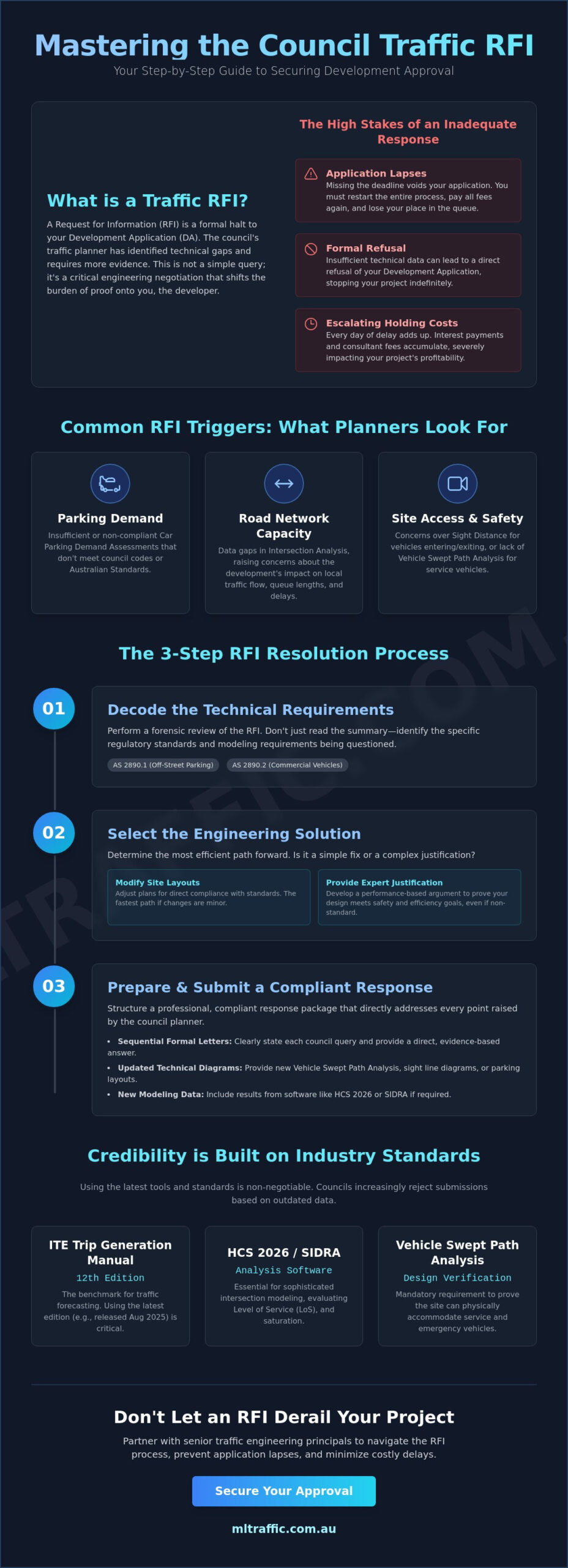
A Request for Information (RFI) is a formal statutory procedure where the council halts the assessment clock of a Development Application (DA). It signifies that the provided documentation is insufficient for a technical determination. While general planning RFIs might focus on landscape species or facade materials, a traffic RFI targets the movement of people and goods. It demands a high level of technical rigor, often requiring understanding traffic engineering principles to resolve. Effectively responding to a council Request for Information (RFI) on traffic is a critical phase that determines whether your project proceeds or stalls.
Common triggers for these requests include insufficient Car Parking Demand Assessments, concerns over Sight Distance Assessment, or data gaps in Intersection Analysis. If the council’s engineering team cannot verify that the proposed development won’t adversely impact the local road network, they cannot legally grant approval. This formal request is their way of shifting the burden of proof back to the developer.
To better understand the mechanics of this formal process, watch this tutorial on the administrative workflow:
Every RFI includes a strict deadline. Failure to provide a comprehensive response by this date often leads to the application lapsing. This is not a minor delay. A lapsed application is legally void, requiring the applicant to resubmit from scratch. You’ll be forced to pay all initial application fees again and lose your place in the assessment queue, adding months to your timeline.
The Consequences of an Incomplete Response
An inadequate response is as dangerous as no response. If the council traffic planner deems the technical data insufficient, they may issue a formal refusal of the DA. Beyond the loss of application fees, the primary drain is the escalation of holding costs. Interest payments on land and consultant fees continue to accrue while the project sits in a bureaucratic stalemate. For large-scale developments, these daily costs can severely undermine project feasibility and profit margins.
Identifying the Traffic Planners Concerns
Success relies on distinguishing between mandatory compliance and desirable design preferences. Traffic planners often use dense technical jargon to mask their core objections. You must determine if the request is a simple clarification or if it mandates new field data, such as updated traffic counts or a new Traffic Impact Assessment (TIA) Report. For instance, a request for a Vehicle Swept Path Analysis is usually a mandatory requirement to prove the site can physically accommodate service vehicles. Reviewing the technical services required early in the response phase ensures every council point is addressed sequentially and professionally.
Step 1: Decoding the Technical Requirements of Your RFI
Decoding an RFI requires a forensic review of the council’s technical objections. It’s not enough to read the summary; you must identify the specific regulatory standards and modeling requirements being questioned. When responding to a council Request for Information (RFI) on traffic, your first task is to cross-reference the council’s comments against the relevant Australian Standards, specifically AS 2890.1 for off-street car parking and AS 2890.2 for commercial vehicle facilities. Compliance with these standards is binary. You’re either compliant, or you’re not.
Council engineers often request sophisticated intersection modeling to verify road network capacity. This typically involves software like SIDRA or HCS 2026 to evaluate the Level of Service (LoS) and degree of saturation. If your initial application lacked this granular data, the RFI will likely demand a detailed analysis of how your development’s peak hour trips affect local queue lengths and delay times. Addressing these technical gaps early prevents further delays in the assessment process. To ensure your response meets these rigorous standards, it’s advisable to speak with a senior principal before submitting new data.
Swept Path and Access Objections
Council planners frequently use phrases like “demonstrate maneuverability” or “tight vehicle movements” when they suspect a design flaw. These objections often focus on loading dock access or driveway entry points. In these cases, you’ll need to provide a Swept Path Analysis using specific vehicle templates. Depending on the land use, council might mandate the use of B99 car templates or Heavy Rigid Vehicle (HRV) templates to prove that vehicles can enter and exit in a single forward motion. Providing clear, color-coded diagrams is the only way to satisfy these concerns and move toward approval.
Parking and Traffic Impact Queries
Objections regarding a “parking shortfall” occur when your proposed supply doesn’t meet the council’s minimum mandated rates. You can resolve this by providing empirical demand data that proves the actual requirement is lower than the statutory rate. This analysis is a core component of a comprehensive Traffic Impact Assessment. When justifying trip generation rates, ensure your data aligns with the ITE Trip Generation Manual 12th Edition, released in August 2025. This manual is the current industry standard for estimating vehicle and person trips across diverse land uses. Using outdated data from pre-2025 sources is a common reason for RFI rejection.
Step 2: Selecting the Engineering Solution to Address Council Objections
Choosing the correct strategy when responding to a council Request for Information (RFI) on traffic is a critical commercial decision. You generally have three pathways to resolve a technical objection. Option A involves modifying the site layout to achieve literal compliance with local planning schemes. This might include a total Car Park Design overhaul or widening a driveway crossover. While this often provides the fastest path to approval, it can significantly increase construction costs or reduce the yield of the development.
Option B focuses on providing expert justification for a “performance-based” solution. This is necessary when site constraints make literal compliance impossible. You must present technical evidence proving the design meets the safety and efficiency intent of the regulations, even if it deviates from the standard. Option C involves commissioning new field data. If the council bases an objection on outdated network data, fresh traffic counts can prove existing capacity is sufficient. For example, data older than three years is frequently rejected by authorities, as seen in recent MoDOT Engineering Policy updates. Proving current conditions with recent data often removes the need for expensive infrastructure upgrades.
When to Redesign vs. When to Justify
Deciding between a redesign and a technical justification requires a cost-benefit analysis. If a Driveway Ramp Grade Assessment identifies a minor non-compliance, a physical adjustment is usually the most logical step. However, if the council flags a major access point, you must use Australian Standards to defend the existing design. Ensuring AS 2890.1 compliance is the baseline for these justifications. If the engineering evidence supports the current layout, a robust technical argument can save hundreds of thousands in potential redesign and construction expenses.
Leveraging Professional Traffic Engineer Expertise
A certified engineer’s signature carries significant weight with council planners. It shifts the conversation from subjective opinion to objective, data-driven analysis. Engaging traffic engineering consultants early allows for direct negotiation with the council’s internal traffic team. Senior principals can often resolve objections through technical clarification before they escalate into a formal DA refusal. This direct line of communication is essential for navigating complex RFI requirements and ensuring the proposed solutions are both technically sound and commercially viable.
Step 3: Preparing and Submitting a Compliant Traffic Response
The submission of your response is a formal administrative act. It requires more than just uploading files to a portal. When responding to a council Request for Information (RFI) on traffic, you must draft a formal response letter that addresses every council query in the exact sequence it was raised. This structured approach simplifies the traffic planner’s review and demonstrates professional diligence. It prevents the assessor from overlooking key evidence that supports your application.
Each technical point must be supported by updated documentation. This typically includes a revised Traffic Impact Assessment (TIA) Report or new Vehicle Swept Path Analysis diagrams. If your architectural plans changed to accommodate traffic requirements, you must ensure the traffic engineer’s report references the most recent drawing numbers and revision dates. Discrepancies between the traffic report and the site plan are a leading cause of secondary RFIs and further project delays.
Formalizing the Technical Memo
A professional technical memo serves as the bridge between your engineering data and the council’s planning requirements. It must reference specific clauses within the local Planning Scheme or relevant Australian Standards. If the council questions access safety, your memo should explicitly cite compliance with sight distance requirements. This level of detail makes it difficult for the council to maintain their objection. You can contact our senior principals to ensure your technical memo meets these rigorous standards.
Managing Deadlines and Extensions
Time management is critical to prevent your application from lapsing. If the RFI requires new field data, such as turning movement counts, you’ll likely need to request a formal extension. This is necessary when existing data is outdated. For instance, industry standards, such as those updated in the Missouri Department of Transportation’s Engineering Policy Guide as recently as January 26, 2026, specify that traffic count data older than three years is generally unacceptable for analysis.
- Submit extension requests in writing at least seven days before the lapse date.
- Provide a clear reason for the delay, such as the lead time for specialized Intersection Analysis.
- Outline the specific date the council can expect the final submission.
If a council denies an extension, you must prioritize the most critical technical objections. Submitting a partial but high-quality response is often better than allowing the application to lapse entirely. Always ensure your response is verified by a seasoned expert before the final deadline to maintain project momentum.
Partnering with ML Traffic Engineers for RFI Resolution
ML Traffic Engineers specializes in the technical resolution of complex planning objections. When you are responding to a council Request for Information (RFI) on traffic, the quality of your engineering advocacy determines your project’s viability. We provide direct access to senior principals, ensuring that seasoned expertise is applied to every technical query. This “no-gatekeepers” approach provides accountability and professional continuity. The expert who initiates your project is the same professional performing the technical work, ensuring no information is lost in transition.
With over 15 years of experience in resolving complex council traffic objections, we understand the nuances of diverse planning requirements across various jurisdictions. Our approach is results-oriented and meticulous. We prioritize securing your Development Approval (DA) while identifying opportunities for cost savings in infrastructure requirements. Our national coverage allows us to apply best-practice methodologies to local challenges, ensuring your submission adheres to the most recent regulatory standards, including the 12th Edition of the ITE Trip Generation Manual and HCS 2026 modeling protocols.
Our Process for RFI Turnarounds
Project delays are expensive, so we maintain a structured and rapid turnaround process for all RFI responses. We focus on clarity, technical accuracy, and adherence to deadlines to prevent your application from lapsing. Our workflow includes:
- Initial Review: We analyze the council’s RFI letter within 24 to 48 hours of receipt to identify core objections.
- Collaborative Strategy: We conduct a strategy session with your architect and planning consultant to align the technical response with the overall project goals.
- Technical Execution: Our principals prepare certified technical reports, ranging from a revised Traffic Impact Assessment (TIA) Report to a precise Vehicle Swept Path Analysis.
- Final Submission: We provide a comprehensive, sequentially addressed response package ready for immediate council submission.
Ready to Resolve Your Traffic RFI?
Don’t let technical queries stall your development or lead to a formal refusal. Our senior engineers are available for an immediate assessment of your council RFI. We provide the technical evidence required to satisfy council planners and move your project toward approval. You can explore our full range of traffic services to see how we address specific engineering requirements like Car Parking Demand Assessments or Intersection Analysis. Ensure your project stays on track by contacting us today for expert RFI resolution.
Secure Your Development Approval with Technical Precision
Navigating the complexities of a council request requires a transition from general planning to rigorous engineering advocacy. You’ve seen that a successful response hinges on decoding technical jargon and applying current Australian Standards. Whether you’re modifying a car park design for literal compliance or providing expert justification for a performance-based solution, your data must be unimpeachable. Successfully responding to a council Request for Information (RFI) on traffic is the final hurdle in protecting your project from lapsing and incurring prohibitive holding costs.
ML Traffic Engineers provides the technical authority needed to satisfy skeptical council planners. With over 15 years of traffic engineering experience and national expertise in planning schemes, we ensure your submission meets every regulatory benchmark. Our clients benefit from direct access to senior principals who manage the negotiation process from initial review to final approval. Don’t leave your project’s future to chance. Get Expert Help with Your Council Traffic RFI today and move your development toward a successful determination.
Frequently Asked Questions
What happens if I miss the council RFI deadline?
If you miss the RFI deadline, your development application will likely lapse and become legally void. This requires you to resubmit the entire application from the beginning, including the payment of all initial council fees. You lose your priority in the assessment queue, which can add several months to your project timeline. It’s essential to track these dates meticulously to avoid the total loss of your initial investment.
Can I respond to a traffic RFI without a professional engineer?
While you can technically submit a response yourself, council traffic planners generally require certified technical data that only a qualified engineer can provide. Technical objections regarding intersection capacity or parking demand require specialized software and adherence to Australian Standards. Submitting a non-professional response often leads to immediate rejection or a secondary RFI, further increasing your holding costs and project risks.
How long does it typically take to prepare a traffic RFI response?
The preparation time varies based on the complexity of the council’s queries. A standard response involving a technical memo and updated diagrams typically takes one to two weeks. If the RFI mandates new field data, such as turning movement counts or a comprehensive Traffic Impact Assessment (TIA) Report, the process can extend to three weeks or more. Early engagement with an expert is vital to meeting statutory deadlines.
Is it possible to negotiate with the council if their traffic request is too expensive?
Yes, responding to a council Request for Information (RFI) on traffic is an engineering negotiation. If a council’s request for infrastructure upgrades is commercially unviable, you can propose a performance-based solution. This involves providing technical evidence that your existing design meets safety requirements without the need for expensive modifications. A seasoned expert can often negotiate these requirements down by proving the council’s initial assumptions were overly conservative.
What is the difference between a TIA and an RFI response?
A Traffic Impact Assessment (TIA) is a comprehensive report submitted with the initial application to outline overall project impacts. An RFI response is a targeted technical submission that addresses specific objections raised by the council assessor after their initial review. While an RFI response may include parts of a TIA, it focuses specifically on resolving the planner’s stated concerns rather than providing a general overview of the site.
Does a traffic RFI always require new vehicle swept path diagrams?
New vehicle swept path diagrams are not always mandatory, but they are the standard requirement for resolving access or maneuverability objections. If the council flags “tight” vehicle movements, you must provide updated analysis using B99 or HRV templates. These diagrams prove that the site can accommodate the necessary vehicles in a single forward motion. Without this visual evidence, technical objections regarding site access are rarely resolved.
How much does it cost to hire an engineer for an RFI response?
The cost of hiring an engineer depends on the volume of technical work required to satisfy the council. Factors such as the need for new traffic counts, complex intersection modeling, or a total car park redesign will influence the final fee. While costs vary across the industry, investing in a professional response is generally more cost-effective than the escalating holding costs associated with project delays or a refused application.
Can I request an extension for my RFI response?
You can request an extension, but it must be submitted in writing before the original deadline expires. When responding to a council Request for Information (RFI) on traffic, councils are often willing to grant additional time if you provide a valid technical reason. This might include the lead time required for commissioning new Intersection Analysis or coordinating with architects on a revised site layout. Always secure the extension approval in writing.

Disclaimer
The content on www.mltraffic.com.au, including all technical articles, guides, and resources, is provided for general informational and educational purposes only. It is not intended to constitute professional advice in traffic engineering, transportation planning, development approvals, or any other technical or legal field.
While ML Traffic Engineers makes every reasonable effort to ensure the accuracy, completeness, and timeliness of the information published, we do not provide any warranties or representations (express or implied) regarding its reliability, suitability, or availability for any particular purpose. Any reliance you place on the content is strictly at your own risk.
In no event shall ML Traffic Engineers, its directors, employees, authors, or affiliates be liable for any direct, indirect, incidental, special, consequential, or punitive damages (including, without limitation, loss of profits, data, or business opportunities) arising out of or in connection with the use of, or inability to use, any information provided on this website.
The articles and guides on this site are not a substitute for engaging a qualified, registered professional traffic engineer (such as an NPER or RPEQ engineer) to assess your specific project requirements. For tailored advice, compliance assessments, or traffic engineering services, please contact a competent professional.
This disclaimer may be updated from time to time without notice. By accessing or using this website, you agree to be bound by the most current version of this disclaimer.
