

A Council Request for Information (RFI) is not an invitation for a debate; it’s a demand for technical certainty that your development complies with the 13 parts of the Austroads Guide to Traffic Management. When that letter arrives, the clock on your Development Application stops, and the risk to your site yield increases. You’ve likely spent weeks managing conflicting advice between architects and Council staff, only to face technical queries that threaten to cut your car parking spaces or force expensive redesigns.
Learning how to respond to council traffic engineer RFI submissions is the only way to restart your timeline and protect your project’s profitability. This guide provides the technical and strategic framework required to resolve these issues using the latest industry standards, including the Austroads update from February 25, 2026, and SIDRA INTERSECTION 11 modeling. We’ll show you how to provide a response that’s so technically sound it forces the Council engineer to move your application forward. We will examine specific strategies for swept path analysis, driveway ramp grades, and car parking demand assessments to ensure your DA remains on track with minimal changes to the architectural design.
Key Takeaways
- Understand the RFI as a formal “stop the clock” mechanism and learn why immediate technical triage is essential to protecting your DA timeline.
- Categorize Council queries into administrative, technical, and strategic tiers to apply the most efficient engineering or design-based solution.
- Discover exactly how to respond to council traffic engineer RFI letters by performing a rigorous gap analysis and coordinating response data with your project architect.
- Leverage advanced modeling tools like Vehicle Swept Path Analysis and AutoTURN to provide definitive proof of compliance for B99 and SRV vehicle movements.
- Master proactive negotiation strategies for post-submission follow-ups to resolve technical disputes and prevent the issuance of a second RFI.
Decoding the Council Traffic Engineer’s Request for Information (RFI)
A Request for Information (RFI) is a formal notice that effectively halts the assessment clock on your Development Application. In the Australian planning system, Council traffic engineers act as technical gatekeepers. They often apply the most conservative interpretations of traffic engineering principles to minimize public liability and road network friction. Understanding how to respond to council traffic engineer RFI requests requires recognizing that these letters are not mere suggestions. They are legal hurdles that, if ignored for the typical 21 to 28 day response window, can lead to immediate application refusal.
To better understand the general structure of these requests, watch this helpful video:
As of May 2026, the regulatory landscape has tightened significantly. The release of the updated Austroads Guide to Traffic Management Part 2 on February 25, 2026, has given Council engineers new benchmarks for traffic theory and lane-based analysis. When determining how to respond to council traffic engineer RFI notices, you must distinguish between “missing data” RFIs and “technical merit” RFIs. The latter challenges your consultant’s justification for parking rate reductions or intersection performance. Technical merit RFIs are dangerous because they signal that the engineer is not yet convinced your development won’t degrade local traffic conditions.
Common Triggers for a Traffic RFI
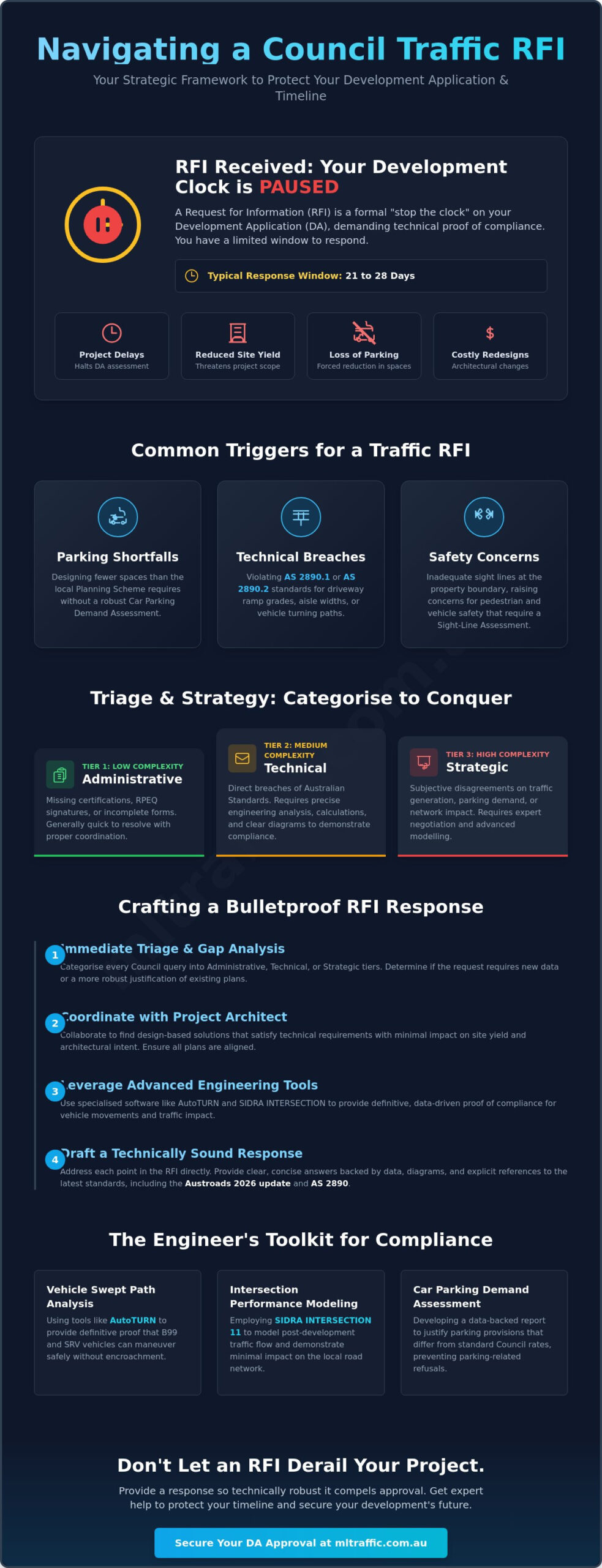
Most RFIs stem from three specific areas of non-compliance. First, parking shortfalls are a primary trigger. If your architect has designed fewer spaces than the local Planning Scheme requires without a robust Car Parking Demand Assessment, an RFI is certain. Second, technical breaches of AS 2890.1 (Off-street car parking) or AS 2890.2 (Commercial vehicles) regarding driveway ramp grades or aisle widths will stop an application. Finally, safety concerns regarding sight distances at the property boundary often prompt requests for additional Sight-Line Assessments to ensure pedestrian safety. At ML Traffic Engineers, the consultant who provides your quote is the one who does the work, ensuring these technical triggers are addressed by senior experts.
The ‘Red Flags’ in a Traffic Engineer’s Letter
You must identify red flags that suggest a fundamental redesign is imminent. If a letter asks you to “demonstrate how a B99 vehicle can turn without encroaching on the opposite lane,” and your site is narrow, you’re likely looking at a loss of site yield. Another red flag is when an engineer requests data outside of standard requirements, such as post-development modeling for intersections three blocks away. These requests impact your “deemed refusal” rights. If you don’t provide a technically sound response that meets the 2026 Austroads standards, you lose the ability to appeal based on Council’s failure to decide. Professional traffic engineering services are essential to navigate these specific technical challenges and protect your timeline.
Triage and Technical Strategy: Categorising the Traffic RFI
Effective triage is the first step in deciding how to respond to council traffic engineer RFI requests without compromising your project’s yield. Not every query carries the same weight. You must categorise the RFI into three tiers to determine your technical response strategy. Administrative issues involve missing certifications or RPEQ signatures. Technical issues involve specific breaches of AS 2890.1 or driveway ramp grades. Strategic issues are the most complex; these involve subjective disagreements regarding traffic generation rates or parking shortfalls that require expert negotiation.
A critical part of triage is determining if the Council requires new site data or merely a more robust analysis of existing information. If your original Traffic Impact Assessment (TIA) used data older than two years, the engineer will likely demand fresh traffic counts to align with the 2024 TfNSW Guide to Transport Impact Assessment. However, if the data is current, the solution usually lies in refined modeling rather than new field surveys. Pushing back is appropriate when a Council engineer requests upgrades to the external road network that are disproportionate to the development’s impact. Conversely, if the RFI identifies a safety breach, such as inadequate sight distance, a design concession is typically the only path to approval.
Parking Supply vs. Parking Design
RFIs often conflate the number of spaces provided with the physical layout of those spaces. Challenges to parking supply require a strategic argument based on empirical data rather than just statutory requirements. Statutory parking rates are fixed figures within a local planning scheme, whereas empirical demand reflects the actual peak parking needs based on observed land-use data and site-specific characteristics. If the RFI focuses on design non-compliance, such as headrooms or aisle widths, you must provide a professional car park design assessment to prove the layout functions safely for all users.
Access and Network Impact Assessment
When Council engineers raise concerns about the ‘Level of Service’ (LoS) at nearby intersections, technical certainty is required. These queries often involve waste management and heavy vehicle access, requiring proof that a 12.5m Heavy Rigid Vehicle (HRV) can enter and exit in a forward direction. We use SIDRA INTERSECTION 11, released on March 25, 2026, to provide micro-analytical traffic assignment data. This software demonstrates that the development’s added trips won’t cause the intersection to fail. Providing this level of technical detail usually satisfies network impact queries and prevents the need for a second RFI. Our senior engineers handle these complex modeling tasks directly to ensure your response is authoritative and meticulous.
Step-by-Step Guide: Crafting a Technically Robust RFI Response
Following a systematic process is the only way to ensure your submission isn’t rejected a second time. We break down how to respond to council traffic engineer RFI notices into five technical steps. First, perform a gap analysis. You must isolate every specific query in the Council letter and map it against your original TIA. Second, consult your architect. Any change to a driveway ramp grade or parking layout has structural implications. Third, draft a formal Traffic Engineering Response Table. Fourth, obtain updated certifications for revised designs, ensuring they align with the Austroads update released on February 25, 2026. Finally, lodge the package via the relevant Planning Portal, ensuring all document names match the Council’s specific naming conventions.
The Importance of the Response Table
The Response Table serves as your closing argument. It lists the Council’s query in the left column and your engineer’s technical resolution in the right. This format is the most effective way to satisfy a Council engineer because it leaves no query unaddressed. By referencing specific clauses, such as Section 2.5 of AS 2890.1 for driveway gradients, you remove room for subjective interpretation. It’s vital to cross-reference updated architectural plans with the traffic report. If the RFI response mentions a revised swept path, the corresponding drawing number must be cited in the table to provide a clear audit trail for the assessor.
Consultant Coordination: Architect, Civil, and Traffic
Misalignment between consultants is a common cause of DA delays. If your civil engineer sets a driveway level that doesn’t account for the 1:20 transition required by Australian Standards, the traffic response will fail. We manage the “Consultant Loop” to prevent conflicting documents from reaching the Council. The traffic consultant must act as the lead for all vehicle-related RFI items. We verify that the architect’s revised basement layout maintains the necessary headrooms and aisle widths before any documents are finalized. This meticulous coordination ensures that our driveway ramp grade assessment matches the civil drawings exactly, providing the technical certainty Council requires for approval.
At ML Traffic Engineers, we don’t pass work to junior staff. The senior engineer who provides your quote is the one who coordinates with your project team. This hands-on approach is essential when negotiating complex design changes that affect site yield. We ensure that every technical response is backed by decades of experience and current industry standards, protecting your project from unnecessary redesigns or further “stopped clock” delays.
Leveraging Advanced Traffic Engineering Tools for Compliance
Technical certainty is the only currency Council engineers accept. When determining how to respond to council traffic engineer RFI notices, relying on manual calculations or outdated software is insufficient. We utilize AutoTURN software to simulate the precise movements of B99 cars and Small Rigid Vehicles (SRVs). This software provides a digital overlay that proves a vehicle can maneuver within your site without striking structural elements or crossing into opposing traffic lanes. For complex intersection queries, we deploy SIDRA INTERSECTION 11. This version, released on March 25, 2026, includes micro-analytical assignment functionality that validates intersection performance under peak loads, satisfying the benchmarks set in the 2024 TfNSW Guide to Transport Impact Assessment.
Proving Access with Swept Path Analysis
Council engineers frequently flag ‘blind’ aisles or inadequate turnaround areas in basement designs. A standard 2D analysis often fails to account for the complexities of multi-level ramps. In these scenarios, providing 3D swept paths is essential to demonstrate that the design is functional in a real-world environment. Swept Path Analysis functions as empirical evidence that your site can accommodate the design vehicle. Integrating these paths directly onto your architect’s site plans allows the Council assessor to see the immediate relationship between the vehicle path and the proposed building footprint. This visual proof often resolves safety objections without forcing a reduction in site yield.
AS 2890.1 Compliance Checks
Adherence to Australian Standards is the baseline for any successful RFI response. Our team performs rigorous AS 2890.1 compliance checks to address specific concerns regarding driveway ramp transitions. We conduct ground clearance assessments to ensure vehicles don’t scrape the pavement on steep gradients. We also verify that structural columns are positioned outside of the required parking bay envelopes. If your RFI mentions obstructions in parking spaces, we provide a precise Sight Distance Assessment to prove that drivers maintain a clear line of sight to pedestrians and oncoming traffic. Our senior engineers handle these assessments personally to ensure every technical detail is meticulous. If you’re facing a complex technical query, contact our senior engineers for a direct consultation on your response strategy.
Sight Distance Assessments are particularly effective at overcoming subjective safety objections. By using the formulas found in the 13 parts of the Austroads Guide to Traffic Management, we provide a fact-based rebuttal to Council concerns. This approach moves the conversation away from the engineer’s ‘opinion’ and back to established engineering standards. We ensure your response package includes all necessary certifications to prove your development meets every safety and maneuverability requirement.
Navigating Post-Submission: Negotiation and Final Approval
Submitting the formal response package is not the final step in the DA process. You must actively manage the post-submission phase to prevent your application from languishing in a queue. A proactive approach is necessary if the Council engineer remains unconvinced by the initial technical submission. If a “Second RFI” is issued, it usually indicates a failure of communication rather than a lack of data. In these instances, the strategy for how to respond to council traffic engineer RFI notices must shift from data provision to direct technical negotiation.
At ML Traffic Engineers, we provide direct access to our principals, Michael Lee and Benny Chen. This “no-gatekeepers” approach is vital during post-submission negotiations. Having a senior engineer with over 30 years of experience handle the follow-up ensures that technical disputes are resolved quickly. If the negotiation fails and the project moves to an appeal, our principals serve as expert witnesses. We provide technical evidence based on the 13 parts of the Austroads Guide to Traffic Management and the February 25, 2026, updates to traffic theory concepts.
The ‘Consultant-to-Consultant’ Meeting
A direct meeting between your consultant and the Council traffic engineer is the most efficient way to achieve a breakthrough. These technical discussions allow for a “Consultant-to-Consultant” dialogue where engineering logic supersedes administrative bureaucracy. We prepare for these negotiations by identifying the specific thresholds for parking rates or access points that satisfy Council safety requirements without sacrificing site yield. This phase is a core part of our ML Traffic Services, ensuring that technical justifications are understood before the final assessment report is written.
Securing the Final Traffic Conditions
Once the engineer is satisfied, they will draft the conditions of consent. You must review these conditions meticulously before they are finalized. Workable conditions are essential; you don’t want to be surprised by a requirement for an expensive intersection upgrade that wasn’t previously discussed. We ensure that no “hidden” traffic costs, such as excessive road widening or unnecessary signalization, are buried in the DA conditions. Our focus is on protecting the developer’s approval timeline and project viability. If you need a seasoned expert to manage your current submission, Contact ML Traffic Engineers to manage your RFI response today.
We have managed over 10,000 sites since 2005, giving us the expertise to handle even the most conservative Council assessors. The traffic consultant who provides your quote is the one who does the work and leads these final negotiations. This accountability ensures that the technical strategy developed at the start of the RFI process is carried through to the final approval. Don’t leave your DA timeline to chance by taking a passive approach to Council feedback.
Secure Your Development Approval with Technical Certainty
Mastering the technical requirements of a Council RFI is the only way to restart your DA timeline and prevent the loss of valuable car parking spaces. A successful response requires more than just submitting documents. It demands a strategic triage of technical queries and the application of advanced modeling tools like SIDRA INTERSECTION 11. By using precise data and referencing the February 25, 2026, Austroads updates, you provide the technical justification Council engineers require to move your application forward.
Knowing how to respond to council traffic engineer RFI notices is a critical skill for any developer, but you don’t have to manage the process alone. ML Traffic Engineers offers over 15 years of experience in Australian Council negotiations and direct access to senior principals Michael Lee and Benny Chen. We have completed more than 10,000 successful site assessments nationwide. This ensures that the traffic consultant who provides your quote is the one who performs the technical work and manages the negotiation directly.
Get a Professional RFI Response Strategy from ML Traffic Engineers and protect your project’s profitability today. Your path to DA approval is within reach when backed by senior expertise and a proven track record of results.
Frequently Asked Questions
What is a traffic RFI in the development application process?
A traffic RFI is a formal Request for Information issued by a Council traffic engineer when a Development Application lacks the technical detail required for a full assessment. It acts as a “stop the clock” mechanism, pausing the statutory processing period until a compliant response is received. These requests typically focus on safety, parking supply, or network capacity issues that weren’t sufficiently addressed in the initial submission documents.
How long do I have to respond to a Council traffic engineer RFI?
Most Australian Councils provide a standard window of 21 to 28 days to submit a formal response. If you fail to provide the requested data within this timeframe, Council may refuse the application or return it as incomplete. Learning how to respond to council traffic engineer RFI notices promptly is essential to maintaining your “deemed refusal” appeal rights and protecting the project timeline from indefinite delays.
Can I push back on a Council traffic engineer’s request for more parking?
You can push back by providing an empirical Car Parking Demand Assessment that uses observed data to justify a lower parking rate. While statutory rates in a planning scheme are the default, they are often conservative. We use surveys from similar land-use types to prove that the actual peak demand is lower than the Council’s requirement. This technical evidence allows for a negotiated outcome without sacrificing valuable site yield.
What happens if I cannot meet the AS 2890.1 requirements mentioned in the RFI?
If a design cannot meet the “deemed-to-comply” benchmarks of AS 2890.1, you must provide a performance-based engineering justification. This involves using Vehicle Swept Path Analysis to prove that the non-compliant element, such as a narrow aisle or steep ramp, still functions safely. If the breach creates a genuine safety risk or prevents a B99 vehicle from maneuvering, a redesign of the car park layout is typically the only path to approval.
Does every RFI require an updated Traffic Impact Assessment (TIA) report?
Not every request requires a full revision of the original Traffic Impact Assessment. Minor queries or administrative gaps can often be resolved through a concise technical letter or a Response Table. However, if the RFI challenges the fundamental traffic generation rates or requires new SIDRA 11 modeling based on the March 25, 2026, software update, an amended TIA report is usually necessary to ensure all project documentation remains consistent.
How much does it cost to have a traffic engineer respond to an RFI?
Costs for an RFI response vary significantly based on whether the request is administrative or requires complex new modeling. A simple swept path check is less intensive than a full intersection analysis using the latest 2026 Austroads standards. We provide fixed-fee quotes based on a triage of the Council’s letter. This ensures you only pay for the specific technical work required to clear the RFI and restart the DA clock.
What is a ‘stop the clock’ notice in a planning application?
A “stop the clock” notice is a legal provision that pauses the Council’s mandatory timeframe for deciding on a Development Application. When an engineer issues an RFI, the assessment clock stops on that date. The clock only restarts once a complete and technically sound response is lodged. This mechanism prevents developers from claiming a “deemed refusal” while Council is waiting for essential information to justify an approval.
Why is the Council asking for a swept path analysis after I already submitted my plans?
Council asks for this analysis because standard architectural plans only show static layouts, not vehicle movement. A Vehicle Swept Path Analysis proves that the design vehicle, such as a 12.5m Heavy Rigid Vehicle, can enter and exit the site in a forward direction without hitting columns or curbs. It provides the technical certainty that the proposed car park design is functional and complies with the maneuverability requirements of AS 2890.1.

Disclaimer
The content on www.mltraffic.com.au, including all technical articles, guides, and resources, is provided for general informational and educational purposes only. It is not intended to constitute professional advice in traffic engineering, transportation planning, development approvals, or any other technical or legal field.
While ML Traffic Engineers makes every reasonable effort to ensure the accuracy, completeness, and timeliness of the information published, we do not provide any warranties or representations (express or implied) regarding its reliability, suitability, or availability for any particular purpose. Any reliance you place on the content is strictly at your own risk.
In no event shall ML Traffic Engineers, its directors, employees, authors, or affiliates be liable for any direct, indirect, incidental, special, consequential, or punitive damages (including, without limitation, loss of profits, data, or business opportunities) arising out of or in connection with the use of, or inability to use, any information provided on this website.
The articles and guides on this site are not a substitute for engaging a qualified, registered professional traffic engineer (such as an NPER or RPEQ engineer) to assess your specific project requirements. For tailored advice, compliance assessments, or traffic engineering services, please contact a competent professional.
This disclaimer may be updated from time to time without notice. By accessing or using this website, you agree to be bound by the most current version of this disclaimer.
