

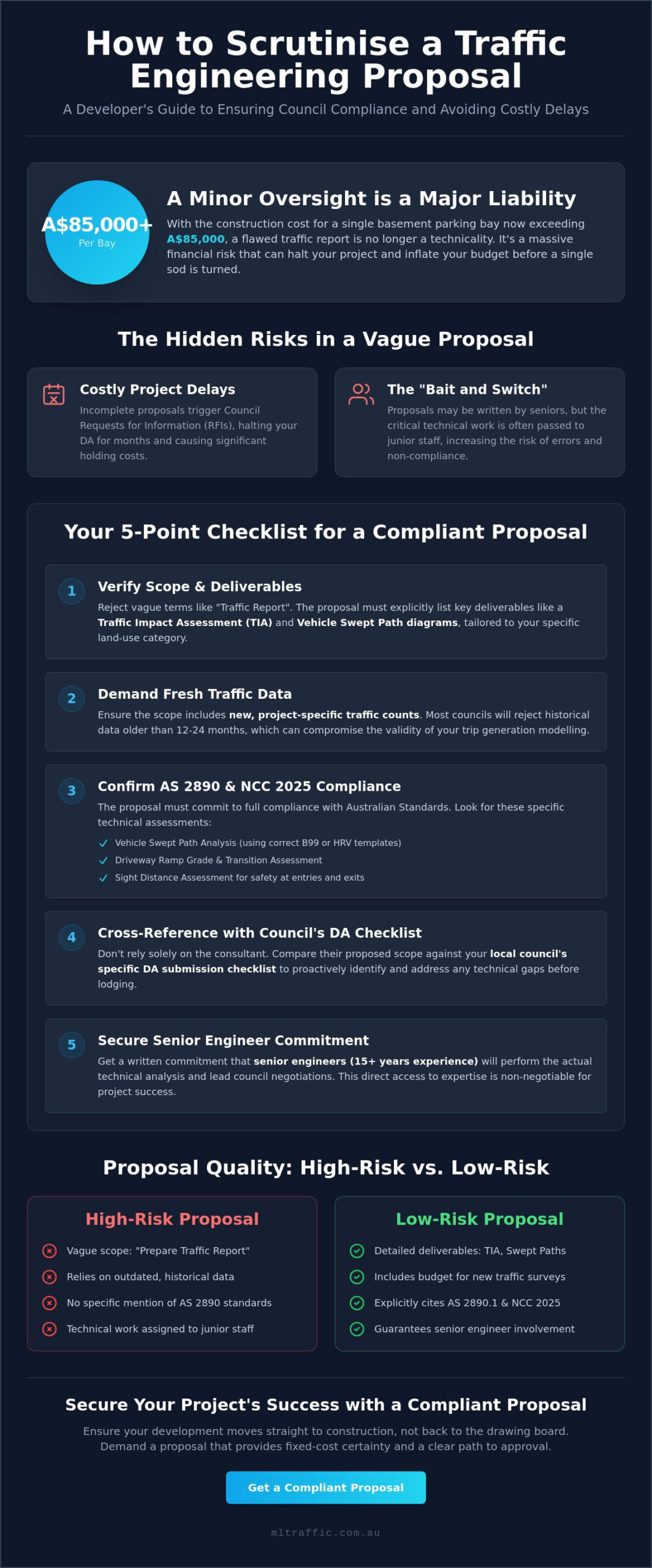
With the construction cost for a single basement parking bay now exceeding A$85,000, a minor oversight in your traffic engineering report is no longer just a technicality; it’s a massive financial liability. You likely understand the frustration of receiving a Council Request for Information (RFI) that halts your development for months because a consultant missed a specific requirement in the AS 2890 series or the NCC 2025. Knowing how to review a traffic engineer’s proposal is the critical difference between a project that moves straight to construction and one that gets bogged down in bureaucratic red tape.
We agree that comparing technical quotes with varying inclusions is a complex task, especially when site-specific Australian Standards are involved. This guide will show you how to scrutinise these technical documents to ensure full council compliance and secure fixed-cost certainty for your planning phase. We will break down the essential inclusions, from Vehicle Swept Path Analysis to modern parking demand assessments, and explain why direct access to senior engineers who perform the technical work is non-negotiable for project success.
Key Takeaways
- Confirm the proposal identifies the correct land-use category and includes mandatory deliverables like Traffic Impact Assessments (TIA) and Swept Path diagrams.
- Determine if the scope includes fresh traffic data collection or relies on historical data that could compromise your trip generation modelling.
- Ensure compliance with AS 2890 by verifying the inclusion of driveway ramp grade assessments and specific vehicle classifications like B99 or Heavy Rigid Vehicles.
- Understand how to review a traffic engineer’s proposal by cross-referencing the engineer’s scope against your local council’s specific DA checklist to spot technical gaps.
- Avoid the “bait and switch” by securing a commitment that senior engineers with over 15 years of experience will perform the actual technical work and council negotiations.
What Should a Professional Traffic Engineering Proposal Include?
A professional traffic engineering proposal is not just a fee estimate. It is a technical roadmap that defines the legal and regulatory boundaries of your development. Knowing how to review a traffic engineer’s proposal requires you to look beyond the bottom line and scrutinise the specific deliverables promised. A proposal that lacks detail often leads to expensive Requests for Information (RFIs) from the council, which can stall a project for months. You need a document that clearly identifies the project scope based on your specific land-use category, whether that is a multi-deck residential complex, a retail centre, or an industrial warehouse.
To better understand the role of the expert behind these documents, watch this helpful video:
The Importance of a Detailed Scope of Works
Vague descriptions such as “Traffic Report” are a significant risk. A robust proposal must detail exactly what the engineer will assess. This involves applying transportation planning principles to evaluate both internal site circulation and the impact on the external road network. If your project has already undergone a pre-DA meeting with the council, the proposal must explicitly state that it will address the specific concerns raised in those meeting minutes. This ensures that the final Traffic Impact Assessment (TIA) Report is fit for purpose and ready for submission without further revisions.
Regulatory Compliance and Australian Standards
Compliance is the non-negotiable foundation of any development application. Every proposal should cite the relevant regulatory frameworks, specifically AS 2890.1 (Off-street car parking) and the updated NCC 2025 requirements. When you learn how to review a traffic engineer’s proposal, you must check for the following technical inclusions:
- Vehicle Swept Path Analysis: Using correct vehicle templates like B99 cars or Heavy Rigid Vehicles (HRV).
- Driveway Ramp Grade Assessment: Essential to prevent vehicle scraping and ensure compliance with AS 2890.1:2004.
- Sight Distance Assessment: To verify safety at property boundaries and intersections.
- State-Based Requirements: Adherence to specific guidelines from authorities like TfNSW or the Victorian Planning Scheme.
The proposal must also confirm that the consultant holds appropriate professional indemnity insurance suited to your project’s scale. Finally, ensure the document outlines a clear timeline for delivery and guarantees that senior engineers, rather than junior staff, will lead the technical strategy and council negotiations. This level of accountability is what provides fixed-cost certainty during the planning phase.
Critical Components of a Traffic Impact Assessment (TIA) Scope
The Traffic Impact Assessment (TIA) is the technical backbone of your development application. It provides the empirical evidence required to prove your project will not adversely affect the surrounding road network. When learning how to review a traffic engineer’s proposal, you must ensure the scope is not merely a summary of existing conditions. It must be a forward-looking analysis that uses rigorous modelling to predict future performance. A proposal that skimps on the TIA phase often results in costly redesigns after the council identifies flaws in the traffic logic.
Data Collection and Traffic Counts
The technical validity of your TIA depends on the integrity of the input data. You should verify whether the proposal includes new, project-specific traffic counts or relies on historical data. Most Australian councils reject data older than 12 to 24 months, especially in high-growth areas. The quote must explicitly include peak-hour surveys, typically covering the 7:00 AM to 9:00 AM and 4:00 PM to 6:00 PM windows for surrounding intersections. Be wary of proposals that treat third-party data procurement as an “out-of-scope” cost; these hidden fees can significantly inflate your final invoice.
Intersection and Network Analysis
For larger developments, a simple description of traffic flow is insufficient. Councils frequently require SIDRA modelling to assess the Level of Service (LoS) at nearby intersections. Your review should confirm that SIDRA analysis is included in the fixed fee. This modelling determines if the additional trips generated by your site will push an intersection from a stable LoS B to a failing LoS F. For a deeper understanding of these requirements, refer to our Definitive Guide for Australian Developers.
The assessment must follow recognised frameworks, such as the Guide to Traffic Impact Assessment, to ensure the methodology stands up to scrutiny during the public exhibition phase. Beyond traffic flow, the proposal should cover car parking demand assessments. If your design provides fewer spaces than the local planning scheme requires, the engineer must provide empirical evidence or case studies to justify the reduction. This often involves comparing your project to similar land uses in comparable urban centres. If you need a detailed breakdown of these technical requirements for your specific site, you can view our range of specialist assessment services to see what a compliant scope looks like.
Finally, ensure the trip generation modelling uses appropriate standards, such as the RTA Guide or ITE standards. Using the wrong trip rate can lead to an overestimation of traffic impact, which might trigger unnecessary and expensive requirements for road upgrades or intersection treatments. A senior-led proposal will always specify which modelling parameters are being used to protect your project from these avoidable overheads.
Reviewing Compliance: AS 2890 and Swept Path Analysis
Compliance with Australian Standards is the primary metric by which councils judge the technical viability of your development. When you determine how to review a traffic engineer’s proposal, you must look for explicit references to the AS 2890 series. A proposal that simply mentions “car park design” without detailing specific compliance checks for B85 and B99 parking spaces is insufficient. These standards ensure that 85% and 99.8% of the vehicle fleet can safely manoeuvre within your site. Failure to meet these specific dimensions often leads to the rejection of a Development Application (DA) or, worse, a car park that is functionally unusable.
A professional proposal should also confirm the use of industry-standard software, such as AutoTURN, to conduct Vehicle Swept Path Analysis. This software allows engineers to simulate the movement of specific vehicles through your site with millimetre precision. For a comprehensive understanding of how these assessments fit into the broader regulatory environment, your review should align with the Austroads Guide to Traffic Management. This document provides the national framework for ensuring that off-street parking facilities integrate safely with the public road network.
Vehicle Swept Path Requirements
A critical gap in many quotes is a failure to specify which vehicle types will be modelled. You must ensure the proposal includes the relevant design vehicles for your specific project. This typically includes B99 cars for standard parking and Small Rigid Vehicles (SRV) or Heavy Rigid Vehicles (HRV) for loading areas. If your development requires on-site waste collection, the proposal must explicitly include modelling for a council-standard waste truck. Check how many “test cases” or diagrams the base fee covers. A quote that only includes one or two movements may result in additional variations if the council requests analysis of alternative access points or internal turn-arounds.
Car Park Design and Ramp Grades
The physical geometry of your car park is where many projects fail during the construction certificate phase. A robust traffic proposal must include a Driveway Ramp Grade Assessment. This involves a detailed review of driveway longitudinal sections to ensure that vehicles do not scrape their undercarriages when transitioning between different gradients. This is a mandatory requirement under AS 2890.1. Additionally, the scope should cover vertical clearance checks for basement car parks, especially if delivery or waste vehicles need to enter. Sight distance assessments at the property boundary are another non-negotiable inclusion. These assessments verify that drivers exiting the site have a clear view of pedestrians and oncoming traffic, a safety requirement that every council planning officer will scrutinise.
How to Spot Gaps: A Checklist for Reviewing Traffic Proposals
Identifying hidden gaps in a consultancy quote is the most effective way to prevent project budget blowouts. When you are determining how to review a traffic engineer’s proposal, you must act as a gatekeeper for your project’s timeline. A low fee often masks a limited scope that will eventually require expensive variations or result in a council refusal. Use this structured checklist to ensure the proposal is comprehensive and legally sound.
- Step 1: Cross-reference the DA checklist. Every local council provides a specific checklist for development applications. Verify that the proposal addresses every traffic-related item, from bicycle parking ratios to loading dock management.
- Step 2: Confirm site visit inclusions. Engineers working purely from architectural plans often miss critical real-world constraints like existing power poles, street trees, or sightline obstructions. A site visit should be a standard component of any professional assessment.
- Step 3: Audit for hidden exclusions. Look for specific mentions of council meeting attendance and RFI responses. If these are not included as a fixed fee or clearly defined hourly rate, your budget is at risk.
- Step 4: Verify seniority. Ensure the proposal guarantees that a senior engineer with extensive experience will perform the technical work. You don’t want your project being used as a training ground for junior staff.
- Step 5: Align the programme. Confirm that the delivery dates match your planning consultant’s schedule. A late traffic report can delay the entire submission by weeks.
Common Exclusions to Watch For
Responses to council Requests for Further Information (RFIs) are a frequent source of frustration. You must clarify if these responses are included in the base fee or billed at an hourly rate. Similarly, attendance at VCAT or the Land and Environment Court is almost always an additional cost. If your project is likely to be contested, ensure the proposal outlines the engineer’s experience in providing expert witness testimony. Check the policy on modifications as well. If the architect changes the site layout mid-process, you need to know how the engineer will charge for updating the swept path diagrams and the final report.
The Red Flags of a Low-Cost Quote
A quote that seems significantly cheaper than competitors often indicates a generic “Statement of Effect” rather than a site-specific Traffic Impact Assessment. This is a critical distinction; a generic statement will not satisfy a council planning officer looking for data-driven evidence. Other red flags include the absence of specific vehicle turning templates or a lack of commitment to AS 2890 compliance certification. If you are unsure if your current quote covers these essentials, contact our senior engineers for a professional second opinion on your project requirements.
A senior-led proposal will always address the specific risks of your site rather than providing a templated response. By following this checklist, you ensure that the professional you hire is accountable for the DA’s success and provides the fixed-cost certainty required for a profitable development.
Why Senior-Led Traffic Engineering Proposals Reduce DA Risk
A significant risk in the consultancy industry is the “bait and switch” tactic. Larger firms often send a senior principal to win the project, only to delegate the technical assessments to junior staff. This delegation increases the likelihood of errors in complex modelling or misinterpretations of the AS 2890 series. When you are learning how to review a traffic engineer’s proposal, you must demand a personnel continuity promise. You need to know exactly who will be conducting the Vehicle Swept Path Analysis and drafting the final Traffic Impact Assessment Report. Technical competence cannot be outsourced to inexperienced personnel without compromising the project’s integrity.
Experience matters in council negotiations. A senior engineer with over 15 years of industry experience understands the unspoken requirements of local planning authorities. They can anticipate council objections before the DA is even lodged. This foresight reduces the risk of project delays and ensures that the technical strategy is robust from day one. Having a single point of contact from the initial proposal through to the final approval provides the accountability required for complex urban developments. It ensures that the person defending the report at a council meeting is the same person who performed the calculations.
Accountability and Direct Access
ML Traffic Engineers operates on a “no-gatekeepers” philosophy. We ensure the same senior expert who initiates the client relationship performs the technical work. This direct involvement means that senior oversight catches design flaws, such as non-compliant driveway ramp grades, before they reach the council desk. Clients benefit from direct access to leadership for phone consultations, ensuring technical questions are answered with authority and precision. This hands-on approach distinguishes our practice from impersonal, tiered firms where information is lost in layers of management.
- Expert continuity: The engineer who quotes the job is the engineer who performs the analysis.
- Fixed-cost certainty: Senior-led scopes are more accurate, reducing the risk of mid-project variations.
- Strategic partnership: We act as an extension of your development team, not just a document provider.
National Expertise with Local Insight
Our team leverages a national portfolio of diverse project environments to solve unique site access challenges. Whether your project is a high-density residential tower or a specialised industrial facility, our multi-decade professional longevity provides the depth of knowledge needed to navigate bureaucratic requirements. We understand how to review a traffic engineer’s proposal from the perspective of both the developer and the regulator. This dual insight allows us to position your project for a smoother approval process by addressing compliance issues proactively.
Success in Australian development requires meticulous attention to detail and a results-oriented mindset. Don’t leave your project’s traffic requirements to junior personnel who lack the experience to navigate complex planning schemes. Contact ML Traffic Engineers for a comprehensive, senior-led proposal that guarantees technical compliance and fixed-cost certainty today.
Secure Your Development Application with Technical Certainty
A comprehensive traffic engineering proposal is more than a cost line item; it is your project’s primary defence against council delays. By understanding how to review a traffic engineer’s proposal, you ensure that every technical deliverable, from driveway ramp grade assessments to SIDRA modelling, is precisely aligned with current Australian Standards and NCC 2025 requirements. Senior-led oversight is the only way to guarantee that the expert who designs your car park is the same person who defends it before the council.
ML Traffic Engineers brings over 15 years of Australian consultancy experience to your development team. We provide direct access to senior principals on every project, specialising in AS 2890 compliance and sophisticated AutoTURN analysis. Our focus on accountability and technical precision eliminates the “bait and switch” risks common in larger, impersonal firms. We are ready to provide the meticulous expertise your project requires.
Request a compliant Traffic Engineering Proposal from our Senior Principals to secure fixed-cost certainty and move your development seamlessly from planning to approval.
Frequently Asked Questions
What is the difference between a Traffic Impact Statement and a full TIA?
A Traffic Impact Statement is a concise assessment for developments with minimal traffic generation, while a full TIA is a comprehensive analysis for larger projects. Statements generally address basic access and parking compliance. TIAs involve rigorous trip generation modelling, SIDRA intersection analysis, and detailed network impact assessments to satisfy council requirements for high-density or commercial developments.
Does a traffic proposal include the cost of traffic counts?
Inclusion of traffic count costs varies between consultancies and is often listed as a disbursement or an out-of-scope item. When you determine how to review a traffic engineer’s proposal, check if peak-hour surveys are integrated into the professional fee. This ensures transparency and prevents unexpected third-party invoices during the data collection phase of your assessment.
How much time should I allow for a traffic engineer to prepare a proposal?
Expect a turnaround of two to five business days for a formal traffic engineering proposal once all architectural plans are provided. This period allows the senior engineer to assess the project’s scale, identify the necessary Australian Standards, and determine if specialised deliverables like Driveway Ramp Grade Assessments or Intersection Analysis are required for your specific site.
Will the traffic engineer attend council meetings as part of the proposal?
Attendance at council meetings or pre-DA consultations is usually excluded from the base fee for report preparation. Most proposals list these services at a senior hourly rate. If your development is likely to face community opposition or complex technical questioning from council planners, you should request that a fixed number of meeting hours be included in the initial quote.
What happens if the council requests changes after the traffic report is submitted?
Revisions required due to council RFIs or architectural changes typically incur additional fees unless they are caused by errors in the original report. A robust proposal will clearly define the process for updates. It’s essential to understand if minor adjustments to Vehicle Swept Path Analysis are covered or if every plan change triggers a new variation.
Is a Swept Path Analysis always required for a residential DA?
Swept Path Analysis is mandatory for any residential development where vehicle manoeuvrability is not immediately obvious, such as basement car parks or narrow access ways. This analysis uses AutoTURN software to prove that a B99 vehicle can enter, park, and exit in a forward direction. Without this evidence, councils will likely reject the DA for non-compliance with AS 2890.1.
How do I know if a traffic engineer is suitably qualified in Australia?
Verify that the lead engineer holds a Bachelor of Engineering (Civil) and maintains current professional indemnity insurance. In Australia, membership with Engineers Australia or registration on the National Engineering Register (NER) provides assurance of technical competence. The proposal should also highlight the engineer’s specific history with local government planning schemes and the AS 2890 series.
Can one traffic proposal cover multiple sites or stages of a development?
One proposal can cover multiple stages of a development provided the total project scope is identified early in the planning phase. Combining stages into a single Traffic Impact Assessment Report often proves more cost-effective. It allows for a holistic view of parking demand and intersection capacity, which helps avoid the need for repetitive modelling as the project progresses.

Disclaimer
The content on www.mltraffic.com.au, including all technical articles, guides, and resources, is provided for general informational and educational purposes only. It is not intended to constitute professional advice in traffic engineering, transportation planning, development approvals, or any other technical or legal field. While ML Traffic Engineers makes every reasonable effort to ensure the accuracy, completeness, and timeliness of the information published, we do not provide any warranties or representations (express or implied) regarding its reliability, suitability, or availability for any particular purpose. Any reliance you place on the content is strictly at your own risk. In no event shall ML Traffic Engineers, its directors, employees, authors, or affiliates be liable for any direct, indirect, incidental, special, consequential, or punitive damages (including, without limitation, loss of profits, data, or business opportunities) arising out of or in connection with the use of, or inability to use, any information provided on this website. The articles and guides on this site are not a substitute for engaging a qualified, registered professional traffic engineer (such as an NPER or RPEQ engineer) to assess your specific project requirements. For tailored advice, compliance assessments, or traffic engineering services, please contact a competent professional. This disclaimer may be updated from time to time without notice. By accessing or using this website, you agree to be bound by the most current version of this disclaimer.
