

What if the primary cause of your project delay isn’t a supply chain issue, but a costly work stoppage due to a non-compliant traffic arrangement? Project managers across Australia frequently encounter council rejection because their Traffic Management Plans (TMP) fail to account for the physical shifts in a site’s footprint. You’ve likely felt the pressure of managing high-frequency heavy vehicle flow while keeping pedestrian detours safe and accessible. Understanding how to stage construction traffic is a technical necessity that requires precise engineering logic and a deep knowledge of current Australian Standards, including AS 2890.2.
This technical guide provides the sequential framework required to move your project from demolition to final completion without regulatory setbacks. You’ll learn the engineering principles necessary to distinguish between strategic TMPs and tactical Traffic Guidance Schemes (TGS) while ensuring full compliance with local council requirements. We’ll preview the specific stages of traffic management and the technical assessments, such as swept path analysis, that guarantee site safety. By following this framework, you can reduce project delays and ensure your site meets the rigorous safety demands of 2026 construction environments.
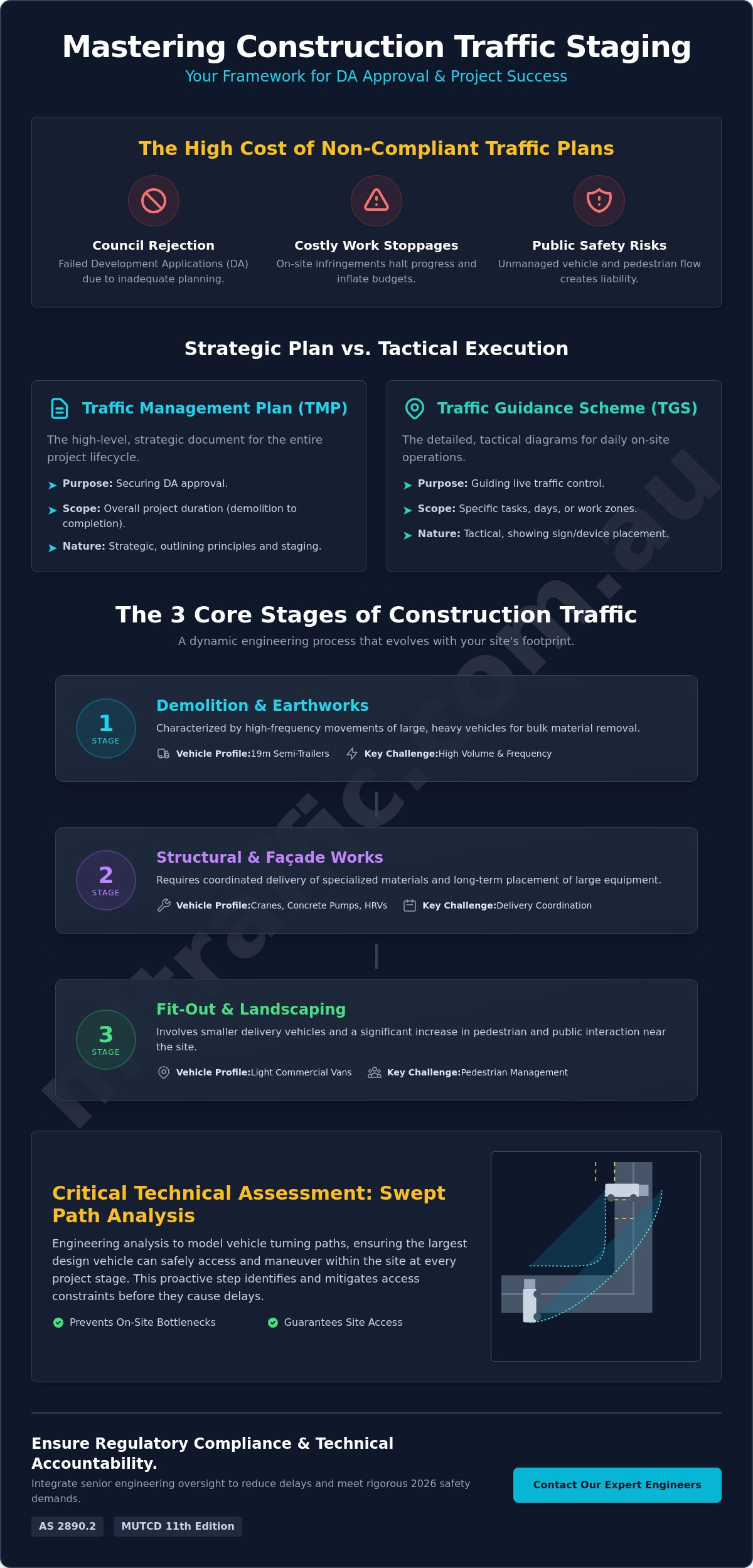
Key Takeaways
- Understand why chronological sequencing of vehicle movements is a mandatory requirement for securing council Development Application (DA) approval.
- Learn how to use Vehicle Swept Path Analysis to identify and mitigate site access constraints during the initial planning phase.
- Discover how to stage construction traffic across three distinct phases, from high-frequency heavy vehicle demolition to complex structural coordination.
- Identify the critical differences between a strategic Traffic Management Plan (TMP) and a tactical Traffic Guidance Scheme (TGS) for daily site operations.
- Ensure regulatory compliance and technical accountability by integrating senior engineering oversight into your pedestrian and vehicle management strategies.
Table of Contents
Understanding Construction Traffic Staging for DA Approval
Traffic staging is the chronological sequencing of vehicle and pedestrian movements throughout a project’s lifecycle. It isn’t a static document but a dynamic engineering process that must evolve alongside the physical build. Australian councils require this staged approach within a Traffic Management Plan (TMP) to ensure that as the site footprint changes, the risks to the public are identified and mitigated. Understanding how to stage construction traffic is critical for securing a Development Application (DA). It demonstrates that the project manager has accounted for the physical constraints of the site during every phase of work, from the first day of demolition to the final landscaping.
This process relies on established Road traffic control principles to maintain site productivity. Without a staged flow, heavy vehicle arrivals often lead to queuing on public roads, resulting in council infringements or immediate work stoppages. Regulatory compliance is primarily driven by the 11th Edition of the Manual on Uniform Traffic Control Devices (MUTCD), with the most recent revisions effective as of March 5, 2026. In the Australian context, we also align these strategies with AS 2890.2 to ensure off-street commercial vehicle facilities meet safety requirements.
To better understand this concept, watch this helpful video:
The Objectives of a Staged Traffic Strategy
A professional strategy prioritizes three core outcomes. First, it ensures the safety of workers and pedestrians by creating physical separation between high-risk activities and the public. Second, it minimizes the impact on existing road network capacity. In high-density Australian urban environments, failing to manage lane reductions can lead to substantial council fines and civil liability. Third, it maintains efficient delivery and waste removal schedules. By coordinating arrivals based on the specific phase of construction, project managers avoid the "bottleneck effect" that delays concrete pours or structural steel deliveries.
In rapidly developing areas, leveraging experienced traffic management services South East Queensland can provide the local expertise needed to navigate these constraints and ensure that site-specific logistics remain seamless.
Staging vs. Static Traffic Management
Static traffic management assumes the site environment remains unchanged. This is a common error that leads to project delays and regulatory scrutiny. A multi-year project involves shifting entry points, varying vehicle sizes, and changing pedestrian detours. A demolition phase requires high-frequency heavy vehicle movements, while the structural phase involves long-term crane placements and concrete boom pumps. These shifts necessitate frequent updates to the Traffic Guidance Scheme (TGS). Unlike a TMP, which offers the broad strategy, the TGS provides the tactical diagrams required for daily operations. Our traffic engineering services focus on providing these precise technical assessments to ensure continuous compliance as the build progresses.
The Planning Phase: Technical Assessments and Site Analysis
Effective planning begins with a technical audit of the existing road environment. You can’t determine how to stage construction traffic without first identifying the physical constraints of the kerbside, overhead clearances, and existing traffic volumes. This phase requires a detailed evaluation of the road hierarchy surrounding your site. Whether you’re operating on a local cul-de-sac or a major arterial road, the impact on the network capacity must be modeled. Citing the importance of comprehensive Transportation Management Plans (TMPs) ensures all stakeholders understand the broader impact on the road network before the first vehicle arrives.
A critical step is identifying the largest design vehicle required for each specific stage. A demolition phase often involves 19m semi-trailers, while the structural phase might transition to 12.5m Heavy Rigid Vehicles (HRV) or specialized concrete boom pumps. Each vehicle type has unique maneuvering requirements that dictate the placement of temporary gates and loading zones. Failing to identify these vehicles early leads to site access failures and costly redesigns of the Traffic Guidance Scheme (TGS).
Swept Path Analysis for Each Stage
Swept Path Analysis (SPA) is the primary tool for validating site access. Using industry-standard software like AutoTURN, engineers simulate heavy vehicle maneuvers to ensure they can enter and exit the site in a forward direction. Unlike static plans, a staged SPA accounts for how the available space shrinks as the building rises. You must run separate simulations for excavation, structural, and fit-out phases. For a deeper technical breakdown, refer to our guide on Swept Path Analysis: A Complete Guide for Australian Developments.
Compliance with AS 2890.2 for Heavy Vehicles
All temporary traffic arrangements must comply with AS 2890.2, which governs the maneuvering requirements for service vehicles. This includes designing temporary driveway ramps that meet maximum grade standards to prevent vehicle "bottoming out" or loss of traction. We also verify sight-line requirements at temporary entry points. If a driver’s view of pedestrians or oncoming traffic is obstructed by hoarding or equipment, the staging plan is non-compliant. Conducting these professional traffic engineering assessments during the planning phase prevents council rejections and ensures your site remains operational. Meticulous planning now avoids the $283 daily lane reduction fees often seen in high-density urban projects.
The 3 Core Stages of Construction Traffic Management
Successful project delivery relies on a dynamic Traffic Management Plan (TMP) that reflects the physical reality of the site. Documenting the transition between project phases is a regulatory necessity. Councils and road authorities expect to see how your site’s traffic profile evolves from high-volume heavy vehicle movements to light vehicle trade access. Learning how to stage construction traffic involves breaking the project into three distinct engineering phases. Each phase requires unique Traffic Guidance Schemes (TGS) and specific technical assessments to maintain safety and flow.
The transition between these stages must be clearly defined in your TMP. This documentation should include trigger points, such as the completion of the basement slab or the removal of the primary tower crane, which signal the need for a revised traffic arrangement. By formalizing these transitions, you provide a clear framework for site supervisors and ensure that regulatory compliance remains continuous rather than reactive.
Demolition and Excavation Traffic
The first phase is characterized by high-frequency heavy vehicle movements. Managing "truck and dog" configurations for spoil removal requires precise planning to prevent queuing on public roads. We implement "Just-in-Time" delivery protocols to ensure vehicles only arrive when the site is ready to receive them. This phase also necessitates temporary work zones and rigorous road maintenance. Site exits must include rumble grids or wheel wash facilities to prevent mud tracking. Failing to manage this can lead to environmental protection notices and immediate site shutdowns by council inspectors.
Structural Phase Coordination
During the structural phase, the focus shifts to coordinating oversized deliveries and long-term plant placements. Mobile cranes and concrete boom pumps often require temporary lane closures. These activities must be coordinated with local traffic peaks to minimize network disruption. Pedestrian management becomes more complex here, as active hoist areas often require overhead protection or temporary diversions. Our engineers conduct specific intersection analyses to ensure that concrete pour days, which might involve 50 or more truck movements, don’t paralyze the local road hierarchy.
Fit-out and Final Access
The final phase involves a transition from heavy vehicle access to high-volume light vehicle flow. Trade vans, couriers, and delivery trucks replace the heavy rigs of the structural phase. This stage is critical for finalizing permanent driveway crossovers and internal parking layouts. You must ensure that the final site configuration achieves full compliance with AS 2890.1 for the final hand-over. We verify driveway ramp grades and sight-line requirements at this stage to ensure the project meets all car park design standards before the occupation certificate is issued.
Essential Components of a Staged Traffic Management Plan
A staged plan is only as effective as its individual technical components. It requires a documentation hierarchy that addresses both long-term project strategy and daily tactical execution. Understanding how to stage construction traffic means knowing which specific documents apply to each phase of the build. Without this clarity, project managers often find themselves with plans that are too vague for site supervisors yet too detailed for council planners. Effective staging integrates tactical diagrams, pedestrian safety protocols, and a rigorous monitoring framework into a single, cohesive strategy.
Stakeholder engagement is a critical but often overlooked component. This involves formal communication with the local council, transport authorities, and neighboring property owners. In high-density Australian urban areas, the 11th Edition of the Manual on Uniform Traffic Control Devices (MUTCD), updated March 5, 2026, requires specific coordination with emergency services. You must provide written confirmation that fire and ambulance services have reviewed your staging plans, ensuring that emergency routes remain unobstructed by construction plant or material deliveries during all phases of the build.
TGS vs. TMP: Knowing the Difference
The Traffic Management Plan (TMP) serves as the high-level strategy for the entire project. It outlines the broad engineering logic and regulatory compliance measures. In contrast, the Traffic Guidance Scheme (TGS) provides the specific, daily signage and device layouts required for a particular activity or stage. While the TMP might cover a three-year timeline, you’ll require dozens of unique TGS diagrams as the site entry shifts and vehicle types change. For a comprehensive breakdown of these documents, see our Traffic Management Plan (TMP): The Definitive Guide for Australian Projects.
Risk Mitigation and Safety Signage
Safety signage must be dynamic to remain effective. As the physical site footprint evolves, speed reductions and warning signs must be relocated to ensure they provide adequate notice to public motorists. Accredited traffic controllers play a vital role in managing site gates and coordinating "Just-in-Time" deliveries. They ensure that heavy vehicles don’t queue on public roads, which can incur significant council fines and disrupt local traffic flow. Pedestrian Management Plans are also essential, requiring clear detours and physical separation from active work zones. These plans must remain compliant with the latest accessibility and safety standards throughout every project stage.
Monitoring and auditing protocols ensure that the approved plan is followed on-site. We recommend weekly technical audits to verify that the physical setup matches the current TGS. If you need help navigating these requirements or determining how to stage construction traffic for your specific site, you can contact our senior engineers at ML Traffic Engineers Australia for a direct technical assessment.
Why Professional Traffic Engineering is Critical for Staging
Professional traffic engineering is the only way to manage the liability and technical complexity of site staging. You cannot simply "guess" how to stage construction traffic when your project is under the scrutiny of council inspectors and road authorities. Engineering rigor ensures that every vehicle movement is backed by data, from swept path assessments to intersection capacity modeling. Technical accountability is paramount. At ML Traffic Engineers, we provide senior engineer oversight on every project, ensuring that your staging plans meet the high standards required for RPEQ or equivalent certification. This level of professional involvement is what prevents costly project shutdowns and regulatory fines.
A poorly engineered plan is a significant project risk. If a heavy vehicle cannot safely navigate a temporary gate or if a pedestrian detour fails to meet the January 18, 2026, state compliance deadline for the 11th Edition of the MUTCD, authorities can halt work immediately. These delays often cost far more than the initial engineering assessment. Our approach eliminates the disconnect between the planning phase and on-site execution. We ensure that the technical strategy developed in the office is actually achievable on the road, protecting your timeline and your budget.
Securing Council Approval for Your DA
Satisfying council planners requires more than a basic set of diagrams. You must present a robust, staged TMP that addresses specific concerns regarding local road congestion and network impact. We specialize in navigating these complex requirements by providing detailed Traffic Impact Assessments (TIA) that justify your staging logic. By addressing potential bottlenecks before they occur, we facilitate a smoother approval process. You can read more about The Role of a Traffic Engineer in Developments to understand how these technical reports influence council decisions.
The Value of Experience in Traffic Staging
Experience is the most reliable predictor of success in traffic engineering. We leverage over 15 years of industry experience across 10,000 sites to solve the most complex staging challenges. Our firm operates on a unique promise: the traffic consultant who provides the quote is the one who does the work. This ensures you have direct access to our principals, Michael Lee and Benny Chen, throughout the project lifecycle. This "no-gatekeepers" approach is critical when you need immediate technical answers for a shifting site footprint. Learn more about our comprehensive traffic engineering services and how our hands-on expertise can streamline your next development application.
Mastering Your Site Logistics
Success on a complex build depends on a strategy that evolves alongside the physical structure. Effective project management requires a deep understanding of how to stage construction traffic to meet the strict 2026 regulatory standards. By integrating sequential Swept Path Analysis and dynamic Traffic Guidance Schemes, you eliminate the bottlenecks that lead to council fines or immediate work stoppages. A staged approach ensures your site remains both productive and compliant from demolition through to final handover. You don’t have to risk the $283 daily lane reduction fees prevalent in high-density urban zones when your strategy is backed by engineering data.
Navigating these technical requirements is simpler with expert oversight. ML Traffic Engineers brings 15 years of experience across 10,000 sites nationally to every project we manage. You get direct access to our senior principals, Michael Lee and Benny Chen. It’s our promise that the consultant who provides your quote is the one performing the engineering. Get a professional Traffic Staging Plan for your next project and secure your site’s operational future today. With the right engineering partner, you’ll focus on the build while we handle the technical complexities of road network compliance.
Frequently Asked Questions
What is the difference between a TMP and a TGS in construction?
A Traffic Management Plan (TMP) is a strategic document that outlines the broad traffic logic and safety goals for a project’s duration. A Traffic Guidance Scheme (TGS) is a tactical diagram showing the precise location of signs and devices for a specific work stage. You’ll typically maintain one TMP while updating multiple TGS documents as you learn how to stage construction traffic through different phases.
Does every construction project require a staged traffic management plan?
Staged plans are mandatory for any development where the site footprint or vehicle access points evolve over time. Councils require these for multi-phase projects to ensure that pedestrian safety and road capacity are maintained as the build progresses. If your site transitions from heavy excavation loads to structural crane placements, a staged approach is a regulatory necessity for DA approval.
How often should a construction traffic staging plan be updated?
You must update your staging plan at every major phase change, such as the transition from demolition to structural works. The 11th Edition of the MUTCD, which became the national standard on March 5, 2026, requires that traffic control measures reflect the current physical site environment. Reviewing your staging logic before each new phase prevents compliance failures and safety risks.
What are the most common reasons councils reject a traffic staging plan?
Rejections often occur due to inadequate pedestrian management or failing to provide a compliant Vehicle Swept Path Analysis. Councils also frequently reject plans that lack written confirmation of emergency service coordination, a requirement that gained increased scrutiny in 2026. Using outdated standards instead of the current 2026 regulatory editions will also lead to an immediate rejection of your application.
How do I manage heavy vehicle swept paths on a constrained site?
Managing constrained sites requires professional Vehicle Swept Path Analysis using software like AutoTURN. This simulation ensures that the largest design vehicles, such as 19m semi-trailers or concrete pumps, can enter and exit the site in a forward direction. This technical assessment proves to authorities that your staging logic won’t result in vehicles mounting kerbs or striking public infrastructure.
What Australian Standards govern construction traffic staging?
Staging is primarily governed by AS 1742.3 for traffic control and AS 2890.2 for commercial vehicle maneuvers. These are supplemented by the 11th Edition of the MUTCD, effective March 5, 2026. Project managers must also ensure that all temporary driveway ramps and loading zones meet the grade standards specified in AS 2890.1 to maintain site accessibility and safety.
Do I need a traffic engineer to stage traffic for a small development?
Professional engineering is required whenever a project impacts public road users or requires RPEQ-certified documentation for council. Even small developments must address complex technical issues like sight-line assessments and temporary driveway ramp grades. Engaging an expert ensures your staging logic is technically defensible and reduces the risk of council-imposed work stoppages.
How does construction traffic staging impact project costs?
Proactive staging reduces costs by avoiding the high penalties associated with unmanaged road occupancy. For instance, the City of Los Angeles applies a unit fee of $283 per lane reduction, per block, as of May 2026. Effective staging also prevents secondary costs related to idle labor and equipment that occur when delivery vehicles cannot access a site due to poor planning.
Which areas do you cover?
We are traffic engineers servicing Melbourne, Sydney, Brisbane, Gold Coast, Hobart, Perth, Adelaide, Darwin, Canberra and surrounding areas.

Disclaimer
The content on www.mltraffic.com.au, including all technical articles, guides, and resources, is provided for general informational and educational purposes only. It is not intended to constitute professional advice in traffic engineering, transportation planning, development approvals, or any other technical or legal field.
While ML Traffic Engineers makes every reasonable effort to ensure the accuracy, completeness, and timeliness of the information published, we do not provide any warranties or representations (express or implied) regarding its reliability, suitability, or availability for any particular purpose. Any reliance you place on the content is strictly at your own risk.
In no event shall ML Traffic Engineers, its directors, employees, authors, or affiliates be liable for any direct, indirect, incidental, special, consequential, or punitive damages (including, without limitation, loss of profits, data, or business opportunities) arising out of or in connection with the use of, or inability to use, any information provided on this website.
The articles and guides on this site are not a substitute for engaging a qualified, registered professional traffic engineer (such as an NPER or RPEQ engineer) to assess your specific project requirements. For tailored advice, compliance assessments, or traffic engineering services, please contact a competent professional.
This disclaimer may be updated from time to time without notice. By accessing or using this website, you agree to be bound by the most current version of this disclaimer.
