

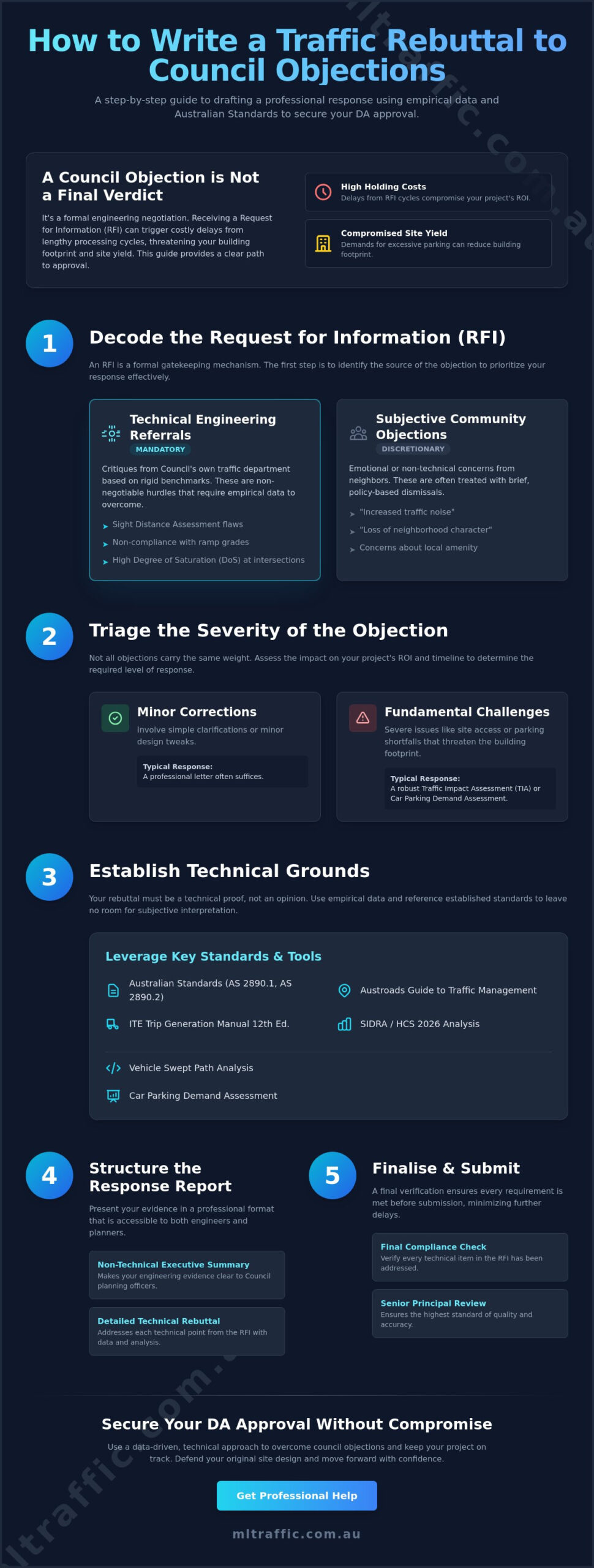
A Council objection is not a final verdict; it’s a formal engineering negotiation where technical compliance overrides subjective concerns. You likely understand the frustration of receiving a Request for Information (RFI) that threatens your building footprint or demands excessive parking. These delays lead to high holding costs while you wait through lengthy processing cycles, which often take 10 to 15 business days just for initial reviews. You need a clear path to approval that doesn’t compromise your site yield.
Learning how to write a traffic rebuttal to council objections is about mastering a technical framework that satisfies engineering referrals. This article provides a step-by-step guide to drafting a professional rebuttal using empirical data and Australian Standards like AS 2890.1. We’ll cover how to leverage tools like HCS 2026 and the ITE Trip Generation Manual 12th Edition to provide the evidence required for DA approval. You’ll learn to use vehicle swept path analysis and car parking demand assessments to defend your original site design and move your project forward.
Key Takeaways
- Learn to distinguish between mandatory engineering referrals and discretionary community objections to prioritize the most critical technical responses.
- Master the application of AS 2890.1 and AS 2890.2 to establish non-negotiable compliance for parking and commercial vehicle access.
- Discover how to write a traffic rebuttal to council objections by determining when to defend your design with empirical data versus when to implement minor site adjustments.
- Implement a professional report structure that includes a non-technical executive summary to ensure your engineering evidence is accessible to Council planning officers.
- Execute a final compliance check and senior principal review to verify that every technical requirement in the RFI is addressed before submission.
Decoding the Council Request for Further Information (RFI)
Receiving a Request for Further Information (RFI) from Council signals the start of a critical negotiation phase. An RFI isn’t a simple list of queries. It represents a formal gatekeeping mechanism used by Council planners to ensure a development aligns with established principles of traffic engineering. Understanding how to write a traffic rebuttal to council objections starts with identifying who is actually objecting. You must distinguish between internal engineering referrals and community submissions. Engineering referrals are technical critiques from Council’s own traffic department. Community objections are often emotional or non-technical concerns from neighbors regarding local amenity.
To better understand the nature of responding to formal objections, watch this helpful video:
Council Traffic Engineers act as technical advisors to the Planning Officer. They assess your proposal against rigid benchmarks like Australian Standard AS 2890.1 or the Austroads Guide to Traffic Management. Generic responses fail because they don’t address the specific data points these referral officers require. If a referral officer identifies a deficiency in your Sight Distance Assessment or driveway ramp grade, a vague assurance of safety won’t suffice. You need technical evidence that proves compliance with national standards.
Analyzing Technical vs. Subjective Objections
Community objections frequently focus on “increased traffic noise” or “loss of neighborhood character.” While these feel significant to residents, they are often discretionary. In contrast, technical objections regarding the Degree of Saturation (DoS) at an intersection or non-compliance with Austroads 2026 standards are mandatory hurdles. A successful rebuttal isolates these technical triggers. It treats subjective complaints with brief, policy-based dismissals while dedicating the bulk of the response to empirical data and engineering proof.
Triage: Assessing the Severity of the Objection
Not all objections carry the same weight. You must triage the RFI to determine the impact on your project ROI and timelines. This step is vital when planning how to write a traffic rebuttal to council objections effectively. Minor corrections might involve simple clarifications on Car Park Design or minor updates to a Vehicle Swept Path Analysis. A professional letter usually suffices for these.
Fundamental challenges are more severe. These involve site access issues or a perceived lack of parking that might force a reduction in building footprint. These require a robust Traffic Impact Assessment (TIA) or a detailed Car Parking Demand Assessment. Every week spent in the RFI cycle increases holding costs. Identifying whether an objection requires a minor design tweak or a technical defense is essential for maintaining your project schedule.
Establishing Technical Grounds for Your Traffic Rebuttal
Technical grounds form the backbone of any successful DA approval. A successful rebuttal isn’t a letter of opinion; it’s a technical proof. You must replace anecdotal claims with empirical evidence derived from current traffic data and 2026 growth projections. Council referral officers prioritize submissions that reference established benchmarks such as the Austroads Guide to Traffic Management. This authoritative approach leaves little room for subjective interpretation by the assessor. Understanding how to write a traffic rebuttal to council objections requires a deep dive into the specific standards that govern site access and intersection performance.
Compliance with Australian Standards (AS 2890)
Adherence to the AS 2890 series is non-negotiable in traffic engineering disputes. You must use AS 2890.1:2004 to justify off-street car parking dimensions, specifically focusing on aisle widths and bay lengths. If Council objects to your driveway design, you should cite specific gradient requirements and transition zones outlined in the standard. This is particularly critical when conducting a Driveway Ramp Grade Assessment to prove that the design prevents vehicle scraping while maintaining safety.
For commercial or mixed-use developments, AS 2890.2 governs heavy vehicle requirements. You must demonstrate that loading docks and service areas accommodate the specific design vehicle, such as an 8.8m Medium Rigid Vehicle (MRV) or a 12.5m Heavy Rigid Vehicle (HRV). While local codes vary, frameworks like the SF Planning TIA Guidelines demonstrate how data-driven metrics for parking and loading are standard practice in urban planning disputes. Referencing the National Construction Code 2025 can also provide additional compliance weight for the interface between building structures and traffic infrastructure.
Traffic Impact and Capacity Modeling
When Council raises concerns about intersection capacity, SIDRA modeling is your primary tool for rebuttal. This software allows you to simulate traffic flow and provide a quantified “Level of Service” (LoS) rating. Council planners often misunderstand LoS; your rebuttal must clearly explain that an LoS of ‘D’ or better is typically acceptable during peak hours in urban environments. In 2026, the acceptable Degree of Saturation for urban intersections generally remains below 0.90 to ensure stable traffic flow during peak periods.
Data-driven arguments are difficult to dismiss. If you can prove that your development adds less than 5% to the existing traffic volume, you can often argue that the impact is negligible. Engaging an expert for a formal Intersection Analysis ensures your rebuttal is backed by certified modeling results. This level of detail is essential when how to write a traffic rebuttal to council objections involves complex urban sites with high existing congestion levels. Accurate modeling prevents Council from forcing unnecessary and expensive road upgrades on your project.
Strategic Rebuttal Approaches: Data vs. Design
Deciding whether to defend a design with data or modify the layout is a critical strategic choice in the RFI process. When you’re determining how to write a traffic rebuttal to council objections, you must weigh the cost of redesign against the time required for technical modeling. A data-driven defense is essential when Council demands would reduce site yield or eliminate profitable floor space. Conversely, if a minor adjustment to a driveway radius satisfies a referral officer without impacting the building footprint, a design tweak is often the fastest path to approval. You need to identify which objections are “deal-breakers” for your development’s commercial viability.
The Power of Vehicle Swept Path Analysis
Council often objects to narrow driveways or tight basement circulations based on visual estimation rather than technical fact. You can counter these subjective claims with a formal Vehicle Swept Path Analysis. By using AutoTURN software, you generate indisputable visual evidence that B85 and B99 vehicles can navigate the site safely. This prevents Council from forcing you to widen driveways at the expense of landscaping or structural columns. Proving that a vehicle can complete a turn with the required clearances ensures your design remains compliant with AS 2890.1. For a deeper look at these technical methods, refer to our specialized Swept Path Analysis guide.
Car Parking Demand Assessments
Parking shortfalls are a primary cause of DA delays and site yield loss. You don’t have to accept the generic parking rates found in local planning schemes if they don’t reflect actual demand for your specific use case. A professional Car Parking Demand Assessment uses empirical data from similar sites to prove that your development requires fewer spaces than the code suggests. This approach is highly effective for sites near major public transport hubs where vehicle ownership rates are statistically lower.
You can also implement a “Green Travel Plan” as a strategic offset for parking deficiencies. This involves providing enhanced bicycle facilities, end-of-trip lockers, or car-share pods to justify a reduction in traditional car spots. Balancing these demands requires a meticulous review of the RFI to ensure your response is technically sound and commercially viable. Every square meter of parking you successfully rebut is a square meter you can return to the building’s primary footprint. This meticulous approach to how to write a traffic rebuttal to council objections ensures you maintain project ROI while satisfying regulatory requirements.
Step-by-Step: Writing the Traffic Engineering Response Report
A professional traffic engineering rebuttal acts as a bridge between technical civil design and administrative planning law. Knowing how to write a traffic rebuttal to council objections involves more than just stating facts; it requires a highly structured document that mirrors the Council’s own RFI. You must address every point raised by the referral officer numerically. This ensures no item is overlooked and allows the Planning Officer to cross-reference your evidence easily. If the Council raised five points, your report should have five corresponding sections.
The “Executive Summary” is the most critical component for the non-technical Planning Officer. While the referral engineer will scrutinize your Intersection Analysis, the Planning Officer needs a concise summary confirming that all technical hurdles are cleared. This summary should explicitly state that the proposal complies with the relevant planning scheme and Australian Standards. Incorporating visual evidence is equally vital. High-resolution swept path diagrams, annotated site photos, and technical Car Park Design layouts provide indisputable proof that text alone cannot convey.
Structuring the Response for Maximum Impact
Your response must follow a logical hierarchy to maintain professional authority. Start with a clear introduction referencing the DA number and the specific RFI date. The body of the report must lead with technical arguments, prioritizing compliance with AS 2890.1 and AS 2890.2. Every claim should link back to a specific clause in the standards or a data point from your Traffic Impact Assessment (TIA) Report. Conclude with a definitive statement confirming the proposal’s technical acceptability and suitability for approval.
Language and Tone in the Rebuttal
Maintaining an objective and authoritative tone is essential for credibility. Avoid defensive or emotional language; it suggests a lack of technical confidence. Your role is to present engineering facts, not to argue person-to-person. For example, when dismissing a subjective resident objection regarding traffic volume, use a sentence like this: “While resident submissions express concern regarding local congestion, empirical SIDRA modeling confirms the development contributes less than 2.1% to peak hour volumes, maintaining the existing Level of Service (LoS) D.”
Precision in language prevents misinterpretation by Council staff. If you need a professionally drafted response that satisfies rigorous engineering referrals, engage our senior principals for a comprehensive Traffic Impact Assessment (TIA) Report today.
Finalising the Rebuttal and Securing DA Approval
The final phase of the rebuttal process is a rigorous compliance audit. You must verify that every specific query in the RFI has a corresponding technical answer. This meticulous check is a core part of how to write a traffic rebuttal to council objections effectively. Council referral officers often look for reasons to issue a second RFI if the initial response is incomplete. With total dwelling approvals in Australia falling 10.5% in March 2026, the pressure to maintain project momentum is higher than ever. You can’t afford procedural delays caused by administrative oversight or missing data points.
The Expert Review Process
A senior principal must review the final document to ensure technical consistency across all project documentation. This review verifies that the rebuttal logic aligns perfectly with the foundational Traffic Impact Assessment. Every calculation within the Traffic Engineering report, including SIDRA intersection modeling and driveway grade assessments, must be checked for absolute accuracy. We prioritize a personnel continuity promise. The expert who performs the technical work is the one who defends it. This hands-on approach ensures that the person speaking to Council knows every nuance of the site’s constraints and engineering opportunities.
Submission and Negotiation
Submission through the planning portal is only the beginning of the final approval stage. You should proactively reach out to the Council Traffic Engineer to walk them through the technical evidence provided in your response. This direct communication often resolves minor queries that might otherwise lead to formal delays. In jurisdictions like Brisbane, where processing times for technical schemes average 10 to 15 business days, early engagement is a strategic advantage. If your project faces a tribunal or formal mediation, having a seasoned expert to present the engineering proof is the difference between approval and rejection.
Professional representation transforms the rebuttal from a defensive act into a proactive approval strategy. This framework for how to write a traffic rebuttal to council objections ensures your project remains technically compliant and commercially viable. Don’t let bureaucratic hurdles reduce your building footprint or inflate your holding costs. For expert assistance in drafting and negotiating your response, ML Traffic Engineers Australia are available to manage your technical rebuttal today.
Securing Your Development Approval with Technical Precision
Mastering the technical framework of a traffic rebuttal ensures your project avoids unnecessary design changes and excessive holding costs. You now understand the importance of distinguishing between subjective community complaints and mandatory engineering benchmarks. Utilizing SIDRA modeling and rigorous adherence to Australian Standards provides the empirical evidence required to satisfy Council referral officers. This systematic approach protects your site yield and maintains your original project vision.
Understanding how to write a traffic rebuttal to council objections transforms a potential project delay into a manageable technical negotiation. ML Traffic Engineers Australia offers 15+ years of experience in Australian traffic engineering. We specialize in AS 2890 and Austroads 2026 compliance to ensure your submission meets every regulatory requirement. You receive direct access to our senior principals for every project, ensuring accountability and technical depth. Contact our senior principals to handle your Council traffic rebuttal and move your development toward a successful determination. Your project’s path to approval is clearer when backed by certified engineering expertise.
Frequently Asked Questions
What is the difference between a traffic objection and a Request for Further Information (RFI)?
An RFI is a formal administrative pause in the DA process where Council seeks clarification on specific project elements. A traffic objection is the technical or subjective reason provided by a referral officer or community member that triggers that RFI. RFIs have strict statutory deadlines. If you don’t address them adequately, your project can remain stalled indefinitely.
Can I write a traffic rebuttal myself, or do I need a qualified traffic engineer?
You need a qualified traffic engineer to provide certified technical evidence that Council referral officers will accept. Planning officers require responses that demonstrate compliance with Australian Standards like AS 2890.1. Knowing how to write a traffic rebuttal to council objections involves using specialized software and engineering principles that non-experts cannot legally certify for a DA submission.
How long does Council typically take to review a traffic rebuttal report?
Council review times vary by jurisdiction. Brisbane City Council typically takes 10 to 15 business days for initial processing of technical schemes. Public notification periods for development applications generally range from 14 to 30 days. It’s essential to account for these benchmarks when you’re planning your project’s construction timeline and holding costs.
What happens if Council rejects my traffic rebuttal?
If Council issues a negative determination, you may need to seek a review through a tribunal such as VCAT in Victoria. There is a critical legal distinction between a merit-based determination and a procedural rejection. Professional representation ensures your technical evidence is robust enough to stand up in a formal appeal or mediation session if the initial rebuttal fails.
Is Swept Path Analysis mandatory for all Council traffic rebuttals?
Swept Path Analysis isn’t mandatory for every rebuttal, but it’s the most effective tool for proving vehicle maneuverability on constrained sites. It provides indisputable visual evidence that B85 or B99 vehicles can navigate driveways and car parks safely. This analysis often prevents Council from forcing a reduction in building footprint to accommodate wider access ways.
How much weight does Council give to resident objections regarding traffic congestion?
Council gives significantly less weight to subjective resident objections than to technical engineering referrals. While community concerns about character or noise are considered, they are often discretionary. Technical triggers like intersection Degree of Saturation (DoS) are mandatory benchmarks. These require empirical data and SIDRA modeling to override resident claims effectively.
Does a traffic rebuttal always require a redesign of the car park or driveway?
No, a rebuttal doesn’t always necessitate a redesign. Many objections are overcome by providing technical justification through SIDRA modeling or a Car Parking Demand Assessment. Proving that the existing design complies with AS 2890.2 or Austroads guidelines often allows you to maintain your original site yield without making physical changes to the site layout.

Article by
Michael Lee
Practising traffic engineer with over 35 years experience.
Disclaimer
The content on www.mltraffic.com.au, including all technical articles, guides, and resources, is provided for general informational and educational purposes only. It is not intended to constitute professional advice in traffic engineering, transportation planning, development approvals, or any other technical or legal field.
While ML Traffic Engineers makes every reasonable effort to ensure the accuracy, completeness, and timeliness of the information published, we do not provide any warranties or representations (express or implied) regarding its reliability, suitability, or availability for any particular purpose. Any reliance you place on the content is strictly at your own risk.
In no event shall ML Traffic Engineers, its directors, employees, authors, or affiliates be liable for any direct, indirect, incidental, special, consequential, or punitive damages (including, without limitation, loss of profits, data, or business opportunities) arising out of or in connection with the use of, or inability to use, any information provided on this website.
The articles and guides on this site are not a substitute for engaging a qualified, registered professional traffic engineer (such as an NPER or RPEQ engineer) to assess your specific project requirements. For tailored advice, compliance assessments, or traffic engineering services, please contact a competent professional.
This disclaimer may be updated from time to time without notice. By accessing or using this website, you agree to be bound by the most current version of this disclaimer.
