

What if your next Traffic Impact Assessment was a tool for unlocking site yield rather than just a mandatory compliance cost? Most developers view traffic engineering as a bureaucratic hurdle that often results in over-engineered parking requirements or unexpected council delays. With commercial real estate investment projected to rise by 16% in 2026, the margin for error in site planning has narrowed. Understanding how traffic assessments impact project ROI is no longer optional for maintaining a competitive edge in a market where annual US GDP growth is forecasted at 2.0%.
We recognize the frustration of costly redesigns late in the DA process and excessive infrastructure contribution costs. This guide demonstrates how professional traffic engineering transforms a compliance hurdle into a powerful tool for protecting your financial returns. You’ll learn how precise Vehicle Swept Path Analysis and Car Parking Demand Assessments prevent the over-provision of expensive car parking spaces. We also outline how navigating new 2026 impact fee schedules in jurisdictions like Tacoma and Bellevue requires a data-driven approach to secure faster approvals and optimize your site’s total yield.
Key Takeaways
- Reframe the Traffic Impact Assessment (TIA) from a mandatory compliance hurdle into a strategic asset that prevents exponential late-stage redesign costs.
- Discover how a Car Parking Demand Assessment can justify lower parking ratios, significantly reducing expensive basement excavation and construction overheads.
- Identify how traffic assessments impact project ROI by detecting critical site access and sightline issues early in the planning phase before they require costly retrofitting.
- Leverage empirical site-specific data and Intersection Analysis to challenge generic Development Control Plan (DCP) requirements and negotiate more favorable council conditions.
- Secure faster DA approvals by utilizing senior-led technical reports that withstand rigorous regulatory scrutiny and ensure personnel continuity throughout the project lifecycle.
Table of Contents
-
Beyond Compliance: The Financial Case for Traffic Impact Assessments
-
Strategic Negotiation: Using Data to Challenge Onerous Council Conditions
Beyond Compliance: The Financial Case for Traffic Impact Assessments
A Traffic Impact Assessment (TIA) is not merely a technical requirement to satisfy council planners; it is a critical financial risk management document. It quantifies the impact of a proposed development on the existing transport network and provides the empirical basis for site design. From a commercial perspective, understanding how traffic assessments impact project ROI involves viewing the report as a safeguard for development capital. It ensures that the project’s yield isn’t compromised by unforeseen infrastructure demands or unworkable access points. Technical metrics such as Intersection Capacity Utilization (ICU) provide the objective data needed to satisfy regulatory bodies while protecting the developer’s bottom line.
To better understand the fundamental role of these studies in development, watch this helpful video:
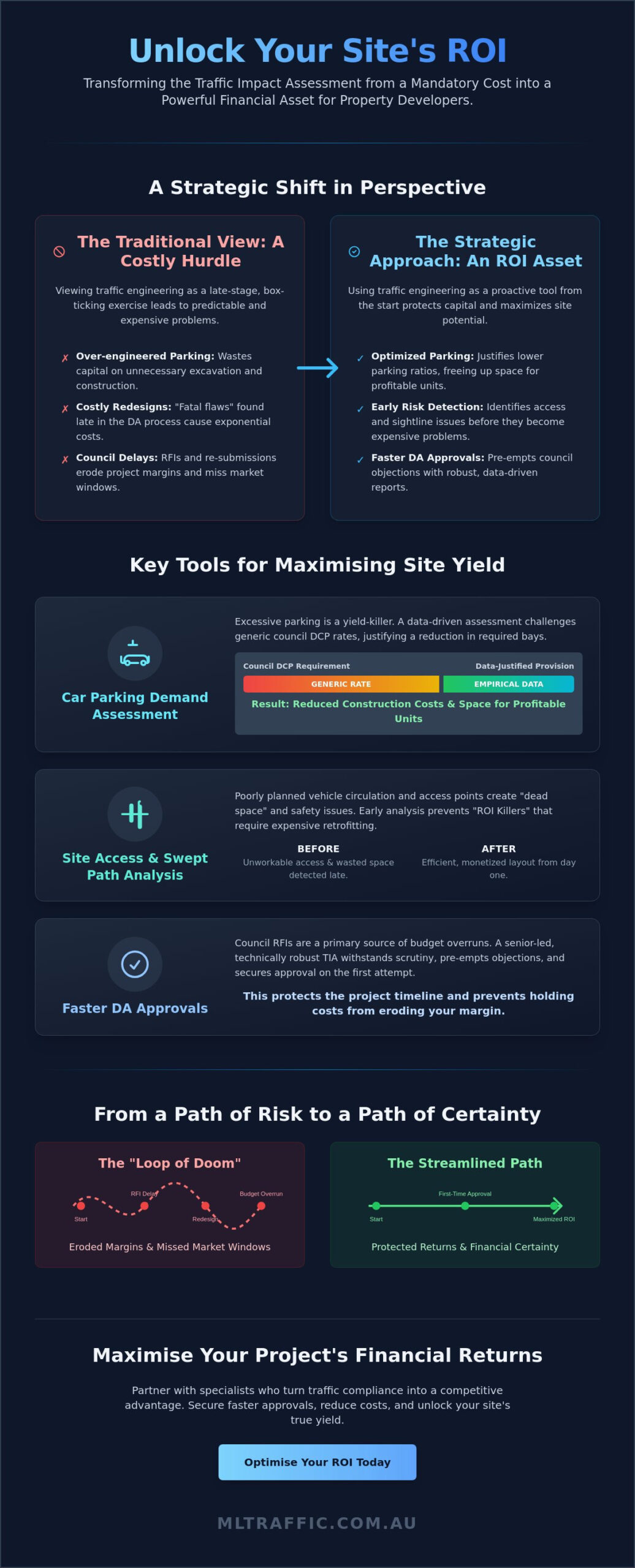
The "sunk cost" fallacy often leads developers to treat traffic engineering as a late-stage box-ticking exercise. This approach is flawed. Ignoring traffic constraints during the initial feasibility phase leads to exponential costs when council identifies "fatal flaws" during the DA process. Direct ROI is measured in the speed of approval, while indirect ROI is realized through enhanced long-term asset value and reduced infrastructure contribution liabilities. Data-driven reports provide the certainty required by financiers and stakeholders, ensuring the project remains bankable throughout its lifecycle.
The ROI of "First-Time" DA Approval
Council Requests for Information (RFIs) are a primary driver of project cost overruns. Every day a project sits in the RFI stage, holding costs erode the potential margin. A robust TIA pre-empts these objections by addressing potential bottlenecks before planning officers raise them. A Traffic Impact Assessment functions as a strategic financial safeguard for development capital by ensuring the technical submission is defensible from the outset. This precision reduces the likelihood of multiple rounds of feedback, keeping the project on its original financial trajectory.
Protecting the Project Timeline
Accuracy in traffic engineering is directly linked to construction commencement dates. Inaccurate data triggers a "loop of doom" involving redesigns, re-submissions, and missed market windows. When a report is technically sound, it acts as a project management tool that maintains the momentum of the development. By securing approval on the first attempt, developers avoid the need for costly retrofitting of driveways or intersections after construction has already started. High-quality data ensures that how traffic assessments impact project ROI is realized through a streamlined path from planning to groundbreaking.
Optimising Site Yield and Reducing Infrastructure Costs
Excessive on-site parking is one of the most significant yield killers in modern development. When a project is forced to adhere to generic council parking rates, the result is often the over-provision of car spaces. This leads to unnecessary excavation and construction overheads that provide zero return. Analyzing how traffic assessments impact project ROI requires a granular look at these construction costs. By commissioning a Car Parking Demand Assessment, developers can challenge broad Development Control Plan (DCP) requirements with empirical data. This technical approach often justifies a reduction in required bays, allowing that square meterage to be repurposed for leasable floor area or additional residential units.
Maximising a project’s physical footprint depends on efficient vehicle circulation. Poorly planned internal layouts create "dead space" that cannot be monetized. Professional traffic engineering identifies these inefficiencies during the design phase. By tightening circulation and optimizing the placement of structural elements, you reclaim high-value space that would otherwise be lost to oversized aisles or redundant turning areas. Developers seeking to maximize their footprint should review our specialized car park design services to ensure every square meter is utilized effectively.
Car Park Design and the "Cost Per Bay"
Structural efficiency in a basement or multi-deck car park is dictated by adherence to technical standards. Strict compliance with the AS 2890.1 Guide ensures that the facility is functional while minimizing wasted volume. Reducing driveway ramp grades and strategically placing columns prevents interference with parking maneuvers. These adjustments allow for a higher density of car bays within the same building envelope. This level of technical precision directly influences how traffic assessments impact project ROI by lowering the total cost per bay and increasing the overall project margin.
Swept Path Analysis as a Space-Saving Tool
We utilize advanced software like AutoTURN to perform detailed Vehicle Swept Path Analysis. This process proves the minimum required clearance for various vehicle classes, from standard cars to heavy rigid vehicles. By accurately modeling these movements, we optimize loading dock layouts and reduce the total building footprint required for service access. Swept Path Analysis prevents architectural over-design by ensuring that circulation spaces are sized exactly to the necessary technical requirements rather than guessed-at margins. This precision converts potential waste into usable, high-value commercial or residential yield.
Mitigating Risk: How Traffic Reports Prevent "ROI Killers"
Identifying technical "fatal flaws" during the initial due diligence phase is the most effective way to protect a project’s financial viability. Issues such as inadequate sightlines, unworkable access points, or insufficient intersection capacity can halt a development entirely if they’re discovered too late. When developers understand how traffic assessments impact project ROI, they treat these reports as iterative design tools rather than static documents. A proactive approach allows for the adjustment of site layouts before capital is committed to finalized architectural plans. Retrofitting is a margin destroyer. Modifying a driveway or internal ramp post-construction is significantly more expensive than getting the design right during the DA stage.
Professional Indemnity and the use of certified Traffic Engineering reports provide a layer of security for both developers and project financiers. Banks and stakeholders require certainty that a project won’t be derailed by unforeseen infrastructure requirements. With significant regulatory changes taking effect in 2026, such as new transportation impact fees in Tacoma and updated schedules in Pierce County, having current, defensible data is mandatory. A senior-led TIA ensures that the development is future-proofed against projected road network changes and shifting legislative landscapes. This level of technical oversight protects the developer against the risk of the council imposing conditions that are technically or financially unfeasible.
Avoiding Costly Intersection Upgrades
We use SIDRA modelling to perform detailed Intersection Analysis. This technical process proves whether a development actually triggers the need for expensive road works or signalization. By strategically placing site access points, we can often avoid the requirement for new traffic lights or major junction upgrades. Negotiating fair, proportional contributions for off-site infrastructure is a key part of the process. Without empirical data to challenge council assumptions, developers often find themselves paying for infrastructure that exceeds the actual impact of their project. Accurate modelling ensures you only pay your fair share.
Safety and Liability Protection
Technical compliance with AS 2890.2 for heavy vehicle access is essential for industrial and commercial projects. Ensuring proper pedestrian and vehicle segregation reduces long-term operational risk and potential legal disputes. While developers should verify requirements for formal audits, understanding the role of a traffic engineer in developments helps in identifying these risks early. A Sight Distance Assessment identifies potential collision points before they become a liability. This focus on safety and technical standards like driveway ramp grades ensures the finished asset is safe, functional, and protected from future litigation.
Strategic Negotiation: Using Data to Challenge Onerous Council Conditions
Generic Development Control Plans (DCPs) often impose conservative, "one-size-fits-all" requirements that do not reflect the specific realities of a site. These generic conditions can create significant financial bottlenecks. Using empirical data gathered through site-specific traffic counts and surveys allows developers to challenge these assumptions with technical evidence. This is a primary way how traffic assessments impact project ROI. By replacing conservative council estimates with actual field data, you can negotiate more favorable terms for infrastructure contributions and site design requirements. When a council relies on "worst-case scenario" modelling, a professional Intersection Analysis provides the necessary counter-argument to prevent unnecessary capital expenditure.
Strategic negotiation also extends to Voluntary Planning Agreements (VPAs). Providing clear traffic impact evidence allows for a more equitable distribution of infrastructure costs. If the data proves that a development’s impact on the local road network is minimal, the developer has a defensible position to reduce their contribution liabilities. In cases where negotiations stall, a senior traffic engineer serves as a critical expert witness in Land and Environment courts. Their professional status and adherence to national regulatory standards provide the authoritative testimony required to overturn unreasonable council refusals. To secure this level of technical representation, contact our senior principals for authority negotiations.
Data-Driven Parking Credits
Proving lower parking demand is possible when a site is located near high-frequency public transport hubs. We use Car Parking Demand Assessments to justify "shared parking" logic for mixed-use developments, where different users occupy spaces at different times. This technical approach often results in a significant reduction in the total number of required bays. A 10% reduction in required parking can save hundreds of thousands of dollars in excavation and structural costs alone. This reclaimed capital directly improves the project’s net present value and overall feasibility.
Challenging Traffic Generation Assumptions
Councils frequently use outdated formulas that overstate the amount of traffic a new development will generate. We use the latest RTA and Transport for NSW (TfNSW) data to correct these technical inaccuracies. By distinguishing between "pass-by" trips and "new" trips, we can often lower the calculated impact on the road network. Leveraging senior Traffic Engineering expertise ensures that your negotiations with road authorities are based on the most current and accurate data available. This precision ensures that how traffic assessments impact project ROI is maximized through reduced impact fees and more efficient site access approvals.
Maximising Project Returns with ML Traffic Engineers
The technical quality of a traffic report is a primary factor in determining how traffic assessments impact project ROI. At ML Traffic Engineers, we provide a "Senior-Only" advantage that distinguishes our consultancy from firms relying on junior-level staff. Reports written by inexperienced personnel often invite rigorous council scrutiny and multiple Requests for Information (RFIs), which delay construction commencement and increase holding costs. Our firm brings 15 years of national experience across residential, commercial, and industrial sectors to every project. This ensures that every report, from a Car Parking Demand Assessment to a complex Intersection Analysis, is technically sound and commercially focused.
Our Continuity Promise ensures that the senior expert who starts your project is the one who finishes it. This hands-on philosophy eliminates the risk of information loss during personnel handovers and ensures that the technical work is performed by a principal who understands your project’s specific commercial objectives. This level of accountability is essential for securing faster approvals and optimizing site yields in an increasingly competitive development market. By maintaining senior leadership involvement in every calculation and site assessment, we provide the meticulous oversight required to turn compliance hurdles into financial assets.
Direct Access to Senior Principals
We prioritize direct communication to speed up technical pivots during the design process. Eliminating "gatekeepers" allows developers to receive high-level strategic advice during the critical early feasibility stage. This immediate access to expertise helps in identifying potential "fatal flaws" in site access or circulation before they become expensive liabilities. You can learn more about our senior-led approach and how it prevents the bureaucratic delays that often derail project timelines. This direct line to leadership ensures that technical decisions are made quickly and remain aligned with the project’s ROI goals.
National Reach, Local Compliance
While we operate nationally, we maintain a meticulous focus on local compliance requirements. We apply Australian Standards like AS 2890 for car park design and driveway ramp grades while adapting to the specific nuances of local Development Control Plans (DCPs). Our track record includes thousands of successful DA submissions across Australia, covering everything from small-scale residential developments to large-scale industrial hubs. This broad experience allows us to apply proven strategies from various jurisdictions to your specific site, ensuring that your traffic engineering submission is both compliant and optimized for yield. Contact our experts today to discuss your project requirements and ensure your traffic engineering is a tool for protecting your project’s financial returns.
Securing Your Project Margin through Expert Traffic Engineering
Professional traffic engineering is a fundamental pillar of development feasibility. By shifting the perspective from simple compliance to strategic yield optimization, developers reclaim high-value floor area and avoid the "fatal flaws" that derail timelines. We’ve explored how empirical data from Car Parking Demand Assessments and Intersection Analysis provides the leverage needed to challenge conservative council requirements. Ultimately, understanding how traffic assessments impact project ROI allows you to protect your capital against the unnecessary costs of over-engineering and bureaucratic delays.
ML Traffic Engineers brings 15+ years of specialist traffic engineering experience to your development. We ensure you have direct access to senior principals from the initial feasibility study to the final DA submission. Our proven track record with councils nationwide provides the reliability you need to secure approvals efficiently. We’re ready to help you optimize your next project and ensure every technical requirement serves your commercial objectives.
Secure your project ROI with an expert Traffic Impact Assessment from ML Traffic Engineers.
Frequently Asked Questions
How much does a Traffic Impact Assessment typically cost for a medium-scale project?
The cost of a Traffic Impact Assessment is determined by the project’s technical complexity and the number of intersections requiring detailed analysis. While general industry benchmarks exist for the cost per intersection, developers should obtain a site-specific fee proposal. Factors such as the need for manual traffic counts, SIDRA modelling, and the scale of the proposed land use will influence the final professional fee for the report.
Can a traffic assessment really help reduce the number of parking spaces required by council?
A professional assessment can justify a reduction in parking spaces by providing empirical evidence of actual demand rather than relying on generic council rates. By conducting a Car Parking Demand Assessment, we use site-specific surveys and proximity to public transport to support lower parking ratios. This process directly influences how traffic assessments impact project ROI by significantly lowering excavation and construction overheads for unnecessary parking levels.
What is the most common traffic-related reason for a DA rejection in Australia?
The most common traffic-related reason for DA rejection is the identification of a "fatal flaw" in site access or safety. This often includes inadequate sight distances or driveway ramp grades that fail to comply with AS 2890 standards. Applications are frequently refused when the proposed access point is deemed to compromise the safety or functional efficiency of the surrounding road network without sufficient mitigation data.
How long does it take to prepare a TIA report for council submission?
Preparation of a TIA report typically requires between two to four weeks depending on the project’s data requirements. This timeframe includes the collection of field data, such as traffic volume counts, and the subsequent technical analysis. Projects involving complex intersection modelling or extensive authority consultation may require additional time to ensure the submission is technically defensible and compliant with local regulatory standards.
Do I need a new traffic assessment if I slightly modify my building design?
A revised assessment is often necessary if design modifications change the Gross Floor Area (GFA) or the intended land use. Even minor adjustments to the building footprint can impact vehicle circulation, parking layouts, and traffic generation rates. A senior engineer should review the revised plans to determine if an updated Vehicle Swept Path Analysis or a TIA addendum is required to maintain DA compliance.
What is the difference between a Traffic Impact Statement and a full Assessment?
A Traffic Impact Statement is a concise document typically reserved for low-impact developments with minimal traffic generation. In contrast, a full Traffic Impact Assessment is a comprehensive technical report required for larger or more complex projects. The full assessment includes detailed intersection modelling, parking demand analysis, and a thorough review of the surrounding transport network’s residual capacity and infrastructure requirements.
How does Swept Path Analysis improve the ROI of a loading dock design?
Swept Path Analysis improves ROI by ensuring that loading docks and service areas are sized exactly to the requirements of the largest anticipated vehicle. This technical precision prevents architectural over-design and reclaims square meterage for high-value leasable areas. It also eliminates the risk of costly post-construction retrofitting that occurs when service vehicles cannot safely maneuver within the site’s original design.
Can a traffic engineer help negotiate lower infrastructure contribution fees?
A traffic engineer provides the technical evidence required to negotiate lower infrastructure contribution fees by proving the development’s actual impact is less than council estimates. We use data-driven modelling to ensure that infrastructure contributions remain proportional to the project’s specific traffic generation. This evidence-based approach is a critical component in how traffic assessments impact project ROI during Voluntary Planning Agreement (VPA) negotiations.
Which areas do you cover?
We are traffic engineers servicing Melbourne, Sydney, Brisbane, Gold Coast, Hobart, Perth, Adelaide, Darwin, Canberra and surrounding areas.

Disclaimer
The content on www.mltraffic.com.au, including all technical articles, guides, and resources, is provided for general informational and educational purposes only. It is not intended to constitute professional advice in traffic engineering, transportation planning, development approvals, or any other technical or legal field.
While ML Traffic Engineers makes every reasonable effort to ensure the accuracy, completeness, and timeliness of the information published, we do not provide any warranties or representations (express or implied) regarding its reliability, suitability, or availability for any particular purpose. Any reliance you place on the content is strictly at your own risk.
In no event shall ML Traffic Engineers, its directors, employees, authors, or affiliates be liable for any direct, indirect, incidental, special, consequential, or punitive damages (including, without limitation, loss of profits, data, or business opportunities) arising out of or in connection with the use of, or inability to use, any information provided on this website.
The articles and guides on this site are not a substitute for engaging a qualified, registered professional traffic engineer (such as an NPER or RPEQ engineer) to assess your specific project requirements. For tailored advice, compliance assessments, or traffic engineering services, please contact a competent professional.
This disclaimer may be updated from time to time without notice. By accessing or using this website, you agree to be bound by the most current version of this disclaimer.
