

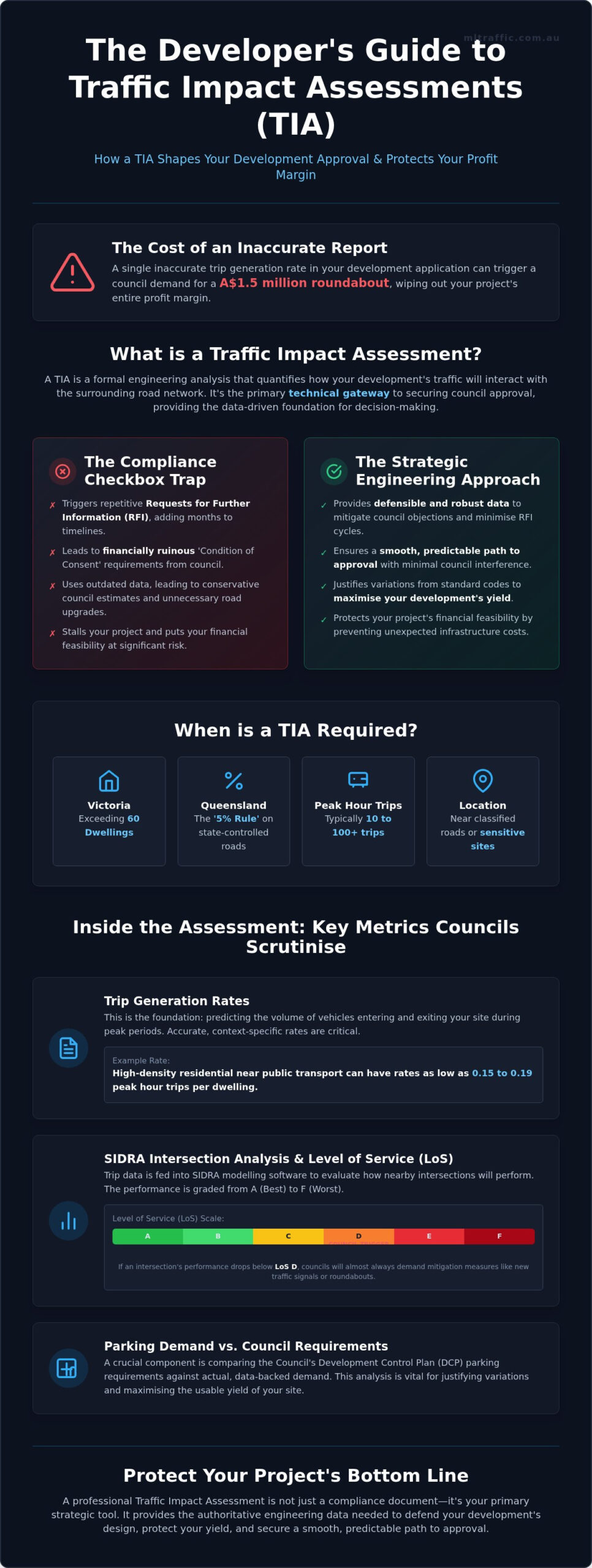
A single inaccurate trip generation rate in your development application can trigger a council demand for a A$1.5 million roundabout that instantly wipes out your project’s profit margin. Many developers treat the Traffic Impact Assessment as a routine compliance checkbox; however, this report is actually the primary mechanism that dictates your long-term infrastructure obligations. Understanding how traffic impact assessments influence development approval is essential for any project manager who wants to avoid unexpected council conditions and expensive road upgrades. It’s the difference between a project that secures a timely approval and one that is stalled by repetitive RFI cycles or technical objections.
You’re likely familiar with the frustration of delays caused by traffic objections or inaccurate data that hurts your project’s feasibility. This article explains how a professional TIA makes or breaks your application and how to use engineering data to protect your interests. We’ll examine the specific triggers for state-based referrals, the impact of post-COVID work patterns on trip generation, and the strategies for compliant car park designs that maximise yield. You will learn how to leverage authoritative traffic modelling to ensure a smooth, predictable path to approval with minimal council interference.
Key Takeaways
- Understand the fundamental role of a Traffic Impact Assessment (TIA) as the primary engineering gateway for securing development approval in Australia.
- Discover how traffic impact assessments influence development approval by establishing the technical evidence needed to mitigate council objections and minimise RFI cycles.
- Identify the critical technical components, such as SIDRA intersection analysis and trip generation rates, that dictate your project’s infrastructure obligations.
- Learn to navigate state-specific regulatory frameworks and referral triggers to avoid unexpected conditions of consent or expensive road upgrades.
- Protect your project’s financial feasibility by utilising senior leadership involvement and accurate engineering data to defend your development’s yield and access design.
The Strategic Role of Traffic Impact Assessments in the DA Process
A Traffic Impact Assessment (TIA) is a formal engineering analysis that quantifies how development-generated traffic will interact with the surrounding road network. It’s the primary document councils use to determine if existing road capacity can support a proposal. For most medium-to-large Australian developments, the TIA is the “gateway” report; without it, the Statement of Environmental Effects (SEE) lacks the technical weight needed to justify a project’s impact on public infrastructure. State planning acts mandate these reports to ensure public safety and network efficiency. These assessments are built on established transportation planning principles and the Austroads Guide to Traffic Management, providing a data-driven foundation for council decision-making.
Understanding how traffic impact assessments influence development approval is vital for any developer navigating the Australian regulatory landscape. Accurate modelling ensures that your project is judged on its actual merits rather than conservative council estimates.
To better understand the technical scope of this analysis, watch this helpful video:
When is a TIA Triggered for a Development?
Specific thresholds for TIAs vary significantly across states. In Victoria, Clause 66.02 of the Victoria Planning Provisions mandates a referral for residential developments exceeding 60 dwellings. In Queensland, the “5% rule” often applies, where an assessment is required if a development adds more than 5% to any critical intersection movement on a state-controlled road. Peak-hour trip generation remains the most common trigger, with thresholds typically ranging from 10 to 100 trips. Proximity to classified roads or sensitive land uses-such as childcare centres, regional shopping centres, and industrial hubs-automatically necessitates traffic engineering input to manage safety and access.
The Consequences of a Poorly Scoped Traffic Report
A superficial traffic report is often worse than no report at all. If your submission uses outdated trip rates or ignores the cumulative impact of nearby developments, the council will issue a Request for Further Information (RFI). This creates a bottleneck in the DA process, often adding months to the timeline. Beyond delays, inadequate modelling can lead to “Condition of Consent” requirements that are financially ruinous. A strategic engineering approach identifies these risks early. Our traffic assessment services ensure that the data presented is defensible and robust, preventing the “box-ticking” trap that often leads to council-mandated road upgrades costing hundreds of thousands of dollars.
Key Technical Components That Dictate Council Approval
Council assessors scrutinise specific technical metrics to determine site suitability. Trip generation rates are the foundation; engineers use these to predict vehicle volumes during peak periods. For instance, high-density residential developments near public transport might use rates as low as 0.15 to 0.19 peak hour trips per dwelling. These figures feed into SIDRA modelling to evaluate intersection Level of Service (LoS). If an intersection drops below LoS D, councils often demand mitigation measures. This technical scrutiny is precisely how traffic impact assessments influence development approval by defining the boundary between a feasible project and one burdened by excessive infrastructure costs.
Parking demand is equally critical. We compare Council Development Control Plan (DCP) requirements against actual demand data to justify variations. This is often necessary when statutory rates conflict with modern transport trends. Referencing documents like Queensland’s official TIA guide ensures that the methodology aligns with state-specific expectations for safety and network performance. Our engineers also evaluate sight distances and driveway ramp grades to ensure every vehicle movement is safe and compliant with local regulations.
Vehicle Swept Path Analysis: The Manoeuvring Deal-Breaker
A swept path analysis is a digital simulation of a vehicle’s turning circle. Councils strictly enforce “forward-gear” entry and exit for all developments to maintain road safety. We use AutoTURN software to verify that waste collection vehicles and delivery trucks can navigate the site without hitting kerbs or requiring complex multi-point turns. If a site layout fails this test, the DA is likely to be refused or require a significant redesign that could compromise your floor space.
Compliance with AS 2890.1 and AS 2890.2
Adherence to AS 2890.1 is non-negotiable for off-street car parking. This standard dictates parking space dimensions, aisle widths, and driveway ramp grades. Even a minor deviation can reduce your total yield or create safety hazards. For industrial projects, AS 2890.2 governs heavy vehicle loading areas, ensuring that B-doubles or service vehicles have sufficient clearance. Ensuring your plans meet these national standards from the outset is the most effective way to protect your project’s feasibility. For expert assistance with these technical requirements, you can speak directly with our senior engineers to review your site layout.
Impact of New Infrastructure on Development Feasibility
The outcomes of a Traffic Impact Assessment are eventually codified as “Conditions of Consent” within a development approval. These conditions often mandate physical infrastructure upgrades that can fundamentally alter a project’s financial viability. For instance, if a TIA identifies that a development’s traffic volume will degrade a local intersection’s performance, the developer may be required to fund signalisation or a new roundabout. Current industry benchmarks indicate that signalising an intersection can cost between A$500,000 and A$1,500,000, while a single-lane roundabout may range from A$1.5 million to A$4 million. Identifying these requirements early is exactly how traffic impact assessments influence development approval and the ultimate ROI of a project.
A strategic traffic engineer prevents the “over-engineering” trap. Councils often default to conservative, worst-case scenarios that lead to unnecessary infrastructure demands. By providing precise, site-specific data, we ensure that mitigation requirements are both necessary and proportionate to the actual impact created by the development. This technical evidence is also a powerful tool for negotiating Section 7.11 (or equivalent) infrastructure contributions, potentially saving hundreds of thousands in developer levies.
Mitigation Measures and Their Commercial Impact
Common mitigation strategies include intersection upgrades, signalised pedestrian crossings, and traffic calming measures. Beyond the direct construction costs, these requirements often demand land dedication for road widening. This reduces the buildable area of your site, directly lowering the potential yield and overall project value. We apply the “proportionality” rule during negotiations; a developer should only be responsible for the infrastructure demand their specific project generates, not for rectifying pre-existing network deficiencies. Ensuring this distinction is maintained is critical for protecting project margins during the DA process.
Using Traffic Data to Protect Project Margins
Generic council trip generation rates are frequently higher than actual observed data. Conducting independent traffic surveys allows us to challenge these assumptions and reduce the perceived impact on the road network. This data-driven approach is also essential when addressing parking requirements. A Car Parking Demand Assessment can justify a parking shortfall by demonstrating that actual usage patterns don’t require the statutory minimums. This often allows for a higher residential or commercial yield within the same building footprint. Engaging traffic engineering expertise during the initial feasibility stage prevents the discovery of project-killing infrastructure costs after significant capital has already been committed.
Navigating Regulatory Frameworks Across Australian States
The Austroads Guide to Traffic Management Part 12 provides the national methodological baseline for transport planning in Australia. However, developers must navigate a complex patchwork of state-specific regulations that often supersede national guidance. For instance, the Transport for NSW Guide to Transport Impact Assessment (TS 00085 v1.1, November 2024) and the Queensland TMR Guide to Traffic Impact Assessment (2018) set the primary technical standards for those respective states. This regulatory environment is exactly how traffic impact assessments influence development approval; a report that fails to address state-specific triggers or local Development Control Plan (DCP) requirements will be rejected regardless of its general engineering merit.
Assessments scale in complexity based on the projected impact. In Western Australia, a three-tier system dictates that developments generating 10 to 100 peak-hour trips require a basic Transport Impact Statement, while those exceeding 100 trips must submit a full TIA. In the Australian Capital Territory, new guidelines effective from 1 July 2025 use a 10-trip peak-period threshold to trigger formal assessment. Understanding these local nuances ensures the correct level of technical detail is provided from the outset.
The Referral Process: When State Authorities Step In
Statutory referrals to state agencies like TfNSW, Victoria’s Department of Transport and Planning (DTP), or Queensland’s TMR are mandatory when a project meets specific criteria. In Victoria, Clause 66.02 mandates referral for residential developments exceeding 60 dwellings. In NSW, Schedule 3 of the SEPP (Transport and Infrastructure) 2021 triggers referral based on proximity to classified roads. Conflicting requirements are common; a local council may prioritise streetscape amenity while a state agency demands wider lanes for arterial flow. An experienced traffic engineer manages these multi-agency negotiations by providing technical data that satisfies both authorities without compromising the project’s buildable area.
The Importance of Pre-Lodgement Consultation
Engaging with council traffic planners before formal submission is a critical step in the DA process. A pre-lodgement scoping meeting allows us to agree on trip generation rates and modelling parameters before the report is finalised. This is particularly vital in jurisdictions with recent policy updates, such as Victoria’s Amendment VC277 (December 2025), which reformed car parking requirements. Early agreement on these technical inputs prevents disputes during the assessment phase and significantly reduces the likelihood of a council issuing a Request for Further Information (RFI). If you are preparing a submission and need to confirm state-specific referral triggers, contact our senior principals for a preliminary regulatory review of your site.
Optimising Your DA Outcome with Expert Traffic Engineering
Expert traffic engineering is the final bridge between a technical document and a commercially successful outcome. A consultant acts as a strategic advocate who translates raw data into a persuasive narrative for council assessors. Direct access to leadership is a critical factor in this process. When a senior principal with over 15 years of experience conducts negotiations with council traffic planners, the discussion is grounded in technical authority and a comprehensive understanding of bureaucratic requirements. This level of expertise is exactly how traffic impact assessments influence development approval; it ensures that every modelling assumption is defensible and that mitigation requirements don’t exceed what’s strictly necessary.
Personnel continuity is equally vital for maintaining report integrity throughout the assessment cycle. We ensure the same expert who initiates the project performs the technical work, preventing the loss of context that often occurs in larger, impersonal firms. A high-quality TIA doesn’t just meet a statutory requirement; it de-risks the project by pre-emptively addressing potential objections before they become formal RFIs.
Choosing the Right Traffic Consultant for Your Project
Selecting a consultant requires verifying technical proficiency in industry-standard software like SIDRA and AutoTURN. You should prioritise firms that offer senior principal involvement in every project rather than delegating the work to junior staff. A diverse range of project experience, from childcare centres to regional shopping centres and industrial hubs, is essential for navigating the niche requirements of different land uses. This breadth of knowledge allows the consultant to apply proven strategies from similar project environments to your specific site, ensuring a smoother path to approval.
Next Steps: Securing Your Traffic Impact Assessment
To initiate a TIA, your traffic engineer requires a complete set of architectural site plans and precise land-use details. Integrating traffic findings into your site layout early is the most effective way to maximise car park yield and ensure compliant vehicle access. This proactive approach prevents costly redesigns after the DA has been lodged. If you require a compliant, feasibility-focused TIA that protects your project’s yield and minimises council delays, contact ML Traffic Engineers Australia to discuss your development requirements directly with a senior principal.
Securing Your Project’s Future with Strategic Traffic Engineering
A Traffic Impact Assessment is more than a technical requirement; it’s a strategic tool that determines the financial viability of your development. By providing precise data on trip generation and intersection performance, you can prevent the over-engineering of infrastructure and negotiate fairer council contributions. Understanding how traffic impact assessments influence development approval allows you to navigate state-specific referral triggers and local DCP requirements with confidence.
Protect your project yield and minimise RFI cycles by partnering with experts who understand the nuances of the Australian planning system. We offer over 15 years of traffic engineering experience and provide direct access to senior principals on every project. Our national expertise ensures your application remains compliant with both Australian Standards and specific council mandates. We handle the technical complexities so you can focus on the broader project delivery.
Don’t leave your DA approval to chance. Get a professional Traffic Impact Assessment for your DA today and ensure your project stays on track. We look forward to helping you achieve a successful development outcome.
Frequently Asked Questions
How long does a Traffic Impact Assessment typically take to complete?
A straightforward assessment typically takes 1 to 2 weeks to complete. Comprehensive TIA reports for larger projects or those requiring extensive intersection modelling can take between 4 and 6 weeks. The exact timeframe depends on the complexity of the development and the responsiveness of relevant road authorities during the initial scoping phase.
Will a TIA automatically trigger expensive road upgrades for my development?
No, a TIA only triggers infrastructure upgrades if the engineering analysis demonstrates that your development degrades the existing road network performance below acceptable levels. Expert traffic engineering ensures that any required mitigation is proportionate to your site’s specific impact. This technical process is exactly how traffic impact assessments influence development approval by establishing a clear, data-driven boundary for your infrastructure obligations.
Can I use a generic traffic report for my Development Application?
No, Australian councils require a site-specific analysis that addresses the unique constraints and trip generation rates of your proposal. Generic reports fail to account for local intersection performance or specific compliance with AS 2890 standards. A tailored TIA is necessary to defend your project’s feasibility and to provide the technical evidence required for a successful Statement of Environmental Effects.
What is the difference between a Traffic Statement and a full Traffic Impact Assessment?
A Traffic Statement is a simplified report used for low-impact developments that fall below specific peak-hour trip thresholds. In contrast, a full TIA is a comprehensive engineering analysis required for larger projects that significantly affect the road network. The TIA includes detailed intersection modelling, such as SIDRA analysis, and long-term operational impact studies that a basic statement does not provide.
How does a TIA influence the amount of car parking I am required to build?
A TIA utilises a Car Parking Demand Assessment to compare statutory council rates against actual observed demand data. If the data demonstrates that your development requires fewer spaces than the local Development Control Plan mandates, the TIA provides the technical justification for a parking variation. This evidence allows you to maximise your site’s yield while remaining compliant with AS 2890.1 design standards.
What happens if Council traffic planners object to the findings of my TIA?
If council traffic planners object, they will typically issue a Request for Further Information (RFI) to clarify specific modelling assumptions. Your traffic consultant must then provide additional technical data or revised modelling to defend the original findings. Having direct access to senior principals during this phase is critical, as they can negotiate directly with council officers to resolve technical disputes and prevent project-killing delays.
Do I need a new TIA if I change the land use of my proposed development?
Yes, changing land use alters the trip generation rates and peak-hour patterns of your development. Transitioning from an office park to a childcare centre, for example, significantly changes the volume and timing of vehicle movements. A revised TIA is necessary to ensure the surrounding road network can accommodate the new traffic profile and to verify that all access designs remain compliant with updated safety requirements.
Is a Swept Path Analysis always included in a standard TIA report?
Swept Path Analysis is a standard component of most TIA reports because it verifies that waste and service vehicles can enter and exit the site in a forward gear. This analysis uses AutoTURN software to ensure compliance with AS 2890.2 for heavy vehicles. It is a critical factor in how traffic impact assessments influence development approval, as councils will refuse any site layout that cannot accommodate necessary vehicle manoeuvres safely.

Disclaimer
The content on www.mltraffic.com.au, including all technical articles, guides, and resources, is provided for general informational and educational purposes only. It is not intended to constitute professional advice in traffic engineering, transportation planning, development approvals, or any other technical or legal field.
While ML Traffic Engineers makes every reasonable effort to ensure the accuracy, completeness, and timeliness of the information published, we do not provide any warranties or representations (express or implied) regarding its reliability, suitability, or availability for any particular purpose. Any reliance you place on the content is strictly at your own risk.
In no event shall ML Traffic Engineers, its directors, employees, authors, or affiliates be liable for any direct, indirect, incidental, special, consequential, or punitive damages (including, without limitation, loss of profits, data, or business opportunities) arising out of or in connection with the use of, or inability to use, any information provided on this website.
The articles and guides on this site are not a substitute for engaging a qualified, registered professional traffic engineer (such as an NPER or RPEQ engineer) to assess your specific project requirements. For tailored advice, compliance assessments, or traffic engineering services, please contact a competent professional.
This disclaimer may be updated from time to time without notice. By accessing or using this website, you agree to be bound by the most current version of this disclaimer.
