
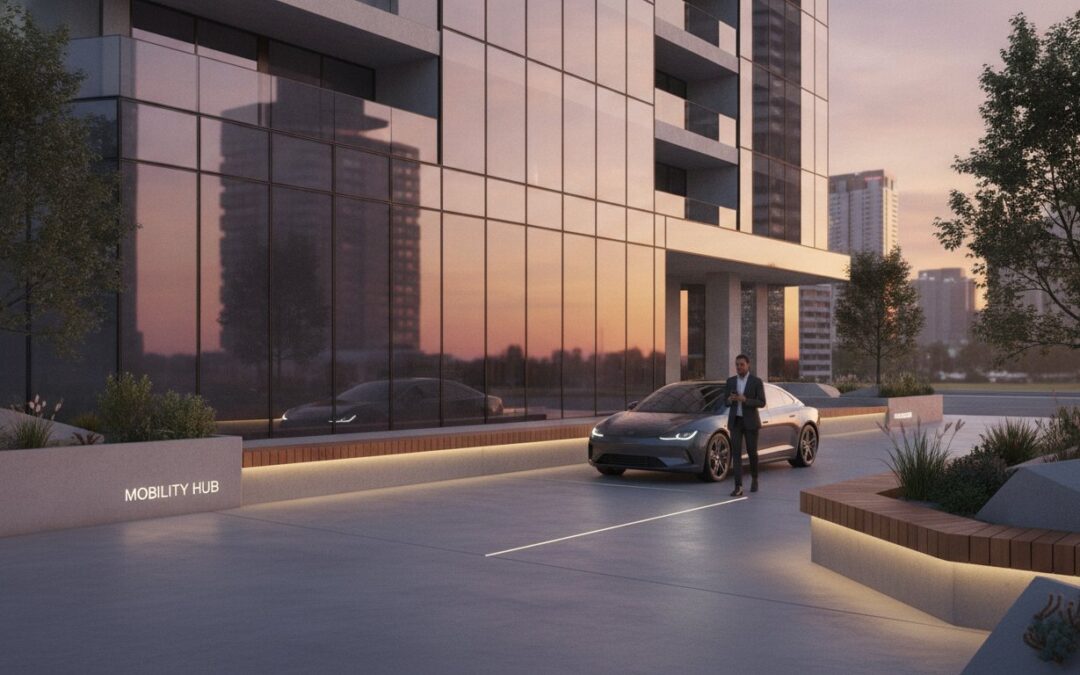
Every basement car parking space you excavate in 2026 could be costing your project upwards of $100,000, yet a significant portion of that infrastructure may be redundant before the first tenant moves in. You’ve likely felt the frustration of designing around rigid Local Environmental Plans (LEPs) that fail to account for how people actually move through our cities. It’s a common struggle to balance high construction costs with Council requirements that seem stuck in the past.
Understanding the impact of ride-sharing on car park demand is now critical for any developer looking to optimise their yield and reduce unnecessary expenditure. This guide demonstrates how ride-sharing is reshaping parking requirements and how you can leverage these shifting trends for successful development applications. We’ll explore the transition of car parks into active transit hubs, the role of professional Car Parking Demand Assessments in justifying shortfalls, and the technical evidence needed to satisfy regulatory authorities while protecting your project’s bottom line.
Key Takeaways
- Understand the transition from private vehicle ownership to Mobility as a Service (MaaS) and how this shift reduces long-term car storage requirements in urban developments.
- Learn how to quantify the impact of ride-sharing on car park demand by comparing outdated LEP rates with real-world data from ride-share heavy precincts.
- Discover how a bespoke Car Parking Demand Assessment can justify parking shortfalls to Council, potentially saving millions in basement excavation and construction costs.
- Identify design strategies for 2026 that prioritise Pick-Up and Drop-Off (PUDO) zones and kerbside management while maintaining strict compliance with AS 2890.1.
- Gain insights into using Traffic Impact Assessments (TIAs) and Green Travel Plans as technical evidence to secure DA approvals despite parking rate deviations.
The Rise of Ride-Sharing and the Australian Car Park
Ride-sharing, facilitated by Transportation Network Companies (TNCs) such as Uber and Ola, has evolved from a niche convenience into a fundamental pillar of Australian urban mobility. This shift has fundamentally altered the functional requirements of modern developments. The impact of ride-sharing on car park demand is no longer theoretical; it’s a measurable trend that influences site feasibility and long-term asset value. Developers who fail to account for these changes risk overcapitalising on expensive basement infrastructure that may soon become redundant.
From Private Ownership to Mobility as a Service (MaaS)
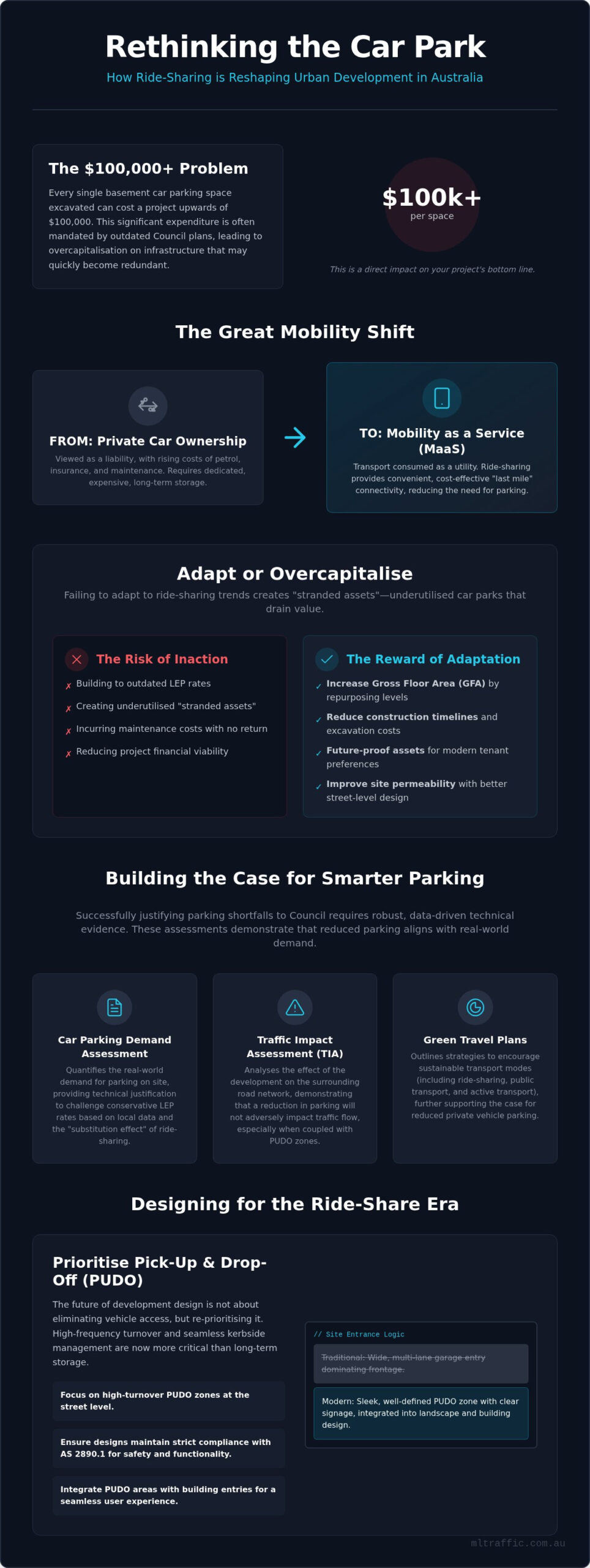
Younger demographics in Australian urban centres increasingly view vehicle ownership as a liability rather than an asset. This psychological shift is driven by the rise of Mobility as a Service (MaaS), where transport is consumed as a utility. Economic factors reinforce this trend. The rising costs of petrol, insurance, and maintenance, combined with high parking fees, often make ride-sharing a more cost-effective alternative to owning a private vehicle.
MaaS provides critical “last mile” connectivity, bridging the gap between high-frequency transit hubs and final destinations. This connectivity reduces the perceived need for a dedicated car space at both residential and commercial endpoints. In high-density precincts, the convenience of on-demand transport often outweighs the utility of a permanent parking bay, leading to a quantifiable drop in peak parking occupancy.
Why Developers Must Adapt Now
The correlation between car park provision and project yield is direct. With basement excavation costs often exceeding $50,000 to $100,000 per space, every unnecessary bay directly reduces the financial viability of a development. Continuing to build to outdated Local Environmental Plan (LEP) rates creates a high risk of “stranded assets”. These are parking levels that remain underutilised, incurring maintenance costs without providing value to occupants.
Adapting to the impact of ride-sharing on car park demand allows developers to:
- Increase Gross Floor Area (GFA): Repurpose parking levels for higher-value uses such as additional residential units or commercial floor space.
- Reduce Construction Timelines: Minimise deep excavation requirements, which often represent the most complex and time-consuming phase of a build.
- Future-Proof Assets: Align project offerings with the preferences of modern tenants who prioritise convenience over vehicle storage.
- Improve Site Permeability: Facilitate better street-level engagement through well-designed drop-off zones rather than expansive garage entries.
Successful development applications in 2026 require a proactive approach. By prioritising ride-share accessibility and kerbside management over traditional long-term storage, developers can create more efficient, robust assets that reflect contemporary transport behaviours.
Quantifying the Impact on Car Park Demand
Traditional parking rates found in Local Environmental Plans (LEPs) frequently mandate fixed ratios that fail to reflect modern usage patterns. The impact of ride-sharing on car park demand has created a measurable gap between statutory requirements and actual site needs. In this context, Parking Demand Elasticity is defined as the degree to which the quantity of parking spaces required fluctuates in response to the availability, cost, and convenience of Transportation Network Companies (TNCs).
Data from urban developments suggests that observed demand is consistently lower than traditional council codes. This is largely due to the “substitution effect”, where ride-sharing services replace the need for a second household vehicle or a dedicated commuter car space. For developers, this provides a technical basis to challenge conservative parking mandates through a formal Car Parking Demand Assessment.
Sector-Specific Demand Reductions
The decline in demand varies across different land-use categories, requiring a nuanced approach to assessment:
- Residential: The “two-car household” is becoming less common in transit-oriented developments. Residents often maintain one vehicle for long-distance travel while relying on ride-sharing for local trips and evening outings.
- Commercial and Office: Flexible work arrangements combined with ride-sharing options have flattened peak-hour parking curves. This reduces the necessity for large-scale, all-day staff parking allocations.
The Economic Case for Parking Reductions
The financial incentives for reducing parking provision are substantial. With the average cost of basement car parking in Australia ranging from $50,000 to $100,000 per space, eliminating an entire basement level can save a project millions in capital expenditure. These savings are not limited to construction costs; they also encompass reduced excavation timelines and lower long-term structural maintenance requirements.
Minimising excavation also improves the environmental profile of a development. Reduced concrete consumption and less soil disturbance contribute to better Green Star ratings. By aligning parking provision with actual demand, developers can optimise project yield while delivering a more sustainable urban outcome.
Navigating Local Council Requirements and TIAs
Local Councils in Australia typically rely on fixed parking rates established in their Local Environmental Plans (LEPs). These rates often ignore the modern impact of ride-sharing on car park demand. To secure a Development Application (DA) approval with a parking shortfall, developers must provide a robust, evidence-based argument. A Traffic Impact Assessment (TIA) serves as the technical foundation for this justification. It demonstrates how the proposed development will function without the full complement of statutory parking spaces.
Councils are increasingly receptive to Green Travel Plans as a substitute for hard parking numbers. These plans outline specific measures to reduce private car reliance, such as dedicated ride-share bays and transport credits. However, generic industry statistics regarding Uber or Ola usage are rarely sufficient. Every DA requires site-specific data to prove the local impact of ride-sharing on car park demand. A bespoke Car Parking Demand Assessment provides this data by analysing local transport infrastructure, demographic trends, and observed parking occupancy in similar developments.
Justifying a Parking Shortfall
A “first principles” assessment is the most effective way to counter rigid LEP parking rates. This involves calculating demand based on the unique characteristics of the site rather than applying a blanket ratio. Key factors include proximity to high-frequency public transport and the site’s location within ride-share hotspots. Technical reports must prove that the combination of ride-sharing availability and public transport accessibility will genuinely lower car ownership levels within the building.
Addressing Council concerns regarding “overspill” is critical. Authorities often fear that a parking shortfall will lead to residents or visitors parking illegally in surrounding residential streets. Meticulous data collection ensures these concerns are addressed with technical certainty, demonstrating that the development will not adversely affect the local road network.
The Importance of Professional Traffic Engineering
Securing approval for a parking reduction requires more than just data; it requires professional weight. A qualified Traffic Engineer provides the technical credibility needed to negotiate with Council planners. Their expertise ensures that all assessments comply with relevant Australian Standards and state-based planning guidelines. Expert witness experience is vital if a DA is challenged at a planning tribunal.
Senior principals at ML Traffic Engineers remain involved in every project, providing direct accountability and seasoned expertise during complex negotiations. This hands-on approach ensures that the technical evidence presented is both meticulous and defensible under scrutiny. By engaging experts who understand the bureaucratic requirements of the field, developers can navigate the planning process with confidence and reliability.
Designing for the Ride-Share Era: AS 2890.1 and Beyond
Designing for the ride-share era requires a fundamental shift away from the static storage models of the past. The impact of ride-sharing on car park demand has transformed the modern basement from a quiet vehicle warehouse into a high-turnover transit zone. This transition makes kerbside management and Pick-Up and Drop-Off (PUDO) zones the new priority for developers and architects. While the total number of spaces may decrease, the complexity of the remaining infrastructure increases.
Safety and efficiency are paramount in these high-activity areas. Every design must maintain strict compliance with AS 2890.1 to ensure regulatory approval and operational safety. Integrating a detailed Swept Path Analysis is essential to prove that ride-share vehicles can manoeuvre safely within the site without obstructing resident traffic or creating bottlenecks at the entry point.
Implementing Pick-Up and Drop-Off (PUDO) Zones
PUDO zones must be designed for high turnover rather than long-term stays. This requires specific geometry to allow for safe door opening and passenger movement. Ride-share bays typically require more generous width and length than standard residential spots to accommodate various vehicle types and luggage handling. It’s critical to separate this ride-share traffic from primary resident or visitor parking areas. Mixing these flows often leads to congestion and safety risks during peak periods.
Using AutoTURN for swept path analysis allows engineers to simulate the movements of common ride-share vehicle types. This technical validation ensures that vehicles can enter, turn, and exit the PUDO zone in a single continuous motion. This prevents the “three-point turn” scenarios that frequently cause basement gridlock.
Future-Proofing Car Park Infrastructure
Developers should consider the long-term lifecycle of their parking assets. Designing parking levels with flat floors and higher floor-to-ceiling clearances allows for easier conversion to commercial or residential use if the impact of ride-sharing on car park demand continues to accelerate. This strategy protects the asset’s value against future shifts in transport technology.
Pedestrian safety remains a significant concern in high-turnover zones. Developers must incorporate designated, well-lit waiting areas for passengers. These zones should provide clear, protected pathways from the PUDO bay to the building entrance, minimising the risk of pedestrian-vehicle conflict. Additionally, incorporating EV charging infrastructure within ride-share bays caters to the growing fleet of electric TNC vehicles, making the development a preferred destination for drivers and passengers alike.
If you need to optimise your basement layout for modern transit requirements, contact the experts at ML Traffic Engineers for a comprehensive design review.
Strategic Parking Demand Assessments for DA Approval
Applying generic council parking codes to modern developments is a high-risk strategy. These codes often lag behind current transport behaviours by a decade or more. A bespoke approach is necessary to accurately account for the impact of ride-sharing on car park demand. Generic data fails to capture site-specific nuances such as local demographics and proximity to high-frequency transit. ML Traffic Engineers specialise in bridging the gap between conservative regulatory requirements and contemporary mobility data. Our assessments provide the technical weight needed to justify parking reductions and optimise site yield.
Our firm brings over 15 years of consultancy experience to every project. We understand the bureaucratic requirements of Local Councils and planning tribunals across Australia. By providing meticulous, fact-based assessments, we build confidence with regulatory authorities. This professional assurance is vital when seeking to deviate from standard Local Environmental Plan (LEP) requirements.
Early Engagement: The Key to Site Efficiency
Engaging a traffic consultant early in the design phase is a critical step for project efficiency. Early input prevents the need for expensive redesigns during the Request for Information (RFI) stage of a Development Application. When traffic constraints are identified during the initial concept, architects can better organise the basement layout and PUDO zones. This proactive approach ensures that the car park design remains compliant with AS 2890.1 from the outset. It also allows for more accurate cost-benefit analysis regarding excavation depths.
A key advantage of working with ML Traffic Engineers is our personnel continuity promise. The same senior principal who initiates the client relationship performs the technical work. This ensures accountability and deep-seated expertise throughout the project lifecycle. You won’t be passed off to junior staff once the contract is signed. We provide a direct line to leadership for every client. For a preliminary assessment of your site’s potential for parking reductions, contact ML Traffic Engineers today.
Closing Thoughts on the Future of Australian Parking
The impact of ride-sharing on car park demand represents a permanent shift in the Australian development landscape. The transition from private vehicle storage to active transit hubs is accelerating. Developers who continue to build excessive parking levels risk creating underutilised assets that drain project capital. The financial burden of redundant basement levels can no longer be ignored in high-density urban corridors.
Optimising your development for 2026 and beyond requires a data-driven strategy. By leveraging professional Car Parking Demand Assessments, you can reduce construction costs and improve project feasibility. Don’t let outdated council codes dictate your project’s bottom line. Trust seasoned experts who understand the technicalities and bureaucratic requirements of the field to deliver a result that reflects modern transport reality. Successful development applications rely on technical certainty, and that is exactly what we provide.
Optimising Project Yield in the Ride-Share Era
The impact of ride-sharing on car park demand is a permanent shift that requires developers to move beyond static parking ratios. By prioritising Pick-Up and Drop-Off (PUDO) zones and leveraging site-specific data, you can avoid the high costs of redundant basement excavation. This strategic approach improves project yield and ensures your development remains relevant to modern transport behaviours.
ML Traffic Engineers provides the technical certainty needed to secure DA approvals under these shifting conditions. With over 15 years of specialist traffic engineering experience, we ensure every design maintains strict AS 2890.1 compliance while advocating for realistic parking reductions. Our service model guarantees direct senior principal involvement in every report, providing reliable expertise and accountability. Don’t let outdated council codes compromise your project’s financial viability. Take control of your site efficiency by engaging experts who understand the technicalities and bureaucratic requirements of Australian planning.
Get an expert Car Parking Demand Assessment for your next project and start optimising your development for 2026 and beyond.
Frequently Asked Questions
How much can ride-sharing reduce parking demand in residential developments?
Ride-sharing availability often leads to a measurable reduction in car ownership, particularly for second vehicles in multi-residential settings. While specific outcomes depend on site location and transit proximity, bespoke assessments frequently justify reductions of 10% to 20% below statutory LEP rates. The impact of ride-sharing on car park demand is most pronounced in high-density urban corridors where residents prioritise mobility as a service over the high cost of vehicle maintenance.
Will Australian Councils accept ride-sharing as a reason for parking shortfalls?
Yes, many Australian Councils now accept ride-sharing data as valid technical evidence when presented within a formal Car Parking Demand Assessment. Success depends on providing site-specific data rather than generic industry claims. Authorities look for a technical nexus between ride-share accessibility and reduced private vehicle reliance. Demonstrating this connection through a professional Traffic Impact Assessment is essential to satisfy planning requirements and overcome conservative council parking mandates.
What is a PUDO zone and how do I design one?
A PUDO (Pick-Up and Drop-Off) zone is a dedicated area designed for high-turnover vehicle activity rather than long-term storage. Designing one requires specific geometry to allow ride-share vehicles to enter and exit in a single forward motion. You must prioritise kerbside management and pedestrian safety. Effective designs use swept path analysis to ensure common ride-share vehicle types can manoeuvre safely without obstructing primary traffic flows or basement access points.
Do I still need to comply with AS 2890.1 if I am reducing my parking spaces?
Compliance with AS 2890.1 remains mandatory for all remaining parking spaces and access ways. Reducing the total quantity of spaces does not exempt a developer from adherence to national regulatory standards for bay dimensions, aisle widths, or ramp grades. In fact, high-turnover zones require even stricter design oversight to ensure operational safety. Every parking layout must be certified by a qualified traffic engineer to meet these essential Australian Standards.
What data is required to prove ride-sharing impact in a Traffic Impact Assessment?
Proof requires a combination of local demographic analysis, proximity to high-frequency transit, and observed parking occupancy data from similar developments. You must demonstrate that the site is located within an active ride-share hotspot. A professional Traffic Impact Assessment will include a first-principles analysis of the specific land use. This technical evidence proves that the availability of on-demand transport directly correlates with a lower requirement for permanent vehicle storage.
Can I repurpose existing car park space if demand drops after construction?
Repurposing existing space is possible but requires careful structural planning during the initial design phase. If you anticipate the impact of ride-sharing on car park demand will increase over time, you should design parking levels with flat floors and sufficient floor-to-ceiling heights. This allows for future conversion into commercial or storage areas. Without these specific design considerations, converting deep basement levels into high-value floor area becomes structurally and financially prohibitive.
How does ride-sharing impact the need for visitor parking?
Ride-sharing significantly reduces the requirement for long-stay visitor parking by providing a convenient alternative for guests. Many visitors now prefer ride-share services to avoid the difficulty of finding on-site or street parking. This shift allows developers to reallocate visitor spaces into PUDO bays or additional resident storage. Technical assessments often justify visitor parking reductions by proving that ride-share turnover provides higher utility than static visitor bays in transit-oriented developments.
What is the cost benefit of reducing one level of basement parking?
Eliminating a single level of basement parking can save between $50,000 and $100,000 per car space in construction costs. On a typical high-density project, this often translates to millions of dollars in direct savings. Beyond capital expenditure, you also reduce excavation timelines and lower long-term maintenance liabilities. These savings can be reinvested into higher-quality finishes or additional Gross Floor Area, significantly improving the overall financial feasibility of the development.

Disclaimer
The content on www.mltraffic.com.au, including all technical articles, guides, and resources, is provided for general informational and educational purposes only. It is not intended to constitute professional advice in traffic engineering, transportation planning, development approvals, or any other technical or legal field.
While ML Traffic Engineers makes every reasonable effort to ensure the accuracy, completeness, and timeliness of the information published, we do not provide any warranties or representations (express or implied) regarding its reliability, suitability, or availability for any particular purpose. Any reliance you place on the content is strictly at your own risk.
In no event shall ML Traffic Engineers, its directors, employees, authors, or affiliates be liable for any direct, indirect, incidental, special, consequential, or punitive damages (including, without limitation, loss of profits, data, or business opportunities) arising out of or in connection with the use of, or inability to use, any information provided on this website.
The articles and guides on this site are not a substitute for engaging a qualified, registered professional traffic engineer (such as an NPER or RPEQ engineer) to assess your specific project requirements. For tailored advice, compliance assessments, or traffic engineering services, please contact a competent professional.
This disclaimer may be updated from time to time without notice. By accessing or using this website, you agree to be bound by the most current version of this disclaimer.
