

Is your current traffic report a defensible asset, or is it a technical liability waiting to be dismantled by a council officer? You’ve likely experienced the frustration of a project stalling because of inconsistent data or a sudden objection to your Traffic Impact Assessment. For developers in 2026, an independent peer review of a third-party traffic report is no longer a luxury. It’s a critical step to ensure regulatory compliance and secure project approvals before a single brick is laid.
You already know that even a minor oversight in trip generation rates or sight distance assessments leads to costly RFI cycles and deferred approvals. We’ll show you how a professional audit identifies these technical gaps and validates your data against the latest standards, such as the ITE Trip Generation Manual 12th Edition. This process turns a vulnerable document into a robust, defensible asset.
This guide details how a validated report provides the clear evidence needed to counter municipal objections and mitigate risks for large-scale developments. You’ll learn how to streamline your path to approval by ensuring your traffic data is accurate, current, and bulletproof.
Key Takeaways
- Understand the technical distinction between internal checks and a formal independent peer review of a third-party traffic report to ensure data integrity.
- Validate trip generation assumptions and confirm strict compliance with AS 2890.1 standards to eliminate vulnerabilities in your development application.
- Identify the difference between minor observational findings and fatal flaws in traffic data before they lead to project refusal or costly delays.
- Leverage senior-led audit results to provide councils with the technical evidence and confidence required to approve high-impact developments.
What is an Independent Peer Review of a Third-Party Traffic Report?
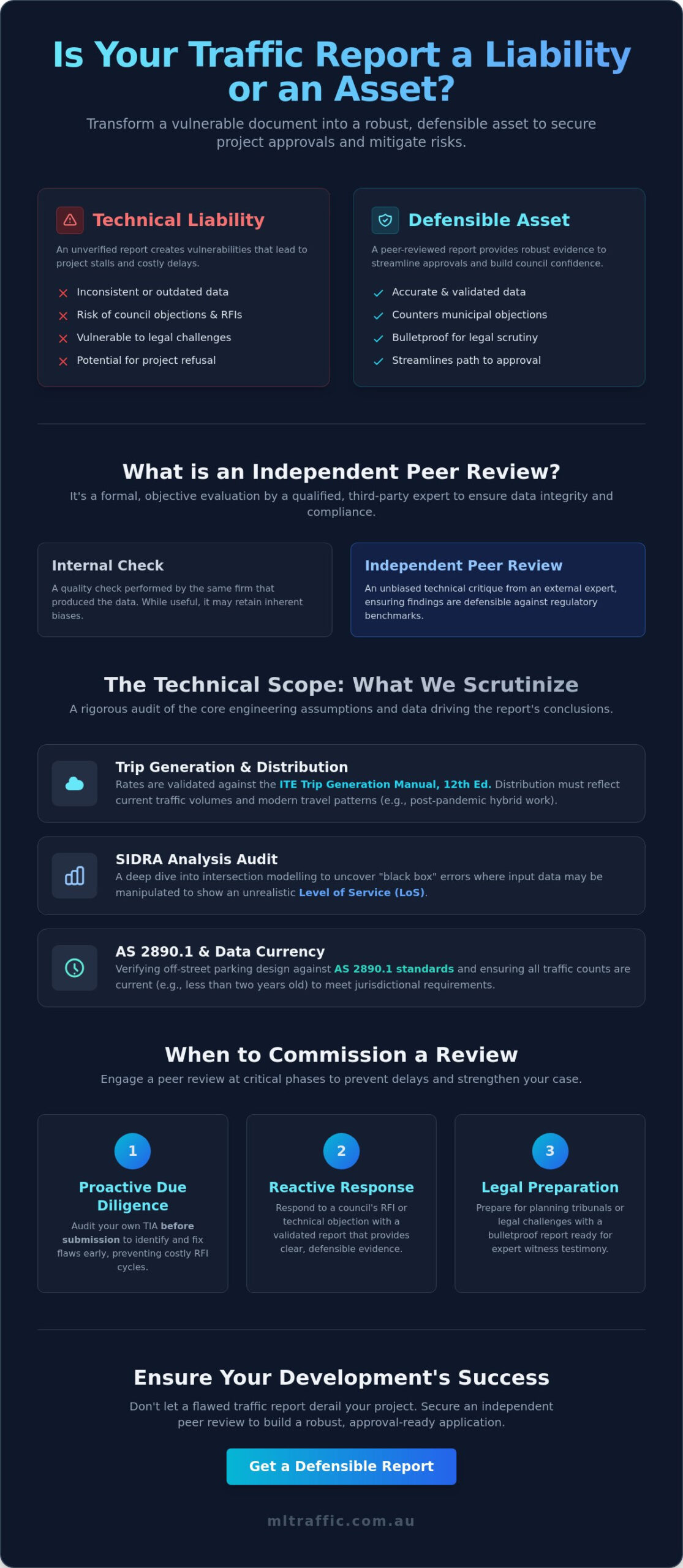
An What is an Independent Peer Review in the context of transport planning is a formal, objective evaluation of a Traffic Impact Assessment (TIA) by a qualified expert who was not involved in the original report’s preparation. While an internal audit is a quality check performed by the same firm that produced the data, a truly independent review offers an unbiased technical critique. This process ensures that the findings are defensible and free from the inherent biases of the primary consultancy.
The independent reviewer acts as a technical gatekeeper. They scrutinize the methodology, data sets, and conclusions against current regulatory benchmarks. This includes checking for compliance with standards like AS 2890.1 or the ITE Trip Generation Manual, 12th Edition. Their goal is to identify technical vulnerabilities before they become grounds for a Development Application (DA) refusal.
To better understand how this process functions in a legal and technical capacity, watch this helpful video:
The Objective of Independent Verification
The primary objective is to verify that the third-party traffic report aligns with national standards and local council requirements. This involves a meticulous check of data collection methods. For example, the reviewer confirms if traffic counts are current, as many jurisdictions, such as Vancouver, Washington, now reject counts older than two years. They ensure that the trip generation rates are robust and that the distribution assumptions reflect actual modern travel patterns, including post-pandemic hybrid work trends. This provides a layer of professional accountability that is essential for high-stakes, large-scale developments where small errors lead to significant financial loss.
When to Commission a Traffic Report Review
Developers typically trigger an independent peer review of a third-party traffic report during three key phases of the DA process. First, proactive due diligence allows developers to audit their own TIA before submission, preventing costly delays. Second, a review is often a reactive response to a council’s Request for Information (RFI) or specific technical objections. Finally, a peer review is critical when preparing for expert witness testimony in planning tribunals or legal challenges. In these scenarios, having a validated, bulletproof report is the difference between project approval and a multi-million dollar stall. You can view our full range of technical traffic services to see how these assessments integrate into broader project requirements.
The Technical Scope: What an Independent Traffic Peer Review Evaluates
An independent peer review of a third-party traffic report is a rigorous technical audit. It goes beyond surface-level proofreading to examine the underlying engineering assumptions that drive a project’s impact calculations. This level of scrutiny is often required for large-scale infrastructure to ensure public safety and long-term resilience. Even in specialized jurisdictions, the U.S. Code for Independent Peer Review highlights the global professional standard for objective verification in complex engineering assessments.
The review process scrutinizes several critical technical areas:
- Trip Generation and Distribution: Reviewers validate that the trip rates used align with the ITE Trip Generation Manual, 12th Edition. They ensure that the distribution of these trips across the local road network accurately reflects current traffic volumes and seasonal variations.
- SIDRA Analysis Audit: This involves a deep dive into intersection modelling. The reviewer checks for “black box” errors where input data might be manipulated to show a better Level of Service (LoS) than is realistic.
- AS 2890.1 Compliance: Every aspect of off-street car parking is checked against Australian Standards. This includes ramp grades, aisle widths, and column clearances.
- Sight Distance Assessments: Safety is paramount. The review confirms that the Sight Distance Assessment meets the requirements of both Austroads and local planning schemes to prevent future liability.
If you’re unsure if your current documentation meets these rigorous standards, you can contact our senior engineers for a preliminary discussion on your project’s specific requirements.
Reviewing Swept Path Analysis and Maneuverability
A common point of failure in development applications is inadequate vehicle maneuverability. The peer review verifies that AutoTURN diagrams use real-world vehicle dimensions rather than default settings. It’s vital to check compliance for heavy vehicle access and waste collection movements. For a deeper look at these requirements, refer to our swept path analysis guide. This ensures that the proposed design doesn’t just look good on paper but functions safely on-site.
Parking Demand and Supply Verification
Reviewers audit the methodology used to justify parking shortfalls. This includes a meticulous check of the parking surveys and occupancy data provided in the original report. The goal is to ensure that any proposed reduction in parking supply is backed by empirical evidence and adheres to local planning schemes. We verify that the data reflects modern benchmarks, including multi-modal transport trends that might influence actual demand. This provides the technical certainty needed to defend a project during council deliberations.
Why Developers and Councils Require Independent Traffic Audits
An independent peer review of a third-party traffic report serves as a critical commercial safeguard. It isn’t just about technical compliance. It’s about protecting capital. Developers often face significant financial losses when a project stalls due to avoidable technical objections. By commissioning a review, you ensure that the data submitted to the council is resilient and defensible. This proactive approach mirrors the FHWA Peer Review Guidance, which emphasizes using impartial expert evaluations to improve the quality and effectiveness of transportation studies.
Councils also rely on these audits to offload technical liability. When a high-impact development is proposed, municipal officers need absolute certainty that the local road network can absorb the additional load. An independent review provides this confidence. It establishes a clear, objective technical basis for negotiations with road authorities. This reduces the friction often found during the consultation phase, as all parties are working from a validated set of facts rather than disputed assumptions.
Risk Mitigation for Large-Scale Projects
Large-scale developments carry inherent risks that surface during the planning phase. An independent peer review of a third-party traffic report identifies “red flag” issues early. These might include unrealistic trip generation rates or inadequate intersection modelling that would otherwise lead to a project refusal. Ensuring your TIA is defensible under cross-examination is vital for projects that may proceed to a planning tribunal. It protects your professional reputation with planning authorities. A developer who consistently submits high-quality, audited data is viewed as a more reliable partner by council assessors.
Streamlining the DA Approval Process
The most common cause of planning delays is the Request for Information (RFI) cycle. Each round of RFIs can add months to a project timeline. A comprehensive initial audit prevents this by addressing potential gaps before the application is lodged. The peer review also acts as a bridge when conflicting traffic consultants provide differing opinions on a site’s capacity. It offers a neutral technical resolution that keeps the approval process moving forward. For more information on how these audits fit into the broader planning framework, see our traffic impact assessment pillar. By resolving discrepancies early, you avoid the high cost of late-stage redesigns and secure a faster path to project commencement.
Interpreting the Results: Resolving Discrepancies in Traffic Data
Receiving the results of an independent peer review of a third-party traffic report requires a systematic technical response. The document identifies specific findings, observations, and recommendations. Findings usually highlight direct non-compliance with standards like AS 2890.1. Observations focus on areas where the methodology could be strengthened. Recommendations provide the specific engineering path to rectify these issues. You must distinguish between “minor” flaws, such as typographical errors in a SIDRA output table, and “fatal” flaws, which are systemic errors that invalidate the report’s conclusions.
A fatal flaw might involve using outdated traffic counts or incorrect trip generation rates from the ITE Trip Generation Manual. If these aren’t addressed, the council will likely issue a project refusal. Resolving these discrepancies ensures the final Traffic Impact Assessment is robust enough to survive legal scrutiny. If you require a meticulous audit of your current documentation, you can book an expert review with our senior principals to ensure your data is defensible.
Categorising Peer Review Findings
- Technical Errors: These include incorrect formulas in Excel models or reliance on superseded regulatory standards. While often simple to fix, they undermine the credibility of the entire report if left uncorrected.
- Methodological Disagreements: These are more complex. They involve differing professional opinions on annual growth rates or the distribution of traffic across the local network.
- Compliance Gaps: These are failures to meet specific requirements of AS 2890.1 or 2890.2, such as inadequate driveway ramp grades or insufficient parking bay dimensions.
The Path to Technical Consensus
Technical consensus is achieved through direct communication between the original consultant and the peer reviewer. We facilitate collaborative workshops to resolve methodological differences. This process often results in a “Statement of Agreed Facts.” This document is critical for planning tribunals, as it narrows the scope of the dispute to only the most contentious points. It provides the court or council with a clear, multi-verified traffic solution. This approach eliminates the “battle of the experts” and provides a defensible foundation for project approval. Finalising this process ensures that the primary consultancy can update their report with data that has already been vetted by a senior independent authority.
Expert Peer Review Services by ML Traffic Engineers
ML Traffic Engineers provides highly specialized technical audits for developers and planning consultants across Australia. We bring over 15 years of experience to every project. Our core focus is providing an independent peer review of a third-party traffic report that stands up to the most rigorous council scrutiny. We don’t believe in gatekeepers or junior-led assessments. When you engage our firm, you gain direct access to senior principals who perform the technical work themselves. This commitment to personnel continuity ensures that the expert who initiates the relationship is the one performing the detailed engineering analysis.
Our expertise spans a vast range of land-use categories and project scales. We’ve audited TIAs and parking assessments for residential subdivisions, commercial precincts, industrial warehouses, and healthcare facilities. This breadth of experience ensures we understand the specific regulatory nuances of each sector. We maintain a meticulous focus on national standards and local planning requirements to protect your project’s timeline and capital investment. Our national expertise allows us to provide an independent peer review of a third-party traffic report regardless of the jurisdiction or project complexity.
Why Choose ML Traffic for Your Independent Review?
We prioritize technical accuracy and results-oriented outcomes. Our peer reviews identify potential failure points before they become costly delays or grounds for project refusal. We provide a comprehensive suite of audit services designed to bulletproof your development application:
- Validation of Traffic Impact Assessment (TIA) Reports
- Vehicle Swept Path Analysis and AutoTURN verification
- Car Parking Demand Assessment audits
- Driveway Ramp Grade Assessment reviews
- Intersection Analysis and SIDRA modelling checks
- Sight Distance Assessment and safety validation
- Car Park Design compliance checks against AS 2890.1
Our approach is direct and authoritative. We understand that a peer review is a strategic tool to secure DA approval. We don’t just find errors; we provide the engineering recommendations necessary to fix them. This accountability is a core part of our professional philosophy. We dislike unnecessary bureaucracy and focus entirely on conveying expertise that builds confidence with planning authorities.
Get Started with a Technical Audit
Engaging an independent authority to verify your traffic data is a critical step in risk mitigation for 2026. We invite you to contact our senior engineers for a confidential discussion regarding your current traffic report. We’ll evaluate your existing documentation and provide a clear path toward a defensible, compliant submission. You can explore our full range of ML Traffic Services to see how our expertise aligns with your development needs. To initiate a review or discuss a specific council objection, please reach out to us via our Contact Us page. We provide direct lines to our leadership team to ensure your technical questions are answered with the depth and precision your project requires.
Securing Project Approval with Technical Certainty
A robust development application requires more than just standard data. It demands technical resilience that can withstand rigorous municipal scrutiny. By commissioning an independent peer review of a third-party traffic report, you transform potential liabilities into defensible engineering assets. This process ensures your project aligns with current standards like the ITE Trip Generation Manual and AS 2890.1. It effectively eliminates the risk of costly RFI cycles and project deferrals.
ML Traffic Engineers provides this level of scrutiny through 15+ years of specialized consultancy experience. We offer national coverage across Australia, ensuring your project meets local requirements regardless of its location. Our commitment to senior-led technical work means you always deal directly with principals who have the authority to defend their findings. We don’t pass your project to juniors. We provide the meticulous attention to detail required for complex site assessments and infrastructure design.
Your path to project commencement is clearer when your traffic data is bulletproof. We look forward to helping you secure your next approval.
Frequently Asked Questions
What is the difference between a traffic audit and a peer review?
A traffic audit typically focuses on the safety and compliance of existing or proposed road infrastructure, whereas a peer review evaluates the technical accuracy of a traffic report. Audits often involve site-specific safety checks. Peer reviews scrutinize the engineering assumptions, SIDRA models, and trip generation data within a Traffic Impact Assessment to ensure the methodology is robust and defensible.
Does an independent peer review guarantee council approval?
No professional service can guarantee council approval, but a review significantly increases the probability of a positive outcome. It identifies technical errors that would otherwise lead to a Request for Information (RFI) or project refusal. By resolving these discrepancies before submission, you provide the council with a defensible, multi-verified document that reduces administrative friction and builds technical confidence.
How long does a typical peer review of a traffic report take?
A standard review typically takes between five to ten business days, depending on the complexity of the development and the quality of the original data. Large-scale precincts with complex intersection modelling require more time for detailed SIDRA verification. We prioritize efficiency to ensure your project timeline remains on track while maintaining meticulous attention to every technical detail and regulatory requirement.
Can a peer reviewer be from the same company that wrote the original report?
No, a reviewer cannot be from the same firm because true independence is required to eliminate internal bias. An independent peer review of a third-party traffic report must be conducted by an external expert with no prior involvement in the project. This objective distance is what gives the report its credibility in planning tribunals and during rigorous council deliberations.
What happens if the peer review finds significant errors in the primary TIA?
If significant errors are found, the reviewer provides specific engineering recommendations to rectify the data. The original consultant must then update the Traffic Impact Assessment to align with Australian Standards and current trip generation benchmarks. This collaborative resolution prevents “fatal flaws” from reaching the council, where they would likely result in a costly project stall or a deferred approval.
Is an independent peer review required by law for all developments?
Regulatory requirements for peer reviews vary by jurisdiction and project scale, though they are often mandated for high-impact developments. Councils frequently request an independent review when a proposal deviates from local planning schemes or involves complex traffic distribution. Even when not legally required, developers commission them as a proactive risk mitigation strategy for large-scale capital investments and complex sites.
How much does an independent traffic peer review cost?
Pricing for peer reviews is not standardized and depends entirely on the scope of the original report and the complexity of the required analysis. Factors influencing the cost include the number of intersections modelled and the depth of car parking demand assessments. We recommend contacting our senior principals directly to obtain a specific fee proposal based on your project’s unique technical requirements.
Can a peer review be used in Land and Environment Court proceedings?
Yes, a peer review is a vital technical document in Land and Environment Court proceedings or planning tribunals. It serves as expert evidence that validates your traffic data under cross-examination. Having an independent peer review of a third-party traffic report demonstrates that your project’s impact has been verified by a senior authority, providing the court with the technical certainty needed for approval.

Disclaimer
The content on www.mltraffic.com.au, including all technical articles, guides, and resources, is provided for general informational and educational purposes only. It is not intended to constitute professional advice in traffic engineering, transportation planning, development approvals, or any other technical or legal field.
While ML Traffic Engineers makes every reasonable effort to ensure the accuracy, completeness, and timeliness of the information published, we do not provide any warranties or representations (express or implied) regarding its reliability, suitability, or availability for any particular purpose. Any reliance you place on the content is strictly at your own risk.
In no event shall ML Traffic Engineers, its directors, employees, authors, or affiliates be liable for any direct, indirect, incidental, special, consequential, or punitive damages (including, without limitation, loss of profits, data, or business opportunities) arising out of or in connection with the use of, or inability to use, any information provided on this website.
The articles and guides on this site are not a substitute for engaging a qualified, registered professional traffic engineer (such as an NPER or RPEQ engineer) to assess your specific project requirements. For tailored advice, compliance assessments, or traffic engineering services, please contact a competent professional.
This disclaimer may be updated from time to time without notice. By accessing or using this website, you agree to be bound by the most current version of this disclaimer.
