

What if the traffic data used to restrict your development’s access is based on assumptions that haven’t been properly reviewed in decades? It is a common frustration for developers when council studies rely on overly conservative modelling or obsolete figures that ignore the reality of modern site requirements. You likely recognise that these bureaucratic hurdles do more than just delay your timelines; they actively erode your project’s parking yield and access potential. When a council assessment uses flawed logic to limit your site, you need a robust technical response to move forward.
Commissioning an independent peer review of council traffic study findings provides the technical leverage required to challenge these flaws and regain control of your DA process. By engaging a seasoned expert to conduct a meticulous audit, you can identify specific errors in council assessments and present a fact-based rebuttal. This guide outlines how a peer review serves as a critical tool to dispute council findings, accelerate your approval, and ensure your site access and parking are optimised for maximum commercial value.
Key Takeaways
- Understand how a peer review functions as a technical audit to verify the accuracy and relevance of council-commissioned traffic data and modelling.
- Learn how to identify critical flaws, such as outdated traffic counts or incorrect trip generation rates, by commissioning a professional peer review of council traffic study findings.
- Discover the technical methodology used to scrutinise vehicle swept path analysis and ensure site access designs comply with AS 2890.1 and AS 2890.2.
- Gain actionable strategies for presenting independent expert reports to planning officers to overcome bureaucratic delays and support a Statement of Environmental Effects.
- Recognise the importance of personnel continuity, ensuring the senior principal who starts your project is the one who performs the technical work.
What is a Professional Peer Review of a Council Traffic Study?
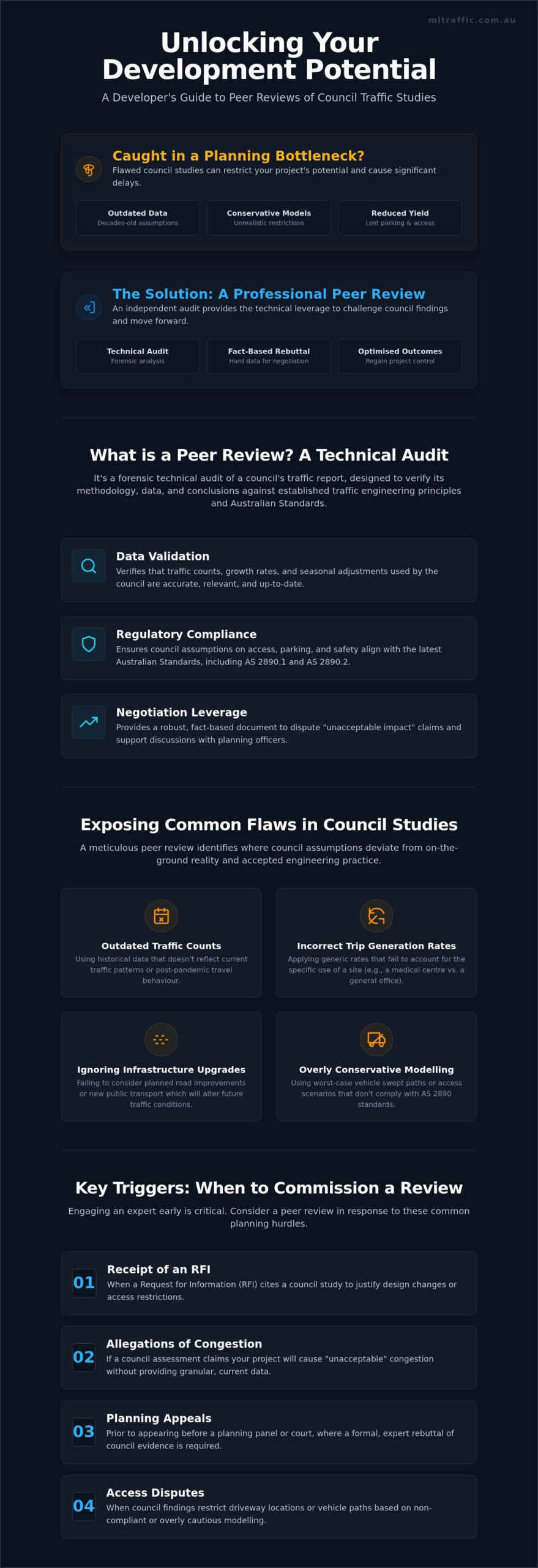
A professional peer review of council traffic study findings is a forensic technical audit of an existing traffic report or local government assessment. While a standard Traffic Impact Assessment (TIA) focuses on supporting a new development proposal, a peer review scrutinises the methodology, data inputs, and conclusions of a study commissioned by a local council. This process is a critical safeguard for developers. It ensures that the technical basis for planning decisions is accurate, current, and compliant with established traffic engineering principles.
The role of an independent traffic engineer in this context is to act as a technical intermediary. Council-commissioned studies often use broad-brush assumptions that may not reflect the specific operational realities of your site. Our senior principals, who maintain direct involvement in every project, verify that the data used to restrict your development potential is representative. In the Australian planning system, an independent peer review carries significant weight. It provides a formal, evidence-based document that can be presented to planning panels or used as expert testimony in court appeals.
The Purpose of Independent Traffic Audits
Independent audits are designed to bring transparency to Local Area Traffic Management (LATM) plans and council assessments. These audits focus on three primary objectives:
- Data Validation: Verifying that traffic counts, growth rates, and seasonal adjustments used by the council are accurate and up to date.
- Regulatory Compliance: Ensuring that all council assumptions regarding site access, parking, and safety align with the latest Australian Standards, including AS 2890.1 and AS 2890.2.
- Negotiation Leverage: Providing a robust technical basis for discussions with planning officers, allowing developers to dispute “unacceptable impact” claims with hard data.
When Should You Commission a Peer Review?
Timing is critical when challenging a council’s technical findings. You should consider a peer review of council traffic study in the following scenarios:
- Receipt of an RFI: When a Request for Information (RFI) cites a council study as the reason for requiring significant design changes or access restrictions.
- Allegations of Congestion: If a council assessment suggests your development will cause “unacceptable” levels of service at nearby intersections without providing granular data.
- Planning Appeals: Prior to appearing before a planning panel or the Land and Environment Court, where a formal rebuttal of council evidence is required.
- Access Disputes: When council findings restrict your driveway locations or vehicle swept paths based on overly conservative modelling.
Engaging a seasoned expert early in the process helps avoid bureaucratic delays. Our approach ensures the same expert who initiates the review performs the technical work, providing the personnel continuity essential for complex traffic engineering services.
Identifying Common Flaws in Council Traffic Assumptions
Council traffic studies are often presented as definitive documents, yet they frequently rely on generalised assumptions that do not withstand technical scrutiny. These reports are prone to systematic errors that can unfairly penalise a development. A meticulous peer review of council traffic study findings is essential to identify where these assumptions deviate from reality. Common issues include the application of generic trip generation rates that fail to account for the specific operational characteristics of a site, such as a specialised medical centre versus a general commercial office.
Many council assessments also fail to acknowledge planned infrastructure upgrades or shifts in public transport accessibility. By ignoring these factors, the study presents a static, often pessimistic view of future traffic conditions. This lack of foresight results in developers being asked to fund unnecessary mitigation measures or accept reduced site yields based on phantom congestion. Our traffic engineering services at ML Traffic Engineers Australia focus on exposing these gaps to ensure your project is judged on its actual merits.
Errors in Traffic Modelling and Software Inputs
Precision in software configuration is paramount. We frequently observe SIDRA Intersection models where parameters like saturation flows and gap acceptance are set to defaults that do not reflect local driver behaviour. Misconfigured inputs often inflate queue lengths and degree of saturation, making an intersection appear to be failing when it is actually operating within capacity. Incorrect modelling parameters generate technical justifications for council to refuse a DA based on perceived traffic impacts that do not exist in practice.
Outdated or Generalised Data Sets
The reliance on historical data is a significant risk in high-growth corridors. Using traffic counts that are three to five years old is unacceptable when local development activity has fundamentally altered road network performance. Council data sets often lack the granularity required for site-specific analysis, missing nuances like peak hour shifts or local school traffic patterns.
A professional peer review of council traffic study verifies that the foundation of the council’s argument is built on current, representative data rather than convenient generalisations. Ensuring data collection complies with the latest state-based guidelines is a core requirement for any robust technical rebuttal. This level of technical rigour is necessary to prevent bureaucratic inertia from stalling your project. Senior principals at ML Traffic Engineers Australia personally oversee these audits to ensure every flaw is documented with professional precision.
The Technical Methodology of a Traffic Peer Review
A professional peer review of council traffic study documents is a rigorous technical audit, not a mere editorial summary. We begin by deconstructing the original study’s methodology and scope to ensure every assumption is defensible under technical scrutiny. This process involves a line-by-line verification of the data inputs used in the council’s modelling. If the foundation of their report is flawed, the resulting restrictions on your development are equally invalid. Our senior principals oversee this process to ensure the technical rebuttal is robust enough for planning panels or legal appeals.
The methodology includes several critical phases designed to provide a complete picture of site performance:
- Comprehensive audit of the original study’s data integrity and modelling assumptions.
- Independent site visits to observe real-world driver behaviour, queuing, and physical constraints that desktop models often overlook.
- Verification of all vehicle swept path analyses to ensure access designs are functional.
- Cross-referencing all findings with the latest national standards and state-based regulatory requirements.
Verifying Swept Path and Access Compliance
Council assessments often reject access designs based on theoretical manoeuvrability issues that don’t exist in practice. We use AutoTURN software to re-verify these claims with precision. This allows us to simulate exact vehicle movements for heavy rigid vehicles (HRV) or standard cars to prove that your proposed access is safe. We also scrutinise driveway ramp grades against AS 2890.1 to ensure compliance. Our experts frequently identify opportunities for improved site access that the council’s initial review missed, such as minor geometric adjustments that satisfy safety requirements without sacrificing site yield.
Parking Demand and Supply Analysis
Parking shortfalls are a primary catalyst for DA refusals. Council studies often apply rigid, generalised parking rates that don’t account for the specific operational needs of a modern development. We audit these claims by conducting independent Car Parking Demand Assessments. This involves collecting empirical evidence from similar land uses and conducting parking accumulation surveys. By providing site-specific data, we can often justify parking reductions and demonstrate that the proposed supply is sufficient. This evidence-based approach replaces council’s conservative estimates with hard data, helping you secure approval for optimised parking layouts.
Leveraging Peer Reviews for Planning Approvals and Appeals
A technical audit is only as effective as its application within the planning system. Once a peer review of council traffic study findings is complete, it serves as the primary evidence to challenge restrictive conditions or DA refusals. We present these findings directly to council planning officers to resolve disputes before they escalate. By providing a clear technical rebuttal, we enable developers to negotiate from a position of authority, ensuring that developer contributions and voluntary planning agreements remain proportionate to the actual traffic impact of the site.
Our independent reports provide the technical substance required for a Statement of Environmental Effects (SEE). While the council’s internal assessment might suggest a development is unsustainable, our peer review often proves otherwise through superior data granularity. This evidence is crucial for justifying why certain infrastructure upgrades demanded by council are technically unnecessary. We focus on delivering a robust document that withstands the scrutiny of both local planning panels and state-based assessment bodies.
The Role of the Expert Witness
Legal proceedings in the Land and Environment Court require a specialised level of technical rigour. Our senior principals provide expert witness statements that translate complex traffic modelling into objective, legal evidence. Credibility in these settings is paramount; therefore, the same expert who performs the technical work is the one who defends it in court. An expert engineer maintains a primary duty to the court to provide impartial, independent evidence that assists the tribunal in reaching a technical determination. This no-gatekeepers approach ensures that our testimony is both authoritative and meticulously informed by the project’s specific constraints.
Navigating Planning Panels and RFIs
Requests for Information (RFI) often cite council-commissioned studies to demand significant design modifications. We address these concerns with evidence-based technical responses that highlight errors in the council’s original logic. In many cases, we turn a “No” into a “Yes” by proposing minor, data-backed design adjustments that satisfy safety requirements without sacrificing site yield. This process is essential for streamlining the Traffic Impact Assessment process and avoiding the costs of prolonged bureaucratic delays.
If you are facing an RFI based on disputed traffic findings, contact our senior principals for a direct technical consultation to discuss your project requirements.
Expert Traffic Engineering Peer Reviews by ML Traffic Engineers Australia
ML Traffic Engineers Australia provides a specialised technical service for developers facing restrictive council findings. With over 15 years of experience in the Australian market, we have conducted hundreds of independent reviews for residential, commercial, and industrial developments. Our peer review of council traffic study reports are designed to be definitive. We don’t just summarise the council’s findings; we audit the underlying data to ensure every conclusion is technically sound and compliant with current standards. This meticulous approach is essential for protecting your project’s commercial viability from flawed bureaucratic assessments.
Our track record includes securing approvals for complex projects where initial council assessments suggested unmanageable traffic impacts. By identifying flaws in modelling and applying site-specific trip generation rates, we provide the evidence needed to bypass roadblocks. Every project benefits from our deep understanding of local government requirements and national regulatory frameworks. We maintain a strict focus on compliance with AS 2890.1 and AS 2890.2, ensuring that your site access and parking designs are beyond reproach. ML Traffic Engineers Australia remains committed to delivering results-oriented engineering solutions that satisfy both regulatory bodies and developer objectives.
Our Hands-On Consultancy Philosophy
We operate on a principle of total accountability. The expert who starts your technical review is the expert who finishes it. This personnel continuity promise distinguishes ML Traffic Engineers Australia from larger firms where projects are often delegated to junior staff after the initial contact. You maintain direct access to senior principals throughout the process, ensuring that the technical work is performed by a seasoned expert with the authority to defend it. Our comprehensive suite of services covers everything from vehicle swept path analysis to the development of Traffic Management Plans.
Get Started with Your Independent Review
Initiating a peer review of council traffic study documents is a straightforward process. You can provide your existing council study and any relevant RFI documentation for a preliminary audit. We deliver clear, declarative, and authoritative reporting that is ready for submission to planning panels or legal counsel. Our commitment to technical precision ensures that your development is assessed on its actual merits rather than outdated or generalised assumptions. We don’t use gatekeepers; you will speak directly with the engineer responsible for your project at ML Traffic Engineers Australia.
Contact ML Traffic Engineers Australia to discuss your project requirements and receive a direct technical consultation with one of our senior principals.
Secure Your Development Approval with Technical Precision
Securing a development approval often depends on your ability to challenge technical findings that are overly conservative or based on obsolete data. Commissioning a professional peer review of council traffic study reports provides a robust, evidence-based rebuttal that protects your site’s access and parking yield. Our approach ensures that every assessment is conducted with specialised expertise in AS 2890 compliance and a thorough understanding of the Australian planning landscape. This technical rigour is essential for overcoming bureaucratic hurdles that otherwise stall viable projects.
With over 15 years of Australian consultancy experience, ML Traffic Engineers Australia eliminates the uncertainty of bureaucratic delays. You gain direct access to senior engineers who perform the technical work themselves, ensuring accountability from the initial audit through to planning panel representation. This hands-on involvement is critical for turning a potential refusal into a successful approval. Don’t let flawed assumptions restrict your project’s potential when a meticulous technical audit can provide the path forward.
Request a Peer Review Proposal from our Senior Principals to ensure your development is judged on accurate data. ML Traffic Engineers Australia looks forward to helping you achieve an optimised outcome for your project.
Frequently Asked Questions
What is the primary goal of a peer review of a council traffic study?
The primary goal is to conduct a forensic technical audit of the council’s report to identify errors, outdated data, or flawed assumptions that unfairly restrict a development. It provides a robust basis to ensure that planning decisions are based on accurate engineering principles rather than overly conservative generalisations that can erode site yield.
Can a peer review actually change a council decision on my DA?
Yes, an expert peer review provides the technical leverage required to challenge a council’s findings during the assessment process or at a planning panel. By exposing specific errors in the council’s traffic modelling or data collection, developers can often negotiate more favourable access arrangements or reduced parking requirements that align with actual site needs.
How much does an independent traffic peer review cost in Australia?
The cost of a peer review of council traffic study varies depending on the complexity of the original report and the scale of the proposed development. Fees are determined by the scope of the audit, including whether the project requires independent traffic counts or intersection modelling. You should request a project-specific proposal to ensure accurate budgeting for your technical requirements.
How long does it take to complete a traffic study peer review?
A standard peer review generally takes between one and two weeks to complete, depending on the availability of the original council data. If the review requires independent site visits or new traffic counts to verify council claims, the timeline may extend to accommodate the necessary data collection and analysis periods.
What qualifications should a traffic engineer have for a peer review?
A traffic engineer must possess a degree in civil engineering and extensive experience in Australian traffic modelling and regulatory standards. For a peer review to hold weight in legal or planning settings, it must be performed by a senior professional who understands AS 2890 and state-specific transport guidelines intimately.
Is a peer review required for Land and Environment Court appeals?
While not strictly mandatory, an independent peer review is highly recommended for court appeals to provide a robust technical rebuttal to council evidence. Expert witness statements based on a peer review allow a traffic engineer to present objective, data-driven testimony that assists the court in making a technical determination regarding traffic impacts.
Will the council accept a report from a private traffic consultant?
Council planning officers are required to consider technical evidence provided by qualified private consultants as part of the DA process. A professionally prepared peer review of council traffic study findings serves as a formal submission that council must address, particularly if it identifies non-compliance with Australian Standards or errors in council modelling.
What happens if the peer review agrees with the council findings?
If a review confirms the council’s technical findings, the focus shifts to identifying design modifications that mitigate the identified impacts. This allows developers to make informed adjustments to site access or parking layouts that satisfy safety requirements while still protecting the project’s overall commercial viability and operational needs.

Disclaimer
The content on www.mltraffic.com.au, including all technical articles, guides, and resources, is provided for general informational and educational purposes only. It is not intended to constitute professional advice in traffic engineering, transportation planning, development approvals, or any other technical or legal field.
While ML Traffic Engineers makes every reasonable effort to ensure the accuracy, completeness, and timeliness of the information published, we do not provide any warranties or representations (express or implied) regarding its reliability, suitability, or availability for any particular purpose. Any reliance you place on the content is strictly at your own risk.
In no event shall ML Traffic Engineers, its directors, employees, authors, or affiliates be liable for any direct, indirect, incidental, special, consequential, or punitive damages (including, without limitation, loss of profits, data, or business opportunities) arising out of or in connection with the use of, or inability to use, any information provided on this website.
The articles and guides on this site are not a substitute for engaging a qualified, registered professional traffic engineer (such as an NPER or RPEQ engineer) to assess your specific project requirements. For tailored advice, compliance assessments, or traffic engineering services, please contact a competent professional.
This disclaimer may be updated from time to time without notice. By accessing or using this website, you agree to be bound by the most current version of this disclaimer.
