

Most developers assume their traffic consultant’s report is beyond reproach, yet technical inaccuracies frequently lead to costly, avoidable infrastructure requirements. An independent review of third party traffic report documents can identify these flaws before they reach the council desk. It’s understandable to feel frustrated by DA delays or concerned that you’re paying for road upgrades that aren’t actually necessary for your specific site. You shouldn’t have to guess if your consultant’s work meets the latest Australian Standards or the updated ITE Trip Generation Manual 12th Edition. This article outlines how a rigorous peer review by senior principals can validate your traffic data, reduce infrastructure costs, and provide a certain path to DA approval. We’ll cover the specific technical pitfalls common in TIAs, the implications of recent regulatory updates, and how expert scrutiny ensures your project remains compliant without unnecessary financial burden. By the end, you’ll understand how to leverage senior-level expertise to protect your project’s bottom line and ensure your submission is technically sound.
Key Takeaways
- Identify how technical inaccuracies in trip generation rates often lead to unnecessary and expensive infrastructure contributions from developers.
- Understand how an independent review of third party traffic report documentation identifies mathematical errors in SIDRA modelling to prevent over-engineered road requirements.
- Streamline the DA approval process by resolving traffic-related Requests for Information (RFIs) faster through validated data and senior expert verification.
- Ensure your project strictly adheres to current Australian Standards, including AS 2890.1, to mitigate the risk of council objections and technical delays.
- Recognise why personnel continuity and direct access to senior principals are critical for maintaining accountability and technical accuracy throughout the peer review process.
What is an Independent Review of a Third Party Traffic Report?
An independent review of third party traffic report documentation is a specialised technical audit conducted by a senior traffic engineer. Unlike a standard Traffic Impact Assessment (TIA) which initialises a project’s data, a peer review scrutinises the existing methodology, data inputs, and conclusions of a report already produced by another firm. This process serves as a strategic “sanity check” for developers who suspect their current findings are overly conservative or technically flawed. It ensures that the traffic component of a broader Environmental impact assessment is accurate and defensible under regulatory scrutiny. Most developers don’t realise that a report which appears compliant on the surface can still contain fundamental modelling errors that lead to project delays.
ML Traffic Engineers Australia provides these reviews to identify where technical errors might lead to unnecessary project costs. A standard report often relies on generic datasets that don’t reflect site-specific realities. A strategic peer review looks for these discrepancies to prevent “gold-plated” infrastructure demands from local councils. The goal is to provide an objective, fact-based assessment that either validates the existing work or provides a clear path for correction.
When to Commission a Second Opinion
Developers typically seek a second opinion when a project faces significant “red flags.” These include recommendations for road upgrades that seem disproportionate to the development’s scale or parking requirements that exceed Australian Standards. If a local council issues a Request for Information (RFI) that challenges the original report’s validity, an independent review of third party traffic report becomes essential. It’s also a vital tool during the acquisition phase of high-stakes sites, providing due diligence to confirm that traffic constraints won’t compromise the site’s feasibility. Common triggers include:
- Unexpectedly high trip generation rates that trigger major intersection upgrades.
- Restrictive car parking requirements that reduce the developable area of the site.
- Conflicting feedback from council engineers regarding the original consultant’s SIDRA modelling.
- Concerns regarding the accuracy of swept path analysis for heavy vehicle access.
The Role of the Independent Traffic Engineer
The independent engineer acts as a technical advocate, ensuring every aspect of the report complies with AS 2890.1 and relevant state guidelines. Their focus is on providing an unbiased assessment of trip generation and parking demand, often referencing the latest ITE Trip Generation Manual 12th Edition to ensure the most current data is utilised. By verifying that the original modelling reflects real-world site conditions, they provide a higher level of accountability. At ML Traffic Engineers Australia, our traffic engineering services are led by senior principals who perform the technical work themselves. We don’t use junior staff for these critical audits. This direct access ensures that the person who audits the report has the multi-decade experience required to defend their findings if the matter progresses to a planning tribunal or court. We focus on technical accuracy and regulatory compliance to secure DA approval without unnecessary infrastructure costs.
Common Technical Flaws in Third Party Traffic Assessments
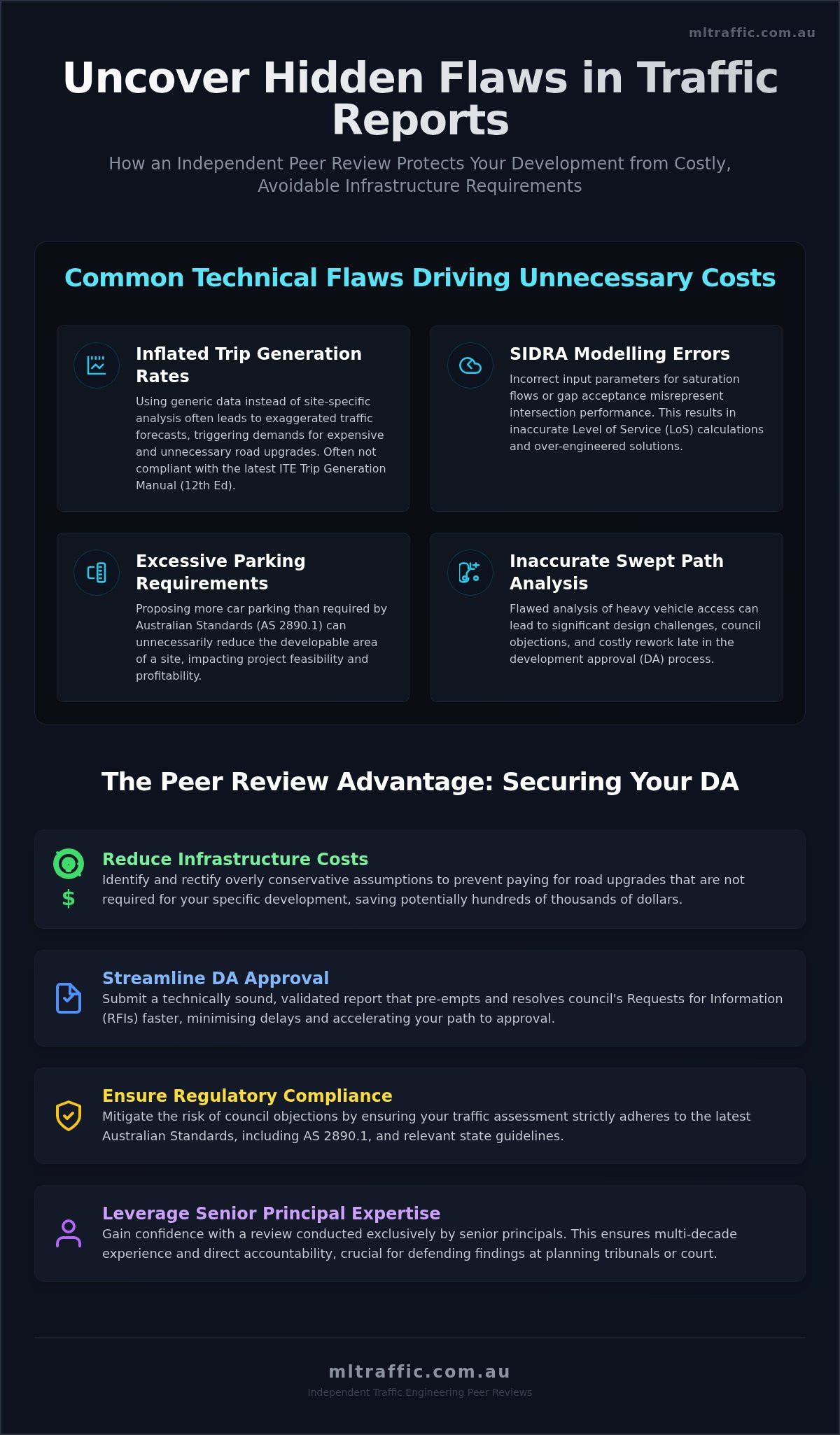
Technical flaws in traffic reports are rarely the result of overt negligence; they are typically the product of overly conservative assumptions and software misconfigurations. An independent review of third party traffic report documentation often reveals that a consultant has applied generic trip generation rates which don’t account for the specific land-use characteristics of a site. These inflated figures trigger unnecessary infrastructure contributions, potentially costing developers hundreds of thousands in avoidable road works. The NHTSA Traffic Records Advisory emphasises that independent sample-based audits are essential for maintaining the integrity of traffic data systems, a principle that applies directly to private development assessments.
Modelling and Data Collection Errors
Mathematical errors in SIDRA modelling represent a significant risk to DA approval. If the input parameters for saturation flows or gap acceptance are incorrect, the software will misrepresent intersection performance. This leads to an inaccurate Level of Service (LoS) calculation, suggesting a junction is failing when it’s actually operating within capacity. Many consultants rely on generic data instead of conducting site-specific counts. With the release of the ITE Trip Generation Manual 12th Edition in November 2025, reports authored before this date often use obsolete post-pandemic travel data. Identifying these peak-hour assumption flaws is a primary objective of our technical audits.
Parking and Access Non-Compliance
Misapplication of Australian Standards frequently results in council objections. We often see car park designs that fail to meet the strict requirements of AS 2890.1 compliance, particularly regarding aisle widths and column placements. In mixed-use developments, consultants sometimes double-count parking demand by failing to apply appropriate reciprocal parking credits between residential and commercial components. Specific technical oversights include:
- Driveway ramp grades that exceed the maximum allowable gradients specified in AS 2890.1.
- Inaccurate vehicle swept path analysis that uses overly conservative software settings, suggesting a vehicle cannot safely manoeuvre through a site when a more precise analysis proves it can.
- Sight distance assessments that fail to account for permanent obstructions like landscaping or signage.
- Incorrect classification of parking spaces (e.g., Class 1A vs Class 2) which impacts required dimensions and clearances.
Our senior principals specialise in identifying these technical oversights to ensure your submission is accurate and defensible. If you’re concerned about the technical validity of your current findings, you should contact our senior experts for a detailed peer review.
The Peer Review Process: How We Audit a Traffic Report
An independent review of third party traffic report documentation follows a structured technical audit to ensure every variable is accounted for. This process is not merely a proofreading exercise; it’s a deep-dive into the mathematical and logical foundations of the original submission. At ML Traffic Engineers, our senior principals execute a four-step methodology to identify discrepancies that could jeopardise your development application. This systematic approach provides the technical rigour required to challenge conservative assumptions or incorrect data inputs.
- Step 1: Comprehensive Audit of Methodology: We scrutinise the original report’s underlying assumptions, including trip generation rates and growth factors. We verify if these align with the latest ITE Trip Generation Manual 12th Edition or specific local council requirements.
- Step 2: Verification of Traffic Modelling: Our experts re-run the digital modelling data to check for software misconfigurations. We look specifically at SIDRA intersection parameters and swept path inputs to ensure they reflect realistic vehicle behaviour.
- Step 3: Physical Site Inspection: A desktop study isn’t enough. We perform on-site inspections to compare report findings with physical constraints. This includes verifying sight distances, existing traffic congestion levels, and the proximity of neighbouring driveways.
- Step 4: Technical Memorandum Delivery: We provide a concise memorandum outlining our findings. This document categorises errors by severity and provides clear, actionable recommendations to correct the report before it reaches the council.
Auditing SIDRA and Swept Path Files
We don’t just review the summary tables provided in a PDF. Our process involves requesting the raw digital SIDRA and AutoTURN files from your previous consultant. This allows us to inspect the “back-end” of the model, where incorrect saturation flows or gap acceptance settings are often hidden. By re-verifying vehicle access using advanced swept path analysis services, we can often prove that heavy vehicles or waste collection trucks can manoeuvre safely in spaces the original report deemed non-compliant. This technical advocacy frequently saves developers from having to redesign entire basement layouts or loading docks.
Regulatory Compliance Check
Every local council in Australia operates under a specific Development Control Plan (DCP) with unique traffic and parking requirements. Our audit includes a cross-reference of the original report against these current DCPs and state-based transport authority guidelines. We identify missing components that often trigger council RFIs, such as a Waste Management Plan or a formal Sight Distance Assessment. Ensuring your independent review of third party traffic report covers these regulatory gaps prevents the “staccato” approval process caused by repeated council objections. We focus on delivering a submission-ready document that meets every technical and bureaucratic benchmark required for a smooth DA path.
Strategic Benefits of an Independent Review for Your DA
Commissioning an independent review of third party traffic report documentation is a proactive risk-management strategy. It prevents the acceptance of “gold-plated” infrastructure demands that often result from conservative or inaccurate traffic modelling. When a consultant overestimates the impact of a development, local councils are likely to impose excessive road upgrade conditions. These technical errors don’t just affect the budget; they can stall a project entirely. By identifying these discrepancies early, you ensure that infrastructure contributions remain proportionate to the actual impact of your site.
An expert audit also streamlines the approval timeline. By resolving traffic-related Requests for Information (RFIs) faster, you significantly reduce holding costs and interest payments. If a DA is escalated to a planning tribunal or court, a robust peer review provides a defensible technical foundation. It demonstrates that your application is backed by senior-level scrutiny, making it much harder for authorities to maintain subjective objections. Beyond compliance, this process often improves the internal functionality of the site, ensuring parking and access layouts are efficient and maximise usable space.
Cost Mitigation and ROI
The financial return on a peer review is often immediate. For instance, identifying a 10% error in trip generation rates can be the difference between a simple driveway modification and a mandatory six-figure intersection upgrade. Over-designed car parks frequently waste valuable leasable floor area by including redundant aisles or oversized bays. A technical peer review serves as a strategic insurance policy against the financial and operational risks of a DA refusal based on flawed traffic data. Precise modelling ensures you only pay for the infrastructure your project actually requires.
Building Credibility with Council
Presenting a “united front” of technical evidence is a powerful way to rebut council objections. When your application includes a second signature from a reputable firm like ML Traffic Engineers, it adds significant weight to your technical claims. This dual-verification approach signals to council engineers that your data has been rigorously tested against current Australian Standards. It replaces subjective debate with objective, senior-level facts. You can explore our full range of traffic engineering services to see how we support complex applications. If your current traffic report is causing delays, contact our senior experts to initiate a strategic audit of your documentation.
Choosing the Right Traffic Consultant for a Peer Review
Selecting a consultant for an independent review of third party traffic report documentation requires a focus on seniority and accountability. A peer review is only as valuable as the expert’s ability to defend the findings under intense regulatory scrutiny. If a report is destined for a planning tribunal or court, the reviewer must possess the multi-decade experience required to act as a credible expert witness. Technical precision is the only way to successfully challenge a restrictive finding that threatens project feasibility.
Personnel continuity is another critical factor. Many large engineering firms utilise senior principals to secure a contract, only to delegate the actual technical work to junior staff. This creates a disconnect in accountability and increases the risk of technical oversights. For a peer review to be effective, the expert who quotes the job must be the one performing the modelling and data verification. This direct involvement ensures that the seasoned expert understands every variable of the site’s traffic profile, from childcare centre parking demand to industrial warehouse heavy vehicle access.
The ML Traffic Difference
ML Traffic Engineers is the preferred choice for independent reviews nationally due to our “no-gatekeepers” approach. Our clients have direct access to senior principals with over 15 years of Australian consultancy experience. We do not use junior engineers for these critical audits. This ensures that every independent review of third party traffic report we produce is technically precise and fully accountable. Our track record includes successfully challenging restrictive third-party findings and reversing conservative council objections that would have otherwise resulted in “gold-plated” infrastructure requirements. We focus on technical rigour and adherence to AS 2890.1 to protect your project’s bottom line.
Next Steps for Your Project
To initiate an audit, you simply need to provide your existing report and any relevant council correspondence for a confidential initial assessment. We evaluate the documentation to identify immediate technical discrepancies in trip generation or modelling assumptions. The typical turnaround time for a professional traffic report audit is approximately five to ten business days, depending on the complexity of the SIDRA modelling and physical site constraints. This small investment in senior-level scrutiny can prevent significant delays and thousands of dollars in unnecessary infrastructure contributions. You should Contact ML Traffic Engineers to discuss your peer review today and secure a technically sound path to DA approval.
Secure Your Development Approval Through Technical Scrutiny
Identifying technical flaws in your traffic documentation is the most effective way to avoid unnecessary infrastructure costs and mitigate DA delays. An independent review of third party traffic report files ensures that every assumption, from trip generation rates to SIDRA modelling parameters, is accurate and defensible. This process transforms a restrictive or conservative assessment into a strategic tool for negotiation with local councils or planning tribunals. You shouldn’t risk your project’s feasibility on a report that hasn’t been rigorously tested against current Australian Standards.
ML Traffic Engineers provides national coverage across all Australian jurisdictions, bringing 15+ years of expert consultancy to every audit. We ensure senior principal involvement on every project, maintaining a “no-gatekeepers” approach that guarantees technical precision and accountability. Our experts have a proven track record of identifying modelling errors that save developers from “gold-plated” road upgrade requirements. Protecting your project’s bottom line starts with verified data and senior-level scrutiny.
Request a confidential review of your third-party traffic report to ensure your submission is technically sound. We look forward to helping you secure a clear path to approval.
Frequently Asked Questions
What is an independent peer review of a traffic report?
An independent peer review is a technical audit of a traffic assessment prepared by another consultancy. It involves a senior engineer scrutinising the methodology, data inputs, and conclusions to ensure they align with Australian Standards and local council requirements. This process identifies errors in trip generation or modelling that might lead to excessive infrastructure costs.
How much does an independent traffic report review cost?
The cost of an independent review of third party traffic report documentation varies based on the project’s scale and the depth of modelling required. Small developments with simple access assessments generally incur lower fees than complex mixed-use sites requiring extensive SIDRA intersection analysis. We provide tailored quotes after reviewing the original report’s scope and the specific technical challenges involved.
Can a peer review help if my DA has already been refused?
A peer review is a critical tool for projects facing DA refusal or restrictive conditions. It provides the technical evidence needed for a section 8.2 review or an appeal in planning tribunals or relevant jurisdictions. By identifying flaws in the original traffic data, an expert can often present a more accurate case that resolves the council’s previous objections.
Will council accept a second traffic report from a different engineer?
Councils accept supplementary traffic evidence if it’s prepared by a qualified professional and addresses specific technical concerns. A peer review often acts as a rebuttal to subjective council feedback or conservative findings in the initial report. Providing a second, senior-level opinion adds technical weight to your application and demonstrates a commitment to accuracy.
What technical files do I need to provide for a review?
You need to provide the original Traffic Impact Assessment (TIA) report, the latest site plans, and any council Requests for Information (RFIs). For a deep-dive audit, we also require the raw digital SIDRA modelling files and AutoTURN swept path data. Access to these files allows our senior principals to verify the back-end settings and identify mathematical errors.
How long does it take to complete an independent traffic audit?
A professional traffic report audit typically takes between five and ten business days to complete. This timeframe allows for a comprehensive methodology review, data verification, and the drafting of a technical memorandum. More complex projects requiring on-site traffic counts or extensive intersection modelling may require additional time to ensure technical rigour.
Is an independent review required for all development applications?
Independent reviews aren’t mandatory for every project but are highly recommended for complex sites or those facing significant council resistance. If your original report triggers expensive road upgrades or contains restrictive parking requirements, a peer review acts as a strategic insurance policy. It’s an essential due diligence step for high-stakes commercial and industrial developments.
Can a peer review identify ways to reduce my parking requirements?
A peer review can often justify a reduction in parking through a detailed Car Parking Demand Assessment. By using empirical data and site-specific surveys, we can prove that the actual demand is lower than the generic rates specified in the Development Control Plan (DCP). This technical advocacy helps maximise leasable floor area and reduces the overall cost of the development.

Disclaimer
The content on www.mltraffic.com.au, including all technical articles, guides, and resources, is provided for general informational and educational purposes only. It is not intended to constitute professional advice in traffic engineering, transportation planning, development approvals, or any other technical or legal field.
While ML Traffic Engineers makes every reasonable effort to ensure the accuracy, completeness, and timeliness of the information published, we do not provide any warranties or representations (express or implied) regarding its reliability, suitability, or availability for any particular purpose. Any reliance you place on the content is strictly at your own risk.
In no event shall ML Traffic Engineers, its directors, employees, authors, or affiliates be liable for any direct, indirect, incidental, special, consequential, or punitive damages (including, without limitation, loss of profits, data, or business opportunities) arising out of or in connection with the use of, or inability to use, any information provided on this website.
The articles and guides on this site are not a substitute for engaging a qualified, registered professional traffic engineer (such as an NPER or RPEQ engineer) to assess your specific project requirements. For tailored advice, compliance assessments, or traffic engineering services, please contact a competent professional.
This disclaimer may be updated from time to time without notice. By accessing or using this website, you agree to be bound by the most current version of this disclaimer.
