

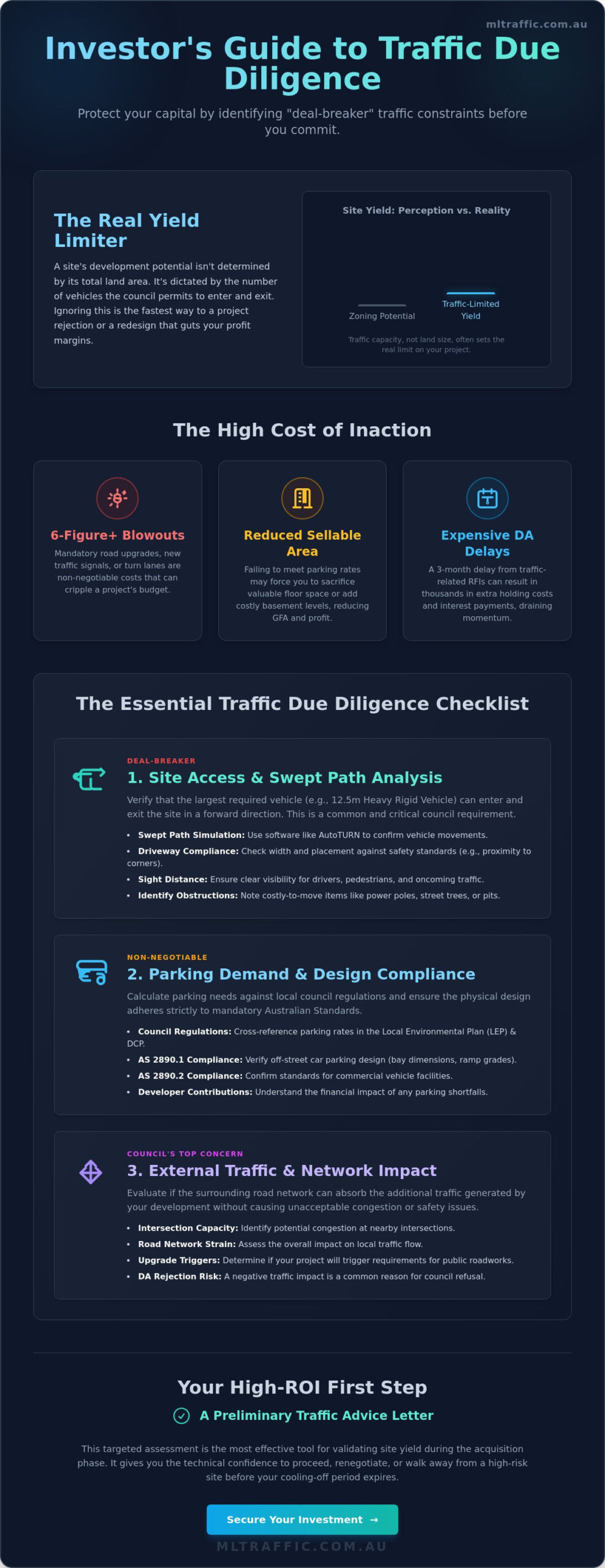
A site’s development yield isn’t determined by its total land area; it’s dictated by the number of vehicles the local council permits to enter and exit the property. Ignoring technical traffic constraints during the acquisition phase is the fastest way to face an unexpected rejection or a functional redesign that guts your profit margins. To protect your capital, you must utilize a rigorous investor due diligence traffic checklist that goes beyond basic site inspections. We understand the frustration of discovering that a 12.5-meter Heavy Rigid Vehicle cannot physically navigate your proposed driveway after you’ve already committed to the purchase.
This article provides the technical framework required to validate site feasibility before you settle. We’ll outline critical engineering risks, including the impact of the January 1, 2025, California parking unbundling law and the updated AS 2890.2 swept path requirements. You’ll gain a clear list of traffic and parking investigation points to ensure your project remains within budget and meets the specific regulatory standards of your jurisdiction. This guide ensures you identify access constraints and parking requirements early, giving you the confidence to proceed or walk away from a high-risk site.
Key Takeaways
- Identify technical deal-breaker constraints before the cooling-off period expires to protect your investment capital.
- Validate site accessibility by ensuring the largest design vehicle can enter and exit in a forward direction using Swept Path Analysis.
- Utilize a professional investor due diligence traffic checklist to calculate parking requirements against local council LEP and DCP standards.
- Evaluate external road network capacity to identify potential intersection congestion that may trigger a development rejection.
- Understand how a preliminary traffic advice letter serves as a high-ROI tool for validating site yield during the acquisition phase.
Table of Contents
Why Traffic Due Diligence is Critical for Property Investors
Traffic due diligence determines if a development site is a viable asset or a technical liability. It’s an authoritative assessment of how vehicles interact with the property and the surrounding road network. For sophisticated developers, an investor due diligence traffic checklist is the primary tool used to identify "deal-breaker" constraints before the cooling-off period ends. This technical due diligence process ensures you aren’t purchasing a site where council traffic requirements will eventually force a reduction in unit count or commercial floor space.
To better understand the broader context of screening investments for risk, watch this helpful video:
Site yield is often capped by traffic capacity rather than zoning density. If a site can’t accommodate the required number of parking spaces or if the driveway placement violates safety standards, the maximum achievable yield drops immediately. Council planning approvals rely heavily on the Traffic Impact Assessment (TIA). Without a clear path to compliance, your development application (DA) will likely face refusal or costly Request for Further Information (RFI) cycles that drain your project’s momentum.
The Financial Impact of Traffic Constraints
Ignoring traffic risks leads to budget blowouts that can exceed six figures. Council may mandate external road upgrades, such as new turn lanes or traffic signals, which are often non-negotiable conditions of consent. If your design fails to meet minimum parking rates set by the Local Environmental Plan (LEP), you might be forced to pay significant developer contributions or lose sellable area to accommodate additional basement levels. Delays in the DA process are equally expensive; a three-month delay due to poor traffic planning can result in thousands of dollars in additional holding costs and interest payments.
Regulatory Compliance and Australian Standards
Compliance with Australian Standards is a mandatory requirement for all new developments. AS 2890.1 governs off-street car parking, while AS 2890.2 sets the standards for commercial vehicle facilities. These documents dictate everything from ramp grades to bay dimensions. Non-compliance isn’t an option; it’s a technical failure that prevents certification. Investors must verify that a site can physically support these standards during the acquisition phase. Learn more about AS 2890.1 compliance to understand how these rules affect your project’s footprint and operational viability.
Site Access and Swept Path Analysis Checklist
A technical investor due diligence traffic checklist must prioritize the physical movement of vehicles on and off the property. Council regulations generally mandate that all vehicles, including service and delivery trucks, enter and exit a development in a forward direction. If a site cannot accommodate this requirement, the project’s feasibility is compromised. You must verify if the proposed driveway location provides sufficient width and complies with safety standards regarding proximity to existing intersections. Driveways located too close to a corner often face immediate rejection due to the risk of vehicle queuing blocking the intersection.
Sight distance is another non-negotiable factor. You need to evaluate if drivers can see pedestrians and oncoming traffic clearly before merging. Obstructions such as existing street trees, power poles, or utility pits can block sight lines and are often expensive to relocate. If you identify these constraints early, you can factor the relocation costs into your feasibility model or request a professional vehicle swept path analysis to confirm if the site remains functional.
Swept Path Analysis: The Technical Deal-Validator
We use industry-standard software like AutoTURN to simulate the exact movements of design vehicles. As of 2026, Australian Standards (AS 2890.2) increasingly require a 12.5-meter Heavy Rigid Vehicle (HRV) as the design vehicle for many developments. This simulation identifies "dead zones" where a truck’s body or wheels would clip a wall, pillar, or landscaping. Identifying these failures during due diligence prevents the need for a total basement redesign after you’ve already settled on the land. Why swept path analysis matters for DAs is centered on proving to council that your site works operationally without impacting public safety.
Driveway and Ramp Grade Feasibility
Topography determines the complexity of your access design. If a site has a steep incline or decline from the street, you must ensure the ramp grades are compliant. Failure to do so leads to vehicles "bottoming out" or scraping, which creates long-term maintenance liabilities and safety hazards. Under AS 2890.1, the maximum allowable grade for a domestic driveway is 1 in 4, which is 25%, provided that appropriate transitions are included to prevent vehicle scraping. You must also account for the 2010 ADA Standards for accessible design, which mandate specific slopes for accessible parking routes. Verifying these grades early ensures your car park design is both compliant and physically possible within the site’s natural contours.
Car Parking Demand and Design Requirements
Parking requirements often dictate the commercial viability of a development. If you cannot fit the mandated number of vehicles on-site, your project’s Gross Floor Area (GFA) or unit count will be forced to shrink. An investor due diligence traffic checklist must account for the specific parking rates defined in local council Local Environmental Plans (LEPs) and Development Control Plans (DCPs). These documents vary significantly between jurisdictions; a residential flat building in one suburb may require 1.5 spaces per two-bedroom unit, while a neighboring council may only require 1.0. You must also evaluate the feasibility of basement parking versus at-grade parking. While basements preserve surface area for more units, the high cost of excavation and the risk of hitting the water table can destroy your profit margins.
Regulatory compliance extends to specialized parking categories. Federal ADA Standards for Accessible Design mandate specific ratios for accessible spaces. For example, a parking lot with 1 to 25 total spaces must provide at least 1 accessible space. As of early 2026, many urban councils are also increasing requirements for bicycle storage and end-of-trip facilities. Failing to account for these "non-car" spaces in your initial footprint assessment leads to significant layout redesigns during the DA phase.
Parking Demand vs. Council Requirements
Council parking rates are often conservative and may not reflect actual usage patterns for certain land uses. In these cases, it’s possible to argue for a parking reduction based on empirical evidence or proximity to high-frequency public transport. Mixed-use sites offer unique opportunities for "shared parking" credits, where residential and commercial peaks occur at different times. You should explore our parking demand assessment services to determine if a site can support a lower parking provision without compromising operational safety or facing council refusal. This technical justification is a powerful tool for maximizing site yield.
Internal Circulation and Safety
A car park’s layout must be functional and safe to avoid long-term liability. We evaluate aisle widths and blind spots to ensure compliance with AS 2890.1 standards. Standard parking aisles typically require a width of 5.8 meters for 90-degree parking, but this can vary based on the bay width. Clearance heights are another critical risk factor. While a minimum of 2.2 meters is required for standard passenger vehicles, delivery vans and waste collection trucks require significantly more vertical space. If your basement height is too low, you may find it impossible to manage waste collection on-site, which is a common reason for council rejection.
External Traffic Impact and Network Capacity
The physical capacity of the surrounding road network often limits a site’s development potential more than the land’s size. An effective investor due diligence traffic checklist evaluates how much additional volume the local infrastructure can absorb. If a nearby intersection already operates at a failing Level of Service (LoS), even a small increase in vehicle trips from your development could trigger a refusal. You must assess existing traffic volumes and identify potential congestion points before committing to a purchase. It’s also critical to check for planned future road works by state transport authorities. A future road widening project could result in a loss of land or restricted access, fundamentally changing your project’s feasibility.
Public transport accessibility plays a significant role in this assessment. High proximity to rail or bus interchanges often allows for "parking credits," which reduce the total number of spaces you’re required to build. Conversely, if the site is isolated, you’ll face higher parking demands and stricter scrutiny of your site’s impact on local roads. We look at these factors to ensure your yield isn’t compromised by external factors beyond your control.
Traffic Impact Assessments (TIA)
Councils typically require a full TIA report when a development is projected to generate 100 or more vehicle trips during the peak hour. This threshold varies by jurisdiction; for instance, some authorities define "substantial impact" as any project adding 5,000 vehicle trips per day. The TIA uses intersection analysis to model how your project affects traffic flow. If the modeling shows a drop in the LoS, you might be forced to fund expensive intersection upgrades. Reading The definitive guide to Traffic Impact Assessments will help you understand how these reports protect your investment from regulatory failure.
Construction Traffic Management (TMP)
Operational viability is only half the battle; you must also consider how the site will be built. Construction traffic management identifies how heavy machinery and delivery trucks will access the site without crippling local traffic. If the site is located on a narrow or busy road, you may need to apply for road closures or work zone permits. These requirements carry significant costs and can delay your project timeline. Understanding Traffic Management Plans is essential for factoring these logistical expenses into your initial budget.
To ensure your site doesn’t face unexpected network constraints, contact our senior engineers for a network capacity review.
Next Steps: Engaging a Traffic Engineer for Due Diligence
A preliminary traffic advice letter provides an immediate return on investment during the due diligence period. This document identifies the technical constraints discussed in previous sections, such as swept path failures or parking shortfalls, before you’re legally committed to the purchase. It transforms the investor due diligence traffic checklist from a theoretical exercise into a project-specific risk assessment. Engaging a hands-on technical consultant rather than a high-volume "quote-provider" ensures that the advice you receive is based on decades of engineering experience rather than automated templates. We understand that a site’s value is tied to its approval potential, and our technical reviews prioritize identifying "deal-breaker" issues early.
ML Traffic Engineers has been trading since 2005 and has completed over 10,000 site assessments across Australia. We operate on a clear philosophy: the traffic consultant who provides the quote, does the work. This eliminates the risk of technical errors being introduced by junior staff who lack the experience to navigate complex bureaucratic requirements. Our principals, Michael Lee and Benny Chen, remain involved in every project to ensure that the data provided is accurate, defensible, and compliant with all relevant Australian Standards.
Assembly of Your Technical Due Diligence Team
Your technical due diligence team must include a traffic engineer who works alongside your town planner and architect. Traffic findings dictate the building’s footprint and the feasibility of basement levels, which directly influences the architect’s design. If our assessment reveals that a site requires a specific intersection upgrade or a significant parking reduction, you can use this data-backed report to negotiate a lower purchase price or adjust your feasibility model. Direct senior engineer involvement is critical for complex site assessments because it ensures that high-level regulatory risks and nuanced council requirements are identified at the earliest possible stage. Integrating these findings early prevents the high costs of remedial traffic works after the land has been settled. Looking beyond the planning phase, ensuring the ongoing operational quality and presentation of commercial assets is equally important, with professional services like Tidy Masters specializing in the maintenance of such high-standard developments.
Contact ML Traffic Engineers
We provide national coverage for all traffic engineering and transport planning needs. Our services include everything from initial site reviews to detailed Traffic Impact Assessment (TIA) reports and Car Park Design. You’ll have direct access to our principals for rapid site reviews, ensuring you can meet tight due diligence deadlines. We’ve worked on every conceivable land-use type, including apartments, warehouses, bars, and medical centers. This breadth of experience allows us to provide reliable advice that builds confidence in your site’s feasibility. Contact Michael Lee or Benny Chen for a due diligence quote today to secure an authoritative technical review of your next acquisition.
Secure Your Development Yield with Technical Due Diligence
Technical traffic constraints represent the difference between a profitable development and a failed acquisition. Utilizing a comprehensive investor due diligence traffic checklist allows you to verify that vehicle swept paths, ramp grades, and parking provisions meet all regulatory standards before you commit capital. We’ve completed assessments for over 10,000 sites nationwide since 2005; this provides the technical certainty required for complex development applications. Identifying "dead zones" or parking shortfalls early protects your margins and ensures your site layout remains operationally viable. For developers who want to extend this level of precision to their digital marketing and online growth, check out Patio SEO.
Securing professional advice during the cooling-off period prevents budget blowouts caused by unexpected road upgrades or yield reductions. At ML Traffic Engineers, you get direct access to senior principals with over 15 years of experience in traffic engineering. We ensure the consultant who quotes your work is the one who executes it. Get a Professional Traffic Due Diligence Quote to validate your site’s true potential. You’ve worked hard to find the right property; now make sure it’s technically feasible to build.
Frequently Asked Questions
What is the most common traffic-related reason for a DA rejection?
Non-compliant vehicle access and safety issues are the most frequent reasons for DA rejection. Councils strictly enforce the requirement that all vehicles must enter and exit a site in a forward direction to maintain public safety. If your site layout forces reversing maneuvers onto a public road, the application will likely fail. Poor sight distance at the driveway interface, often caused by existing street trees or utility poles, is another common technical failure.
How much does a traffic impact assessment (TIA) typically cost for due diligence?
The cost of a TIA varies based on the development’s scale and the complexity of the surrounding road network. A small residential development with 10 units requires less modeling than a commercial warehouse with 5,000 vehicle trips per day. For the purposes of an investor due diligence traffic checklist, we provide fixed quotes after reviewing the specific site address and proposed land use. This ensures the fee reflects the actual technical requirements of your project.
Can I use a swept path analysis to increase my site’s development yield?
A Vehicle Swept Path Assessment directly impacts development yield by optimizing the placement of structural pillars and basement ramps. By simulating the exact turning circle of a 12.5-meter Heavy Rigid Vehicle, we identify "dead zones" that can be reclaimed for additional parking bays or storage units. This technical precision allows architects to maximize the use of every square meter while ensuring the design remains compliant with AS 2890.2 standards.
Is a traffic report mandatory for all Australian development applications?
Traffic reports are mandatory for most Australian development applications where the proposal changes the site’s trip generation or parking demand. While some minor residential renovations may be exempt, any project involving new commercial floor space or multiple dwellings requires professional certification. Most councils use a threshold of 100 peak-hour vehicle trips to trigger a full TIA; however, a basic Traffic Impact Statement (TIS) is often required even for smaller sites.
What is the difference between AS 2890.1 and AS 2890.2?
AS 2890.1 and AS 2890.2 are distinct parts of the Australian Standard for parking facilities. AS 2890.1 governs off-street car parking for passenger vehicles, specifying bay dimensions, aisle widths, and ramp grades. AS 2890.2 focuses on commercial vehicle facilities, covering the requirements for delivery vans, trucks, and heavy rigid vehicles. Both standards are non-negotiable for compliance; our assessments ensure your project satisfies the technical criteria of each relevant document.
How long does it take to prepare a traffic due diligence report?
Preparing a comprehensive traffic due diligence report typically takes between 5 and 10 business days. This timeframe allows for the collection of existing traffic data, site inspections, and the execution of swept path simulations. If your project requires complex intersection analysis or intersection modeling, the duration may increase. We prioritize direct access to our senior engineers to ensure that this investor due diligence traffic checklist is delivered within your acquisition’s cooling-off period.
What happens if my site does not meet the minimum council parking requirements?
If a site fails to meet minimum council parking requirements, you must provide a Car Parking Demand Assessment to justify the shortfall. We analyze empirical data from similar land uses or leverage proximity to high-frequency public transport to prove that the actual demand is lower than the council’s DCP rates. Successfully arguing for a parking reduction can save significant costs in basement excavation and preserve the project’s overall development yield.
Can a traffic engineer help negotiate with council during the pre-DA stage?
Traffic engineers play a vital role in pre-DA negotiations by providing technical evidence to support your proposal. We attend council meetings to discuss driveway locations, parking reductions, and potential road upgrades before you submit the final application. This proactive approach identifies technical objections early, reducing the risk of a formal rejection. Having a senior engineer present ensures that discussions with council traffic officers remain focused on technical standards and engineering facts.
Which areas do you cover?
We are traffic engineers servicing Melbourne, Sydney, Brisbane, Gold Coast, Hobart, Perth, Adelaide, Darwin, Canberra and surrounding areas.

Disclaimer
The content on www.mltraffic.com.au, including all technical articles, guides, and resources, is provided for general informational and educational purposes only. It is not intended to constitute professional advice in traffic engineering, transportation planning, development approvals, or any other technical or legal field.
While ML Traffic Engineers makes every reasonable effort to ensure the accuracy, completeness, and timeliness of the information published, we do not provide any warranties or representations (express or implied) regarding its reliability, suitability, or availability for any particular purpose. Any reliance you place on the content is strictly at your own risk.
In no event shall ML Traffic Engineers, its directors, employees, authors, or affiliates be liable for any direct, indirect, incidental, special, consequential, or punitive damages (including, without limitation, loss of profits, data, or business opportunities) arising out of or in connection with the use of, or inability to use, any information provided on this website.
The articles and guides on this site are not a substitute for engaging a qualified, registered professional traffic engineer (such as an NPER or RPEQ engineer) to assess your specific project requirements. For tailored advice, compliance assessments, or traffic engineering services, please contact a competent professional.
This disclaimer may be updated from time to time without notice. By accessing or using this website, you agree to be bound by the most current version of this disclaimer.
