

The lowest quote for your Traffic Impact Assessment might actually be the most expensive line item in your project budget. Most developers and project managers are under constant pressure to trim consultancy fees to protect their margins. It’s understandable why you might ask if a cheap traffic report is a false economy when comparing initial quotes. However, when a cut-price report fails to meet rigorous Australian Standards like AS 2890 or lacks the technical depth required by Council officers, that initial saving quickly evaporates. You’re often left facing unexpected Requests for Further Information (RFIs) and project delays that blow out holding costs by thousands each week.
This guide explains why low-cost consulting frequently leads to these expensive bottlenecks and how to identify a high-quality assessment that secures a smooth DA approval. We will examine the real cost of inexperienced consultants who suggest over-engineered road works and how direct access to senior engineering expertise protects your project’s bottom line. You will learn why ensuring the expert who starts your project is the one performing the technical work is the only way to guarantee compliance and ensure infrastructure costs are minimised from the outset.
Key Takeaways
- Understand why selecting a consultant based on the lowest fee often leads to significant holding costs, proving that asking if a cheap traffic report is a false economy is a critical step in project planning.
- Identify common technical red flags in budget reports that trigger Council Traffic Officers to issue a Request for Further Information (RFI).
- Learn how expert design and accurate Vehicle Swept Path Analysis can prevent over-engineered road works and minimise your total construction budget.
- Discover the essential benchmarks for a compliant Traffic Impact Assessment, including adherence to Australian Standards AS 2890 and the use of specialised software.
- Recognise how direct access to senior principals ensures technical accountability and streamlines the Development Application approval process.
Understanding the ‘Cheap’ Traffic Report: Why Low Fees Can Be Deceptive
In Australian property development, a false economy occurs when an initial saving on professional fees results in a disproportionate increase in total project expenditure. Choosing the lowest quote for a Traffic Impact Assessment (TIA) often fits this description perfectly. While the upfront saving might look attractive on a spreadsheet, the question of whether is a cheap traffic report a false economy becomes clear once Council reviews the submission. Developers frequently fall into this trap because they view traffic reports as a commodity. A high-quality TIA functions as a rigorous risk-management document rather than a simple tick-box exercise.
The transportation planning process requires precise data and site-specific insights to satisfy regulatory bodies. When considering whether is a cheap traffic report a false economy, developers must look beyond the invoice. Budget consultants often cut corners by bypassing the physical site inspection. This step is critical for identifying actual sight distance constraints or existing parking pressures that generic data cannot capture. Relying on desktop-only assessments is a primary reason why many applications stall at the first stage of Council review.
To better understand this concept, watch this helpful video:
The Anatomy of a Low-Cost Traffic Assessment
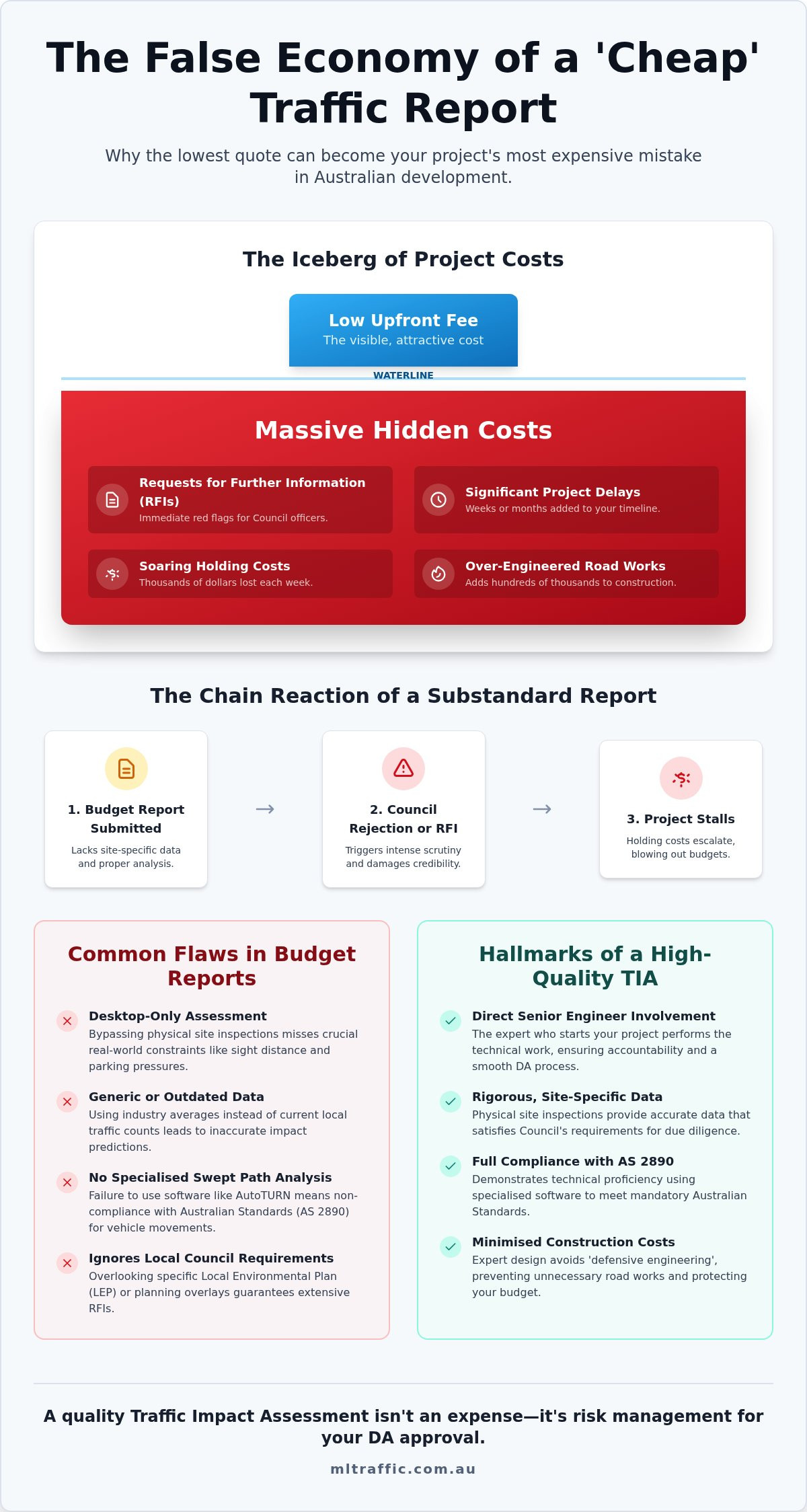
Low-cost reports frequently rely on outdated traffic counts or generic industry averages that do not reflect current local conditions. These assessments often lack a detailed Vehicle Swept Path Analysis for complex movements, which is a mandatory requirement for most commercial and multi-residential developments. Without using specialised software like AutoTURN, these reports fail to demonstrate compliance with Australian Standards AS 2890.1 or AS 2890.2. You can view our full range of technical Traffic Impact Assessment services to see the required level of detail. Budget providers also tend to ignore specific local Council planning overlays or Local Environmental Plan (LEP) requirements. This oversight leads to immediate rejection or extensive RFIs from planning officers who require specific technical justifications.
Why Initial Fees Are Only Part of the Story
The upfront fee is only a fraction of the total cost of approval. A substandard report often leads to ‘defensive engineering’. This occurs when an inexperienced consultant recommends excessive and unnecessary road upgrades simply to avoid professional liability or Council scrutiny. These over-engineered solutions can add hundreds of thousands to a construction budget. There is also the hidden cost of consultant unavailability. Low-cost firms often operate on a high-volume model where the expert becomes unreachable once the Council issues a Request for Further Information (RFI). This lack of personnel continuity forces developers to pay for a second report, effectively doubling the original cost while project holding fees continue to accumulate.
The Hidden Risks: How a Substandard Report Triggers Council Rejection
Council Traffic Officers serve as the primary gatekeepers for development approvals. Their role is to ensure that every proposed movement, from a passenger vehicle to a heavy rigid truck, complies with safety and efficiency standards. When an officer receives a report that lacks site-specific data or uses generic assumptions, it raises immediate red flags. A poorly prepared submission signals to Council that the developer hasn’t conducted sufficient due diligence. This damage to your professional credibility often results in more intense scrutiny for the remainder of the DA process, confirming why is a cheap traffic report a false economy in the eyes of experienced project managers.
Errors in Swept Path Analysis are among the most common reasons for project stagnation. If a consultant fails to use specialised software like AutoTURN, they may submit diagrams that don’t account for the actual turning radius of specific vehicles. When Council identifies these inaccuracies, the project can stall for months while the design is revised. This is where you realise that wondering if a cheap traffic report is a false economy is a valid concern. The initial saving on the report is eclipsed by technical failures that prevent approval and require expensive redesigns.
The Dreaded RFI: A Developer’s Greatest Delay
A Request for Further Information (RFI) effectively resets the Council’s assessment clock. This “stop the clock” mechanism means your application sits in limbo while you wait for your consultant to provide technical justifications. For mid-scale developments, a four-week delay can result in thousands of dollars in additional holding charges and interest. Budget consultants frequently exclude RFI responses from their initial scope, meaning they will charge premium hourly rates to fix their own mistakes. These hidden fees quickly erase any perceived upfront savings while your project timeline continues to blow out.
Non-Compliance with Australian Standards (AS 2890)
Strict adherence to AS 2890.1 for parking design is non-negotiable for any compliant development. Reports that fail to verify correct ramp grades or aisle widths often necessitate a complete site redesign. If the basement height or driveway slope is found to be non-compliant after the plans are submitted, you may even need to reduce the number of yield units to fix the geometry. Using certified software for vehicle manoeuvrability is the only way to protect your project from these outcomes. To ensure your submission meets these rigorous requirements, you can consult with our senior principals about your site layout before submitting to Council.
Beyond the Fee: The Impact of Traffic Advice on Your Construction Budget
The consultant’s invoice represents only a small fraction of the total financial impact of traffic advice. When assessing whether is a cheap traffic report a false economy, developers must consider the potential for “defensive engineering.” Inexperienced consultants often lack the technical authority to push back against aggressive Council requirements. To avoid professional scrutiny, they may recommend excessive road upgrades or unnecessary intersection signalisation. These over-engineered solutions can add tens of thousands of dollars to your construction budget before the first sod is turned.
A high-quality assessment protects your project from these inflated infrastructure costs. It ensures that every suggested road work is strictly necessary and supported by data. This technical confidence is the primary reason why asking if a cheap traffic report a false economy is essential for protecting your project’s bottom line. Investing in senior expertise allows for a more nuanced approach to traffic management that prioritises both safety and cost-efficiency.
Negotiating Council Contributions and Works
A professional Traffic Impact Assessment acts as a critical negotiation document during the DA process. By providing site-specific data instead of relying on generic industry averages, an expert can demonstrate that the actual impact on the local road network is manageable. This evidence allows developers to argue against unnecessary capital works. In previous projects, thorough technical analysis has successfully negotiated away the need for costly intersection upgrades. While the high-quality report required a slightly larger upfront investment, it saved the developer over $50,000 in mandated road works.
Optimising Site Yield Through Expert Design
Site yield is another area where expert advice pays for itself. Precise car parking demand assessments can often justify a lower parking provision than standard rates suggest. Reducing the parking requirement by even a few spaces can significantly lower excavation and shoring costs. Additionally, expert Car Park Design ensures that pillars and circulation aisles are positioned to maximise the utility of every square metre. This efficiency directly increases the total saleable or leasable floor area, making the difference between a marginal project and a highly profitable one. Compliance with Australian Standards is maintained while the utility of the site is pushed to its absolute limit.
Due Diligence: Identifying a High-Quality Traffic Impact Assessment
Technical credentials serve as the primary indicator of quality. Check for Professional Indemnity insurance and registration on the National Engineering Register (NER). These certifications provide a baseline of accountability that budget firms often lack. When a consultant offers a fee significantly below the market average, it usually indicates they are cutting costs on technical rigour or senior oversight. Over 15 years of experience in the Australian market has shown that Council officers quickly identify reports that lack these professional hallmarks. Understanding why is a cheap traffic report a false economy is the first step toward project security.
Evaluating a consultant’s track record with your specific development type is equally vital. A firm experienced in high-density residential projects may not understand the specific requirements for an industrial logistics hub or a child care centre. Understanding why is a cheap traffic report a false economy requires looking at the risk of professional negligence. If a report is found to be technically flawed during a Council hearing, the cost of legal representation and new expert witnesses will be astronomical. You don’t want to be the developer who pays twice for the same assessment because the first version was non-compliant.
Key Questions to Ask Your Traffic Consultant
Before accepting a quote, verify the operational structure of the firm. Ask these specific questions to ensure technical accountability:
- Will a senior engineer conduct the site visit and perform the technical calculations personally?
- Do you use specialised software like AutoTURN for all swept path and access assessments to ensure compliance with AS 2890?
- Is the fee inclusive of the first round of Council RFI responses, or will these be billed as extra hourly charges?
The Value of a Comprehensive Traffic Engineering Service
A high-quality Traffic Engineering service covers more than just the basics of parking counts. It must provide a holistic view of site safety, access, and broader network impacts. At ML Traffic Engineers Australia, we maintain a “no-gatekeepers” approach. This ensures you speak directly to the expert performing the technical work rather than a junior staff member. Our personnel continuity promise means the expert who starts your project is the one who finishes it. Multi-decade experience is indispensable in high-stakes planning negotiations where technical authority can be the difference between approval and rejection. To ensure your next project is backed by senior expertise, contact our principals for a detailed technical quote that protects your project’s bottom line.
The ML Traffic Advantage: Minimising Risk Through Senior Expertise
The analysis provided throughout this guide demonstrates that is a cheap traffic report a false economy for any developer seeking a predictable approval pathway. When a technical document lacks the authority of a senior principal, it invites the very delays and RFIs that erode project margins. ML Traffic Engineers Australia addresses this risk by removing the layers of bureaucracy typical in larger consultancies. We replace the high-volume, junior-led model with a technical approach rooted in senior-level accountability and multi-decade experience. This ensures that every report we produce is a robust risk-management tool designed to withstand the most rigorous Council scrutiny.
Our firm operates on a personnel continuity promise. This ensures the expert who assesses your site layout and performs the initial calculations remains your primary point of contact until Council issues the final approval. At ML Traffic Engineers Australia, we don’t delegate critical technical analysis to inexperienced staff. This direct involvement of senior leadership ensures that every Traffic Impact Assessment is prepared to the highest standard of accuracy, preventing the technical errors that lead to costly redesigns. By prioritising technical rigour, we provide the certainty required to keep your project on schedule and within budget.
Our Commitment to Australian Developers
With over 15 years of experience in the Australian market, our principals have navigated every conceivable planning challenge. This tenure has allowed us to develop a meticulous understanding of AS 2890.1 and AS 2890.2 requirements across a vast range of projects. Our project experience is exhaustive, covering residential subdivisions, multi-storey commercial office towers, industrial warehouses, child care centres, medical clinics, service stations, and large-scale retail developments. This breadth of knowledge allows us to anticipate Council concerns before they are formally raised, providing a level of technical authority that budget reports cannot match. We understand that is a cheap traffic report a false economy when it fails to account for the specific planning overlays of your local area.
Secure Your Project’s Future
Protecting your project’s bottom line requires a consultant who prioritises technical rigour over the lowest upfront fee. We encourage you to explore our full range of traffic services to see how we can support your next development application. Whether you require a Vehicle Swept Path Analysis or a complex Intersection Analysis, our senior principals provide the authoritative advice needed to secure your DA. You can contact our leadership directly to discuss your specific site requirements and receive a quote that reflects the true value of professional certainty. Dependable engineering is not just a service; it is the foundation of a successful property development.
Securing Approval and Protecting Your Development Margin
Selecting a traffic consultant based on the lowest initial fee often leads to technical failure during the Council review process. A substandard report triggers avoidable Requests for Further Information (RFIs) and resets the assessment clock; this causes holding costs to accumulate rapidly. Determining whether is a cheap traffic report a false economy is a pivotal step in ensuring your project remains financially viable. Senior expertise allows for precise negotiations with Council regarding infrastructure contributions and ensures your site yield is maximised through efficient design.
ML Traffic Engineers Australia provides national coverage for all development types with a focus on technical accountability. Our team offers 15+ years of specialist experience in the Australian market to ensure your submission complies with AS 2890.1 and AS 2890.2 from the outset. You receive direct access to senior principals who perform the technical analysis personally; this eliminates the risk of junior errors and streamlines the approval pathway. Prioritising authoritative advice is the most effective way to safeguard your project budget and construction timeline. Contact our Senior Principals today for a reliable Traffic Impact Assessment and move forward with professional certainty.
Frequently Asked Questions
What is the average cost of a Traffic Impact Assessment in Australia?
The cost of a Traffic Impact Assessment varies significantly based on project complexity and the number of intersections requiring analysis. While budget quotes might appear attractive, asking if a cheap traffic report is a false economy is vital when considering total project expenditure. A comprehensive TIA involves site visits, data collection, and technical modelling. Lower fees often indicate a lack of senior oversight or generic data usage, which leads to expensive Council delays later in the approval process.
Can a cheap traffic report actually lead to a DA rejection?
A substandard traffic report is a frequent cause of Development Application (DA) rejection or project stagnation. If a report fails to demonstrate compliance with national safety standards or uses inaccurate traffic counts, Council Traffic Officers will likely refuse the application. This forces developers to restart the process with a qualified consultant. Investing in authoritative advice from the beginning ensures the technical justifications are robust enough to withstand rigorous scrutiny from planning authorities.
How long does a standard traffic assessment take to complete?
A standard Traffic Impact Assessment typically requires two to four weeks for completion. This timeframe allows for the collection of current traffic counts, site-specific observations, and the development of technical models. Complex projects involving intersection analysis or parking demand assessments may require additional time for detailed data processing. Engaging a consultant early in the planning phase is essential to ensure the traffic report is ready for the initial DA submission.
What is a Request for Further Information (RFI) and how do I avoid one?
A Request for Further Information (RFI) is a formal query from Council issued when a submission lacks technical detail or clarity. You can avoid RFIs by ensuring your traffic report is prepared by an experienced professional who understands local planning requirements. High-quality assessments include accurate Vehicle Swept Path Analysis and clear compliance statements. These details give Council officers the confidence to approve the application without requesting additional technical justifications or data.
Do I really need a senior traffic engineer for a small-scale development?
Senior engineering oversight is critical even for small-scale developments. All projects must comply with the same rigorous Australian Standards, regardless of size. Junior consultants often overlook site constraints like sight distance or driveway gradients; this can necessitate expensive redesigns once identified by Council. Direct access to senior principals ensures that potential issues are identified early. This technical accountability is a primary reason why is a cheap traffic report a false economy for developers.
How does a traffic report impact my construction and infrastructure costs?
Traffic advice directly influences your construction budget through the design of parking layouts and the negotiation of road upgrades. Expert engineers can often justify reduced infrastructure contributions by proving the development’s impact is lower than generic models suggest. Efficient car park design also minimises excavation and shoring requirements. These design optimisations can save developers tens of thousands of dollars in physical construction costs while maintaining full compliance with safety regulations.
What Australian Standards must my car park design comply with?
Every car park design in Australia must comply with the AS 2890 series of standards. The most critical documents are AS 2890.1:2004 for off-street car parking and AS 2890.2:2018 for off-street commercial vehicle facilities. These standards dictate everything from ramp grades and aisle widths to the dimensions of individual parking spaces. Failure to strictly adhere to these benchmarks will result in Council rejection and may require a complete site redesign to achieve compliance.
Why is Swept Path Analysis critical for Council approval?
Vehicle Swept Path Analysis is critical because it provides visual proof that vehicles can safely enter and exit your site. Council officers use these diagrams to verify that delivery trucks or emergency vehicles won’t strike pillars or block traffic flow. Using specialised software like AutoTURN ensures that these simulations are accurate and reliable. Without this analysis, your application lacks the technical proof required to demonstrate that the site layout is functional and safe for all users.

Disclaimer
The content on www.mltraffic.com.au, including all technical articles, guides, and resources, is provided for general informational and educational purposes only. It is not intended to constitute professional advice in traffic engineering, transportation planning, development approvals, or any other technical or legal field.
While ML Traffic Engineers makes every reasonable effort to ensure the accuracy, completeness, and timeliness of the information published, we do not provide any warranties or representations (express or implied) regarding its reliability, suitability, or availability for any particular purpose. Any reliance you place on the content is strictly at your own risk.
In no event shall ML Traffic Engineers, its directors, employees, authors, or affiliates be liable for any direct, indirect, incidental, special, consequential, or punitive damages (including, without limitation, loss of profits, data, or business opportunities) arising out of or in connection with the use of, or inability to use, any information provided on this website.
The articles and guides on this site are not a substitute for engaging a qualified, registered professional traffic engineer (such as an NPER or RPEQ engineer) to assess your specific project requirements. For tailored advice, compliance assessments, or traffic engineering services, please contact a competent professional.
This disclaimer may be updated from time to time without notice. By accessing or using this website, you agree to be bound by the most current version of this disclaimer.
