

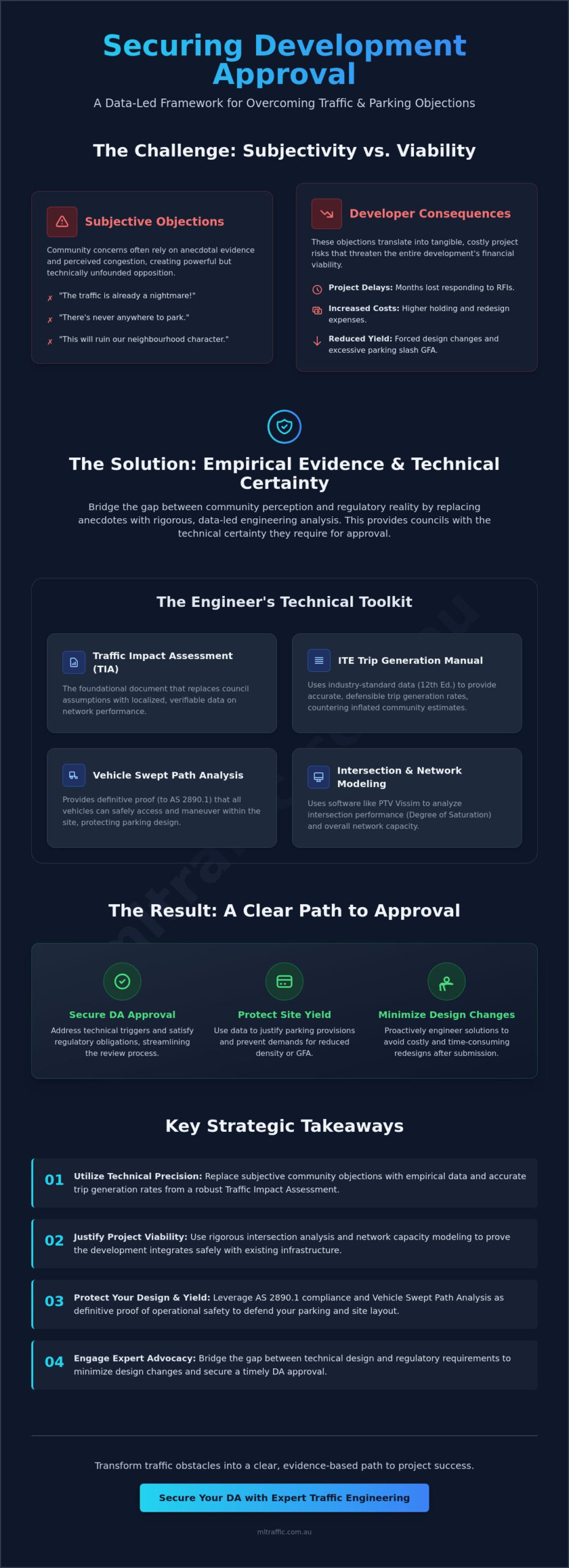
Subjective community objections are often the loudest voice in a Development Application meeting, but they’re rarely the most accurate. You understand that a single Request for Further Information (RFI) regarding local congestion can stall a project for months, driving up holding costs and threatening your site’s viability. These delays often lead to aggressive parking requirements that slash your total yield. Successfully justifying a development against existing traffic concerns requires moving beyond generalities and using a rigorous, data-led framework that replaces anecdote with empirical evidence.
By leveraging the latest technical standards, such as the ITE Trip Generation Manual 12th Edition and PTV Vissim 2026 simulation modeling, you can provide the technical certainty councils require. This article outlines how to use precise Traffic Impact Assessments and Vehicle Swept Path Analysis to overcome objections and secure DA approval with minimal design changes. You will learn how to transform traffic-related obstacles into a clear, evidence-based path toward project success. We’ll examine the strategic application of intersection analysis and parking demand assessments to protect your design integrity and streamline the regulatory review process.
Key Takeaways
- Utilize technical precision in Traffic Impact Assessments to replace subjective community objections with empirical data and accurate trip generation rates.
- Establish a clear path to project viability by justifying a development against existing traffic concerns using rigorous intersection analysis and network capacity modeling.
- Protect your site yield and parking design by leveraging AS 2890.1 compliance and Vehicle Swept Path Analysis as definitive proof of operational safety.
- Secure DA approval and minimize design changes through expert engineering advocacy that bridges the gap between technical design and regulatory requirements.
The Challenge of Justifying a Development Against Existing Traffic Concerns
Urban densification creates a natural tension with the fixed capacity of established road networks. Developers often face intense resistance when proposing high-yield projects in areas where residents already feel the strain of daily commutes. This friction results in “existing traffic concerns” becoming the primary justification for project opposition. Without a rigorous technical framework, these objections remain subjective and difficult to navigate. Identifying these friction points early is the first step toward securing a successful approval.
Many objections stem from a fundamental misunderstanding of Traffic Engineering Principles. There is a distinct difference between perceived congestion, which is how residents experience their local streets, and actual technical saturation. A road might feel “full” to a local driver, yet it may still operate well within its theoretical design capacity. Successfully justifying a development against existing traffic concerns requires quantifying this gap using empirical data rather than relying on anecdotal evidence.
To better understand how these concerns manifest during the planning phase, watch this overview of community traffic objections:
Traffic concerns are a leading cause of DA refusal because they intersect with public safety and infrastructure longevity. Planners use these concerns as a technical trigger to issue complex Requests for Further Information (RFIs). Early engineering intervention prevents these RFIs from stalling your project. By addressing capacity and safety issues before the initial submission, you move the conversation from emotional debate to evidence-based engineering.
The Economic Cost of Traffic Objections
Delays in the planning cycle translate directly to increased holding costs. Every month spent responding to a traffic-related RFI erodes your project margins. Councils may also demand excessive parking provisions or reduced site yield to mitigate perceived issues. A proactive justification strategy, utilizing a comprehensive range of traffic services, is significantly more cost-effective than attempting to redesign a site after a refusal. Protecting your yield requires technical evidence that silences subjective demands for reduced density.
Council vs. Community: Understanding the Source of Resistance
It’s vital to distinguish between mandatory engineering requirements and discretionary planning concerns. Community feedback often focuses on neighbourhood character or personal convenience. However, council planners are primarily bound by regulatory standards and safety benchmarks. Identifying specific technical triggers, such as intersection degree of saturation or sight distance, allows you to address the root of the resistance. Effective advocacy relies on meeting these technical benchmarks to satisfy the planners’ regulatory obligations.
The Traffic Impact Assessment (TIA) as Your Primary Justification Tool
A technical report serves as the foundation for any successful planning application. It is not merely a procedural requirement; it is your primary instrument for justifying a development against existing traffic concerns. A high-quality traffic impact assessment replaces council assumptions with localized, verifiable data. It provides a structured analysis of how a project integrates with the current road network without compromising safety or efficiency. To achieve this, the assessment must look beyond basic traffic counts and address the specific operational characteristics of the site.
A robust TIA must include several critical components to withstand scrutiny from council engineers. These include detailed descriptions of the proposed land use, an analysis of the existing road environment, and a projection of future traffic conditions. The assessment also addresses the following technical areas:
- Baseline traffic volume and peak hour flow rates.
- Site-specific trip generation and distribution modeling.
- Intersection capacity and queue length analysis.
- Provisions for parking, loading, and waste collection.
- Pedestrian and cyclist safety considerations.
Trip Generation: Moving Beyond Generic Rates
Standard rates provided by RTA or Austroads are often conservative and may overstate the actual impact of your project. Using generic averages can lead to unnecessary demands for infrastructure upgrades or reduced site density. We use empirical data from surveys of similar existing developments to provide a more realistic projection of traffic flow. This approach accounts for modern urban factors, such as “multi-modal” shifts where residents rely on public transport, walking, or cycling rather than private vehicles. Incorporating the latest data from the ITE Trip Generation Manual 12th Edition, released in August 2025, ensures your justification aligns with current global standards for post-pandemic traffic behavior.
Intersection Analysis and Network Capacity
Proving that a development’s contribution to peak hour traffic is negligible requires precise modeling. We utilize SIDRA software to evaluate intersection performance through metrics like the Degree of Saturation (DoS) and Level of Service (LoS). An acceptable change in LoS is often the difference between a project’s approval and its refusal. Our analysis accounts for “background traffic growth,” ensuring the development remains viable within the long-term strategic plan of the area. If you’re facing specific objections regarding local bottlenecks, a targeted intersection analysis can provide the technical evidence needed to silence subjective concerns. This level of detail demonstrates that the existing network can absorb the additional trips without creating a safety hazard or significant delays.
Justifying parking shortfalls also requires a data-led approach. By conducting car parking demand assessments, we prove that proximity to public transport and local amenities reduces the need for on-site spaces. This prevents council from imposing aggressive parking requirements that would otherwise reduce your total site yield.
Leveraging Empirical Data to Counter Subjective Concerns
Community opposition often relies on vague qualitative statements regarding “neighbourhood character” or “loss of amenity.” These are discretionary planning concerns that can be effectively dismantled through hard engineering evidence. When justifying a development against existing traffic concerns, the objective is to translate these emotional fears into quantifiable technical problems. A project that appears intrusive to a resident may actually align perfectly with state-mandated infrastructure benchmarks. Our role is to provide the data that bridges this gap between perception and reality.
Engineering precision provides the only reliable defense against subjective resistance. This technical approach is essential when justifying a development against existing traffic concerns during a contested council meeting. While a resident might claim a street is “dangerous,” a Sight Distance Assessment provides a binary result. The access point either meets the required safety standards or it doesn’t. This shift from opinion to empirical measurement is critical for securing DA approval without compromising your site’s design integrity.
Data-Driven Rebuttals for Parking Objections
Parking is frequently the most contentious aspect of a new development. Residents fear “spillover” parking will saturate local streets and limit their own access. We counter this by conducting local occupancy surveys that prove existing capacity can absorb any minor fluctuations. By using a Car Parking Demand Assessment, we provide evidence that lower-than-standard parking rates are justified by the specific demographics of the future occupants. Incorporating car-sharing schemes and green travel plans further reduces the demand for on-site spaces. This data-led approach links parking reductions directly to council’s own sustainability goals, making it difficult for planners to reject the proposal on discretionary grounds.
Safety as a Justification for Design
Safety is often used as a proxy for volume concerns by community groups. Proving that increased vehicle movements don’t equate to increased accident risk requires a structured approach. We apply road safety audit principles to validate every site access point and internal circulation route. This ensures that the design is fundamentally sound regardless of the traffic volume. Pedestrian safety modeling is also vital in high-density justifications. By demonstrating that walkability and sightlines are maintained, we silence objections that rely on perceived danger. This technical rigor ensures that safety remains a justification for the design rather than a barrier to its approval.
Strategic Design Modifications and Compliance Frameworks
Strategic design modifications serve as the final technical layer in justifying a development against existing traffic concerns. While data modeling addresses network capacity, the physical layout of the site must withstand scrutiny regarding access and safety. Technical compliance acts as a shield against subjective planning objections. By using AS 2890.1 as a non-negotiable benchmark, we ensure that parking designs are operationally sound and legally defensible. This precision prevents councils from imposing arbitrary design changes that could reduce your site’s total yield.
Minor adjustments to site geometry often resolve significant traffic flow objections. These tweaks might include widening a driveway throat to prevent queuing on the public road or adjusting a ramp gradient to improve vehicle transition. When we provide a Driveway Ramp Grade Assessment, we eliminate the guesswork for council engineers. This proactive approach proves that the site can function safely without impacting the existing road network. If you need to validate your site access, you can contact our senior principals for a technical review of your current plans.
Swept Path Analysis: Visual Evidence for Council
Visual turning path diagrams are significantly more persuasive than written descriptions in a DA submission. We utilize AutoTURN software to perform detailed swept path analysis, which provides definitive proof of vehicle maneuverability. This analysis is critical for proving that service vehicles, such as waste collection trucks and delivery vans, can access the site and exit in a forward direction. Demonstrating that these movements occur without disrupting local traffic flow is a key component in justifying a development against existing traffic concerns. It removes the ambiguity that often leads to costly Requests for Further Information (RFIs).
Compliance with Australian Standards (AS 2890)
Councils find it difficult to reject a design that strictly adheres to national regulatory standards. Adherence to the AS 2890 series provides a robust framework for car park design, including bay dimensions, aisle widths, and sightline requirements. However, unique sites often require navigating the “discretionary” space within these standards. The role of a traffic engineer is to apply expert judgment in these scenarios, certifying that the proposed design meets the intent of the code even when site constraints are present. This certification provides the accountability and professional assurance that planners require to grant approval. Our senior leadership remains involved in every certification to ensure the highest level of technical reliability and personnel continuity.
Securing DA Approval through Expert Engineering Advocacy
The final phase of the planning process requires more than technical accuracy; it requires authoritative advocacy. Justifying a development against existing traffic concerns often culminates in direct negotiations with council planners and engineers. A well-constructed Traffic Impact Statement acts as the definitive record of your project’s viability. This document must be finalized with a focus on persuasive impact, ensuring every technical finding is linked to a specific regulatory compliance requirement. Technical data is only as effective as the expert who defends it.
Advocacy involves knowing when to defend a design and when to accept modifications. If empirical data proves the road network can handle the projected load, the engineer must stand firm against subjective community pressure. However, minor modifications to a Car Park Design or a Driveway Ramp Grade Assessment can often satisfy a council’s safety concerns without compromising the project’s total yield. This strategic flexibility is only possible when the engineer possesses a deep understanding of the site’s technical constraints and the local planning context.
In cases where a DA is refused despite sound engineering, the matter may progress to the Land and Environment Court. The role of expert witness statements is paramount in these appeals. The court relies on objective, technical evidence to resolve disputes between developers and authorities. Providing clear, evidence-based testimony is frequently the deciding factor in overturning a refusal. A seasoned expert ensures that the engineering justification remains robust under the most rigorous legal scrutiny.
The Value of Senior Principal Involvement
Credibility in council meetings is built over decades of professional practice. Our senior principals bring over 15 years of experience to every project, providing a level of authority that junior staff cannot match. We employ a “no-gatekeeper” approach, ensuring developers have direct access to the experts performing the technical work. This continuity is a core signature of our philosophy. The engineer who initiates the relationship is the same professional who performs the analysis and defends the project before council. This builds long-term trust with planning departments, as they recognize the consistent reliability of our technical certifications.
Next Steps: From Objection to Approval
Moving from objection to approval requires a systematic review of your current position. If you are facing traffic-related hurdles, our team provides a clear path toward justifying a development against existing traffic concerns through the following steps:
- Reviewing existing traffic reports to identify technical vulnerabilities or data gaps.
- Preparing comprehensive, evidence-based rebuttals to council RFIs.
- Conducting targeted Intersection Analysis to prove network capacity.
- Finalizing a robust Traffic Impact Assessment (TIA) Report for submission.
Contact ML Traffic Engineers Australia today for a national services consultation to secure the expert advocacy your project requires.
Advancing Your DA from Submission to Approval
Successful site development depends on a robust technical foundation. You’ve seen how a data-led approach replaces subjective community fears with empirical engineering evidence. By utilizing rigorous Traffic Impact Assessments and adhering strictly to AS 2890.1 standards, you protect your site yield and minimize the risk of costly RFIs. The final step in justifying a development against existing traffic concerns is securing expert advocacy that withstands council scrutiny and legal appeals.
ML Traffic Engineers Australia provides the technical certainty required for complex urban projects. With over 15 years of experience and more than 10,000 successful projects across Australia, we offer the reliability your development needs. You receive direct access to senior principal engineers who manage your project from inception to certification. This personnel continuity ensures accountability and professional results. Secure your DA approval with expert traffic engineering justification. Contact ML Traffic Engineers Australia today.
Your project deserves a clear path to viability. We are ready to provide the technical evidence to make that happen.
Frequently Asked Questions
How do I justify a parking shortfall to the council?
You justify a parking shortfall by submitting a formal Car Parking Demand Assessment that utilizes empirical data rather than generic averages. This report analyzes local parking occupancy rates and the project’s proximity to high-frequency public transport. By proving that the actual demand is lower than the statutory requirement, you can protect your site yield. This evidence-based approach addresses council concerns regarding overspill into surrounding residential streets.
What is the most common reason for traffic-related DA refusal?
The most common reason for refusal is the failure to adequately address intersection capacity and road safety. Planners often cite unacceptable impacts on the local road network when a TIA lacks site-specific data. Without rigorous SIDRA modeling or sight distance assessments, council engineers may rely on conservative assumptions. These technical gaps make it difficult to overcome subjective objections from the community during the assessment phase.
Can the council reject my development if I meet all Australian Standards?
Yes, councils can still reject a development even if it meets all Australian Standards. While compliance with AS 2890 provides a strong technical shield, planners maintain discretionary power over broader impacts. They may argue that the cumulative impact on local congestion is too high. This is why justifying a development against existing traffic concerns requires a strategic framework that goes beyond simple code compliance to address network-wide performance.
How much does a Traffic Impact Assessment cost for a medium-sized development?
The cost of a Traffic Impact Assessment depends entirely on the project’s complexity and the specific requirements of the local council. Factors influencing the fee include the number of intersections requiring SIDRA modeling and the need for on-site traffic counts. Because every site has unique constraints, a customized quote is necessary to reflect the required technical rigor. Professional fees represent a small fraction of the potential holding costs caused by planning delays.
What happens if the local community objects to the traffic my project will create?
If the community objects, their submissions are reviewed by the council’s planning department. You must counter these qualitative fears with quantitative engineering evidence. By providing a technical rebuttal that addresses specific concerns like safety and volume, you move the debate from emotion to fact. This process is essential for justifying a development against existing traffic concerns and ensuring the planning decision is based on empirical data rather than resident sentiment.
How long does it take to prepare a technical rebuttal for a traffic RFI?
Preparing a technical rebuttal for a traffic RFI typically takes between one and three weeks. The timeframe depends on whether the council requires additional modeling, new traffic surveys, or minor design modifications. Responding quickly and accurately is vital to minimize holding costs. A well-prepared rebuttal addresses every point raised by the council engineer to prevent further rounds of questioning and move the project toward approval.
Is a swept path analysis mandatory for all developments?
Swept path analysis is not always mandatory, but it’s highly recommended for any site with constrained access or service vehicle requirements. Most councils require this analysis for medium to high-density developments to prove that waste and delivery trucks can enter and exit in a forward direction. Using AutoTURN software provides the visual evidence needed to confirm that the site layout is operationally safe and compliant with national standards.

Disclaimer
The content on www.mltraffic.com.au, including all technical articles, guides, and resources, is provided for general informational and educational purposes only. It is not intended to constitute professional advice in traffic engineering, transportation planning, development approvals, or any other technical or legal field.
While ML Traffic Engineers makes every reasonable effort to ensure the accuracy, completeness, and timeliness of the information published, we do not provide any warranties or representations (express or implied) regarding its reliability, suitability, or availability for any particular purpose. Any reliance you place on the content is strictly at your own risk.
In no event shall ML Traffic Engineers, its directors, employees, authors, or affiliates be liable for any direct, indirect, incidental, special, consequential, or punitive damages (including, without limitation, loss of profits, data, or business opportunities) arising out of or in connection with the use of, or inability to use, any information provided on this website.
The articles and guides on this site are not a substitute for engaging a qualified, registered professional traffic engineer (such as an NPER or RPEQ engineer) to assess your specific project requirements. For tailored advice, compliance assessments, or traffic engineering services, please contact a competent professional.
This disclaimer may be updated from time to time without notice. By accessing or using this website, you agree to be bound by the most current version of this disclaimer.
