

A nearby train station or bus stop doesn’t, by itself, justify providing fewer parking spaces. When justifying parking reduction public transport access must be considered alongside how people can reach the site, how useful the available services are and the likely demand for parking.
Good public transport access can influence parking needs, but proximity alone doesn’t show that a reduction will work for a particular development or meet the relevant planning requirements. A defensible case needs site-specific evidence, not assumptions.
This article explains how to assess parking demand and transport access, identify the planning criteria that apply to your project, and present a clear, evidence-led justification. It also outlines how a car parking demand assessment can test key assumptions, and when a Traffic Impact Assessment can provide wider network context. The aim is to help you understand what decision-makers may consider and whether specialist traffic engineering input could strengthen your application.
Key Takeaways
- Understand how justifying parking reduction public transport proposals depends on site-specific evidence, not proximity to a stop alone.
- Assess the journey from the development entrance to public transport, including service frequency, operating hours, connections and available accessibility information.
- Compare proposed parking supply with relevant demand evidence and planning benchmarks, explaining how surveys or comparable sites relate to your project.
- Organise the justification so each conclusion is supported by clear evidence and the planning controls that apply in your project’s jurisdiction.
- Identify when a Car Parking Demand Assessment or Traffic Impact Assessment could help test assumptions and address wider network considerations.
When Can Public Transport Support a Parking Reduction?
A parking reduction is a proposal to provide fewer spaces than the applicable planning baseline, benchmark or reasonable expectation for a development. Public transport access can support that proposal, but it doesn’t prove on its own that fewer people will need parking. A defensible approach to justifying parking reduction public transport proposals connects likely demand at the site with the transport options available to its intended users.
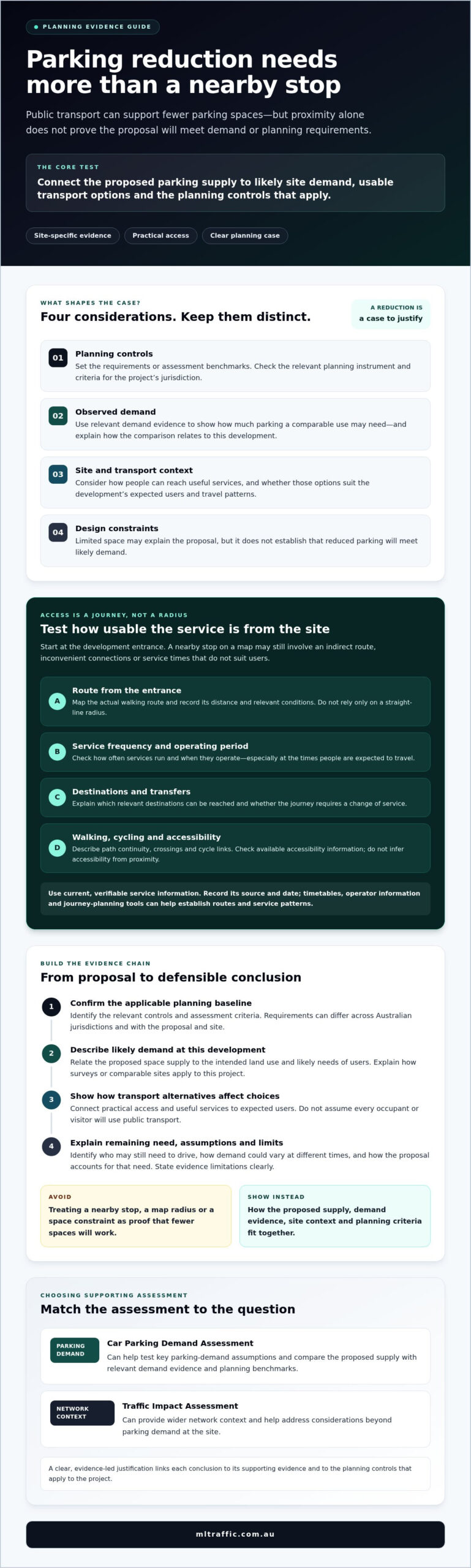
Keep four considerations distinct. Planning controls set the requirements or assessment benchmarks that apply. Observed demand helps show how much parking a comparable use may need. Site context affects whether people can realistically choose other travel modes. Design constraints, such as limited space, may explain the proposal but don’t establish that the reduced supply will meet demand.
Requirements differ across Australian jurisdictions and can vary with the proposal and site. Check the relevant planning instrument and assessment criteria before relying on a particular benchmark or assuming a general rule applies. The planning framework determines what needs to be assessed; the evidence explains why the proposed supply is appropriate for this development.
What does a parking reduction justification need to show?
Build a clear link between the proposed number of spaces, the development’s intended land use and the likely parking demand of its users. Explain how available alternatives could affect travel choices, rather than assuming every occupant or visitor will use public transport. A Transit-Oriented Development (TOD) approach places housing and activity near public transport to support reduced car dependency, but the principle still needs to be tested against the site and its users.
State the assumptions behind the case and any limitations in the evidence. Identify who may still need to drive, whether demand could vary at different times, and how the proposal accounts for that remaining need. A clear explanation is more persuasive than presenting a lower space count without showing how it relates to likely demand.
Why is proximity to public transport not enough on its own?
A stop can look close on a map but still be difficult to reach as part of a practical journey. Consider the route from the development entrance, connections between services and whether the transport option serves destinations relevant to users. Check service frequency and operating hours as well. A nearby service with limited operating times may not suit the travel patterns the development is expected to generate.
Don’t rely on a fixed distance rule unless the applicable planning framework specifies one. Measure access in the way required by the assessment criteria, and explain what that measure does and doesn’t show. This helps decision-makers assess transport access alongside demand, site conditions and the applicable planning controls.
How to Measure Public Transport Access for a Parking Case
Measure access from the development’s actual entrance to the public transport services people could use. A map radius can indicate what’s nearby, but it won’t show whether there’s a direct walking route or whether people must take a longer route to reach a stop or station. Record the route, its distance and the conditions that affect the journey.
For a sound case for justifying parking reduction public transport access needs to be assessed in practical terms. Review current, verifiable service information and record its source and date. Timetables, operator information and journey-planning tools can help establish routes and service patterns. Check available accessibility information, but don’t assume a service is accessible based on proximity alone.
Which public transport access measures are useful?
Present the measures that explain how useful the service is for the development’s expected users. These may include:
- Walking route: Map the route from the site entrance to the stop or station, rather than measuring only a straight-line radius.
- Service frequency and operating period: Summarise how often services run and when they operate, with particular attention to the times people are expected to travel.
- Destinations and transfers: Explain which relevant destinations can be reached and whether a journey requires a change of service.
- Walking and cycling connections: Describe the continuity and quality of paths, crossings and cycle links leading to public transport.
Frequency at one time of day may not reflect access for users travelling at another. Match the service review to the development’s likely travel periods. If access depends on a transfer, consider whether the connection makes the journey less practical rather than simply counting the available services.
How should site context shape the assessment?
Public transport access doesn’t affect every user in the same way. Consider the land-use mix, likely user groups, opening hours and any shift patterns. A site serving workers outside standard service hours may have different transport options from one with travel concentrated during the day. State these assumptions clearly and avoid treating all occupants, staff and visitors as if they have identical travel choices.
Check the walking and cycling routes on the ground where practical. Gradients, missing footpaths, difficult crossings and other barriers can affect whether a mapped route is usable. Note what was verified on site and what relies on published information. Include the assessment date, as timetables and service conditions can change.
For a proposal that also needs parking-demand evidence, a Car Parking Demand Assessment can help test assumptions alongside the access findings. The assessment should support a site-specific case, not imply that public transport access alone determines the appropriate parking supply.
What Evidence Makes a Parking Reduction Defensible?
A defensible case compares the proposed parking supply with relevant demand evidence and the planning benchmarks that apply to the development. It also explains how public transport access relates to the people expected to use the site. For justifying parking reduction public transport access is part of the evidence, not a substitute for testing likely parking demand.
Show where each conclusion comes from. The table below separates common evidence types, what they can support and the limitations decision-makers should be able to see.
| Evidence | What it can support | Limitations to explain |
|---|---|---|
| Applicable planning benchmarks | A clear comparison between the proposal and relevant parking requirements or assessment criteria. | A benchmark doesn’t, by itself, establish actual demand or explain why a different supply suits this site. |
| Parking surveys | An indication of observed occupancy at a particular site and during specified periods. | Results may not represent other seasons, days, operating periods or land uses. |
| Comparable-site evidence | A reference point for demand where the comparator has relevant land use, transport access and operating characteristics. | Differences between the sites can weaken the comparison. Explain how the sites were selected. |
| Public transport access information | Evidence about travel alternatives available to expected users, including service times and destinations. | Service availability doesn’t prove that all users can or will rely on it. |
How can parking demand evidence support the case?
For each survey, report when it was undertaken, the periods observed, the site’s land use and the measured parking occupancy. Note relevant limitations, such as seasonal conditions or unusual activity that may have affected the result. A snapshot can be useful, but shouldn’t be presented as conclusive without explaining what it represents.
Choose comparison sites carefully. Similar land use matters, as do public transport access, operating hours and other characteristics that could affect travel behaviour. If a comparator differs from the proposal, identify the difference and explain how it affects the comparison. Avoid relying on a single unrelated site as proof of demand.
How should transport and parking evidence be compared?
Set out the planning baseline, the proposed supply and the evidence used to assess likely demand. Then explain how transport access may influence travel patterns for the development’s users. Identify uncertainty and consider how the conclusion could change if demand is higher, services change or user travel patterns differ from the assumptions. This makes the reasoning transparent, including where parking may still be needed.
Keep the scope clear: a Car Parking Demand Assessment can test the proposal’s demand assumptions, while car park design addresses layout considerations. These are related but distinct parts of the case.
How to Prepare a Clear Parking Reduction Justification
A clear report makes it easy to follow the reasoning from the planning framework to the proposed parking supply. Each conclusion should point to evidence about this development, rather than relying on broad claims about public transport or parking demand. For justifying parking reduction public transport access is one part of a case that must also address likely demand, site conditions and the needs of different users.
What steps should the report follow?
Set out the assessment in a logical order so the reader can check how the evidence supports the proposal:
- Define the proposal: Describe the development, intended land use, proposed parking supply and scope of the assessment.
- Confirm the planning framework: Identify the relevant planning controls, benchmarks and assessment criteria for the project’s jurisdiction. Don’t assume a national rule applies.
- Present the evidence: Bring together site-specific parking demand, public transport access and site layout information. Identify the source and date of key evidence.
- Test the rationale: Explain how the evidence supports the proposed supply, what assumptions it relies on and what limitations remain.
- State the conclusion: Summarise whether the evidence supports the reduction and identify any residual parking or operational concerns.
Keep the conclusion proportionate to the evidence. If demand information is limited or travel patterns are uncertain, state that plainly rather than presenting assumptions as established facts.
How can applicants address likely assessment concerns?
Anticipate questions about who will use the development, when they will travel and whether available transport options suit those trips. Explain any operational needs that could affect parking demand. Treat accessible parking, loading and other distinct parking functions separately, in line with the applicable planning criteria and project requirements. A general reduction in parking supply shouldn’t obscure how these needs have been considered.
Mitigation or monitoring may be relevant where a specific, supportable measure addresses an identified risk. Describe what the measure is intended to address and how it relates to the evidence. Don’t rely on a future measure to fill a gap in the demand assessment, or propose monitoring without explaining what would be monitored and why.
Keep parking demand evidence distinct from design considerations. The AS 2890.1 car park design guide provides related context on car park design, but it doesn’t replace a site-specific case for the proposed parking supply.
Where the assessment would benefit from a structured review of demand assumptions and transport access, consider a Car Parking Demand Assessment to support the evidence-led case.
When to Use a Traffic Engineer for a Parking Reduction Proposal
A traffic engineer can help when the proposal depends on technical assumptions that need to be tested, or when parking, public transport access and site design evidence must be brought together. For justifying parking reduction public transport access should be considered alongside the development’s likely parking demand, not treated as a standalone reason for fewer spaces.
A Car Parking Demand Assessment can examine the proposed supply against the evidence available for the intended land use and site. It can also help identify gaps, such as survey information that doesn’t reflect expected operating periods or assumptions about who can use nearby transport. The purpose is to test the case, not guarantee that reduced parking provision will be accepted.
If the proposal also raises questions about vehicle movements or effects on the surrounding network, a Traffic Impact Assessment (TIA) may provide wider context. Parking demand analysis and a TIA address related but different questions. The appropriate scope depends on the proposal and the assessment requirements that apply.
What can a traffic engineer contribute to the assessment?
Technical input can connect the different parts of the case and check whether the conclusions follow from the evidence. This may include reviewing parking demand methods, public transport access assumptions and how the evidence sources relate to one another. A review can also highlight missing information or inconsistencies before the assessment is submitted.
Where the proposed parking supply needs to be considered alongside the car park layout, car park design can address relevant design considerations. This helps keep the demand case distinct from questions about how the proposed spaces function on site.
ML Traffic Engineers Australia provides traffic assessment and parking services, including Car Parking Demand Assessments and Traffic Impact Assessments. These services can support the technical assessment, but the planning decision remains with the relevant decision-maker.
What information should you prepare before seeking advice?
Provide the material that defines the proposal and explains how the reduction has been developed. A useful starting package includes:
- A development description, plans and proposed parking supply.
- Any parking surveys or comparable-site information, with survey dates, methods and site details.
- Public transport access information, including the source and date of service details.
- Relevant assessment documents and the planning controls or assessment questions, if known.
Clear source material helps the traffic engineer understand the project and identify what may need further assessment. For advice specific to your proposal, contact the traffic engineering team with the available plans and assessment information.
Build a Stronger Case for Your Parking Proposal
A sound case for justifying parking reduction public transport access combines practical access information with evidence of likely parking demand. It also explains how the proposed supply relates to the development’s users, site conditions and applicable planning criteria. Nearby services may support the rationale, but they don’t establish by themselves that fewer spaces are appropriate.
Keep the assessment clear and traceable. Use current transport information, explain the basis and limitations of demand evidence, and address remaining parking needs and relevant site constraints. A Car Parking Demand Assessment can test the proposal’s assumptions. If wider traffic or network effects also need consideration, a Traffic Impact Assessment may provide additional context. Neither assessment guarantees a planning decision.
ML Traffic Engineers Pty Ltd has over 15 years of experience supporting development applications with traffic engineering and transport planning services, including Car Parking Demand Assessments and Traffic Impact Assessments.
For project-specific advice, discuss your parking reduction assessment. Share your available plans and assessment information to help the team understand the proposal and the evidence it requires.
Frequently Asked Questions
Can public transport access justify a parking reduction?
Yes, public transport access can support a parking reduction when it forms part of a site-specific case about likely demand and travel choices. For justifying parking reduction public transport access should be considered alongside the development’s land use, expected users, parking evidence and site conditions. Check the relevant planning controls and assessment criteria for the project’s jurisdiction. Access alone doesn’t establish that a lower parking supply is suitable or will be accepted.
How close does public transport need to be to justify less parking?
There isn’t one distance that applies to every development. Check whether the relevant planning framework sets a specific measure or threshold. Otherwise, assess the practical route from the development entrance to the stop or station, not just a straight-line radius. Consider route continuity, crossings, gradients, service frequency, operating hours and destinations. A short mapped distance may still involve an inconvenient or inaccessible journey, so explain the actual access conditions.
What evidence supports a reduced parking requirement?
Useful evidence can include applicable planning benchmarks, parking surveys, relevant comparable-site data and current public transport service information. Explain survey dates, observation periods, site context and limitations. If using comparable sites, show why their land use, transport access and operating characteristics are relevant. Connect the evidence to the development’s likely users and proposed parking supply. No single survey or comparator should be treated as conclusive without explaining its scope.
Does proximity to a train station guarantee parking approval reductions?
No. Being near a train station doesn’t guarantee that a parking reduction will be accepted. The decision depends on the applicable planning framework and the evidence presented for the proposal. Explain how the station can be reached, whether services operate at relevant times, which destinations they serve and how these options relate to expected travel patterns. The case should also address likely parking demand, site constraints and any remaining parking needs.
How do you assess public transport access for a development application?
Start at the development entrance and document practical walking or cycling routes to usable stops or stations. Review current operator information or timetables, recording the source and date. Describe service frequency, operating periods, transfers and relevant destinations, and check available accessibility information. Consider whether route barriers or gaps affect access. Relate these findings to expected user groups and travel times, rather than assuming nearby services suit every trip.
Should a traffic engineer prepare a parking reduction justification?
Not every proposal needs a traffic engineer, but specialist input can help where demand assumptions, survey methods or access conditions need technical assessment. A Car Parking Demand Assessment can test the evidence and proposed supply. A Traffic Impact Assessment may address wider traffic or network considerations. ML Traffic Engineers Pty Ltd provides both services. Technical advice can strengthen the application, but it can’t guarantee the decision-maker’s outcome.

Disclaimer
The content on www.mltraffic.com.au, including all technical articles, guides, and resources, is provided for general informational and educational purposes only. It is not intended to constitute professional advice in traffic engineering, transportation planning, development approvals, or any other technical or legal field.
While ML Traffic Engineers makes every reasonable effort to ensure the accuracy, completeness, and timeliness of the information published, we do not provide any warranties or representations (express or implied) regarding its reliability, suitability, or availability for any particular purpose. Any reliance you place on the content is strictly at your own risk.
In no event shall ML Traffic Engineers, its directors, employees, authors, or affiliates be liable for any direct, indirect, incidental, special, consequential, or punitive damages (including, without limitation, loss of profits, data, or business opportunities) arising out of or in connection with the use of, or inability to use, any information provided on this website.
The articles and guides on this site are not a substitute for engaging a qualified, registered professional traffic engineer (such as an NPER or RPEQ engineer) to assess your specific project requirements. For tailored advice, compliance assessments, or traffic engineering services, please contact a competent professional.
This disclaimer may be updated from time to time without notice. By accessing or using this website, you agree to be bound by the most current version of this disclaimer.
