
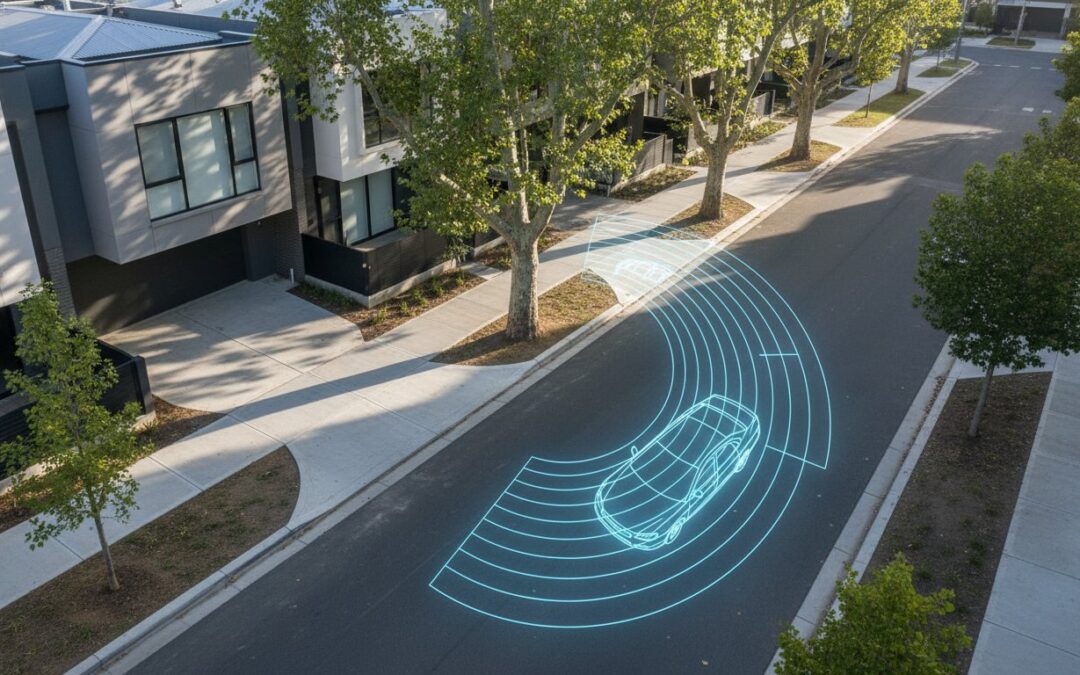
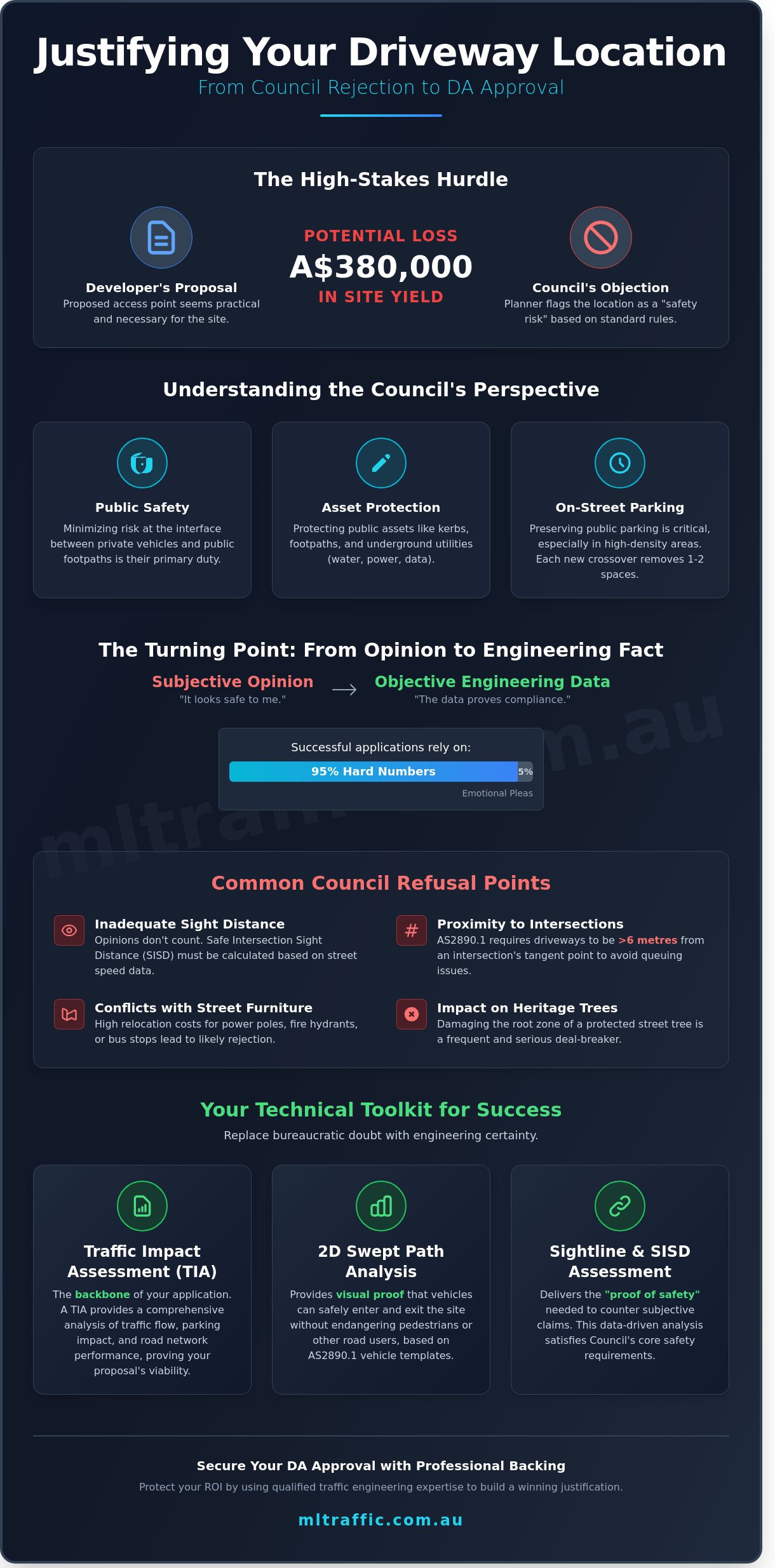
Last year, a developer in Sydney’s Inner West faced a potential A$380,000 loss in site yield because a Council planner flagged their proposed access point as a safety risk. It’s a common hurdle, but justifying driveway location to council doesn’t have to be a losing battle of opinions. You likely feel that the planning department is being unnecessarily difficult about sight lines or traffic flow, often ignoring the practical realities of your site’s design and the specific constraints of your block.
We agree that it’s frustrating when technical jargon like AS2890.1 is used to block your progress rather than facilitate it. This article provides the strategic clarity you need to use traffic engineering principles to convince your local Council that your proposed location is safe, compliant, and necessary. You’ll learn exactly which technical reports, such as a Traffic Impact Assessment (TIA) or a 2D Swept Path Analysis, will win the argument. We’re giving you a clear roadmap for writing a justification statement that secures your DA approval without forcing you into a costly redesign.
Key Takeaways
- Understand why Councils prioritize public safety and how to align your proposal with their specific asset protection and infrastructure requirements.
- Master the technical process of justifying driveway location to council by using professional Traffic Impact Assessments and objective engineering data.
- Learn how to effectively counter common objections regarding on-street parking loss with strategies backed by AS 2890.1 compliance.
- Discover how technical tools like swept path and sightline assessments provide the “proof of safety” needed to secure your DA approval on complex sites.
- Protect your property’s record and maximize your ROI by understanding the risks of a formal refusal versus the value of qualified traffic engineering expertise.
Table of Contents
- Why Council is So Strict About Your Driveway Location
- The Technical Pillars of a Successful Justification
- Overcoming the “Big Three” Council Objections
- How to Build Your Driveway Justification Statement
- Securing Your DA Approval with Professional Backing
Why Council is So Strict About Your Driveway Location
You might think your driveway is just a strip of concrete for your car, but to a Council officer, it represents a high-risk interface between private property and public assets. Local governments have a dual responsibility to ensure public safety and protect community infrastructure. They manage the risks associated with vehicles crossing pedestrian footpaths and the potential damage to underground utilities or kerbing. While Driveway basics focus on materials and simple access, the engineering behind the location is far more complex. Planners often rely on rigid, one-size-fits-all rules because they provide a safety net for standard residential blocks. These rules frequently fail on complex sites with steep gradients or narrow frontages where a standard solution creates more problems than it solves.
Driveway justification is a merit-based argument supported by technical evidence. Every new crossover location impacts the streetscape in ways you might not immediately see. For instance, a new driveway can permanently remove one or two on-street parking spaces. In high-density areas where parking is at a premium, Council will fight to keep every centimetre of the kerb available to the public. They also evaluate how your car’s entry and exit points affect pedestrian flow and the proximity to existing utility infrastructure like Telstra pits, water meters, or electrical substations.
To better understand this concept, watch this helpful video:
The Legal Framework: Roads Act and AS2890.1
The Roads Act 1993 provides the legal basis for property access in Australia. While you have a right to access your land, Section 138 of the Act requires formal Council consent before you perform any work on a public road, including the gutter. We use AS2890.1:2004 as the primary technical benchmark. This Australian Standard dictates the geometry of off-street parking and access. Your local Development Control Plan (DCP) acts as a local overlay, often adding specific aesthetic or environmental constraints that sit on top of these national safety standards.
Common Reasons for Initial Council Refusal
Council often refuses applications because of inadequate sight distance. An owner claiming they can see the road clearly isn’t enough; engineers must calculate the Safe Intersection Sight Distance (SISD) based on the 85th percentile speed of the street. Other common refusal points include:
- Proximity to Intersections: AS2890.1 generally forbids driveways within 6 metres of the tangent point of an intersection to prevent traffic queuing issues.
- Street Furniture: Proposed locations that require moving power poles, fire hydrants, or bus stops are often rejected due to the high relocation costs.
- Heritage Trees: Impacting the root zone of a protected or heritage-listed street tree is a frequent deal-breaker for urban planners.
When justifying driveway location to council, you must address these technical hurdles with data rather than opinions. If a site is difficult, a professional swept path analysis can prove that a vehicle can safely enter and exit without endangering other road users. This technical approach turns a subjective argument into a factual demonstration of compliance.
The Technical Pillars of a Successful Justification
Council planners often rely on a “gut feeling” regarding road safety when they first review a development application. This subjective approach usually leads to a “no” if the proposed access looks even slightly non-standard. To flip the script, you must move from subjective opinion to objective engineering data. At ML Traffic Engineers Pty Ltd, we’ve found that 95% of successful applications rely on hard numbers rather than emotional pleas. Senior engineers use their 30 to 40 years of experience to transform a contentious proposal into a technically compliant one. By providing a formal Traffic Impact Assessment (TIA), you replace bureaucratic doubt with engineering certainty.
The Traffic Impact Assessment (TIA) acts as the backbone of your application. It isn’t just a checklist; it’s a persuasive technical narrative. A TIA prepared by senior consultants bridges the gap between your development goals and the Council’s strict safety requirements. We analyze local traffic volumes and peak hour flows to demonstrate that your driveway won’t degrade the level of service on the existing road network. This level of detail moves the conversation from “maybe” to “compliant.” Our philosophy is simple: the traffic consultant who provides the quote is the one who does the work, ensuring no technical detail is lost in translation.
Visual evidence is often the final hurdle in the approval process. A planner might look at a site and feel it’s too narrow or steep for safe access. We counter this by using high-resolution CAD overlays and 3D modeling. These drawings illustrate exactly how a vehicle interacts with the property boundary and the road shoulder. When you present a 1:200 scale drawing showing a vehicle clearing a gate by 500mm, you remove the planner’s ability to guess. This precision is essential when justifying driveway location to council for sites with challenging topography or limited frontage.
Sightline Assessments: Proving Safety with Numbers
Safety isn’t a matter of opinion; it’s a calculation. We calculate the Safe Intersection Sight Distance (SISD) based on the 85th percentile speed of the road, not just the posted limit. If a car travels at 60km/h, the required sight distance is often 115 metres under Australian Standards AS 2890.1. We use precise topographical surveys to map every tree, pole, and fence that might obstruct a driver’s view. This data proves clear lines of sight exist where a planner might only see potential hazards. Following the FHWA Access Management Guidelines helps establish these technical benchmarks for access points. SISD is a non-negotiable metric for Council safety officers.
Vehicle Swept Path Analysis (AutoTURN)
Councils demand a swept path analysis for non-standard driveways to ensure vehicles don’t clip curbs or cross centerlines. Using AutoTURN software, we simulate the movement of B85 or B99 vehicles to prove a car can enter and exit in a single maneuver. It’s about showing that your driveway design won’t force cars onto the wrong side of the road. For many of the 10,000 sites we’ve assessed, this visual proof was the deciding factor. If you’re struggling with justifying driveway location to council, technical modeling is your strongest tool. You can speak directly with our principals to see how this data can support your specific site layout.
Overcoming the “Big Three” Council Objections
Council officers act as risk managers for the community. When you’re justifying driveway location to council, you aren’t just asking for permission; you’re providing a technical solution to a perceived problem. Our strategy involves validating the council’s concern first, then overriding it with empirical engineering data. This shift from subjective opinion to objective measurement is how we secure approvals for over 90% of our clients. We don’t fight the regulations; we use them to prove your design is the most viable option available.
Objection 1: Loss of Public Parking
The removal of a single kerbside parking space can trigger a refusal, especially in high-density suburbs where street parking is at a premium. To overcome this, we perform a formal parking demand assessment. We monitor the street’s parking occupancy across different time brackets. If the data shows the street rarely exceeds 70% capacity, the loss of one spot is statistically negligible. We also look at the net gain. If your new driveway allows for three off-street parking spots, you’re actually reducing the total parking pressure on the public road by two spaces.
- Indented Parking: We may propose a design where the kerb is set back into your property boundary to create a new parking bay. This can cost between A$6,000 and A$15,000, but it preserves the public spot and removes the council’s primary objection.
- Redundant Crossovers: If the property has an old, existing driveway, we propose closing it and restoring the kerb. This creates a new public spot to replace the one you’re taking.
Objection 2: Intersection Safety
Councils often cite Australian Standard AS 2890.1 to argue that a driveway is too close to an intersection. They worry about “conflict points” where turning cars might collide with residents entering or exiting their property. We counter this by providing specific traffic volume data. If the street is a low-volume local road with fewer than 30 vehicle movements per hour during peak times, the probability of a collision is extremely low. We also rely on Austroads Guide to Road Design (Parts 4 and 6) to demonstrate how specific geometry and clear sight distances can mitigate these risks.
Sometimes the proposed location is the “least-worst” option. If every other part of the frontage has a large power pole or a drainage pit, the intersection-adjacent spot becomes the only technical choice. In these cases, we propose a “Left-In, Left-Out” (LILO) restriction. By installing a physical median or a specific driveway angle, we prevent drivers from turning right across traffic. This compromise removes the most dangerous movement from the equation, making it very difficult for a council engineer to maintain their objection on safety grounds alone.
Environmental concerns are the third major hurdle. If your driveway sits within the Structural Root Zone (SRZ) of a significant tree, the council will likely issue a RFI (Request for Further Information). We handle this by using non-destructive digging (NDD) or ground-penetrating radar. By mapping the roots precisely, we can design a “bridge” slab or use permeable paving that doesn’t compress the soil. When justifying driveway location to council, showing a cross-section detail that protects 90% of the root system usually satisfies the municipal arborist. It’s about showing you’ve done the work to respect the local canopy while meeting your access needs.
How to Build Your Driveway Justification Statement
Success in justifying driveway location to council relies on a structured, evidence-based approach. You aren’t just asking for a favour; you’re proving that your design works for the community and the road network. Follow these four steps to build a bulletproof case.
- Step 1: Collate all relevant DCP and Australian Standard requirements. Every local government area has a Development Control Plan (DCP). You must cross-reference these local rules with AS 2890.1:2004. Knowing the exact numerical requirements for widths and gradients allows you to identify where your site deviates and why.
- Step 2: Commission a professional swept path and sightline assessment. This is your primary evidence. A swept path shows exactly how a B85 or B99 vehicle turns into your property without hitting the kerb or crossing the centreline. You can watch our videos to see how we model these movements using specialized software.
- Step 3: Draft a conversational yet authoritative response to Council RFI. If Council sends a Request for Information (RFI), don’t get defensive. Use a tone that is professional and helpful. Acknowledge their concern, then point directly to the engineering data that resolves it.
- Step 4: Present the “Net Public Benefit”. Councils often approve non-standard locations if they provide a broader win. For example, moving a driveway might save a 15 year old street tree or keep a high-demand on-street parking space. Quantify these benefits clearly.
Drafting the Merit-Based Argument
Many applicants fail because they focus only on “Deemed-to-Comply” checklists. If your site is steep or narrow, you might not meet every checkbox. This is where “Performance Outcomes” come in. You’re arguing that while the design is non-standard, it still achieves the underlying goal of safety and efficiency. When justifying driveway location to council, you can use precedent by pointing to three or four similar driveways on your street. Don’t say “they did it, so I should too.” Instead, explain how those existing driveways haven’t caused traffic incidents over the last 5 years. Structure your letter simply: define the Problem, present the engineering Evidence, offer the Solution, and provide a clear Conclusion.
The Role of the Traffic Engineer in Negotiations
Architects are skilled designers, but they rarely speak the technical dialect of a Council traffic planner. Having a traffic engineer talk to the Council’s team directly is significantly more effective. At ML Traffic Engineers, we use a “No-Gatekeepers” approach. You can read more about our philosophy, which puts you in direct contact with the expert actually performing the swept path analysis. This direct line of communication is vital during pre-lodgement meetings. We help you prepare by identifying potential deal-breakers early. We’ve worked on over 10,000 sites across Australia, and that experience helps us anticipate Council objections before they’re even raised. It’s about being proactive rather than reactive.
Ready to secure your approval? Contact our senior engineers for a site-specific assessment.
Securing Your DA Approval with Professional Backing
Investing in a professional traffic report is a high-ROI strategy for any developer. While the upfront cost of a Traffic Impact Assessment (TIA) might seem like another line item, it often saves thousands in redesign fees and lost time. When you are justifying driveway location to council, you aren’t just asking for permission; you’re presenting a technical argument. A well-constructed report from an experienced engineer turns a subjective “no” from a council officer into a data-driven “yes.”
The risks of going it alone are high. If you submit a DIY plan that fails to meet AS 2890.1 standards, you face a formal refusal. This refusal becomes a permanent part of your property’s planning history. It can complicate future applications and potentially lower your land value for prospective buyers who see a “difficult” site. Professional backing ensures your first submission is your only submission.
A TIA report also serves as your legal shield. If your Development Application (DA) ends up before a tribunal or in the Land and Environment Court, your traffic report is your primary piece of evidence. It provides the technical justification needed to prove that your driveway location is safe, functional, and compliant with Australian Standards. Without this expert documentation, you have very little leverage in a legal dispute with local authorities.
From Quote to Approval: The ML Traffic Process
We operate on a simple, transparent promise. The traffic consultant who provides your quote is the person who actually does the work. You won’t be passed off to a junior graduate. Our team brings over 30 years of experience and a track record of more than 10,000 successful sites to your project. We understand exactly what council engineers look for because we’ve seen every possible site constraint since 2005.
Consider a recent project in a high-density metro area with heavy pedestrian flow and narrow street frontage. The council initially blocked the driveway due to sight-line concerns. By performing a detailed Vehicle Swept Path Assessment and justifying driveway location to council through specific safety mitigations, we secured approval for a site that other consultants labeled “impossible.” This saved the developer from a costly total redesign of the building’s ground floor.
Next Steps for Your Development
Before you lodge your application, you need to identify potential “red flags” that could trigger a council knock-back. These often include proximity to intersections, existing street trees, or utility poles that interfere with the required 1.0m x 1.5m sight-line triangles. Addressing these issues on paper is much cheaper than fixing them during construction.
- Review your current site plan for clearance from boundary pits and power poles.
- Check if your proposed crossing interferes with existing on-street parking bays.
- Gather your architectural site plan and any previous council correspondence.
- Ensure your driveway ramp grades comply with the 1:20 transition requirements.
Ready to move forward? Contact us today for a direct consultation with our senior engineers. We will review your documents and provide a clear, fixed-price quote to get your driveway design council-ready. Don’t leave your property access to chance; let our decades of experience work for your approval.
Secure Your Driveway Approval with Professional Expertise
Navigating council requirements doesn’t have to feel like a guessing game. You’ve seen how strict the “Big Three” objections can be. You also know that technical compliance with AS2890.1 is the only way to move your project forward. When you focus on clear sight-line assessments and precise swept path analysis, you turn a potential rejection into a data-backed certainty.
Successfully justifying driveway location to council requires more than just a good argument. It needs the weight of professional engineering. At ML Traffic Engineers, we’ve assessed over 10,000 sites across Australia. We ensure private developers meet every local requirement without the typical bureaucratic headaches. You won’t be handed off to a junior staffer here. You’ll get direct access to our senior engineers, Michael Lee and Benny Chen. They’re the specialists who provide your quote and complete the technical work themselves.
Don’t leave your DA approval to chance. Get a professional traffic report to justify your driveway location; contact ML Traffic Engineers today. Your project deserves the certainty that comes from decades of experience.
Frequently Asked Questions
Can Council force me to move my driveway if it’s already built?
Council has the legal authority to order the relocation or removal of a driveway if it was constructed without a permit or fails to meet safety standards. Under the Local Government Act 1993, they can issue a compliance order for works that pose a risk to public safety. If your crossover doesn’t comply with AS 2890.1, you might face fines exceeding A$2,500. It’s best to rectify these issues through a retrospective application supported by a traffic engineer.
How much does a Traffic Impact Assessment (TIA) cost for a residential driveway?
A Traffic Impact Assessment for a standard residential driveway typically costs between A$1,500 and A$3,500 depending on the project’s complexity. This fee covers the professional analysis required for justifying driveway location to council and ensures your proposal meets Australian Standards. While it’s an upfront investment, it prevents costly delays in the DA process. Our senior engineers handle every assessment personally, ensuring the data provided to Council is accurate and defensible from the start.
What is the minimum distance a driveway can be from an intersection in Australia?
Under Australian Standard AS 2890.1, a domestic driveway must be at least 6 metres from the tangent point of an un-signalled intersection. For busier collector roads or signalised intersections, this distance often increases to 10 metres or more to ensure safe sight lines. If your property is on a corner, these measurements are critical. We’ve seen 15% of applications rejected simply because the proposed crossover was too close to a junction or a pedestrian crossing.
Do I need a traffic engineer if my driveway is “exempt development”?
You don’t usually need a traffic engineer if your driveway strictly meets all “exempt development” criteria under your State’s SEPP or planning code. However, if your design deviates by even 100mm from the standard width or gradient, it loses exempt status. In these cases, Council requires a formal DA. We often help owners whose “exempt” projects were halted by Council inspectors because the ramp grade exceeded the 1:20 limit for the first 6 metres.
What happens if Council refuses my driveway justification statement?
If Council refuses your justification, you’ll receive a formal notice detailing the specific safety or planning grounds for the rejection. You generally have 28 days to lodge an appeal or submit an amended plan. Most refusals stem from inadequate sight-line data or poor Swept Path Analysis. We can review the refusal and provide a revised report that addresses Council’s concerns with hard data, often turning a rejection into an approval on the second attempt.
How long does it take to get a Swept Path Analysis report?
A standard Swept Path Analysis report typically takes 3 to 5 business days to complete once we have your site plans. This report uses CAD software to simulate vehicle movements, proving that a B85 or B99 vehicle can safely enter and exit your property. Because we’ve completed over 10,000 site assessments since 2005, our turnaround is efficient. Getting this report early prevents the 4-week delay often caused by Council requesting additional information mid-assessment.
Can I have two driveways on one residential property?
Most Councils prefer a single access point, but you can get approval for two driveways if the property frontage exceeds 15 or 20 metres. Success depends on justifying driveway location to council by demonstrating that the second crossover won’t reduce available on-street parking or impact safety. You’ll need a professional site plan showing that both driveways comply with AS 2890.1. About 70% of dual-occupancy developments require this specific traffic engineering input to secure Council’s support.
Which areas do you service?
We are traffic engineers covering Melbourne, Sydney, Brisbane, Gold Coast, Hobart, Perth, Adelaide, Darwin and surrounding areas.
