

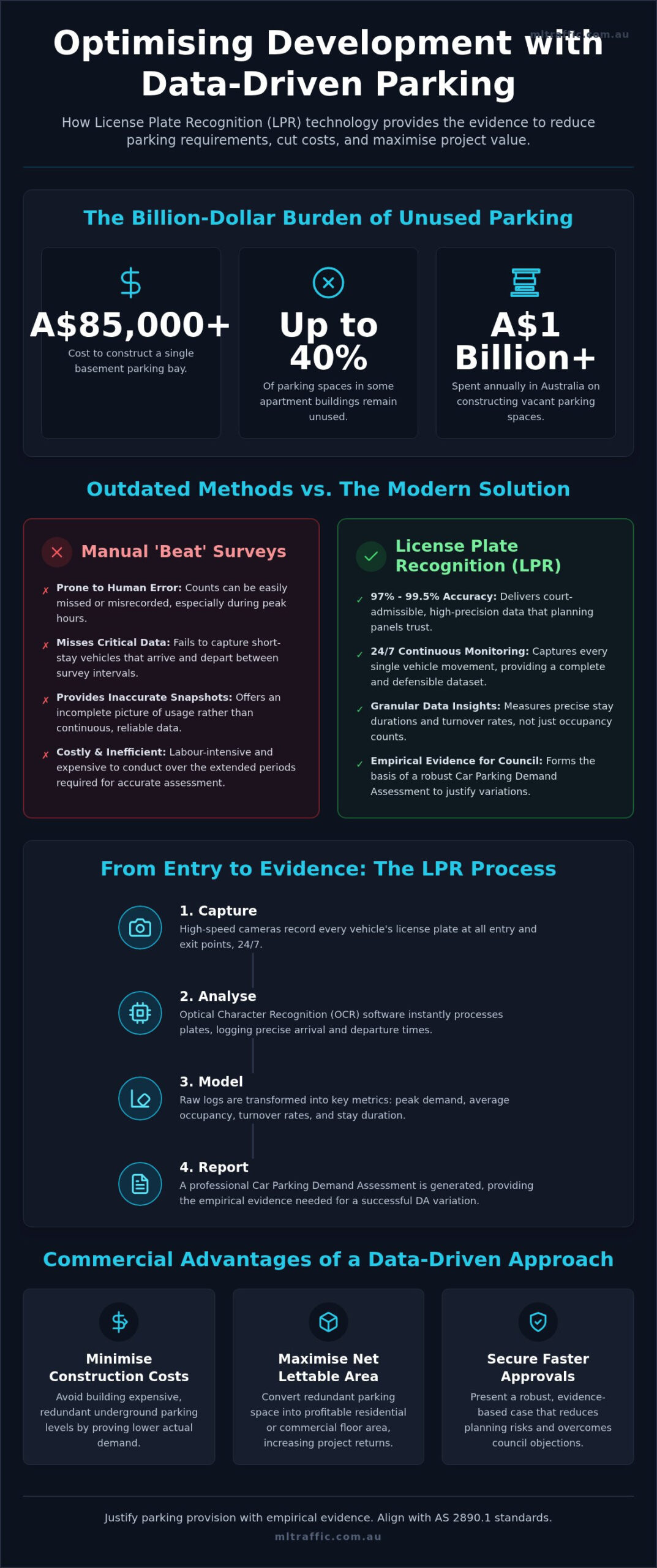
With the cost of constructing a single basement parking bay now exceeding A$85,000, developers cannot afford to build redundant infrastructure. Research indicates that in some Australian apartment buildings, up to 40% of parking spots remain unused, yet many local councils continue to enforce rigid, outdated parking minimums. It’s a significant financial burden that can jeopardise the feasibility of a project. Relying on manual parking surveys often fails to provide the level of accuracy needed to challenge these decisions effectively during the planning process.
You can overcome these bureaucratic hurdles by providing empirical evidence that proves your site’s specific needs. This guide from ML Traffic Engineers Australia details the methodology for justifying parking provision with LPR data to secure a successful development application with reduced parking requirements. We’ll show you how License Plate Recognition technology delivers the precision required for a data-backed Traffic Impact Assessment. By replacing theoretical estimates with high-accuracy data, you can minimise your car park footprint and significantly improve your project’s net lettable area. We’ll explore the technical requirements of AS/NZS 2890.1 and explain how our senior-led analysis can turn a potential council rejection into an approved, optimised development.
Key Takeaways
- Avoid the high cost of over-parking by understanding why statutory rates often fail to reflect actual transport trends and modern site requirements.
- Master the process of justifying parking provision with LPR data to deliver the empirical evidence necessary for a successful parking reduction request.
- Compare the technical advantages of LPR technology over manual ‘beat’ surveys to ensure your data is defensible before planning panels.
- Implement a compliant parking occupancy survey by selecting optimal camera positions and survey durations that capture true peak and average occupancy.
- Leverage senior-level expertise to transform raw LPR logs into a professional Car Parking Demand Assessment that aligns with AS 2890.1 standards.
The Challenge of Rigid Parking Provision in Australian Planning
Australian planning schemes frequently utilise rigid statutory parking rates that fail to account for modern transport trends. These “one-size-fits-all” requirements often lead to excessive parking provision, which places an unnecessary financial burden on developers. Councils generally expect developments to meet these minimums unless a professional Car Parking Demand Assessment provides empirical evidence for a variation. Justifying parking provision with LPR data has emerged as the most reliable method for bridging the gap between theoretical requirements and actual site needs. It replaces outdated “beat” surveys with high-precision metrics that planning panels trust.
Councils typically require evidence across several key areas before granting a variation:
- Proximity to high-frequency public transport networks.
- Availability of on-street parking and surrounding land uses.
- Empirical data demonstrating actual peak demand for similar developments.
- Alignment with local Integrated Transport Plans (ITP).
The Commercial Impact of Excess Parking
The financial implications of over-parking are severe. As of May 2026, the cost of constructing a single basement parking bay is estimated at over A$85,000. When a development is forced to include redundant levels of underground parking, it directly impacts project feasibility and extends construction timelines. Industry data suggests Australia spends over A$1 billion annually on constructing parking spaces that remain vacant. In some apartment buildings, up to 40% of parking spaces stay empty. By reducing the car park footprint, developers can maximise net lettable area and align with modern sustainable development goals that aim to reduce car dependency.
When to Challenge Standard Parking Rates
Not every site requires the full statutory allocation. Sites with high walkability scores or proximity to major public transport hubs are primary candidates for parking reductions. Mixed-use developments also present a “shared parking” opportunity where different tenancies reach peak demand at different times. In redevelopment scenarios, existing usage is often poorly understood. Utilising Automatic Number Plate Recognition (ANPR) technology allows for the collection of precise occupancy and turnover data. This empirical approach ensures that justifying parking provision with LPR data is based on facts rather than assumptions. It provides a clear path for our senior principals to navigate complex Australian Standards and secure council approval for variations. This data-driven strategy is essential for projects where traditional manual surveys would be too inaccurate or costly to perform over an extended period.
Leveraging License Plate Recognition (LPR) for Accurate Data
LPR technology employs high-speed cameras and specialised OCR software to record vehicle movements at entry and exit points. Unlike static counts, this system tracks individual vehicles to determine precise stay durations and turnover rates. This granular level of detail is fundamental when justifying parking provision with LPR data. It provides the empirical foundation for a robust Car Parking Demand Assessment. Modern systems achieve accuracy rates between 97% and 99.5%, processing data in milliseconds to ensure no vehicle is missed. This high-speed capture is essential for sites with high traffic volumes where manual recording is physically impossible.
Why LPR Outperforms Manual Surveys
Traditional “beat” surveys rely on staff walking through a site at set intervals. This method is prone to human error and often misses “short-stay” vehicles that arrive and depart between recording rounds. LPR eliminates these gaps by providing 24/7 monitoring without the risk of staff fatigue. It captures the exact length of stay for every vehicle, which is a critical metric for demand modelling. By moving towards data-driven parking management, developers can present a continuous picture of usage rather than a series of snapshots. This comprehensive data set allows for a more nuanced analysis of peak versus average occupancy, ensuring the resulting assessment reflects reality.
Data Integrity and Council Acceptance
Planning authorities and councils increasingly demand verifiable evidence for parking variations. Manual tally sheets are often viewed with scepticism due to their subjective nature. In contrast, LPR produces timestamped logs that serve as “hard evidence” in a Traffic Impact Assessment. These data sets are entirely auditable, allowing council officers to verify the findings if required. We ensure all data collection complies with Australian privacy regulations, including the secure handling of vehicle identifiers. This meticulous approach to data integrity is why our traffic engineering services are trusted by developers and planning panels alike. If you need to prove that a site’s actual demand is lower than statutory rates, the precision of LPR is your most persuasive tool. You can contact our senior principals to discuss a tailored survey for your next project.
Justifying Parking Reductions with Empirical Evidence
Raw LPR data is merely a collection of timestamps and plate identifiers. The value for a developer lies in transforming these logs into a professional Car Parking Demand Assessment. By justifying parking provision with LPR data, we provide planning authorities with a clear picture of how a site actually performs under various conditions. We specifically analyse the relationship between peak occupancy and average occupancy to identify the minimum viable number of spaces. If peak demand only occurs for a very brief period, building a permanent basement level to accommodate that outlier is commercially illogical and often unnecessary.
Parking turnover rates offer further proof of efficiency. In the context of commercial viability, parking turnover refers to the number of different vehicles that occupy a single parking space over a defined period, indicating the intensity of use for visitors. High turnover suggests that a smaller number of spaces can successfully serve a larger volume of users. This logic is increasingly accepted by authorities across the country. For example, local government parking technology trials across Australia demonstrate how municipalities are using similar technology to better understand and manage parking behaviour. This shift towards data-driven policy supports developers who can provide comparable, site-specific evidence.
Calculating the ‘True’ Parking Demand
To ensure operational resilience, ML Traffic Engineers Australia applies a technical safety buffer to the LPR data. This typically involves adding a 10 to 15 percent margin to the recorded peak demand to account for arrival fluctuations and ensure the car park remains functional during busy periods. We also adjust for seasonal variations or special events that might influence usage. This rigorous approach addresses the “spill-over” concern often raised by planning panels. By proving that the proposed provision can handle peak loads without forcing vehicles onto local streets, we remove a primary reason for DA rejection.
Building the Case for Council Approval
The final step involves integrating these LPR findings into a comprehensive Traffic Impact Assessment. We compare the actual demand data against the AS 2890.1 car park design standards to demonstrate where statutory rates are excessive for the specific site context. Presenting this data through occupancy graphs and heat maps makes the evidence undeniable. It allows our senior principals to argue for variations based on site-specific truth rather than generic planning codes. This meticulous documentation is essential for justifying parking provision with LPR data before a planning panel or in an appeals process.
Executing a Compliant Parking Occupancy Survey
A successful parking reduction request depends entirely on the validity of the survey methodology. A single day of data is insufficient for justifying parking provision with LPR data before a planning authority. We typically recommend a minimum monitoring period of seven consecutive days to capture the full variance between weekday and weekend demand. It’s critical to perform these studies under “normal” operating conditions. We purposely avoid school holiday periods, major public holidays, or times when local road closures may artificially influence traffic flow. Coordinating these efforts with a qualified traffic engineer from ML Traffic Engineers Australia ensures that the resulting data set is robust enough to withstand council scrutiny.
Survey Methodology and Best Practices
Determining the survey’s catchment area is the first technical requirement. This involves identifying all on-site and relevant off-site parking within a walking distance appropriate for the specific land use. We differentiate between staff, visitor, and resident parking behaviour because each group exhibits distinct arrival and stay-duration patterns. Data cleaning is another essential step in our process. We implement strict protocols to handle “ghost vehicles”, which are instances where a plate might be misread or an exit obscured. Justifying parking provision with LPR data requires this level of meticulous oversight to ensure the final demand figures are accurate and defensible.
Technical Requirements for LPR Deployment
The physical deployment of LPR hardware must be precise to ensure high capture rates. Cameras are positioned at specific mounting heights and angles to accommodate Australian plate formats and various vehicle types. Technical considerations include:
- Infrared Lighting: Essential for maintaining plate recognition accuracy during night-time hours or in low-light basement environments.
- High-Speed Processing: Software must manage high-volume entry and exit points during peak periods without data latency or loss.
- OCR Calibration: Regular calibration ensures the system maintains the high accuracy rate expected by planning panels.
Our senior principals oversee every stage of the deployment and data analysis. This “no-gatekeepers” approach ensures that the expert presenting your data to the council is the same person who managed the technical study. To ensure your next project is backed by compliant evidence, contact ML Traffic Engineers Australia to discuss a tailored survey plan.
The Role of ML Traffic Engineers in Your DA Success
ML Traffic Engineers Australia brings over 30 years of combined expertise to every project. While the technology provides the raw data, our registered traffic engineers (NPER and RPEQ) provide the authoritative interpretation required to influence planning authorities. We have assessed over 10,000 sites since 2005, giving us a deep understanding of how various councils view parking variations. When justifying parking provision with LPR data, you need more than just a spreadsheet of timestamps. You require a meticulous report that aligns with national regulatory standards and addresses specific site constraints.
A core signature of our firm is direct access to leadership. We operate with a “no-gatekeepers” approach, meaning the senior principal who initiates your project is the same expert performing the technical work and finalising the report. This personnel continuity promise ensures accountability and provides you with a single point of contact who understands your development inside and out. Justifying parking provision with LPR data becomes significantly more persuasive when presented by a seasoned expert who can defend the methodology in council meetings or before planning panels.
Beyond Data: Strategic Traffic Advice
Our involvement extends beyond simple data collection. We use LPR insights to provide strategic advice on internal car park circulation and layout efficiency. This includes ensuring AS 2890.1 and AS 2890.2 compliance for all parking and service areas. For tight urban sites where every millimetre counts, we integrate occupancy data with a detailed swept path analysis to prove that reduced parking doesn’t compromise vehicle manoeuvrability. This holistic approach ensures your car park design is both functional and commercially optimised.
Our principals are experienced in defending assessments during formal planning appeals and council briefings. We don’t just hand over a report; we act as your technical advocate. By providing a data-backed Traffic Impact Assessment, we help you navigate the bureaucratic requirements of the DA process with confidence. Our focus is entirely on delivering a results-oriented service that maximises your project’s net lettable area while maintaining full regulatory compliance.
Getting Started with Your Parking Assessment
Initiating your parking study early in the design phase is essential for project feasibility. During our initial consultation, we review your site plans, proposed land uses, and any preliminary council feedback. This allows us to determine the optimal survey period and camera placement for your specific catchment area. Most data collection and report finalisation cycles take between two to four weeks, depending on the complexity of the site and the required survey duration. To secure empirical evidence for your next development application, Contact our senior engineers for a consultation and ensure your project is backed by 30 years of professional reliability.
Optimising Your Development with Data-Backed Evidence
The financial burden of unnecessary basement parking can no longer be ignored by Australian developers. By replacing rigid statutory rates with empirical truth, you can significantly reduce construction costs and maximise your project’s net lettable area. The precision of License Plate Recognition technology ensures that your traffic impact assessment is defensible before any planning panel. Justifying parking provision with LPR data provides the hard evidence councils require to approve variations from standard planning codes.
Success in a complex regulatory environment requires technical precision and seasoned expertise. Our registered NPER and RPEQ engineers offer direct access to senior principals who have assessed over 10,000 sites since 2005. This “no-gatekeepers” approach ensures that your data is analysed and presented with the highest level of professional accountability. We invite you to Request a Parking Demand Assessment from our expert engineers to secure the empirical evidence needed for your next DA. Taking control of your parking requirements today is a critical step toward a more feasible and sustainable development.
Frequently Asked Questions
Is LPR data actually accepted by Australian local councils for parking justifications?
Yes, Australian local councils and planning panels widely accept LPR data as empirical evidence for parking variations. The auditability and precision of timestamped logs provide a higher level of reliability than traditional manual counts. When justifying parking provision with LPR data, councils gain a clear, factual understanding of site-specific demand. This data-driven approach is essential for supporting a robust Car Parking Demand Assessment during the planning approval process.
How long does an LPR parking survey typically need to run for a DA?
A standard LPR parking survey typically runs for seven consecutive days. This duration is necessary to capture the full variance between weekday and weekend demand cycles. Surveys conducted over a single day are rarely sufficient to withstand council scrutiny or provide a defensible peak occupancy figure. We ensure all surveys take place during “normal” operating conditions, avoiding school holidays or public holidays that might skew the results.
Can LPR data help justify a 100% reduction in visitor parking?
LPR data can demonstrate that visitor demand is significantly lower than statutory rates, but a total 100% reduction is rare. Such a variation usually requires additional supporting factors, such as high walkability scores or immediate proximity to high-frequency public transport hubs. The data provides the empirical foundation to argue for a substantial reduction by proving that existing or similar sites operate successfully with fewer visitor spaces than the council requires.
What happens if the LPR data shows higher demand than the council rate?
If the survey reveals that actual demand exceeds statutory rates, we provide strategic advice on car park design and management. This may involve optimising internal circulation or implementing shared parking arrangements for mixed-use developments. However, our extensive experience with over 10,000 site assessments shows that statutory rates are often overly conservative. LPR technology typically reveals that actual peak demand is lower than the theoretical figures used by many local authorities.
Do I need a traffic engineer to interpret the LPR data for my report?
Yes, councils require a registered traffic engineer to certify the findings within a formal report. At ML Traffic Engineers, our NPER and RPEQ registered engineers oversee the entire data analysis process. This ensures that the methodology complies with AS 2890.1 and other relevant Australian Standards. Having a senior principal interpret the results adds significant weight to your submission, as they can defend the technical merits of the assessment before planning panels.
How does LPR data differ from manual parking counts in terms of cost?
LPR technology is often more cost-effective for multi-day studies because it eliminates the high labour costs associated with manual “beat” surveys. Manual counting requires staff to record plates at set intervals, which is prone to human error and misses short-stay vehicles. LPR provides 24/7 coverage with 97 to 99.5 percent accuracy. This continuous monitoring delivers a more comprehensive data set for justifying parking provision with LPR data than intermittent manual snapshots.
Can LPR technology be used for both on-street and off-street parking studies?
Yes, LPR systems are highly effective for both on-street and off-street parking assessments. On-street studies are particularly useful for proving the availability of surrounding parking to address “spill-over” concerns from a new development. Off-street studies allow us to track internal occupancy and turnover rates for specific tenancies. Using LPR for both environments provides a holistic view of the local transport network, which strengthens the overall Traffic Impact Assessment for your project.
Does the LPR data include the personal details of vehicle owners?
No, the LPR data collection process does not involve accessing the personal details of vehicle owners. We record license plate identifiers solely to track stay durations and turnover rates within the study area. All data is handled in strict compliance with Australian privacy regulations and the Australian Privacy Principles (APPs). The focus is entirely on vehicle movement patterns and parking demand metrics, ensuring that the privacy of individual drivers is maintained throughout the study.

Disclaimer
The content on www.mltraffic.com.au, including all technical articles, guides, and resources, is provided for general informational and educational purposes only. It is not intended to constitute professional advice in traffic engineering, transportation planning, development approvals, or any other technical or legal field.
While ML Traffic Engineers makes every reasonable effort to ensure the accuracy, completeness, and timeliness of the information published, we do not provide any warranties or representations (express or implied) regarding its reliability, suitability, or availability for any particular purpose. Any reliance you place on the content is strictly at your own risk.
In no event shall ML Traffic Engineers, its directors, employees, authors, or affiliates be liable for any direct, indirect, incidental, special, consequential, or punitive damages (including, without limitation, loss of profits, data, or business opportunities) arising out of or in connection with the use of, or inability to use, any information provided on this website.
The articles and guides on this site are not a substitute for engaging a qualified, registered professional traffic engineer (such as an NPER or RPEQ engineer) to assess your specific project requirements. For tailored advice, compliance assessments, or traffic engineering services, please contact a competent professional.
This disclaimer may be updated from time to time without notice. By accessing or using this website, you agree to be bound by the most current version of this disclaimer.
