

A Traffic Impact Assessment is not a static document designed solely to secure a permit; it’s a predictive roadmap that requires real-world validation to protect your long-term commercial interests. If your forecasts don’t align with actual road performance, you risk facing expensive, retrospective infrastructure demands from local authorities. Understanding the key components of a traffic impact assessment report is the only way to ensure your development remains compliant and cost-effective from the initial planning stages through to full operation.
We recognise the frustration of facing council delays due to insufficient data or the uncertainty of post-opening monitoring requirements. It’s common for developers to worry about unexpected costs for infrastructure upgrades that could have been mitigated with more rigorous upfront analysis. This article promises to clarify the essential technical elements of a TIA report and provides strategies to minimise your mitigation costs. You’ll learn how to handle post-opening validation to ensure long-term council compliance.
We’ll examine the importance of using current standards, such as the ITE Trip Generation Manual 12th Edition released in August 2025, and the role of advanced software like TORUS 2026 in modern intersection analysis. This overview covers everything from initial trip generation to the final validation of traffic forecasts after your site opens to ensure your project meets all regulatory expectations.
Key Takeaways
- Identify the key components of a traffic impact assessment report, specifically focusing on site context, trip generation rates, and distribution modelling to satisfy regulatory bodies.
- Learn how industry-standard SIDRA modelling determines intersection performance through critical metrics like Degree of Saturation (DoS) and Level of Service (LoS).
- Understand the role of Post-Opening Performance Evaluations (POPE) and why councils may mandate ongoing monitoring programs as a legal condition of consent.
- Discover how adhering to Australian Standards (AS2890) and utilising senior-led reporting can streamline council negotiations and minimise infrastructure upgrade costs.
- Establish a technical roadmap for validating traffic forecasts post-opening to ensure your development meets long-term council requirements without unexpected expenses.
Essential Structural Elements of a Traffic Impact Assessment (TIA)
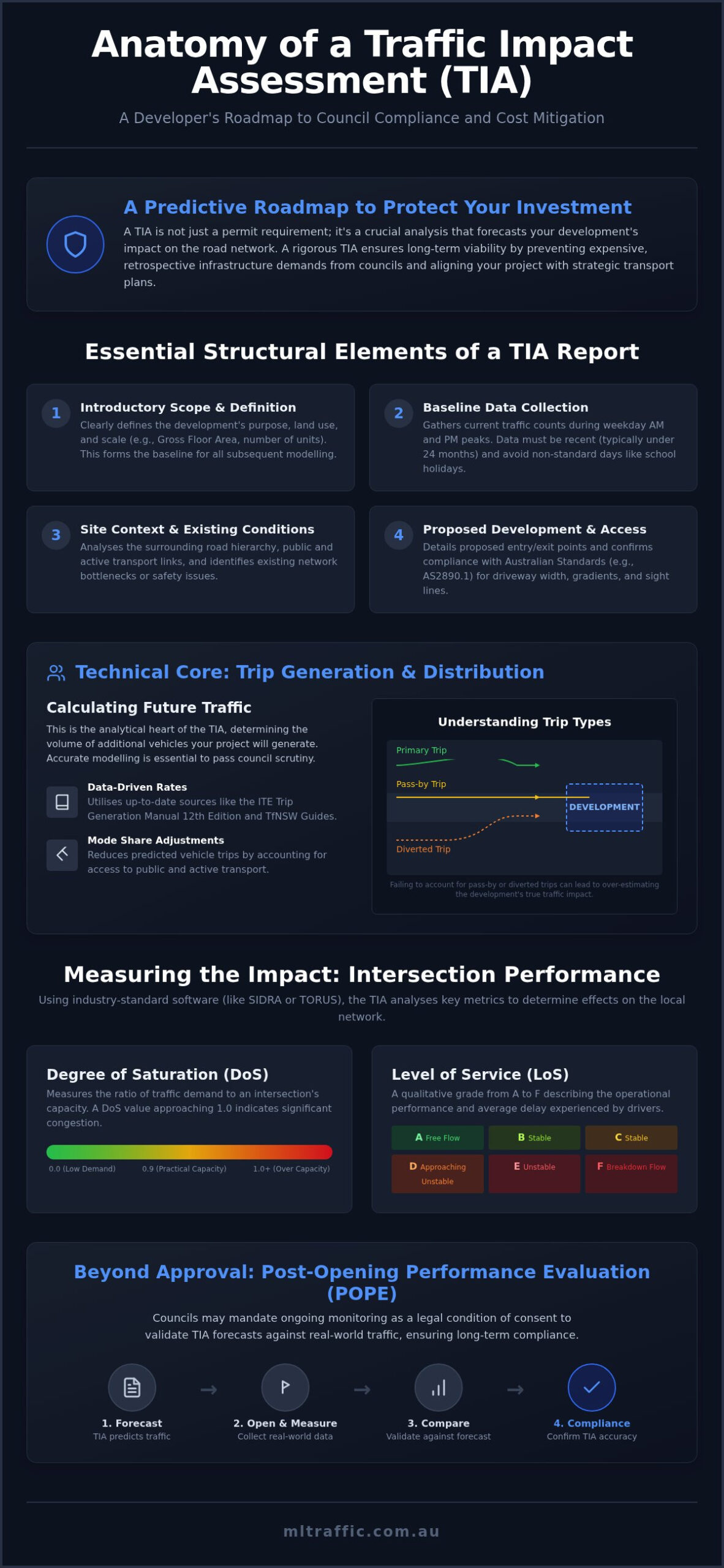
A Traffic Impact Assessment (TIA) serves as the technical foundation for any development application that alters road network demand. It isn’t merely a checklist; it’s a rigorous analysis of how a project interacts with the existing urban fabric. One of the key components of a traffic impact assessment report is the introductory scope, which must explicitly define the development’s purpose and scale. For larger infrastructure projects, this TIA often forms a critical chapter within a comprehensive Environmental Impact Statement (EIS). Without a clear definition of land use and intensity, the subsequent modelling lacks a reliable baseline.
Baseline data acts as the anchor for every assessment. We rely on current traffic counts, typically collected during weekday AM and PM peak periods, to establish the existing “Level of Service” on the surrounding network. These counts must be taken on standard traffic days, avoiding school holidays or public holidays which skew the results. Councils generally reject reports based on outdated figures, often requiring data no older than 12 to 24 months. Policy alignment is equally critical. The report must demonstrate how the proposal adheres to local council Development Control Plans (DCPs) and state-based transport requirements. This ensures the project fits within the long-term strategic transport planning for the region.
Site Context and Existing Conditions
Successful reporting requires a deep dive into the site’s surroundings. This includes documenting current traffic volumes and identifying established peak hour patterns that might affect site access. We analyse the existing road hierarchy, from local streets to major arterial roads, to determine how the network currently functions. Assessing public transport accessibility and active transport links is mandatory to satisfy multi-modal transport goals. Identifying existing safety issues or known network bottlenecks early ensures that the development doesn’t exacerbate pre-existing deficiencies.
Proposed Development and Access Arrangements
The report must provide a detailed description of the proposed land use, including the Gross Floor Area (GFA) and the number of residential units or commercial tenancies. This section outlines the proposed entry and exit points for both vehicles and pedestrians. A preliminary compliance check with AS2890.1 is essential at this stage to confirm that driveway widths, gradients, and sight distances meet national safety standards. By addressing these structural elements early, we reduce the risk of costly redesigns during the council’s request for further information (RFI) stage.
Technical Core: Trip Generation and Distribution Modelling
Trip generation and distribution represent the analytical heart of any development proposal. These calculations determine the volume of additional vehicles your project will contribute to the local network. As one of the key components of a traffic impact assessment report, this section requires high-precision data to withstand rigorous council scrutiny. We look at trip generation rates first, typically sourced from the Transport for NSW Guide to Traffic Generating Developments or the ITE Trip Generation Manual 12th Edition. This latest ITE manual, released in August 2025, is essential for modern assessments as it incorporates post-pandemic travel data and refined land-use codes.
For retail developments, we must distinguish between primary trips and ‘pass-by’ or ‘diverted’ trips. A pass-by trip is a vehicle already on the road that stops at the development on the way to another destination. Failing to account for these can lead to over-estimating the actual impact on the wider network. Mode share also plays a vital role in the technical core. By demonstrating high accessibility to trains, buses, or cycling infrastructure, we can justify a reduction in predicted vehicle trips. These technical models are among the most scrutinised key components of a traffic impact assessment report during the development application process.
Calculating Expected Traffic Volumes
Reliable forecasting depends on selecting the correct trip generation rates for your specific land use. While standard databases provide a solid starting point, unique developments often require bespoke surveys of similar sites to ensure accuracy. It’s necessary to differentiate between weekday AM/PM peaks and weekend peaks, as a shopping centre has a vastly different impact profile than an office block. We also identify ‘trip credits’ for existing site uses, ensuring you only pay for the net increase in traffic. If you’re unsure about your current site’s capacity, our team can provide a comprehensive traffic assessment to clarify your obligations.
Distribution and Assignment Patterns
Once volumes are established, we must determine where that traffic is going. We apply a ‘gravity model’ to predict flow based on the proximity of residential catchments and major employment hubs. This methodology is a standard practice detailed in technical resources like the County Traffic Impact Study Manual, which provides a framework for rigorous network analysis. We then assign these trips to specific intersections and turning movements to identify potential capacity issues. Trip assignment is the process of allocating predicted traffic volumes to specific routes within the road network to determine the resulting load on individual infrastructure elements.
Validating Traffic Report Forecasts After Opening
The submission of a technical report is often viewed as the final hurdle in the development application process. However, the actual performance of the road network once the development is operational is what matters to long-term compliance. A Post-Opening Performance Evaluation (POPE) serves as a formal audit to verify that the initial forecasts were accurate. While the technical core and site context are key components of a traffic impact assessment report, post-opening validation ensures those theoretical models translate into real-world safety and efficiency.
Council conditions frequently include a ‘monitoring program’ as a legal requirement of the consent. This occurs when there’s uncertainty regarding trip generation rates for a specific land use or when the network is already operating near capacity. Comparing predicted traffic volumes against actual counts allows for a transparent assessment of the development’s impact. If actual volumes exceed forecasts, developers may be required to implement additional mitigation measures. Conversely, demonstrating that a project has a lower impact than predicted provides a significant advantage for future stages of multi-phase developments, potentially reducing the scale of required infrastructure contributions.
Why Councils Require Post-Opening Monitoring
Local authorities use monitoring to manage community concerns regarding ‘traffic chaos’ that often accompany new large-scale developments. It’s an accountability mechanism to ensure that ‘Green Travel Plans’ or other demand-management strategies are actually being implemented by the end-users. Validation also verifies that installed mitigation measures, such as new traffic signals or turn lanes, are performing as intended. This process protects the council from liability and ensures the road network remains functional for all users.
Methodologies for Real-World Validation
We use several data collection methods to validate our initial findings. These include:
- 7-day pneumatic tube counts: These provide a comprehensive overview of daily traffic fluctuations and total weekly volumes.
- Peak hour turning movement counts: These focus on the most critical times of day at site access points and major intersections.
- Queue length analysis: We measure the physical length of vehicle queues to ensure they don’t block adjacent intersections or driveway entries.
Level of Service validation involves comparing the observed delays and congestion levels against the theoretical ratings established during the initial modelling phase. By confirming these key components of a traffic impact assessment report through empirical data, we provide developers with the evidence needed to close out council conditions and proceed with confidence.
Intersection Performance and Network Impact Analysis
Intersection analysis is the primary method for determining if the local road network can absorb the predicted traffic volumes discussed in the previous sections. SIDRA modelling is the industry standard for Australian intersection analysis, providing a rigorous mathematical framework to evaluate performance. These capacity results are among the most critical key components of a traffic impact assessment report because they directly influence council approval or rejection. We utilise advanced software such as TORUS 2026 for roundabout design to ensure seamless integration with SIDRA capacity analysis, reflecting the latest industry standards.
We assess both signalised and unsignalised intersections to determine their Degree of Saturation (DoS) and Level of Service (LoS). DoS measures the ratio of demand to capacity, while LoS provides a qualitative rating from A (excellent) to F (failing) based on average vehicle delay. If a development pushes an intersection beyond a DoS of 0.90 for signals or 0.80 for priority control, it typically triggers a requirement for mitigation. For heavy vehicle access, we perform Swept Path Analysis to ensure that trucks can enter and exit the site without encroaching on opposing lanes or damaging kerbs.
Capacity Analysis and SIDRA Modelling
Our evaluation focuses on whether a development causes an unacceptable increase in delay for existing road users. Councils often define ‘unacceptable’ as a drop in the Level of Service or an increase in delay exceeding specific local thresholds. We translate complex SIDRA output tables into clear summaries for non-engineer stakeholders, highlighting the practical implications for local traffic flow. If you require technical clarity on your project’s impact, contact our principals for an expert Intersection Analysis.
Mitigation and Infrastructure Upgrades
When modelling identifies a capacity shortfall, we propose specific infrastructure upgrades to restore network performance. These mitigation strategies often include:
- Extending existing turn lanes to prevent queue blocking.
- Installing new traffic signals or roundabouts at high-volume access points.
- Proposing road widening to increase through-lane capacity.
Negotiating Voluntary Planning Agreements (VPAs) allows developers to fund these traffic works as part of their contribution to the community. Additionally, we address car parking demand within the TIA to prevent overspill into local streets, which is a common point of contention during the council review process. Ensuring these key components of a traffic impact assessment report are handled by senior engineers reduces the likelihood of costly retrospective infrastructure demands.
Navigating Council Approvals with a Compliant TIA Report
A robust TIA report is more than a technical exercise. It is a tool for negotiation. When we compile the key components of a traffic impact assessment report, we do so with the specific goal of accelerating the DA approval timeline. Councils often issue Requests for Further Information (RFIs) when data is ambiguous or standards aren’t met. By providing a meticulous, data-backed report from the outset, we minimise these delays. A well-structured TIA demonstrates a proactive approach to network management. This builds essential trust with planning authorities.
Responding to RFIs effectively requires more than just providing more data. It requires a technical defence of the original methodology. Because our reports are built on current standards and verifiable counts, we address council concerns with authority. This reduces the risk of expensive, retrospective infrastructure demands. A compliant report ensures that the development’s impact is clearly defined and that any proposed mitigation is proportional to the scale of the project.
Meeting Australian Standards (AS2890.1 & AS2890.2)
Adherence to Australian Standards is non-negotiable for any successful application. We certify that car park layouts, ramp grades, and sight distances meet the strict requirements of AS2890.1 for off-street parking. For commercial sites, we ensure loading docks and service areas accommodate the required design vehicles according to AS2890.2. These technical certifications from a qualified traffic engineer are essential for council sign-off. Compliance prevents the need for costly redesigns after the DA has been submitted.
The ML Traffic Difference: Senior-Led Continuity
Our approach is defined by senior-led project continuity. The expert who initiates the client relationship and performs the initial site counts is the same one who performs the technical work. This eliminates the communication gaps common in larger firms where work is delegated to junior staff. We leverage over 15 years of national consultancy experience to deliver local results across Australia. This hands-on, accountable philosophy ensures that the key components of a traffic impact assessment report are handled with precision. For professional advice on your next project, contact our principals directly for a tailored TIA quote.
Securing Long-Term Project Compliance through Technical Excellence
A successful development relies on a technical strategy that extends beyond the initial planning approval. We’ve detailed how the key components of a traffic impact assessment report, from initial trip generation to intersection capacity analysis, provide the necessary framework for council negotiation. By integrating rigorous SIDRA and AutoTURN modelling with real-world post-opening validation, developers can avoid the unexpected costs associated with retrospective infrastructure upgrades. This proactive approach ensures your project remains compliant with Australian Standards throughout its lifecycle.
Our senior principals perform the technical work on every project personally. This ensures accountability and professional continuity from the first traffic count to the final council meeting. With over 15 years of Australian consultancy experience, we provide the expertise required to navigate complex regulatory environments and secure efficient project outcomes. We invite you to Request a Traffic Impact Assessment Quote from Our Senior Engineers to ensure your next development meets all regulatory expectations. We look forward to supporting your project’s success.
Frequently Asked Questions
What is the difference between a Traffic Impact Statement and a Traffic Impact Assessment?
A Traffic Impact Statement (TIS) is a concise report typically reserved for low-impact developments that generate minimal additional vehicle trips. A Traffic Impact Assessment (TIA) is a comprehensive technical document required for larger projects that significantly alter road network demand. The TIA includes detailed modelling and analysis of the key components of a traffic impact assessment report, such as intersection performance and multi-modal transport links, to satisfy rigorous council requirements.
How much does a Traffic Impact Assessment report typically cost for a DA?
The total fee for a TIA report depends on the scale of the development, the complexity of the required modelling, and the number of intersections under review. Factors like the requirement for bespoke traffic counts or specialised software analysis also influence the final cost. We recommend requesting a project-specific quote that reflects your site’s unique technical requirements and the specific bureaucratic expectations of your local council.
When is a Swept Path Analysis required as part of a TIA report?
Swept Path Analysis is mandatory whenever a development must accommodate specific design vehicles, such as heavy rigid vehicles (HRVs) for waste collection or articulated vehicles for loading docks. It’s an essential component of a TIA report to demonstrate that these vehicles can enter, exit, and circulate within the site safely. This analysis ensures compliance with AS2890.2 and prevents operational issues like kerb mounting or lane encroachment during daily site operations.
Can a council refuse a development based solely on traffic forecasts?
Councils maintain the authority to refuse a development application if the traffic forecasts indicate an unacceptable drop in the Level of Service (LoS) or an excessive Degree of Saturation (DoS) on the local network. If the report fails to propose adequate mitigation measures or infrastructure upgrades to address these impacts, the project may be deemed non-compliant. Robust modelling using SIDRA and AutoTURN is necessary to defend the proposal during the formal assessment process.
How long does it take to prepare a comprehensive traffic report?
Preparing a comprehensive traffic report typically takes between two to four weeks, depending on the availability of current traffic data. If new traffic counts are required, these must be scheduled on standard traffic days to ensure accuracy. Complex projects involving extensive intersection modelling or internal car park design may require additional time to ensure all key components of a traffic impact assessment report meet national regulatory standards.
What happens if the post-opening traffic counts are higher than predicted?
If post-opening traffic counts exceed the initial predictions, the council may require the developer to implement additional mitigation measures as specified in the conditions of consent. This might include adjusting traffic signal timings, extending turn lanes, or improving active transport infrastructure. These requirements are often managed through a formal Post-Opening Performance Evaluation (POPE) to ensure the development does not adversely affect road safety or network efficiency.
Does every development need a SIDRA intersection analysis?
Not every development requires a SIDRA intersection analysis; it’s generally triggered when a project generates enough trips to potentially affect the performance of surrounding signalised or unsignalised intersections. Councils often set a threshold, such as 30 to 50 additional peak hour trips, before requiring this level of technical modelling. Smaller projects with negligible network impact may only require a qualitative assessment of the existing conditions and access arrangements.
What are the common triggers that require a TIA for a small-scale project?
Common triggers for a TIA on small-scale projects include proposed access near a major intersection, a shortfall in required car parking spaces, or high-turnover land uses like childcare centres and medical clinics. Safety concerns regarding sight distances or driveway gradients can also prompt a request for a formal assessment. Even if trip generation is low, demonstrating compliance with AS2890.1 for car park design remains a mandatory requirement for most council approvals.

Disclaimer
The content on www.mltraffic.com.au, including all technical articles, guides, and resources, is provided for general informational and educational purposes only. It is not intended to constitute professional advice in traffic engineering, transportation planning, development approvals, or any other technical or legal field.
While ML Traffic Engineers makes every reasonable effort to ensure the accuracy, completeness, and timeliness of the information published, we do not provide any warranties or representations (express or implied) regarding its reliability, suitability, or availability for any particular purpose. Any reliance you place on the content is strictly at your own risk.
In no event shall ML Traffic Engineers, its directors, employees, authors, or affiliates be liable for any direct, indirect, incidental, special, consequential, or punitive damages (including, without limitation, loss of profits, data, or business opportunities) arising out of or in connection with the use of, or inability to use, any information provided on this website.
The articles and guides on this site are not a substitute for engaging a qualified, registered professional traffic engineer (such as an NPER or RPEQ engineer) to assess your specific project requirements. For tailored advice, compliance assessments, or traffic engineering services, please contact a competent professional.
This disclaimer may be updated from time to time without notice. By accessing or using this website, you agree to be bound by the most current version of this disclaimer.
