

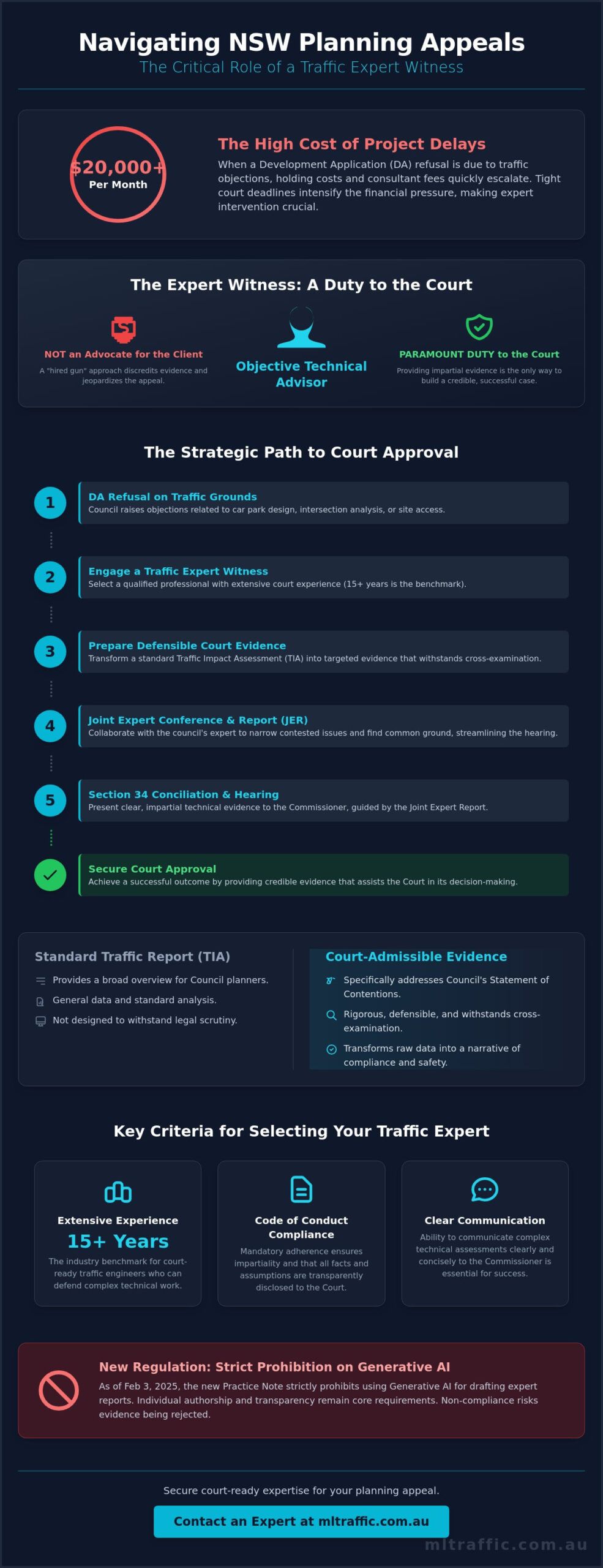
Project delays in NSW currently cost developers over $20,000 per month in holding costs and consultant fees. When a DA refusal hinges on council traffic objections, the financial pressure intensifies against tight court-imposed deadlines. Securing a successful outcome requires a professional land and environment court traffic expert witness who understands the technicalities of the Expert Witness Code of Conduct and the 2025 NSW Low and Mid-Rise Housing Policy. It’s a high-stakes environment where technical credibility is the only currency that matters to the Court.
Technical disputes regarding Car Park Design or Intersection Analysis often derail project timelines and threaten site yields. This guide demonstrates how a qualified traffic expert secures development approvals through defensible evidence and rigorous joint expert conferencing. It covers the strategic approach to Section 34 conciliations and the preparation of a Joint Expert Report that narrows contested issues. You’ll learn the process of achieving technical consensus and securing court approval for traffic and parking designs without sacrificing the project’s core viability.
Key Takeaways
- Understand why a traffic expert’s primary duty is to the Court, ensuring that impartial opinion evidence remains the foundation of a credible appeal.
- Learn how a land and environment court traffic expert witness uses the mandatory Code of Conduct to provide defensible evidence that withstands judicial scrutiny.
- Discover the role of the Joint Expert Conference in identifying technical agreements and producing a Joint Expert Report (JER) to streamline the hearing.
- Identify key selection criteria, focusing on an expert’s ability to communicate complex technical assessments clearly to the Commissioner.
- Gain insight into how senior-led technical work ensures accountability and consistency throughout the Section 34 conciliation and hearing process.
What is a Land and Environment Court Traffic Expert Witness?
A land and environment court traffic expert witness is a specialized traffic engineer qualified to provide opinion evidence in planning appeals and legal proceedings. This professional operates under a specific legal framework where their primary duty is to the Court, not the developer who retains them. This independence is paramount. If an expert is perceived as an advocate for the client, the Court may diminish the weight of their evidence or reject it entirely. The expert’s role is to provide an objective, technical assessment to help the Commissioner or Judge make an informed decision.
There’s a significant difference between a standard Traffic Impact Assessment (TIA) Report and court-admissible evidence. While a TIA provides a broad overview for a Council’s planning department, evidence for the Land and Environment Court must be targeted and defensible under cross-examination. It must specifically address the technical disputes raised in the Council’s Statement of Contentions (SOC). A seasoned expert witness transforms raw data into a narrative of compliance and safety that aligns with the Court’s requirements.
To better understand this concept, watch this helpful video:
Merits Review vs. Judicial Review in Traffic Appeals
In Class 1 proceedings, the Court conducts a merits review. The expert re-evaluates the planning merits of the development’s parking, access, and site layout. It’s essentially a fresh look at whether the proposal is good planning practice. Class 4 proceedings are different. These are judicial reviews focusing on the legal validity of traffic-related conditions or decisions. In these cases, the expert’s testimony shifts from planning “merits” to technical facts that support or challenge the legal basis of a Council’s requirement.
Qualifications and Admissibility
Admissibility in the Land and Environment Court relies on the “test for admissibility.” The engineer must demonstrate specialized knowledge based on their training, study, or experience. While there’s no set rule, 15+ years of experience is the industry benchmark for court-ready traffic engineers. This level of experience ensures they can defend complex technical work, such as an Intersection Analysis or Car Park Design, during a Joint Expert Conference. Senior-level involvement is vital because the expert who signs the report must be the one who stands in the witness box.
An expert witness in Australian planning tribunals is an independent professional whose specialized technical knowledge assists the Court in resolving complex issues that fall outside the common understanding of the tribunal.
Mandatory Compliance: The Expert Witness Code of Conduct
Every land and environment court traffic expert witness must formally acknowledge and adhere to the Expert Witness Code of Conduct. This isn’t a mere administrative hurdle. It’s a fundamental legal obligation. The Court prioritizes the expert’s duty to provide impartial advice over their duty to the client. “Hired gun” experts who prioritize a developer’s commercial interests over technical reality often fail during cross-examination. This failure doesn’t just discredit the expert; it actively damages the project’s credibility in the eyes of the Commissioner. When an expert’s impartiality is questioned, the entire technical basis of the appeal can collapse. This often results in the Court upholding the Council’s refusal.
Transparency in data is equally vital. Experts must disclose all facts and assumptions used in traffic modeling. Under the new Practice Note commencing February 3, 2025, the use of Generative AI for drafting expert reports is strictly prohibited. While parties can seek leave to use AI for data analysis, individual authorship remains a core requirement for transparency. Professionals who ignore these regulatory shifts risk having their evidence ruled inadmissible. It’s essential to ensure that every calculation, from a Car Parking Demand Assessment to a complex intersection model, is manually verified and defensible.
Defensible Technical Standards
Defensible evidence is built on the foundation of Australian Standards. Specifically, AS 2890.1 compliance serves as the primary defense against council parking objections. Technical assessments like a Sight Distance Assessment or Intersection Analysis provide the empirical data needed to prove safety. A Swept Path Analysis acts as powerful visual evidence. It demonstrates vehicle maneuverability in a way that raw numbers cannot. These visual tools help the Court visualize how a heavy vehicle interacts with a proposed Car Park Design. If you need to verify your site’s technical compliance, reviewing our specialized traffic services is a logical first step.
Common Evidentiary Traps to Avoid
Using outdated traffic count data is a common trap that leads to immediate challenges from opposing counsel. Traffic patterns change. Data from several years ago rarely reflects current conditions. Another mistake is failing to address the specific ‘contentions’ raised by the Council. A land and environment court traffic expert witness must tailor their evidence to answer these points directly. Simply re-stamping a standard TIA Report from the DA stage is insufficient. Court evidence requires a higher level of detail and a focus on resolving the specific technical disputes at hand. Experts must also avoid making claims about road safety audits or street lighting plans if they aren’t specifically qualified in those sub-disciplines.
The Joint Expert Conference and Joint Expert Report (JER)
The Joint Expert Conference is a pivotal stage in Class 1 and Class 4 proceedings. It’s a private meeting between the applicant’s expert and the respondent’s expert where no legal counsel or clients are permitted to attend. The primary purpose is to identify technical agreements and narrow the scope of the hearing. A skilled land and environment court traffic expert witness uses this time to resolve minor technical disputes regarding driveway ramp grades or car park dimensions. This process directly supports the Court’s objective of procedural efficiency and reduces the time required for a formal hearing.
Following the conference, the experts produce a Joint Expert Report (JER). This document is strictly governed by the Joint Expert Report policy. It lists the issues agreed upon and provides detailed technical reasons for any remaining disagreements. The JER is a binding document. Once signed, an expert cannot change their position during the hearing without the Court’s leave. This “lock-in” effect makes the conferencing stage critical. Any technical oversight or failure to defend a position during this meeting can compromise the entire appeal.
Steps to a Successful Joint Expert Report
Preparation is the foundation of a successful JER. The expert must meticulously review the opposing party’s evidence to identify technical flaws in their traffic modeling or parking assessments. Discussions during the conference are “without prejudice.” This environment allows experts to speak freely to find middle ground without their statements being used against them later. If disagreements persist, the JER must clearly articulate the technical reasons for the impasse. This clarity allows the Commissioner to focus only on the core contested issues during the trial.
Section 34 Conciliation Conferences
Section 34 conciliation conferences often occur on the development site and provide a platform for a mediated settlement. A proactive land and environment court traffic expert witness identifies opportunities for design compromises that satisfy both the developer’s yield requirements and the Council’s safety concerns. By applying fundamental Traffic Engineering principles, experts can often resolve objections to site access or intersection impacts during the site visit. Successful conciliation can save developers upwards of $20,000 per month in holding costs by avoiding the delays of a full court hearing.
Selecting the Right Traffic Expert for Your Appeal
Choosing a land and environment court traffic expert witness is a decision that directly impacts the project’s success. It isn’t enough to hire a competent engineer; you need a professional who understands the specific evidentiary requirements of the NSW planning system. The right expert must meet four primary criteria. First, they need a documented history of providing evidence in Class 1 and Class 4 proceedings. Second, they must be able to translate technical Traffic Impact Assessments into clear, persuasive testimony. Third, they must maintain a reputation for technical integrity that the Court trusts. Finally, you should ensure that senior principals are personally conducting the work rather than delegating it to junior staff.
Why Senior Experience is Non-Negotiable
Authority and demeanor are critical during concurrent evidence, often referred to as “hot-tubbing.” During this process, the Commissioner observes how experts interact and defend their technical positions in real-time. A senior expert carries more weight than a junior engineer who may struggle under pressure. It’s a fundamental requirement that the expert who initiates the relationship and writes the report is the same person who stands in the witness box. This ensures continuity and accountability. You should also evaluate an expert’s specific track record with your land-use type. An engineer who excels in high-density residential projects may have a different approach than one specializing in childcare or industrial developments. This specialized knowledge allows the expert to anticipate Council objections before they are even raised.
The Cost-Benefit of Expert Evidence
While hiring a top-tier expert is an investment, the cost of failure is much higher. In NSW, project delays can exceed $20,000 per month in holding costs alone. An inefficient parking layout on a 20-lot project can result in losses of over $185,000 in saleable land. A skilled expert protects your capital investment by ensuring the site yield remains viable while meeting safety standards. They also reduce legal fees by narrowing contested traffic issues early in the Joint Conferencing stage. This efficiency prevents the hearing from dragging on unnecessarily. For a professional assessment of your project’s technical standing, you can Contact ML Traffic Engineers Australia for a preliminary review of your court case.
ML Traffic Engineers Australia: Court-Ready Expertise
ML Traffic Engineers Australia provides a specialized consultancy for developers facing planning appeals. We’ve spent over 15 years providing expert evidence for Australian developments. Our approach is defined by direct access to senior principals. We don’t delegate technical court work to junior staff. This ensures the person who prepares the analysis is the same person who defends it in the witness box. Technical accountability is the hallmark of our firm. It’s a standard that builds trust with the Court and provides developers with reliable representation.
Our team has a proven track record in Joint Expert Conferencing and Section 34 Conciliations. We understand how to navigate the specific requirements of the Land and Environment Court. We provide comprehensive support from the initial Traffic Impact Assessment (TIA) Report to the final Court Hearing. This end-to-end involvement ensures consistency in the technical narrative. It also prevents the evidentiary gaps that often occur when multiple firms handle different stages of a project. Our focus remains on securing approvals through defensible data and expert negotiation.
Our Technical Capabilities
Our work is grounded in empirical data and advanced modeling. We utilize advanced Vehicle Swept Path Analysis to verify site access and maneuverability. Our Car Park Design expertise ensures that every layout meets AS 2890.1 and AS 2890.2 standards. These technical tools are vital when challenging a Council’s refusal. We offer a full suite of assessments to support your appeal:
- Data-driven Intersection Analysis to evaluate local road impacts and capacity.
- Detailed Car Parking Demand Assessments to justify parking variations.
- Precise Sight Distance Assessments for safety compliance and risk mitigation.
- Driveway Ramp Grade Assessments to ensure functional vehicle access.
You can explore our full range of Expert Services to see how we support complex developments through the planning process.
The ML Traffic Engineers Australia Commitment
Technical truth is our priority. We maintain strict adherence to the Expert Witness Code of Conduct. Our role as a land and environment court traffic expert witness is to provide the Court with reliable, meticulous, and impartial evidence. We don’t adjust our findings to suit a narrative. Instead, we find the technical solutions that make a project viable and compliant. This integrity is why our evidence carries weight during concurrent evidence sessions.
We ensure your project meets all national regulatory standards and specific council requirements. This includes navigating the 2025 NSW Low and Mid-Rise Housing Policy and the Transport Oriented Development (TOD) Program. Our expertise helps developers secure approvals by providing evidence that stands up to the highest levels of judicial scrutiny. We’re results-oriented and focused on achieving technical consensus through the Joint Expert Report process. We provide the technical certainty needed to move your development forward.
Secure Your Development Approval with Technical Evidence
Securing a development approval in a contested appeal requires a shift from standard planning to rigorous legal defense. The most effective strategy involves using technical precision to resolve council contentions before they reach a formal hearing. By prioritizing a land and environment court traffic expert witness who can reach technical consensus during joint conferencing, developers protect both their timelines and their project’s commercial viability. This approach ensures that the final design isn’t only compliant with Australian Standards but also defensible under the scrutiny of the Court.
ML Traffic Engineers Australia provides the specialized representation necessary to navigate these high-stakes proceedings. With over 15 years of court experience and a policy of direct principal involvement, our team delivers the technical certainty required for complex appeals. We offer national coverage for developers across Australia, ensuring that every project benefits from senior-level accountability and meticulous site assessments. Technical disputes shouldn’t be the reason your project fails.
Secure an Expert Traffic Witness for Your Appeal today to resolve technical objections and move your development toward a successful determination.
Frequently Asked Questions
What is the difference between a traffic report and an expert witness statement?
A traffic report is a planning document prepared for a standard DA submission to Council. In contrast, an expert witness statement is formal legal evidence specifically formatted for Court proceedings. It must include a signed declaration of compliance with the Expert Witness Code of Conduct. The statement focuses on resolving the specific technical disputes listed in the Statement of Contentions rather than providing a general site overview.
Can my original traffic engineer act as an expert witness in court?
Your original engineer can act as an expert witness if they possess the specialized training and experience required by the Court. However, the engineer must remain entirely impartial. If their initial work is the primary subject of the dispute, some developers appoint a new expert to provide a fresh perspective. The Court prioritizes technical independence over previous project involvement.
What happens during a Joint Expert Conference for traffic issues?
Experts meet in a private setting to discuss technical matters like Intersection Analysis or parking layouts. No lawyers or clients attend this meeting. The experts work through each contention to see where they can reach a consensus. This process results in a Joint Expert Report (JER) that tells the Court exactly which technical issues are settled and which require a judicial decision.
How long does it take to prepare a court-ready traffic report?
Preparation usually requires two to four weeks depending on the complexity of the Council’s objections. This timeframe allows for updated traffic counts, site observations, and detailed technical modeling. A land and environment court traffic expert witness must ensure all data is current and defensible. Rushed reports often fail under cross-examination, so meticulous data verification is a mandatory part of the process.
Does the traffic expert witness attend the site inspection with the Commissioner?
The expert witness typically attends the site inspection to provide technical assistance to the Commissioner. They may be asked to point out specific site constraints or explain how a Vehicle Swept Path Analysis relates to the physical road geometry. Their role is to answer technical questions accurately while maintaining their primary duty to the Court. This attendance is vital for clarifying site-specific traffic impacts.
What is ‘hot-tubbing’ in the Land and Environment Court?
‘Hot-tubbing’ is the informal term for concurrent evidence. During this process, experts from both sides are sworn in together and sit in the witness box at the same time. The Commissioner facilitates a professional discussion between them. This allows the Court to compare technical opinions directly on matters such as Car Parking Demand Assessment or intersection safety without the delay of traditional back-and-forth questioning.
Can a traffic expert witness help with a Section 34 Conciliation?
A land and environment court traffic expert witness is essential for a successful Section 34 Conciliation. They provide immediate technical feedback on whether a proposed design compromise is safe and compliant. By resolving technical objections on-site, the expert helps the parties reach a mediated settlement. This proactive problem-solving can prevent the need for a costly and time-consuming full hearing.
What are the most common traffic contentions raised by councils?
Councils frequently raise contentions regarding inadequate parking supply, non-compliance with Australian Standards, and the safety of site access points. Objections often focus on the results of an Intersection Analysis or the perceived impact on local residential amenity. Experts address these by providing empirical data and demonstrating how the Car Park Design meets all relevant regulatory requirements and safety benchmarks.

Article by
Michael Lee
Practising traffic engineer with over 35 years experience.
Disclaimer
The content on www.mltraffic.com.au, including all technical articles, guides, and resources, is provided for general informational and educational purposes only. It is not intended to constitute professional advice in traffic engineering, transportation planning, development approvals, or any other technical or legal field.
While ML Traffic Engineers makes every reasonable effort to ensure the accuracy, completeness, and timeliness of the information published, we do not provide any warranties or representations (express or implied) regarding its reliability, suitability, or availability for any particular purpose. Any reliance you place on the content is strictly at your own risk.
In no event shall ML Traffic Engineers, its directors, employees, authors, or affiliates be liable for any direct, indirect, incidental, special, consequential, or punitive damages (including, without limitation, loss of profits, data, or business opportunities) arising out of or in connection with the use of, or inability to use, any information provided on this website.
The articles and guides on this site are not a substitute for engaging a qualified, registered professional traffic engineer (such as an NPER or RPEQ engineer) to assess your specific project requirements. For tailored advice, compliance assessments, or traffic engineering services, please contact a competent professional.
This disclaimer may be updated from time to time without notice. By accessing or using this website, you agree to be bound by the most current version of this disclaimer.
