
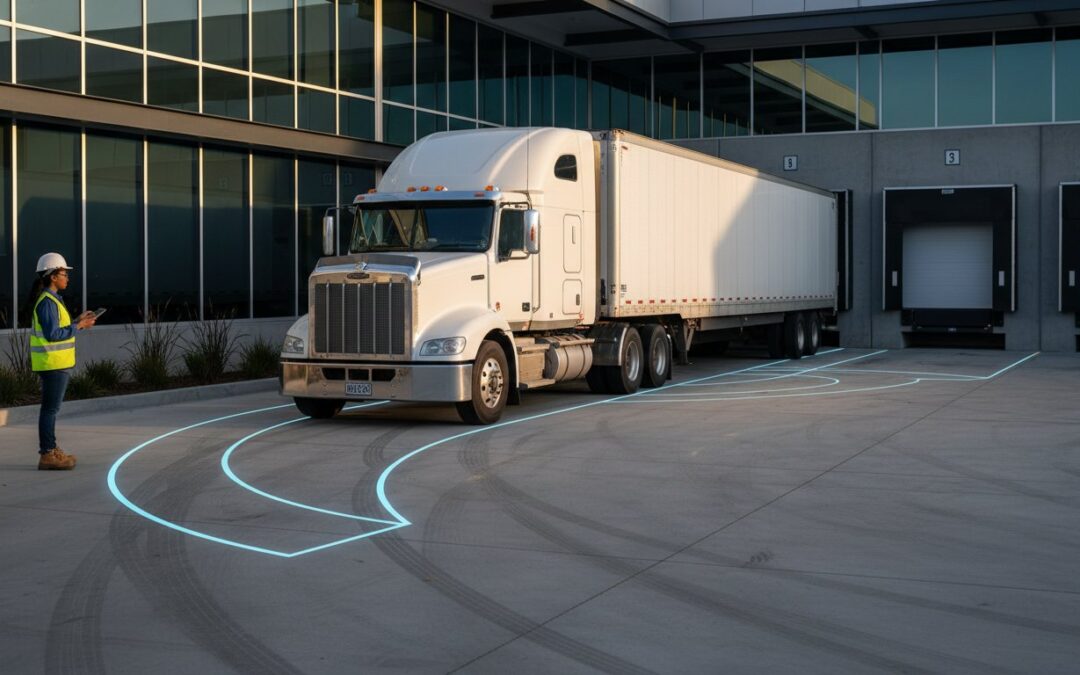
A loading dock design that fails to account for the exact swept path of a 19.0 metre articulated vehicle is a guaranteed way to trigger a Council DA rejection. Achieving compliance with loading dock design standards australia requires more than just allocating floor space. It demands a technical understanding of AS 2890.2:2018. You likely feel the pressure of balancing operational efficiency with the strict geometric requirements of heavy vehicles. It’s frustrating to risk over-engineering a site and wasting valuable square meterage. The fear of non-compliant truck access stalling your project is very real.
This guide provides the technical clarity needed to navigate the complexities of AS 2890.2 and ensure your commercial loading dock design achieves seamless Council approval. We’ll outline how to calculate precise swept paths for various design vehicles and maintain the necessary 4.5 metre vertical clearances. You’ll also find specific data on maximum ramp grades and the critical role of digital simulation in securing a successful Development Application. By adhering to these national safety standards, you can maximise operational efficiency and avoid costly redesigns during the planning phase.
Key Takeaways
- Identify the core requirements of AS 2890.2:2018 to ensure your commercial facility accommodates everything from small delivery vans to heavy articulated vehicles.
- Apply specific geometric standards for bay dimensions and vertical clearances, including the 4.5m minimum height requirement for high-clearance heavy vehicles.
- Utilise swept path analysis and AutoTURN simulations to provide the technical proof of vehicle access required for Council Development Application (DA) approval.
- Integrate a comprehensive Traffic Management Plan (TMP) to maintain operational safety and verify the physical separation of pedestrians from heavy vehicle movements.
- Consult with expert traffic engineers to navigate loading dock design standards australia, ensuring a compliant design that maximises site efficiency and avoids costly redesigns.
Understanding AS 2890.2: The Framework for Australian Loading Docks
AS 2890.2:2018 is the primary regulatory document for off-street commercial vehicle facilities in this country. This standard, maintained by Standards Australia, establishes the geometric requirements for every commercial site. Compliance with loading dock design standards australia is a mandatory component of the urban planning process. It ensures that delivery vehicles can enter, circulate, and exit a site in a forward direction without creating bottlenecks or safety hazards. The scope is broad, covering small-scale retail delivery points through to high-volume industrial distribution centres.
A well-designed dock prevents operational failures that lead to illegal on-street parking or blocked thoroughfares. Local government authorities typically require a Traffic Impact Assessment to prove that the proposed infrastructure meets these national benchmarks. This assessment evaluates how the facility interacts with existing road networks and pedestrian paths. It specifically addresses how heavy vehicle movements affect the surrounding transport infrastructure and local amenity.
To better understand the mechanical components often integrated into these designs, watch this helpful video:
The Role of the Design Vehicle
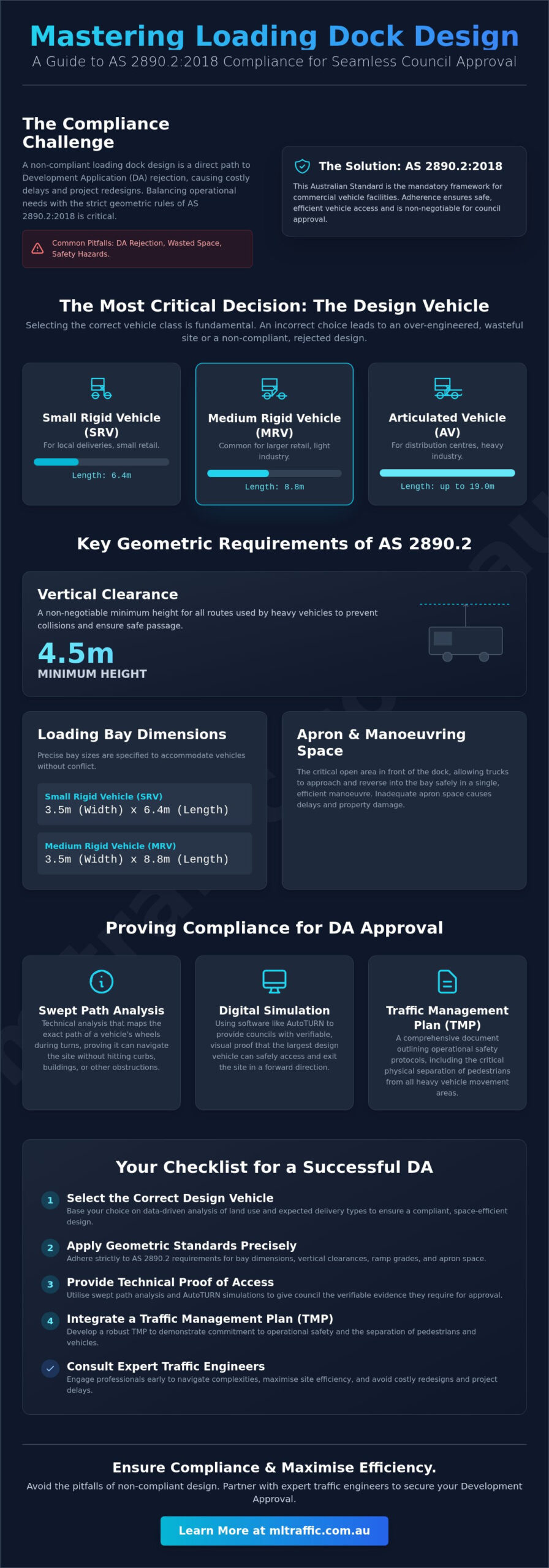
The choice of design vehicle is the most critical decision in the planning phase. Dimensions for a Small Rigid Vehicle (SRV) differ significantly from a 19.0 metre Articulated Vehicle (AV) or a 25.0 metre B-double. Selecting a vehicle class that is too large results in over-engineered docks and wasted floor space, directly reducing the site’s commercial yield. Conversely, under-estimating the vehicle size leads to non-compliance and DA rejection. ML Traffic Engineers Australia uses data-driven analysis to identify the correct vehicle class based on your specific land use, ensuring the design is both compliant and space-efficient. We verify that the design accounts for the specific swept paths and vertical clearances required for the largest expected vehicle.
Regulatory Hurdles in Development Applications
Councils maintain a strict preference for off-street loading to preserve public road capacity and safety. They scrutinise the “service frequency” metric, which determines how many bays are required based on the volume of expected daily deliveries and the duration of each stay. If your design doesn’t provide enough bays or fails to prove safe truck access via Auto-TURN simulations, the application will likely stall. Engaging ML Traffic Engineers Australia early in the process prevents these issues. This proactive approach identifies potential access constraints, such as inadequate sight distances or excessive ramp grades, before the site layout is finalised. It ensures your project moves through the DA process without expensive revisions or project delays.
Key Geometric Design Standards for Compliance
Adhering to loading dock design standards australia requires precise geometric planning for every vehicle bay. AS 2890.2:2018 specifies that a Small Rigid Vehicle (SRV) requires a minimum bay width of 3.5 metres and a length of 6.4 metres. For a Medium Rigid Vehicle (MRV), the length increases to 8.8 metres while maintaining the 3.5 metre width. These dimensions are non-negotiable for achieving a compliant layout. You must also account for the apron space, which is the dedicated area required for a truck to manoeuvre and reverse into a bay. Inadequate apron depth leads to multi-point turns that block internal roadways and increase the risk of property damage.
Effective site access must align with broader regulatory frameworks, such as the Heavy Vehicle Access Policy. This policy ensures that off-street facilities don’t compromise the safety of the public road network. When designing the apron and circulation roadways, engineers must verify that the largest design vehicle can navigate the site without encroaching on pedestrian zones or opposing traffic lanes. If your site has tight constraints, you might need a custom Car Park Design that integrates loading requirements with visitor parking to save space without sacrificing compliance.
Headroom and Vertical Clearance
Vertical clearance is a frequent point of failure in commercial developments. You must identify and measure the lowest possible points, including entry gates, overhead fire services, and dock soffits. While an SRV typically requires 3.5 metres of clearance, HRVs and larger vehicles demand a minimum of 4.5 metres. The standard vertical clearance for a Medium Rigid Vehicle under AS 2890.2 is 4.5 metres to ensure safe passage under all overhead infrastructure. For sites with unavoidable height restrictions, we can develop a “Performance Solution” to justify alternative clearances, provided operational safety isn’t compromised.
Gradient and Crossfall Limitations
Steep gradients in loading areas create significant safety risks for forklift operations and manual pallet jack handling. AS 2890.2:2018 limits the maximum grade within the loading bay itself to 1:40 (2.5%) to prevent vehicle roll-away and ensure stable loading. Ramps leading to the dock can be steeper, typically up to 15%, but they require transition zones to prevent heavy vehicles from bottoming out. For drainage, a crossfall of approximately 1:50 (2%) is ideal. This provides sufficient water runoff without causing lateral instability for high-reach forklifts. Professional site planning ensures these gradients are managed across the entire vehicle path. For a technical review of your site levels, contact the team at mltraffic.com.au to ensure your gradients meet national standards.
Vehicle Access and Swept Path Analysis Requirements
Council approval hinges on technical proof that your site can accommodate the specified design vehicles. Swept Path Analysis is the engineering process used to simulate the movement of a vehicle through a digital site plan. By using industry-standard software like AutoTURN, we generate diagrams that show the exact path of a truck’s body and wheels during entry, manoeuvring, and exit. These diagrams are mandatory for any development seeking to meet loading dock design standards australia. Without these simulations, it’s impossible to verify that a truck won’t strike structural elements or mount kerbs during a turn.
Most Australian urban developments operate under a “reverse-in, drive-out” preference. This requirement ensures that heavy vehicles enter the property from the public road in a forward direction, reverse into the loading bay within the site boundaries, and exit back onto the street forward. This configuration significantly reduces the risk of collisions with pedestrians and other road users. While B85 and B99 car templates are used for standard parking assessments, loading docks require the much larger swept paths of Small Rigid Vehicles (SRVs) or Heavy Rigid Vehicles (HRVs). The difference in turning radii between a standard car and a 12.5 metre HRV is vast, and failing to account for this leads to immediate DA rejection.
Manoeuvring and Turning Circles
Structural columns and basement walls are the primary obstacles in loading dock design. Even a minor misplacement of a support pillar can render a loading bay unusable for its intended vehicle class. Different Council jurisdictions have varying tolerances for manoeuvring complexity. While some allow a “three-point turn” to reach a bay, many metropolitan Councils now insist on “one-point turns” to maintain high operational efficiency. ML Traffic Engineers Australia optimises site layouts by calculating the tightest possible turning circles, ensuring that every square metre of floor space is used effectively while maintaining full compliance with AS 2890.2.
Safety Buffers and Clearance Zones
A compliant design must include a 300mm minimum safety buffer on each side of the vehicle’s swept path. This clearance zone accounts for minor driver error and vehicle oscillations, preventing damage to the building’s infrastructure. Beyond the path itself, you must verify sight distances at the property boundary. Drivers exiting the dock need a clear line of sight to see approaching pedestrians and cyclists on the footpath. Where geometric constraints make perfect sightlines impossible, we specify the use of convex mirrors and audible or visual warning signage. These measures don’t replace good design, but they are essential components of a safe, DA-compliant traffic environment.
Operational Safety and Traffic Management Plans
Safe operation within a commercial facility extends beyond the physical layout. A Traffic Management Plan (TMP) is essential to govern how vehicles and people interact once the site is live. While loading dock design standards australia define the geometry, the TMP defines the daily behavior of the site. Modern designs incorporate hydraulic dock levellers to bridge the gap between the dock and vehicle bed. These aren’t just for convenience; they are safety devices that prevent forklift accidents caused by uneven surfaces. Heavy-duty rubber bumpers protect the building’s structural integrity from repetitive impact forces. Wheel chocks or automatic vehicle restraints are also standard requirements to prevent “trailer creep” during high-intensity loading operations.
Council often imposes time-of-day restrictions on deliveries to mitigate noise and congestion in residential areas. We address these constraints during the Traffic Impact Assessment phase. This ensures your operational schedule aligns with local planning controls while maintaining site productivity. If your project involves complex scheduling or high-volume turnover, you need a plan that stands up to regulatory scrutiny. We specify the exact service windows and noise mitigation strategies required to keep the site compliant and the neighbors satisfied.
Pedestrian Protection and Exclusion Zones
Physical separation is the primary defense against workplace accidents. AS 2890.2 compliance requires clear line marking and physical barriers to create exclusion zones where heavy vehicles operate. Designated walkways ensure staff move through the site without entering a truck’s swept path. High-spec facilities often use interlocked dock doors. These systems ensure the door only opens once the vehicle is safely docked and the engine is off. Clear, high-visibility signage is mandatory to direct drivers and warn pedestrians of active loading zones. We design these zones to be intuitive, reducing the reliance on human vigilance alone.
Waste Management and Service Vehicle Integration
Loading docks frequently serve a dual purpose as waste collection points. This integration requires a Waste Management Plan that accounts for the specific dimensions of garbage trucks. Rear-loading vehicles require different clearance and apron depths compared to side-loading models. We perform separate swept path analyses for these service vehicles to ensure they don’t conflict with standard delivery operations. Integrating these service requirements into your initial traffic report prevents operational bottlenecks and ensures long-term site viability. Waste collection often occurs during off-peak hours, so we also factor in lighting and visibility requirements for night-time operations.
Secure your project’s operational future by requesting a certified Traffic Management Plan from our expert team.
Securing Council Approval with Expert Traffic Engineering
Successfully applying loading dock design standards australia involves managing the intersection of AS 2890.2:2018 and the specific expectations of local government authorities. ML Traffic Engineers Australia brings over 15 years of specialised experience to this process. We’ve delivered thousands of certified Vehicle Swept Path Analysis reports and TIAs for diverse commercial developments. Our role is to act as a technical bridge between your architectural vision and the regulatory requirements of the planning authority. By engaging our team early, you ensure the site layout is right the first time, preventing the costly delays associated with RFI letters or DA rejection.
One of our core signatures is the personnel continuity promise. We guarantee that the expert who initiates your project is the same professional who performs the technical work and defends the design before Council. This hands-on approach distinguishes ML Traffic Engineers Australia from larger firms where projects are often handed down to junior staff after the initial contract is signed. This accountability ensures that every technical detail, from the height of a soffit to the radius of a turning circle, is handled with senior-level precision.
Our National Capability
We provide compliant loading dock designs for projects in every Australian state and territory. Our team maintains absolute proficiency in the latest versions of AutoTURN and all relevant Australian Standards. Whether you’re developing a retail hub in Sydney, a warehouse in Melbourne, or a mixed-use site in Brisbane, our technical assessments meet the specific local requirements of that jurisdiction. We verify that every design vehicle movement is physically possible and safe within your site’s unique constraints. To discuss your project’s specific access requirements, contact ML Traffic Engineers Australia for a comprehensive assessment.
Why Senior-Led Consultancy Matters
Direct access to senior principals is a critical factor in speeding up the DA process. When Council engineers raise technical queries regarding your loading dock design standards australia compliance, you need immediate, authoritative answers. Our principals have a proven track record of successfully negotiating complex designs with local authorities, often finding innovative solutions for sites with significant spatial restrictions. This senior-led involvement ensures that your traffic report is not just a document, but a robust defence of your project’s viability. We handle the technical complexities so you can focus on the development’s broader goals. Explore our full range of traffic engineering services to see how we can support your next application.
Optimise Your Site for AS 2890.2 Compliance
Achieving a DA-approved development requires a meticulous application of loading dock design standards australia. You now understand that successful compliance relies on three core pillars: selecting the correct design vehicle class, verifying every movement with rigorous swept path analysis, and integrating operational safety through a robust Traffic Management Plan. These technical requirements aren’t just bureaucratic hurdles; they are the blueprint for a safe and efficient commercial facility. Precision in the early design stages prevents the costly floor space wastage and operational bottlenecks that often plague poorly planned sites.
ML Traffic Engineers Australia provides the technical certainty needed to navigate these complex regulations. With over 15 years of Australian traffic engineering experience, we specialise in AS 2890.2 compliance and swept path certification. Our firm offers direct access to senior principals who manage your project from inception to approval, ensuring accountability and expert oversight. Don’t risk project delays with non-compliant designs that fail to meet Council expectations.
Get a Compliant Loading Dock Assessment from our Senior Engineers and move your development forward with confidence.
Frequently Asked Questions
What is the difference between AS 2890.1 and AS 2890.2?
AS 2890.1 governs off-street car parking facilities for light vehicles, whereas AS 2890.2 is the specific standard for off-street commercial vehicle facilities. The requirements for commercial vehicles are significantly more demanding in terms of pavement strength, vertical clearances, and turning radii. Using car parking standards for a truck facility will lead to operational failure and potential structural damage from heavy vehicle impacts.
Do I need a swept path analysis for a small loading bay?
Yes, most local Councils require a swept path analysis for every loading bay to verify that the design vehicle can enter and exit the site in a forward direction. Even for a Small Rigid Vehicle, you must provide technical proof that the truck can manoeuvre without striking columns or encroaching on pedestrian zones. This documentation is a critical component of meeting loading dock design standards australia for DA approval.
What is the minimum height clearance for an Australian loading dock?
The minimum vertical clearance is 3.5 metres for Small Rigid Vehicles and 4.5 metres for Medium and Heavy Rigid Vehicles. In high-volume industrial settings, a clearance of 4.8 metres is often preferred to accommodate high-clearance loads safely. Designers must ensure that overhead services, such as fire sprinklers and lighting, don’t encroach into this required clearance zone.
Can a loading dock be used for waste collection vehicles?
A loading dock can serve as a waste collection point if the design specifically accounts for the swept paths and heights of garbage trucks. Waste vehicles often have different turning circles and overhead requirements than standard delivery vans. You should integrate these requirements into your Waste Management Plan to ensure delivery and waste operations don’t conflict during peak hours.
Is on-street loading still allowed for new developments in Australia?
Councils generally prohibit on-street loading for new developments and require all servicing to occur within the property boundaries. On-street loading is only considered in exceptional circumstances for highly constrained urban sites where off-street provision is physically impossible. Even then, you’ll likely face strict time-of-day restrictions and be required to provide a detailed justification from a traffic engineer.
What are the design vehicle classes used in AS 2890.2?
AS 2890.2:2018 defines several vehicle classes, including the Small Rigid Vehicle (SRV), Medium Rigid Vehicle (MRV), Heavy Rigid Vehicle (HRV), and Articulated Vehicle (AV). Larger logistics sites may also need to accommodate B-doubles up to 25.0 metres long. The specific class you choose dictates every geometric detail of your site, including the width of bays and the depth of the manoeuvring apron.
How does a Traffic Management Plan impact loading dock design?
A Traffic Management Plan (TMP) defines the operational rules, such as one-way traffic flow and pedestrian exclusion zones, which the physical design must support. The TMP ensures that the dock operates safely by managing vehicle arrival times and separating forklift movements from staff walkways. If the TMP indicates high-frequency turnover, the design may need additional holding bays to prevent trucks from queuing on public roads.
What happens if my site cannot meet the prescriptive AS 2890.2 standards?
If your site has physical constraints that prevent it from meeting prescriptive standards, we can develop a “Performance Solution” to justify an alternative design. This involves demonstrating to Council that the proposed layout still meets the safety and operational objectives of the Australian Standard. These solutions must be supported by rigorous engineering evidence, including AutoTURN simulations and detailed risk assessments.

Disclaimer
The content on www.mltraffic.com.au, including all technical articles, guides, and resources, is provided for general informational and educational purposes only. It is not intended to constitute professional advice in traffic engineering, transportation planning, development approvals, or any other technical or legal field.
While ML Traffic Engineers makes every reasonable effort to ensure the accuracy, completeness, and timeliness of the information published, we do not provide any warranties or representations (express or implied) regarding its reliability, suitability, or availability for any particular purpose. Any reliance you place on the content is strictly at your own risk.
In no event shall ML Traffic Engineers, its directors, employees, authors, or affiliates be liable for any direct, indirect, incidental, special, consequential, or punitive damages (including, without limitation, loss of profits, data, or business opportunities) arising out of or in connection with the use of, or inability to use, any information provided on this website.
The articles and guides on this site are not a substitute for engaging a qualified, registered professional traffic engineer (such as an NPER or RPEQ engineer) to assess your specific project requirements. For tailored advice, compliance assessments, or traffic engineering services, please contact a competent professional.
This disclaimer may be updated from time to time without notice. By accessing or using this website, you agree to be bound by the most current version of this disclaimer.
