

A poorly managed loading dock is the quickest way to turn a high-value commercial asset into a logistical nightmare. You’re likely already aware that delivery congestion and heated tenant disputes over bay availability aren’t just minor inconveniences. They’re significant operational liabilities that can stall your Council approval or lead to serious onsite safety risks. Implementing a formal loading dock management plan for commercial tenants is the only way to mitigate these risks and ensure your site functions as intended under Australian Standards.
This guide explains how to develop a robust framework that streamlines daily operations and satisfies strict regulatory requirements. You’ll learn how to implement a clear system for scheduling deliveries and reducing liability through rigorous safety compliance. We’ll also examine the technical assessments, including swept path analysis and the specific bay dimensions mandated by AS 2890.2:2018, that are essential for securing seamless Council approval for your development application. By the end of this article, you’ll have a professional roadmap to transform your loading area from a point of friction into an efficient, compliant hub.
Key Takeaways
- Understand why a strategic LDMP is essential for securing Council approval and ensuring safe vehicle access and egress for commercial developments.
- Learn the critical physical requirements, including headroom clearances and bay dimensions, mandated by Australian Standard AS 2890.2:2018.
- Discover how a centralised booking system and scheduled time slots create an effective loading dock management plan for commercial tenants by eliminating delivery congestion.
- Identify the necessary technical steps, such as conducting a swept path analysis, to ensure your facility can safely accommodate the largest anticipated vehicles.
- Recognise the importance of professional site assessments in moving seamlessly from the initial Development Application (DA) to daily site operations.
What is a Loading Dock Management Plan (LDMP)?
A loading dock is the operational backbone of any commercial asset. A loading dock management plan for commercial tenants (LDMP) is the strategic document that defines how heavy vehicles access, manoeuvre, and exit these facilities. It serves as a technical blueprint for site safety and efficiency. Without this framework, commercial sites quickly descend into logistical chaos, creating risks for both personnel and the public. It’s a professional requirement that bridges the gap between architectural design and daily site reality.
Securing Council approval for new developments or major refurbishments almost always requires a formal LDMP. This document provides the evidence Councils need to be certain that your project won’t cause traffic back-ups on public roads. It’s frequently integrated with a more comprehensive Traffic Impact Assessment. While single-occupancy sites have straightforward requirements, multi-tenant buildings demand a higher level of technical scrutiny. The presence of multiple businesses increases the frequency of deliveries and the variety of vehicle types, from Small Rigid Vehicles (SRV) to larger articulated lorries, all competing for the same limited space.
The Purpose of Dock Management
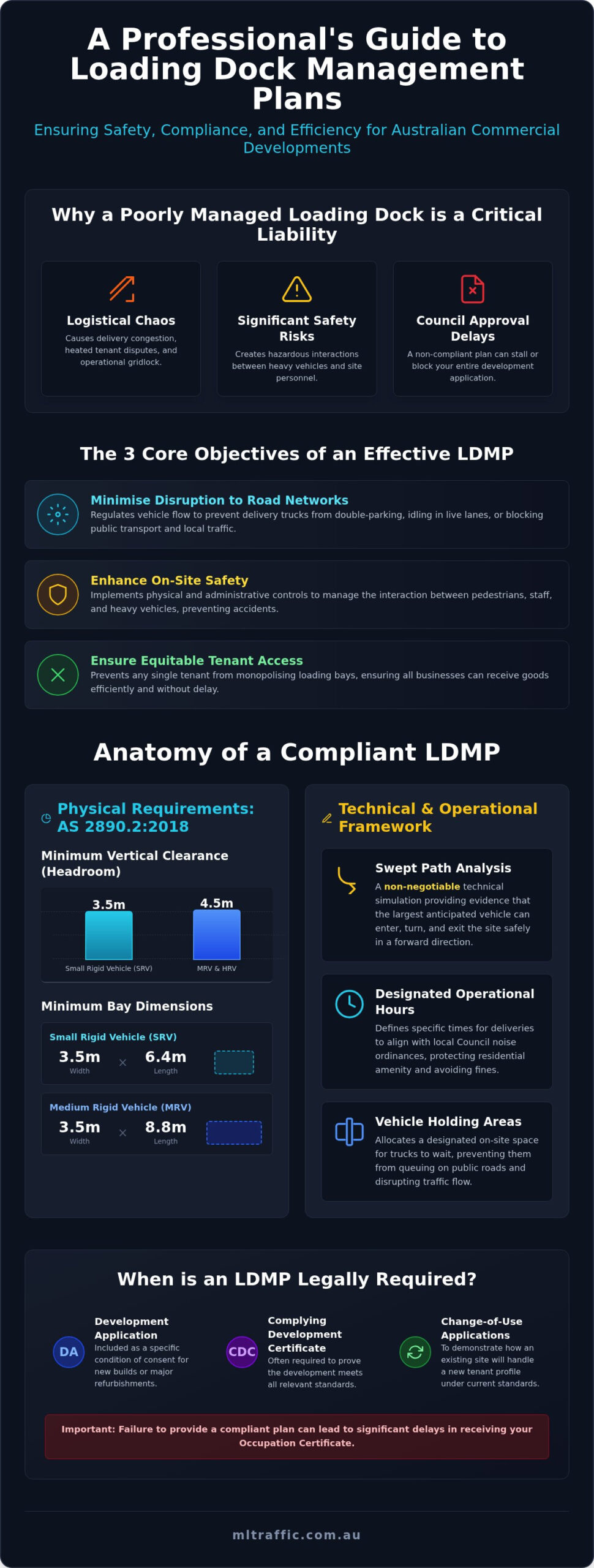
The core objective of an LDMP is to minimise disruption to the surrounding road network. When delivery drivers find a dock full, they often double-park or idle in live lanes, which blocks traffic and public transport. A formalised plan prevents this by regulating flow. Safety is the other primary driver. High-traffic commercial precincts see constant interaction between pedestrians and heavy vehicles. An effective plan creates physical and administrative barriers to prevent accidents. Finally, it ensures equitable access. It prevents a single large tenant from monopolising the bays, allowing all businesses on-site to receive their goods without delay.
When is a Plan Legally Required?
The requirement for an LDMP usually surfaces during the Development Application (DA) or Complying Development Certificate (CDC) process. Councils often include it as a specific condition of consent. You’ll also need one for change-of-use applications. If you’re repurposing an older industrial building for a different commercial use, the existing delivery infrastructure might no longer be compliant. In these cases, developing a comprehensive loading dock management plan for commercial tenants must demonstrate how the site will meet current standards, such as AS 2890.2:2018, while handling the new tenant profile. Failure to provide a compliant plan can lead to significant delays in receiving your Occupation Certificate.
Key Components of a Robust Loading Dock Plan
A robust loading dock management plan for commercial tenants begins with an accurate assessment of the site’s physical limits. Under AS 2890.2:2018, specific minimum dimensions apply to ensure functionality. Small Rigid Vehicles (SRV) require a bay width of 3.5 metres and a length of 6.4 metres. Medium Rigid Vehicles (MRV) extend this length to 8.8 metres. Vertical clearance is equally critical. SRVs need 3.5 metres of headroom, while MRVs and Heavy Rigid Vehicles (HRV) require 4.5 metres. Any plan that fails to document these clearances risks operational failure or structural damage.
Physical dimensions alone don’t guarantee access. Manoeuvrability is the primary concern for Council assessors. A Swept Path Analysis is a non-negotiable component of a professional plan. This technical simulation proves that the largest anticipated vehicle can enter, turn, and exit the site in a forward direction without striking walls, columns, or other parked vehicles. It removes guesswork from the DA process. If your site cannot accommodate these movements safely, the plan must outline specific vehicle size restrictions to maintain compliance.
Beyond physics, the plan must address environmental and community impacts. Operational hours must align with local Council noise ordinances to protect neighbouring residential properties. Designated holding areas are essential. They ensure trucks don’t queue on public roads while waiting for a bay to become vacant. This prevents traffic congestion and potential fines from local authorities. For complex sites, engaging an expert to provide specialised traffic engineering services ensures these holding zones are positioned correctly.
Vehicle Identification and Classification
Defining the “Design Vehicle” is a fundamental step. The plan must specify if the facility is designed for SRVs, MRVs, or HRVs. It’s vital to set maximum vehicle length and height limits for the facility to prevent oversized trucks from entering. The plan should distinguish between “courier-style” deliveries, which require short-stay bays, and large palletised freight deliveries that need extended dock time. This classification allows for more efficient bay allocation and prevents smaller vans from occupying bays designed for larger trucks.
Infrastructure and Signage
Clear wayfinding and safety signage within the dock area are mandatory. Drivers need immediate visual cues for bay numbers, height limits, and pedestrian exclusion zones. Infrastructure like convex mirrors, bollards, and high-visibility line marking play a critical role in accident prevention. Modern plans also integrate loading dock technology, such as bay-occupancy indicators or sensors. these tools provide real-time data to dock managers, allowing them to redirect incoming vehicles to available bays before they enter the site and cause congestion.
Managing Deliveries and Tenant Coordination
Operational efficiency in a multi-tenant environment is impossible without a structured coordination strategy. A loading dock management plan for commercial tenants serves as the operational rulebook that prevents site-wide gridlock. Relying on an informal “first-in, best-dressed” approach invariably leads to vehicle queuing on public roads and frequent tenant disputes. An effective plan replaces this chaos with a predictable schedule that respects the unique needs of every business on-site.
A centralised booking system is the most effective tool for managing limited bay capacity. You should allocate specific time slots based on the tenant’s floor area and delivery frequency. For example, a major supermarket tenant may require multiple morning slots, while a boutique retailer might only need a single 20-minute window twice a week. This tiered approach ensures that high-volume tenants have the access they need without locking out smaller operators.
Peak periods, such as the pre-opening retail rush or the midday food and beverage delivery window, require strict enforcement. Ad-hoc deliveries and unannounced couriers represent the biggest threat to these schedules. To manage this, the plan should designate “short-stay” zones specifically for couriers, with a maximum stay of 15 minutes. This keeps the primary bays free for larger, pre-booked freight vehicles. Clear communication through a loading dock management plan for commercial tenants ensures that all parties know when and where they are permitted to park.
Tenant Responsibilities and Communication
Tenants must understand their obligations under the site-wide management plan. It is not enough to simply have the document; it must be actively enforced. A dedicated Dock Manager or Building Manager should oversee the daily schedule and address non-compliance immediately. Drafting clear “House Rules” for suppliers is a critical step. These rules should be included in tenant lease agreements and delivery contracts to ensure third-party drivers adhere to site-specific time limits and access routes. Consistency in enforcement is the only way to maintain driver discipline.
Safety Protocols for On-Site Personnel
Safety is paramount in high-traffic commercial zones. The plan must mandate the physical separation of pedestrians and vehicles using clearly marked walkways and exclusion zones. According to Safe Work Australia guidelines, administrative controls like high-visibility vests are secondary to engineering solutions. All regular drivers and contractors must complete a site induction before being granted access. Finally, the plan must coordinate waste collection schedules. Scheduling rubbish removal to occur during off-peak delivery hours prevents the dock from becoming overcrowded and reduces the risk of collisions between waste trucks and delivery vans.
Compliance with Australian Standards and Safety
Adherence to AS 2890.2:2018 is the legal baseline for any loading dock management plan for commercial tenants. This standard governs the geometric design of off-street commercial vehicle facilities. It ensures that every aspect of the facility, from ramp grades to driveway widths, meets national engineering benchmarks. Developing a loading dock management plan for commercial tenants requires a deep understanding of these technical nuances to ensure the site remains functional under heavy load. Compliance is not optional. It is a critical requirement for meeting Work Health and Safety (WHS) obligations. These laws protect workers from vehicle-related injuries and the public from traffic hazards at the property boundary. Engaging a Professional Traffic Engineer is the most reliable way to certify that your site design and operational procedures satisfy these rigorous standards.
AS 2890.2 Technical Requirements
The current 2018 edition of AS 2890.2 provides the specific formulas for calculating minimum bay lengths and widths. These dimensions vary significantly based on the vehicle class, ranging from Small Rigid Vehicles (SRV) to Articulated Vehicles (AV). Vertical clearance is another non-negotiable metric. The standard mandates a minimum of 3.5 metres for SRVs and 4.5 metres for heavier classes. Beyond the bays, the plan must address reversing manoeuvres. Vehicles should ideally enter and exit the site in a forward direction. If reversing is necessary, it must be performed entirely within the site boundaries. Sight distance at the property line is also vital. It ensures drivers can see pedestrians and other vehicles before emerging onto public footpaths or roads.
Environmental and Noise Compliance
Loading docks are frequent sources of noise complaints, especially in mixed-use or residential-adjacent zones. An effective management plan addresses these impacts directly. Strategies include managing engine idling times and regulating the use of refrigeration units. Some Councils mandate the installation of acoustic barriers or restrict operating windows to daytime hours. Coordinating these efforts with Waste Management Plans ensures that refuse removal does not occur during noise-sensitive periods. This holistic approach prevents legal disputes with neighbours and ensures the long-term viability of the commercial asset. If you require a compliant management plan for your development application, request a technical assessment from our senior principals today.
Implementing Your LDMP: From DA to Daily Operations
Moving from a theoretical design to a functional facility requires a disciplined implementation strategy. A loading dock management plan for commercial tenants is not a static document; it is an operational manual that must evolve with the building’s lifecycle. The transition from the Development Application (DA) phase to daily site management involves five critical steps:
- Step 1: Technical Assessment. Engage a qualified traffic consultant to conduct a comprehensive site assessment and vehicle swept path analysis. This ensures the physical layout can accommodate the design vehicle.
- Step 2: Strategic Drafting. Develop the LDMP by balancing specific tenant requirements with the conditions of consent issued by the Council.
- Step 3: Submission and Approval. Submit the completed plan as part of your DA or to satisfy post-approval requirements before the Occupation Certificate is issued.
- Step 4: Operational Onboarding. Train building management staff on the booking system and communicate the finalised plan to all commercial tenants and their logistics partners.
- Step 5: Lifecycle Review. Perform an annual review of the document to account for changes in tenant mix, delivery volumes, or vehicle types.
Monitoring and Enforcement
Consistent oversight is the only way to prevent a loading dock from becoming a liability. Building managers should use CCTV and digital logbooks to track compliance with scheduled time slots. This data provides an objective record when addressing non-compliance. Implement a formal warning system for repeat-offender suppliers who exceed their allocated windows or arrive unannounced. Periodic audits are also essential. These reviews identify bottlenecks in the delivery flow and allow for data-driven adjustments to the booking schedule. Regular monitoring ensures the site remains safe for all personnel and keeps traffic moving efficiently.
Why Professional Expertise Matters
The technical complexity of AS 2890.2:2018 and Council traffic requirements leaves no room for error. ML Traffic Engineers ensures your loading dock management plan for commercial tenants is both compliant and practical for the end-user. Our senior principals are involved in every technical assessment, providing a level of accountability that larger firms often lack. We provide a personnel continuity promise, meaning the same expert who starts your project will be the one performing the technical work. Our approach focuses on results. We bridge the gap between complex regulatory standards and the practical needs of site operators. Every report we produce undergoes rigorous review by senior leadership. This ensures that your management plan is defensible during the DA process and functional during daily operations. If you require a specialised traffic assessment for your next project, contact our team to discuss your requirements.
Securing Your Site’s Operational Future
A compliant loading dock is more than a regulatory requirement; it’s a strategic asset that prevents traffic congestion and onsite accidents. By adhering to the technical standards of AS 2890.2:2018 and implementing a structured booking system, you ensure equitable access for all businesses within the building. Developing a robust loading dock management plan for commercial tenants is the most effective way to eliminate delivery gridlock and secure Council approval for your development application.
ML Traffic Engineers brings over 15 years of Australian traffic engineering experience to every project. Our specialists in AS 2890.2 compliance provide direct access to senior principals who oversee every technical assessment from start to finish. We ensure your documentation is both defensible and practical for daily use. Get a Professional Loading Dock Management Plan from ML Traffic Engineers to streamline your next project. You can transform your loading facility into a safe, efficient, and fully compliant hub that supports long-term tenant satisfaction and operational safety.
Frequently Asked Questions
What is the difference between an LDMP and a Traffic Management Plan?
An LDMP focuses specifically on the daily operations of a loading facility, while a Traffic Management Plan (TMP) is a broader document covering all vehicle and pedestrian movements across a whole site or road network. The LDMP is a subset of site-specific traffic management that details bay scheduling, vehicle clearances, and dock-specific safety protocols. TMPs often address construction or temporary road changes, whereas an LDMP is typically an ongoing operational document for the building’s lifecycle.
Does every commercial building need a loading dock management plan?
Not every building requires a formal plan, but it’s mandatory for most new developments and major refurbishments where Council identifies potential traffic or safety impacts. If your building has multiple tenants sharing limited loading space, a loading dock management plan for commercial tenants is essential for maintaining order and safety. Small, single-occupancy sites with low delivery volumes may be exempt unless specific safety risks or street-side congestion triggers a Council requirement during the DA phase.
How do I determine the largest vehicle that can enter my loading dock?
You must identify the “Design Vehicle” by reviewing the site’s physical constraints against the classifications in AS 2890.2:2018. The most reliable method is to perform a Vehicle Swept Path Analysis using specialised software to simulate the turning circles of different truck classes. This technical assessment accounts for ramp grades, overhead obstructions, and internal pillar placement. If a Heavy Rigid Vehicle cannot navigate the entry without crossing into oncoming lanes, your site’s limit is likely restricted to smaller classes.
Can Council reject my DA if the loading dock plan is insufficient?
Council can and frequently does refuse Development Applications or issue “Requests for Further Information” if the loading dock plan lacks technical detail. An insufficient plan fails to prove that deliveries won’t cause illegal queuing on public roads or create safety hazards for pedestrians. Without a professional report that demonstrates compliance with Australian Standards, your project risks significant delays or a total refusal of the Occupation Certificate. Professional engineering certification is the only way to mitigate this risk.
How do I manage multiple tenants who all want morning deliveries?
You must implement a prioritised booking system that allocates fixed windows based on tenant type and floor area. Retail and food tenants generally receive priority for early morning slots, while non-perishable goods or office deliveries are moved to mid-morning or afternoon periods. A loading dock management plan for commercial tenants should specify these windows clearly in the House Rules. This prevents first-in, best-dressed chaos and ensures the dock operates at peak efficiency during high-demand hours.
What are the consequences of non-compliance with AS 2890.2?
Non-compliance leads to structural damage, operational gridlock, and increased legal liability in the event of an accident. If a vehicle strikes an overhead obstruction because the clearance height was incorrectly documented, the building owner may face substantial repair costs and insurance disputes. Failure to meet these national engineering benchmarks can also result in Work Health and Safety (WHS) breaches. This leads to heavy fines from state regulators and potential closure of the loading facility until rectified.
How often should a loading dock management plan be updated?
A management plan should be reviewed annually or whenever there’s a significant change in the tenant mix. If a low-impact office tenant is replaced by a high-volume retail outlet, the existing delivery schedule will likely become obsolete. Regular audits allow building managers to adjust time slots and bay allocations to reflect current site usage. This proactive approach prevents congestion from building up over time as the commercial requirements of the building evolve and delivery frequencies increase.
Can a loading dock be shared with waste collection services?
Yes, but this requires strict scheduling to ensure waste trucks don’t interfere with standard delivery windows. Waste collection should ideally occur during off-peak hours, such as late evening or very early morning, to avoid competing for bay space with freight vehicles. The LDMP must integrate with the site’s Waste Management Plan to define specific zones and times for refuse removal. This coordination is vital for maintaining hygiene and preventing collisions in confined dock areas where space is limited.

Disclaimer
The content on www.mltraffic.com.au, including all technical articles, guides, and resources, is provided for general informational and educational purposes only. It is not intended to constitute professional advice in traffic engineering, transportation planning, development approvals, or any other technical or legal field.
While ML Traffic Engineers makes every reasonable effort to ensure the accuracy, completeness, and timeliness of the information published, we do not provide any warranties or representations (express or implied) regarding its reliability, suitability, or availability for any particular purpose. Any reliance you place on the content is strictly at your own risk.
In no event shall ML Traffic Engineers, its directors, employees, authors, or affiliates be liable for any direct, indirect, incidental, special, consequential, or punitive damages (including, without limitation, loss of profits, data, or business opportunities) arising out of or in connection with the use of, or inability to use, any information provided on this website.
The articles and guides on this site are not a substitute for engaging a qualified, registered professional traffic engineer (such as an NPER or RPEQ engineer) to assess your specific project requirements. For tailored advice, compliance assessments, or traffic engineering services, please contact a competent professional.
This disclaimer may be updated from time to time without notice. By accessing or using this website, you agree to be bound by the most current version of this disclaimer.
