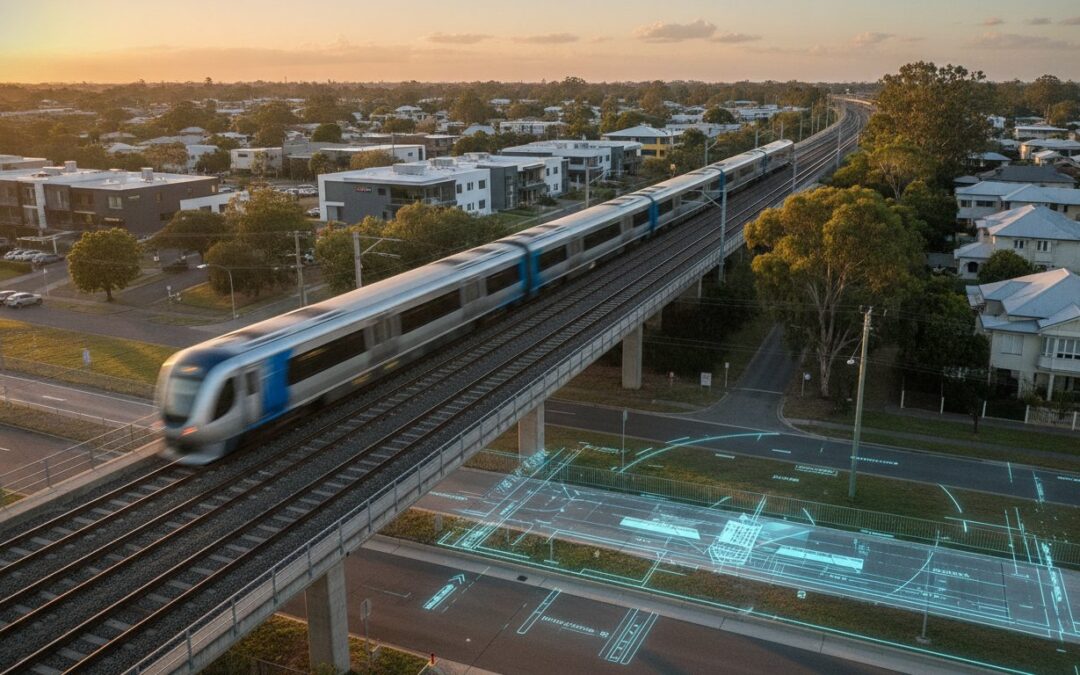
A $5.8 billion infrastructure investment does not simply add tracks; it fundamentally resets the traffic and access rules for every development within the corridor. With the Logan and Gold Coast Faster Rail project moving into the delivery phase in June 2026, the baseline data you relied on six months ago for your Traffic Impact Assessment (TIA) is likely already obsolete. It is a bold statement, but in a corridor undergoing this much change, yesterday’s traffic counts won’t satisfy today’s regulatory scrutiny.
We recognise the frustration of planning around shifting road realignments and the removal of five major level crossings at Kuraby, Woodridge, Bethania, Holmview, and Beenleigh. You need technical certainty to ensure your development remains viable and compliant. This article outlines the full technical scope of the Logan and Gold Coast Faster Rail project and explains how it impacts traffic engineering requirements for nearby developments. We will preview the specific challenges of construction-phase traffic management and how the relocation of Loganlea Station by 2027 alters the local pedestrian and vehicle network.
Key Takeaways
- Understand the technical scope of the Logan and Gold Coast Faster Rail project, including the track duplication and the removal of five level crossings between Kuraby and Beenleigh.
- Learn why road realignments near new rail overpasses necessitate updated Vehicle Swept Path Analysis to maintain site access compliance.
- Identify how to adjust Traffic Impact Assessment (TIA) data to account for changing traffic volumes and Council expectations within Transit Oriented Development (TOD) zones.
- Evaluate the impact of station precinct upgrades and the relocation of Loganlea station on local vehicle and pedestrian movements.
Logan and Gold Coast Faster Rail: Project Overview and 2026 Status
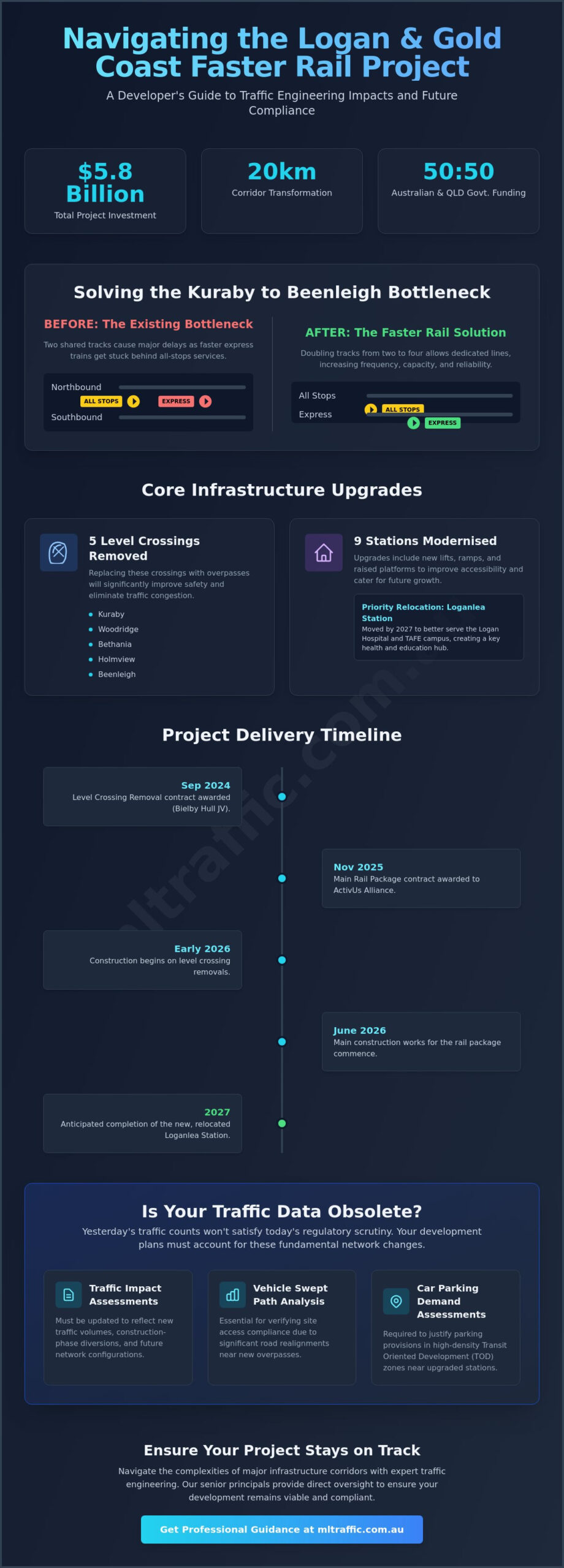
The Logan and Gold Coast Faster Rail project is a critical transport capacity reset for South East Queensland. Valued at $5.8 billion, this infrastructure initiative is funded on a 50:50 basis by the Australian and Queensland Governments. The technical scope centres on doubling the rail capacity from two to four tracks along a 20km corridor between Kuraby and Beenleigh. This expansion is essential to accommodate the projected population growth and transport demands associated with the 2032 Olympic and Paralympic Games.
The Kuraby to Beenleigh Corridor Bottleneck
The existing rail configuration between Kuraby and Beenleigh has long functioned as a major operational bottleneck. Suburban and Gold Coast express services currently share a single track in each direction. This arrangement causes significant delays, as faster express trains are often caught behind all-stop suburban services. By doubling the tracks, the South East Queensland Rail Network will gain the ability to separate these service types, allowing for more frequent and reliable regional transit.
Modernisation is a key component of this upgrade. The project includes enabling works for the European Train Control System (ETCS). This digital signalling technology allows trains to run closer together safely, further increasing the capacity and safety of the line. For developers, this means a permanent increase in commuter volume and a shift in the strategic importance of station precincts along this route.
Timeline and 2026 Progress
Procurement for this massive undertaking followed funding commitments in the 2021-2022 Federal and State budgets. As of mid-2026, the project has transitioned into the active delivery phase with several major contracts underway:
- Rail Package: Formally awarded to the ActivUs Alliance (comprising ACCIONA, CPB Contractors, UGL, SMEC, and WSP) in November 2025. Main construction works are scheduled to commence in June 2026.
- Open Level Crossing Removal Package: The Bielby Hull Joint Venture was awarded the Design and Construct contract in September 2024. Construction on these critical road-rail separations is expected to begin in early 2026.
- Loganlea Station Relocation: This $174 million package, managed by the Martinus Rail and Degnan Joint Venture, is currently in progress with completion anticipated by 2027.
These concurrent workstreams will create complex construction-phase traffic environments. Developers seeking to progress projects in these areas must account for these timelines when preparing a Traffic Impact Assessment (TIA) Report to ensure baseline data reflects the active construction environment and future network configuration. Our senior principals provide direct oversight on these assessments to navigate the evolving requirements of major infrastructure corridors.
Key Infrastructure Upgrades: Stations, Tracks, and Precincts
The physical transformation of the 20km corridor involves a comprehensive overhaul of existing rail and road infrastructure. A central component of the Logan and Gold Coast Faster Rail initiative is the delivery of full accessibility upgrades at nine stations. These stations will feature new lifts, ramps, and raised platforms to meet modern disability compliance standards. These upgrades are designed to facilitate the higher passenger volumes expected as the South East Queensland rail network expands to meet 2032 targets.
Station Precinct Redevelopment List
The project focuses on nine specific station precincts: Kuraby, Trinder Park, Woodridge, Kingston, Loganlea, Bethania, Edens Landing, Holmview, and Beenleigh. The relocation of Loganlea station is a priority. It will be moved to better serve the Logan Hospital and the local TAFE campus, creating a more integrated health and education hub. These modernised stations act as catalysts for high-density residential development under the Transit Oriented Development (TOD) framework.
For developers, these precinct changes often lead to zoning shifts that allow for increased density. However, this also results in higher scrutiny regarding local parking and access. Proximity to a high-frequency station may allow for reduced on-site parking, but this must be justified through a professional Car Parking Demand Assessment. Our senior principals ensure these assessments reflect the specific precinct changes and the increased reliance on active transport connections.
Level Crossing Removals and Local Road Changes
Safety and efficiency improvements include the removal of five key level crossings as part of the Logan and Gold Coast Faster Rail project. These are located at Kuraby, Woodridge, Bethania, Holmview, and Beenleigh. The transition from rail-level crossings to grade-separated overpasses or underpasses fundamentally alters local road network connectivity. While these changes reduce vehicle idling and improve safety, they also modify existing traffic flow patterns and site access points.
For adjacent developments, level crossing removals often necessitate significant road realignments. A new overpass can change the road grade in front of a site, which might impact driveway ramp compliance or sight distances at existing intersections. The project also includes improved walking and cycling connections that must be safely integrated with vehicle entry points. Ensuring your site layout remains functional during and after these infrastructure shifts requires precise technical modelling. We provide the meticulous analysis needed to navigate these structural changes and maintain project viability.
Traffic Impact and Access Considerations for Surrounding Developments
The transition from at-grade level crossings to grade-separated overpasses fundamentally changes the geometry of the local road network. For developments adjacent to the Logan and Gold Coast Faster Rail corridor, these physical changes can significantly alter existing site entry and exit points. When a road is realigned to meet a new bridge or underpass, the previous access configuration may no longer comply with safety standards or Council requirements. Some land parcels risk becoming “landlocked” during the construction and realignment phases, requiring meticulous planning to maintain operational continuity.
The removal of level crossings at Kuraby, Woodridge, Bethania, Holmview, and Beenleigh will eliminate the “stop-start” congestion currently caused by passing trains. While this improves overall network efficiency, it also triggers a redistribution of traffic volumes. Vehicles that previously avoided these bottlenecks may return to the local network, changing the peak-hour profiles used in your development’s traffic modelling. Accuracy in these assessments is vital to avoid costly redesigns later in the approval process.
Swept Path Analysis for Commercial Access
New rail overpasses often involve narrower road widths or tighter turning radii to fit within constrained urban corridors. Ensuring that heavy vehicles can still manoeuvre safely is a critical requirement for commercial and industrial sites. We conduct rigorous Swept Path Analysis to verify that delivery trucks and waste collection vehicles can access loading docks without encroaching on opposing traffic lanes or damaging infrastructure. All manoeuvres must maintain strict compliance with Australian Standards (AS 2890.2) for off-street commercial vehicle facilities. Our direct involvement in these technical assessments ensures that your loading dock design remains functional despite the altered road environment created by the Logan and Gold Coast Faster Rail works.
Sight Distance and Safety at New Intersections
The introduction of rail bridges and elevated tracks creates new vertical and horizontal sightline challenges. We assess sight distances at newly created road junctions to ensure they meet the minimum requirements for safe stopping and turning. Changes in road grade, such as the steep inclines required to approach a new overpass, can negatively affect driveway safety. A driveway that was previously level might now intersect with a sloping road, necessitating a Driveway Ramp Grade Assessment to prevent vehicle scraping and ensure clear sightlines for exiting drivers.
Pedestrian safety also requires prioritisation near high-frequency station entrances. The increased foot traffic from the upgraded stations must be safely integrated with vehicle entry points to your development. We provide the Intersection Analysis and safety modelling required to mitigate risks for pedestrians while maintaining efficient vehicle flow. Our senior principals oversee every report, providing the technical accountability needed for projects located near major rail infrastructure.
Preparing Your Traffic Impact Assessment (TIA) in Major Rail Corridors
Major infrastructure projects like the Logan and Gold Coast Faster Rail render historical traffic data obsolete. Baseline data is the foundation of any development application. If your data doesn’t reflect current network conditions, your DA will likely face significant delays or requests for information (RFI) from Council. Relying on traffic counts from even two years ago is a risk when the entire Kuraby to Beenleigh corridor is being physically and operationally restructured. Engaging a traffic engineer during the early feasibility stage is essential to avoid expensive design rework as the rail project progresses.
Baseline Data and Traffic Modelling
The standard growth forecasting models used in South East Queensland must be adjusted for the specific impacts of the Logan and Gold Coast Faster Rail works. Historical traffic volumes in the Kuraby-Beenleigh corridor do not account for the redistribution of vehicles following level crossing removals or the relocation of the Loganlea station. Modelling must now factor in a significant increase in pedestrian and cyclist activity within station precincts. This shift requires a sophisticated approach to multi-modal transport planning. For a detailed breakdown of these regulatory requirements, refer to our Traffic Impact Assessment guide.
Council expectations for developments within Transit Oriented Development (TOD) zones have become more stringent. Authorities now require clear evidence of how a development integrates with the broader rail network. You must demonstrate that your project supports the “faster rail” objective by facilitating efficient commuter access without compromising the local road network’s performance. Our Intersection Analysis services provide the empirical data needed to satisfy these planning requirements.
Parking Demand and AS 2890.1 Compliance
Developments located near high-frequency rail hubs often qualify for reduced parking rates. However, this is not an automatic entitlement. You must provide a robust Car Parking Demand Assessment to justify any departure from standard planning schemes. This assessment must prove that the proximity to the upgraded rail line will realistically reduce private vehicle reliance for your specific land use.
- Design Standards: Every car park must maintain strict compliance with AS 2890.1. We ensure aisle widths, bay dimensions, and ramp grades meet these national standards.
- Active Transport: Modern compliance requires a focus on bicycle parking and end-of-trip facilities. These must be accessible and safely separated from heavy vehicle loading areas.
- Construction Management: Your initial DA submission should address how your construction traffic will interact with the ongoing rail works. A preliminary Traffic Guidance Scheme (TGS) can help mitigate Council concerns regarding construction-phase conflicts.
Precision in these technical documents is the only way to ensure a smooth approval process. Contact our senior principals to discuss the specific traffic engineering requirements for your site within the Logan and Gold Coast Faster Rail corridor.
Professional Traffic Engineering for Projects Near Major Infrastructure
ML Traffic Engineers provides the specialised technical expertise required for complex urban transport projects within the Logan and Gold Coast Faster Rail corridor. Our firm offers national experience backed by over 15 years of navigating the specific regulatory requirements of both state transport authorities and local councils. We recognise that developments near major infrastructure require more than just standard modelling; they demand a deep understanding of evolving bureaucratic expectations and physical network changes. Our hands-on approach is designed to reduce the risk of significant DA delays and the financial burden of late-stage redesigns.
A key distinction of our practice is the direct access we provide to senior principals. We operate with a “no-gatekeepers” philosophy, meaning your project is managed and executed by the same seasoned expert from inception to completion. This personnel continuity promise ensures that the technical work is performed by a qualified professional who is fully accountable for the results. It distinguishes us from larger, more impersonal firms where work is often delegated to junior staff. Our leadership remains directly involved in every assessment, ensuring that the technicalities of site access and traffic flow are addressed with meticulous precision.
Our Approach to Major Rail Corridors
We combine technical precision with a transparent communication style. Every Traffic Impact Assessment we produce is specifically tailored to the unique land-use category of your development. Whether you are delivering a high-density residential project in a Transit Oriented Development (TOD) zone or a complex industrial facility near a new rail overpass, our reports address the specific challenges of the site. We ensure your project remains compliant with all national and local regulatory standards, including the latest Australian Standards for parking and access.
Our team meticulously analyses how the Logan and Gold Coast Faster Rail upgrades affect your site’s specific requirements. We provide a comprehensive range of technical services, including Vehicle Swept Path Analysis, Car Parking Demand Assessments, and Intersection Analysis. This data-driven approach provides the empirical evidence needed to satisfy planning authorities and secure your approval. We focus on delivering results that are technically sound and capable of withstanding rigorous scrutiny from regulatory bodies.
Secure Your Planning Approval
The value of a meticulous traffic report in the DA approval process cannot be overstated. A professional assessment serves as a professional resume for your development’s transport viability. It answers the critical questions regarding safety, capacity, and network integration before they become obstacles. We provide the assurance and reliability needed to move your project forward in a rapidly changing infrastructure environment. Our involvement ensures that potential traffic conflicts are identified and mitigated early in the design phase.
Precision and accountability are the foundations of our consultancy. We invite you to access our Contact page for immediate project support and a direct consultation with an expert. Our senior leadership is available to guide your development through the technical and bureaucratic complexities of the Logan and Gold Coast Faster Rail corridor, providing a clear path to planning success.
Navigating Infrastructure Shifts with Technical Precision
The Logan and Gold Coast Faster Rail project represents a permanent shift in the transport landscape for South East Queensland. Developers must account for the physical road realignments and redistributed traffic volumes that accompany the removal of five major level crossings. Relying on outdated baseline data for your Traffic Impact Assessment (TIA) is a significant risk. It often leads to costly RFI delays or complete project redesigns.
ML Traffic Engineers offers the technical expertise required to manage these complexities. With over 15 years of traffic engineering excellence, we provide direct accountability with no gatekeepers. Every project benefits from Senior Principal involvement to ensure your submission meets the most stringent Council and State requirements. We focus on delivering meticulous reports that secure your planning approval efficiently.
Get an Expert Traffic Assessment for Your Project
We look forward to providing the technical certainty your development needs to succeed in this rapidly evolving rail corridor.
Frequently Asked Questions
What is the Logan and Gold Coast Faster Rail project?
The Logan and Gold Coast Faster Rail is a $5.8 billion infrastructure project designed to double the rail capacity between Kuraby and Beenleigh. The project involves expanding the corridor from two to four tracks over a 20km stretch. Jointly funded by the Australian and Queensland Governments, it addresses a major regional bottleneck to improve service frequency and reliability for commuters moving between Brisbane and the Gold Coast.
How will the track doubling affect local traffic congestion?
Track doubling reduces local congestion by removing five open level crossings that currently cause significant vehicle idling and delays. Separating rail and road movements through grade separation allows for a more continuous traffic flow. While overall network efficiency improves, the project triggers a redistribution of vehicle volumes. Developers must account for these shifting peak-hour profiles in their technical modelling to ensure site access remains functional.
Which stations are being upgraded as part of the project?
Nine stations along the Kuraby to Beenleigh corridor are receiving full accessibility and facility upgrades. These include Kuraby, Trinder Park, Woodridge, Kingston, Loganlea, Bethania, Edens Landing, Holmview, and Beenleigh. These upgrades focus on compliance with modern disability standards and the integration of active transport connections. For nearby developments, these modernised precincts act as catalysts for increased residential density and transit-oriented growth.
Will the level crossing removals change my property access?
Level crossing removals frequently necessitate significant road realignments that can fundamentally change existing site entry and exit points. The transition to overpasses or underpasses alters road grades and intersection geometries. We recommend conducting a Vehicle Swept Path Analysis to verify that heavy vehicles can still manoeuvre safely into your site. These physical changes can impact driveway ramp compliance and sight distance requirements at newly created junctions.
Do I need a new Traffic Impact Assessment if my site is near the rail corridor?
You likely require an updated Traffic Impact Assessment (TIA) Report because the Logan and Gold Coast Faster Rail project renders historical baseline data obsolete. Previous traffic counts do not reflect the current construction-phase environment or the future road configurations. Accurate modelling is essential to satisfy Council and State transport requirements. Our senior principals ensure that every TIA reflects the specific technical scope of this $5.8 billion corridor upgrade.
How does the project support the 2032 Olympic and Paralympic Games?
The project provides the high-capacity transport infrastructure required to manage the massive spectator volumes expected during the 2032 Olympic and Paralympic Games. Removing the Kuraby-to-Beenleigh bottleneck is a critical prerequisite for delivering reliable, high-frequency rail services between Brisbane and Gold Coast venues. It ensures the regional transport network can accommodate the surge in demand while providing a permanent legacy of improved connectivity for South East Queensland.
What are the benefits of the Loganlea station relocation?
Relocating the Loganlea station closer to the Logan Hospital and TAFE campus creates a more integrated health and education precinct. This $174 million relocation package improves direct access for staff, students, and patients who rely on the rail network. For developers, this shift creates new opportunities for high-density land uses within the immediate vicinity of the relocated station, though it requires precise modelling of local pedestrian and vehicle movements.
Can I reduce my car parking provision if my site is near a new station?
Reductions in car parking provisions are possible for developments near high-frequency rail hubs, but they are not automatically granted. You must provide a robust Car Parking Demand Assessment to justify any departure from standard planning scheme rates. This assessment must prove that the proximity to the upgraded rail line will realistically reduce private vehicle reliance for your specific land use. Council approval depends on this empirical evidence to maintain local network performance.

Disclaimer
The content on www.mltraffic.com.au, including all technical articles, guides, and resources, is provided for general informational and educational purposes only. It is not intended to constitute professional advice in traffic engineering, transportation planning, development approvals, or any other technical or legal field. While ML Traffic Engineers makes every reasonable effort to ensure the accuracy, completeness, and timeliness of the information published, we do not provide any warranties or representations (express or implied) regarding its reliability, suitability, or availability for any particular purpose. Any reliance you place on the content is strictly at your own risk. In no event shall ML Traffic Engineers, its directors, employees, authors, or affiliates be liable for any direct, indirect, incidental, special, consequential, or punitive damages (including, without limitation, loss of profits, data, or business opportunities) arising out of or in connection with the use of, or inability to use, any information provided on this website. The articles and guides on this site are not a substitute for engaging a qualified, registered professional traffic engineer (such as an NPER or RPEQ engineer) to assess your specific project requirements. For tailored advice, compliance assessments, or traffic engineering services, please contact a competent professional. This disclaimer may be updated from time to time without notice. By accessing or using this website, you agree to be bound by the most current version of this disclaimer.
