

In major Australian hubs, excavating a single basement parking spot can add over A$120,000 to your construction costs before you even reach ground level. This financial burden often forces developers to choose between a reduced project yield or a risky DA that faces immediate Council pushback. If you’re tired of losing profitable floor space to empty concrete stalls, it’s time to start making a strong case for parking reduction using technical data that planners cannot ignore.
You likely agree that rigid parking minimums are often out of touch with modern transport trends and buyer demands. It’s a common frustration to see a project’s ROI gutted by unnecessary excavation requirements that don’t reflect the actual needs of the local area. This guide provides the exact data-driven strategies and engineering evidence required to justify a reduction and win over skeptical planning officers. We’ll show you how to use empirical demand assessments and site-specific traffic surveys to secure an approval that lowers your costs and maximises your development’s potential.
Key Takeaways
- Identify the critical gap between outdated statutory council codes and real-world vehicle demand to justify a departure from rigid parking requirements.
- Learn the technical process of gathering empirical evidence through “proxy” site surveys to replace general assumptions with hard, site-specific data.
- Discover how to leverage “Green Travel Plans” as a high-impact negotiation tool when making a strong case for parking reduction during council meetings.
- Understand the essential components of a high-performing parking assessment report designed to turn complex traffic data into a persuasive case for approval.
- See why a principal-led approach with an experienced traffic engineer is vital for navigating high-stakes planning panels and expert witness requirements.
Table of Contents
- Understanding Statutory Requirements vs. Actual Parking Demand
- Gathering the Evidence: The Foundation of Your Case
- Strategic Arguments to Reduce Parking Requirements
- How to Structure a Winning Parking Assessment Report
- Partnering with a Traffic Engineer to Secure Approval
Understanding Statutory Requirements vs. Actual Parking Demand
Most local council planning schemes in Australia rely on static parking rates established decades ago. These rigid codes often assume every resident, staff member, or visitor arrives via a private vehicle. This creates a significant disconnect between what the law requires and how people actually move in 2026. Developers often find themselves caught between building unnecessary infrastructure and meeting project budgets. Bridging this gap requires a technical shift from following generic tables to making a strong case for parking reduction based on site-specific evidence.
A Car Parking Demand Assessment is the primary tool for this transition. It replaces theoretical “worst-case” scenarios with empirical data. By demonstrating that a development won’t result in overspill parking on local streets, you can justify deviations from the standard planning scheme. This doesn’t just save money; it allows for better architectural outcomes, such as increased landscaping or more efficient floor plates.
The Problem with “One-Size-Fits-All” Parking Rates
Generic land-use categories fail because they ignore the nuances of modern urban life. A gym in a suburban business park has different needs than a boutique studio in a high-density corridor. By 2026, car ownership trends in major hubs like Sydney and Melbourne have shifted significantly. Data indicates that up to 18% of residents in transit-oriented developments now rely entirely on car-sharing services or micro-mobility.
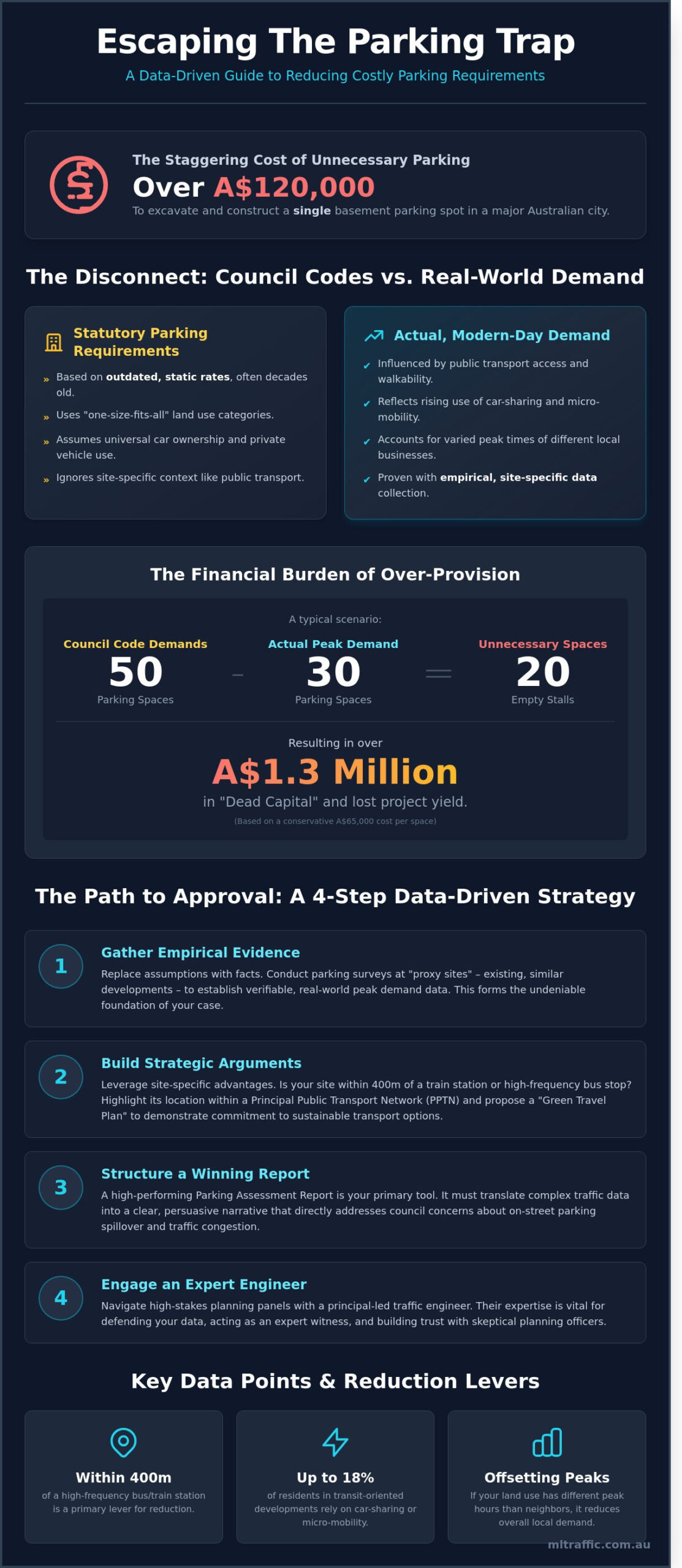
The financial burden of over-provision is immense. Constructing a single underground parking space in Australia currently costs between A$65,000 and A$130,000. When a council code demands 50 spaces but the actual demand is 30, you are looking at over A$1.3 million in “dead” capital. This unnecessary expenditure often makes the difference between a project being feasible or stalled. Rigid codes don’t account for these economic realities, making expert intervention essential.
When to Consider a Parking Reduction Request
You should evaluate a reduction request whenever site constraints make full compliance impractical. Narrow frontages, significant slope, or heritage overlays often limit the physical space available for ramps and turning circles. If your site is within 400 metres of a high-frequency bus stop or train station, you have a primary lever for a reduction. To identify which technical studies your project requires, you can review the ML Traffic Services page for a breakdown of assessment types.
- Identify if the site is within a Principal Public Transport Network (PPTN) area.
- Assess if the land use has peak demand times that differ from surrounding businesses.
- Check for existing on-street parking availability through a formal parking occupancy survey.
Success in making a strong case for parking reduction depends on professional data. We use industry-standard methodologies to prove that your project’s specific location and demographic will generate less traffic than the “standard” model suggests. This evidence-based approach provides the assurance councils need to approve your application without the burden of excessive parking stalls.
Gathering the Evidence: The Foundation of Your Case
Council planners and committees don’t make decisions based on gut feelings or generalisations. If you walk into a meeting claiming that “nobody drives in this area,” your application will likely stall. Empirical data is the only currency that matters. In 2023, local councils across Australia increased their scrutiny of traffic reports, requiring developers to prove that lower parking provision won’t lead to street congestion. You need a foundation built on verifiable facts rather than optimistic guesses.
The Power of Empirical Parking Surveys
We often use “proxy sites” to demonstrate how your development will actually function. A proxy site is an existing building that mirrors your project’s use, size, and proximity to public transport. To be valid, these sites must be within a similar socio-economic catchment. We conduct 24-hour occupancy counts and duration-of-stay surveys to track exactly how long visitors and residents stay. Peak parking demand is the maximum number of vehicles observed at any one time. Analysing this peak, rather than just an average, ensures your proposal remains functional during the busiest hours of the week.
Historical data helps us predict future transport behaviour by looking at patterns over the last 5 to 10 years. If a suburb has seen a 15% increase in cycling infrastructure, parking demand usually drops accordingly. You can see how our experienced traffic consultants apply these technical assessments to complex urban sites.
Utilising Census and Demographic Data
The 2021 ABS Census data provides a wealth of information for making a strong case for parking reduction. We look at car ownership rates per household in your specific LGA. For example, in high-density zones like inner-city Sydney or Melbourne, car ownership often sits below 0.7 vehicles per dwelling. Linking resident profiles to parking needs is a highly effective strategy. Students and young professionals in studio apartments typically have a 35% lower vehicle dependency than families in three-bedroom townhouses. Presenting these demographic trends as a long-term shift allows you to justify a reduction based on who will actually live in the building, not just outdated statutory requirements.
Strategic Arguments to Reduce Parking Requirements
Successful developers don’t just tell Council they lack space. They build a narrative that proves why the parking isn’t necessary. This shift from a “shortfall” to an “optimized design” is the secret to making a strong case for parking reduction. A Green Travel Plan (GTP) serves as your strongest negotiation tool here. It isn’t just a document; it’s a formal commitment to reducing car dependency through actionable strategies. When we pair a GTP with an on-street parking survey, the evidence becomes hard to ignore. If our data shows that kerbside occupancy within a 200-metre radius stays below 85% during peak hours, it demonstrates that the local area can easily absorb any minor overflow without impacting residents.
The Impact of Sustainable Transport Links
Proximity to transit is a data point, not a feeling. We use the “Walk Score” metric to quantify this accessibility. A score of 80 or higher suggests a “Walker’s Paradise,” providing a factual basis for lowering parking ratios. To support this, end-of-trip facilities are essential. Installing secure bike racks, lockers, and showers proves to planners that you’ve provided a viable alternative to driving. Furthermore, car-share schemes are incredibly effective in Australian urban centres. Dedicated pods for operators like GoGet or Flexicar can often replace between 10 and 13 private parking spots in a Development Application. This reduction significantly lowers excavation costs while meeting the mobility needs of the occupants.
Shared Parking and Complementary Land Uses
Shared parking, or “reciprocal parking,” is based on the reality that not every tenant needs a space at the same time. It’s an efficient use of land that councils increasingly support. For example, a cafe that operates from 7:00 am to 3:00 pm and a wine bar that opens from 5:00 pm to late can utilize the same parking bays. There is no overlap in their peak demand. When making a strong case for parking reduction, we use these diurnal demand curves to justify a smaller total footprint. All shared layouts must still meet the technical requirements of AS 2890.1 to ensure vehicle swept paths and aisle widths are compliant. You can learn more about how we apply these technical standards on our services page. This methodical approach ensures the site remains functional for all users throughout the day and night.
How to Structure a Winning Parking Assessment Report
A traffic report functions as your primary tool for negotiation with the local council. It isn’t just a collection of numbers; it’s a technical argument that must withstand intense scrutiny from planning officers. When you’re making a strong case for parking reduction, the structure of your document determines whether your application is fast-tracked or buried in a pile of “Requests for Further Information.”
Council officers often review dozens of applications weekly. They value clarity over fluff. We’ve found that reports using clear visual aids, such as colour-coded heat maps of street parking and high-resolution site photos, receive fewer objections. Data tables should be easy to read, highlighting the 85th percentile of peak demand to prove that your proposed numbers meet actual needs rather than theoretical maximums.
Step-by-Step Report Architecture
Every report begins with a detailed project description. We specify the exact reduction being sought, such as a 25% departure from the standard Development Control Plan (DCP) rates. The core evidence comes from empirical surveys. We typically collect data over a 3-day period to show real-world usage in the immediate vicinity. A critical component is the Vehicle Swept Path Analysis. This technical drawing proves that even with a tighter layout, B85 or B99 vehicles can safely enter and exit the site in a single forward motion. This removes safety concerns, which are the most common grounds for council refusal.
Drafting the Persuasive Narrative
We don’t just present raw data; we frame it to guide the planning officer toward a positive conclusion. When making a strong case for parking reduction, we use the term “right-sizing” rather than “shortfall.” This suggests the development is tailored to its environment, especially for sites within 400 metres of high-frequency transit hubs. This conversational yet authoritative approach builds a bridge between technical engineering and urban planning goals.
The final section must include a signed certification from a registered traffic engineer. At ML Traffic Engineers Pty Ltd, our principals have between 30 and 40 years of experience each. This level of seniority provides the “no-nonsense” accountability that councils trust. We address potential objections, like overspill into residential side streets, by providing specific data from nearby comparable sites.
Reach out to our senior team to request a quote for your parking assessment today.
Partnering with a Traffic Engineer to Secure Approval
Securing a parking waiver isn’t just about showing a lack of cars. It’s about technical advocacy. When you’re making a strong case for parking reduction, the person standing behind the data matters as much as the data itself. A principal-led approach ensures that the senior engineer who calculated your rates is the same person defending them before a planning panel or Council officer. This continuity prevents critical information from being lost in translation between junior staff and senior management.
Involving a traffic expert during the initial design phase saves significant capital. We’ve seen developers face A$10,000 to A$20,000 in avoidable architectural redesign fees because they didn’t assess parking demand until after the DA was lodged. By identifying a shortfall early, we can adjust the layout or justify the deficit through a formal Traffic Impact Assessment (TIA) before the plans are set in stone. This proactive strategy turns a potential “refusal” into a negotiable “approval.”
- Expert witness representation for planning panels or court appeals where technical testimony is required.
- Direct negotiation with Council engineers to resolve RFIs (Requests for Further Information) without delay.
- Rigorous compliance checks against AS 2890.1 to ensure physical car park layouts are functional and safe.
Direct Access to Senior Expertise
ML Traffic Engineers operates on a simple promise: the consultant who quotes your project is the one who does the work. You won’t be handed off to a graduate with limited field experience. Our principals bring between 30 and 40 years of experience each to your project, which is vital when navigating difficult LGAs with strict parking requirements. You can learn more about our senior engineers and our hands-on methodology. We’ve completed over 10,000 projects, providing us with a massive database of precedents to support your specific application.
From Quote to DA Submission
The path to approval starts with a tailored fee proposal based on your specific land use. Once engaged, we conduct a detailed parking demand study, typically delivering the report within 10 to 14 business days. This speed is vital for meeting tight submission deadlines. If Council issues an RFI during the assessment, we handle the technical response directly to keep the project moving. It’s all part of making a strong case for parking reduction that stands up to scrutiny. Contact ML Traffic Engineers to discuss your project requirements and secure a professional quote today.
Secure Your Development Approval with Data-Driven Parking Strategies
Success in modern development means looking beyond rigid statutory requirements to find the actual demand for your specific site. You’ve seen how gathering empirical evidence and structuring a professional assessment report are the essential pillars of making a strong case for parking reduction. By aligning your project with Australian Standards AS 2890.1, you turn a potential planning hurdle into a streamlined path toward approval. It’s about showing council that your design works in the real world, not just on a spreadsheet.
Don’t leave your project outcomes to chance or bureaucratic guesswork. At ML Traffic Engineers, you get direct access to Principal Engineers with over 30 years of experience who’ve successfully assessed more than 10,000 sites across Australia. We ensure the consultant who quotes your job is the one who does the work, providing the technical authority needed to satisfy strict council requirements. Request a Traffic Assessment Quote for Your Development today to get your project moving. We’re ready to help you maximize your site’s potential while staying fully compliant.
Frequently Asked Questions
Is it possible to get a 100% parking reduction for a development?
Yes, achieving a 100% parking reduction is possible for developments in high-density zones or transit-oriented development precincts. Councils in Sydney and Melbourne often approve zero-parking residential or commercial projects if they’re within 400 metres of a major rail hub. You’ll need a robust Green Travel Plan to prove residents won’t rely on private vehicles. Making a strong case for parking reduction in these instances requires detailed empirical data from similar sites.
How much does a Car Parking Demand Assessment cost in 2026?
A Car Parking Demand Assessment in 2026 typically costs between A$3,500 and A$7,000 for standard medium-density projects. This price reflects the technical expertise required for site-specific surveys and compliance with AS 2890.1 standards. Larger mixed-use developments or those requiring multi-day peak hour observations may see fees exceed A$10,000. These costs cover the data collection, analysis, and the formal report needed for your Council submission.
What is the most common reason councils reject parking reduction requests?
Councils most frequently reject parking reduction requests because of a lack of site-specific empirical evidence. Simply stating that a site is near transport isn’t enough for a Planning Officer. Rejections often stem from failing to provide 15-minute interval survey data or neglecting to account for the peak demand of the specific land use. If your assessment doesn’t use 10 comparable sites to justify the lower rate, the Council will likely default to standard requirements.
Does a parking reduction affect the resale value of the development?
A parking reduction doesn’t necessarily lower resale value and can actually increase project feasibility by saving A$50,000 to A$80,000 per basement space in construction costs. In inner-city markets, 65% of buyers now prioritise location over car ownership. By reducing the parking footprint, you can often reallocate space to increase the net lettable area or improve the architectural design. This directly enhances the total asset value for the developer.
How close to public transport does a site need to be for a reduction?
Most Australian councils define a site as well-serviced if it’s within 400 metres of a high-frequency bus stop or 800 metres of a railway station. This distance is considered a 5 to 10-minute walk for the average person. Making a strong case for parking reduction involves mapping these walking catchments and demonstrating that service frequencies occur at least every 15 minutes during peak periods. Proximity alone isn’t a guarantee; you must prove the transport link’s reliability.
Can I use on-street parking to justify a shortfall in my private development?
You can use on-street parking to justify a shortfall by conducting a formal parking occupancy survey within a 200-metre radius of your site. Council requirements usually demand that on-street vacancy rates remain above 15% during peak demand periods after your development is occupied. If the survey shows that 20 out of 100 kerbside spaces are consistently empty at 7:00 PM, you have a solid technical basis to request a reduction in on-site provisions.
What is a Green Travel Plan and do I need one for my DA?
A Green Travel Plan is a strategic document that outlines specific actions to encourage occupants to use sustainable transport instead of private cars. You’ll need one for your DA if you’re requesting a significant departure from standard parking rates. A typical plan includes commitments like providing 20% more bicycle racks than required or offering car-share memberships to residents. It serves as a formal pledge to Council that the development’s impact on local traffic will be managed.
How long is a parking demand survey valid for council submission?
A parking demand survey is generally valid for 12 months from the date of data collection. Councils require recent data to ensure the traffic conditions and surrounding land uses haven’t changed significantly. If your survey is older than 365 days, or if a major new development has opened nearby within that timeframe, you’ll likely need to conduct a fresh 48-hour count. Always check the specific requirements of your local government area before submitting an older report.
Which areas do you cover?
We are traffic engineers servicing Melbourne, Sydney, Brisbane, Gold Coast, Hobart, Perth, Adelaide, Darwin, Canberra and surrounding areas.
Disclaimer
The content on www.mltraffic.com.au, including all technical articles, guides, and resources, is provided for general informational and educational purposes only. It is not intended to constitute professional advice in traffic engineering, transportation planning, development approvals, or any other technical or legal field.
While ML Traffic Engineers makes every reasonable effort to ensure the accuracy, completeness, and timeliness of the information published, we do not provide any warranties or representations (express or implied) regarding its reliability, suitability, or availability for any particular purpose. Any reliance you place on the content is strictly at your own risk.
In no event shall ML Traffic Engineers, its directors, employees, authors, or affiliates be liable for any direct, indirect, incidental, special, consequential, or punitive damages (including, without limitation, loss of profits, data, or business opportunities) arising out of or in connection with the use of, or inability to use, any information provided on this website.
The articles and guides on this site are not a substitute for engaging a qualified, registered professional traffic engineer (such as an NPER or RPEQ engineer) to assess your specific project requirements. For tailored advice, compliance assessments, or traffic engineering services, please contact a competent professional.
This disclaimer may be updated from time to time without notice. By accessing or using this website, you agree to be bound by the most current version of this disclaimer.
