

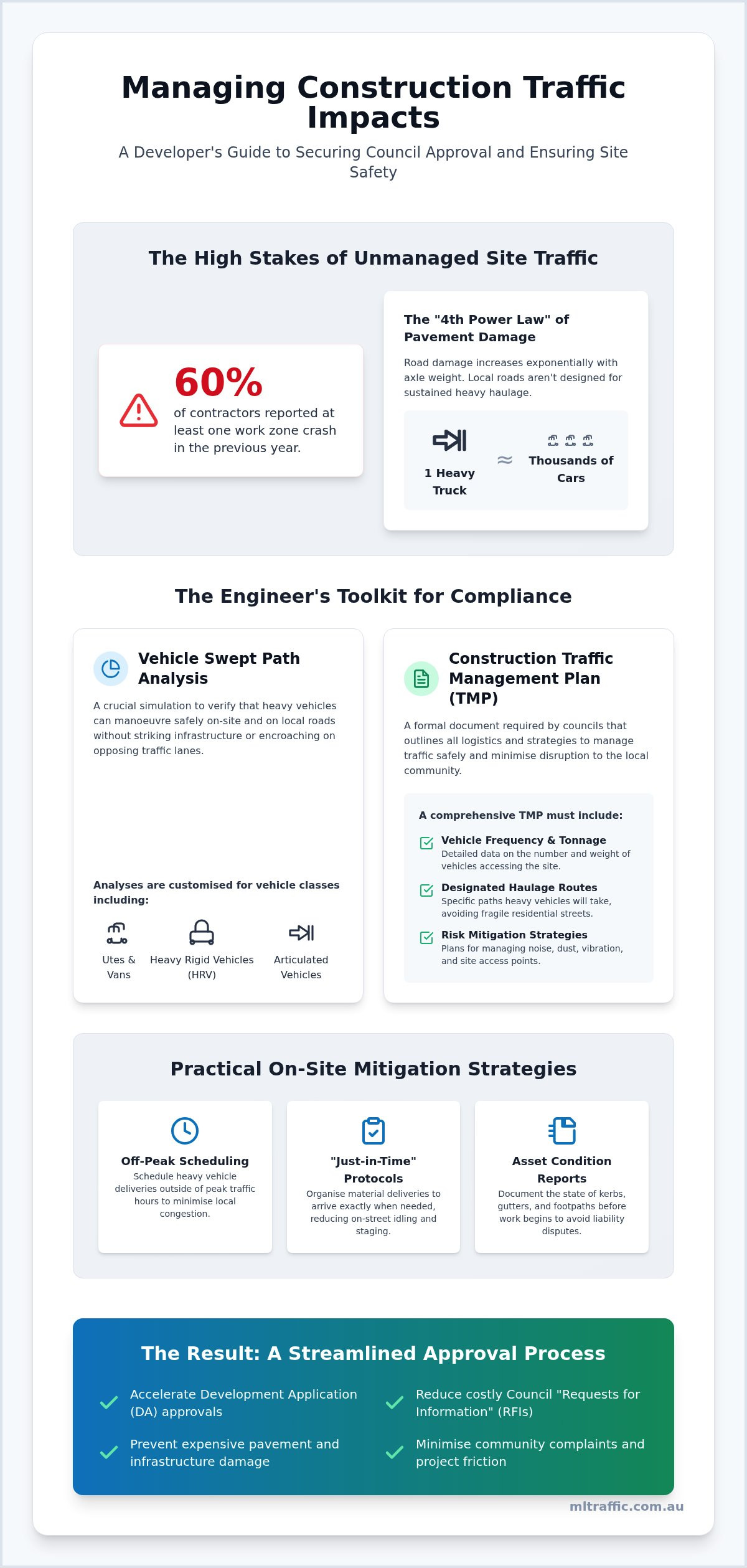
A 2026 industry survey revealed that 60% of contractors reported at least one crash involving a moving vehicle in their work zones over the previous year. This statistic highlights the significant risks and liabilities present when heavy plant and equipment interface with public infrastructure. Managing construction vehicle impact on local roads is a non-negotiable requirement for modern development, yet it remains a primary cause of costly council delays and community friction.
You probably recognise the frustration of a stalled Development Application (DA) due to concerns over pavement integrity or noise complaints from residents. It’s a complex balancing act between project efficiency and regulatory compliance. This article outlines the technical and strategic methods you need to mitigate construction traffic impacts and secure council approval through expert traffic engineering. We will explore how tools like Vehicle Swept Path Analysis and structured management plans provide a clear framework for site logistics, ensuring safety and minimising road maintenance costs for the long term.
Key Takeaways
- Understand why managing construction vehicle impact on local roads is critical for preserving public infrastructure and preventing exponential pavement damage.
- Learn how Vehicle Swept Path Analysis ensures heavy rigid vehicles (HRVs) can safely manoeuvre within site constraints without encroaching on opposing traffic lanes.
- Identify the essential components of a Construction Traffic Management Plan (TMP) required to establish a formal agreement with local councils.
- Implement practical site logistics, such as off-peak delivery scheduling and “Just-in-Time” protocols, to minimise community complaints and local congestion.
- Discover how professional traffic engineering provides the technical data required to reduce “Requests for Further Information” (RFIs) and accelerate DA approvals.
The Significance of Managing Construction Vehicle Impact on Local Roads
Heavy vehicles do not interact with road surfaces in the same way as passenger cars. Civil engineers apply the “4th Power Law” to model this relationship, which demonstrates that road damage increases exponentially with axle weight. A single fully loaded construction truck can cause as much wear to a local street as thousands of standard vehicles. Because local roads are often not designed for sustained heavy haulage, Managing construction vehicle impact on local roads is essential to prevent rapid pavement failure and costly remediation works.
Local councils prioritise road safety and the preservation of public infrastructure above all else during the construction phase. Unmanaged site traffic leads to severe congestion, increases the risk of collisions, and triggers community backlash that can halt a project. To address these concerns, a professional traffic impact assessment is a standard requirement for planning approval. This document provides the technical evidence councils need to verify that the existing road network can support the proposed construction intensity.
Regulatory Requirements and Council Expectations
Councils expect a clear nexus between the scale of a development and the capacity of the local road network. They require detailed reports outlining vehicle frequency, tonnage, and specific haulage routes to ensure heavy plant doesn’t traverse fragile residential streets. This data is usually integrated into the Statement of Environmental Effects (SEE), where traffic planning must demonstrate compliance with Australian Standards. Effective Road traffic control strategies must be documented early to avoid project delays. Managing construction vehicle impact on local roads requires a proactive approach that aligns site requirements with these strict regulatory frameworks.
Identifying Potential Risks to Local Infrastructure
The physical risks extend beyond the road surface itself. Heavy rigid vehicles (HRVs) frequently damage local kerbs, gutters, and footpaths when making tight turns or mounting verges. Engineers must evaluate the structural integrity of these assets before work begins. Beyond physical damage, we must assess the impact on existing traffic flow and intersection performance to prevent gridlock during peak periods. Mitigating noise and vibration impacts on residential neighbourhoods is also a critical factor. Excessive idling or early-morning deliveries often lead to formal complaints, which can result in council-imposed work stoppages or restrictive permit conditions.
Utilising Swept Path Analysis to Minimise Road Geometry Impact
Swept Path Analysis is the primary technical tool used by traffic engineers to verify vehicle clearance and manoeuvrability on tight local roads. This computer-aided simulation determines the exact physical space required for a specific vehicle to complete a turn or navigate a site access point. When Managing construction vehicle impact on local roads, developers must prove that heavy rigid vehicles (HRV) can enter and exit the site safely. Without this data, there is a high risk of trucks crossing onto the wrong side of the road, mounting kerbs, or striking overhead infrastructure. Effective Managing construction vehicle impact on local roads relies on these simulations to prevent operational gridlock and ensure site accessibility during all phases of development.
The Role of AutoTURN in Site Access Design
Industry-standard software like AutoTURN allows engineers to simulate real-world truck turning circles with high precision. By inputting the specific dimensions of the vehicles expected on-site, we can identify “pinch points” in the local road network before construction commences. These simulations are customised for various vehicle classes, including:
- Standard utes and delivery vans for light site logistics.
- Heavy Rigid Vehicles (HRV) for material deliveries and waste removal.
- Articulated vehicles for transporting large plant and machinery.
The 2026 versions of this software include updated vehicle libraries that reflect the current fleet of heavy vehicles used across Australia. This allows for highly accurate modelling of the specific wheelbases and steering characteristics of modern equipment. If a simulation shows a vehicle cannot make a turn without encroaching on opposing traffic, the site access design must be modified. You can consult with a principal engineer to review your specific site access constraints early in the design phase.
Ensuring Compliance with AS 2890.2
Australian Standard AS 2890.2 governs the design of commercial vehicle facilities and access. It sets strict minimum requirements for heavy vehicle loading areas, driveway gradients, and turning radii. A detailed swept path analysis is the most effective way to demonstrate to council that a project is feasible under these standards. Swept path analysis provides the visual and mathematical proof councils require to approve a site’s logistics plan. This assessment is particularly critical for construction waste removal, where large skip trucks require significant clearance that is often underestimated in preliminary drawings. Compliance involves more than just horizontal clearance; it includes vertical clearance and driveway ramp grades to ensure vehicles don’t bottom out and block traffic.
Essential Components of a Construction Traffic Management Plan (TMP)
A Construction Traffic Management Plan (TMP) is a high-level strategic document. It outlines how a project will manage all road users, including pedestrians and cyclists, during the active construction phase. This document serves as a formal agreement between the developer, the contractor, and the local council. It’s the primary mechanism for Managing construction vehicle impact on local roads by ensuring all logistics are planned before the first truck arrives. ML Traffic Engineers specialises in creating robust TMPs that facilitate smooth traffic engineering outcomes.
Effective TMPs must balance site efficiency with the safety of local residents. Councils will not approve a plan that prioritises speed over community protection. A well-constructed plan reduces the risk of accidents and provides a clear legal framework for the contractor to follow. It’s a binding document that protects the developer from liability by demonstrating a proactive approach to safety and infrastructure preservation.
Step-by-Step Development of a TMP
Creating a TMP requires a systematic approach to site logistics. The process begins with data collection and ends with a formal council submission.
- Step 1: Identify all vehicle types and projected movement frequencies. This includes everything from concrete agitators to delivery vans. We must account for the peak number of arrivals to ensure the local road capacity isn’t exceeded.
- Step 2: Map designated haulage routes. These routes must avoid sensitive residential areas, school zones, and streets with weight restrictions. The goal is to keep heavy plant on arterial roads for as long as possible.
- Step 3: Establish clear protocols for on-site vehicle queuing and loading. Trucks should never idle on public roads while waiting for site access. A dedicated loading zone within the site boundary is the preferred solution.
Success in Managing construction vehicle impact on local roads depends on the accuracy of these initial steps. If the projected frequencies are incorrect, the local network may suffer from unexpected congestion.
Differentiating Between TMPs and Traffic Guidance Schemes (TGS)
A common point of confusion in the development industry is the difference between a TMP and a TGS. A traffic management plan is a strategic document. It covers the broad “who, what, where, and when” of the project traffic impact. In contrast, a Traffic Guidance Scheme (TGS) is a specific, tactical diagram. It shows the exact placement of signs, cones, and bollards for a particular work activity, such as a lane closure or a site entry point.
Your project needs both strategic and tactical elements to satisfy council requirements. The TMP provides the framework, while the TGS provides the on-ground instruction. Accredited personnel must sign off on TGS requirements to ensure compliance with the latest 2026 revisions of the Manual on Uniform Traffic Control Devices (MUTCD). This ensures every sign and taper length meets rigorous safety standards, reducing the risk of work zone fatalities which, while decreasing, still claimed 850 lives in 2024.
Practical Mitigation Strategies for Construction Traffic
Managing construction vehicle impact on local roads requires tactical precision in daily operations. Effective site management starts with timing. Deliveries should be scheduled outside peak traffic windows, typically avoiding 7:00 am to 9:00 am and 3:00 pm to 5:00 pm. This reduces the burden on the local network during high-volume periods. Implementing “Just-in-Time” (JIT) delivery protocols ensures that vehicles arrive only when the site is prepared for immediate unloading. This strategy prevents heavy trucks from idling or queuing on residential streets, which is a primary cause of community friction and council intervention.
Safety at site interface points is managed through accredited traffic controllers. These personnel facilitate the safe movement of heavy plant across footpaths and into traffic streams. Providing a direct communication channel, such as a designated site contact number, allows residents to report concerns immediately. This proactive engagement often prevents minor issues from escalating into formal council complaints that could jeopardise your permit. For comprehensive site planning, you can explore our full range of traffic engineering services.
Haulage Route Planning and Optimisation
Selecting the correct haulage route is about more than finding the shortest path. Engineers must choose roads structurally suited for heavy vehicle tonnage to avoid pavement deformation. Strategic route planning involves several key considerations:
- Avoiding right-hand turns: Minimising right-hand turns at busy, non-signalised intersections reduces accident risks and prevents trucks from blocking through-traffic while waiting for a gap.
- Cumulative impact coordination: If multiple developments are active in one precinct, haulage schedules must be coordinated to prevent a bottleneck of heavy vehicles on a single local collector road.
- Bridge and height restrictions: Routes must be verified for overhead clearances and bridge load limits to prevent catastrophic infrastructure damage.
Site Logistics and On-Site Management
Internal site organisation directly influences external traffic performance. Managing construction vehicle impact on local roads is significantly easier when the site layout supports efficient movement. Councils prefer designs that allow all vehicles to enter and exit in a forward direction. Reversing onto public roads is high-risk and often prohibited under modern TMPs. Worker parking must also be managed internally or through designated off-site areas. Relying on local street parking for construction crews leads to resident complaints and reduces the available road width for heavy vehicle manoeuvres. Finally, wash-down bays and sediment control measures are mandatory to prevent site debris from contaminating the road surface, which can create slip hazards for other motorists.
How Professional Traffic Engineering Streamlines the Approval Process
Professional traffic engineering acts as the critical bridge between a developer’s logistical needs and a council’s regulatory requirements. Local authorities are inherently risk-averse regarding public infrastructure. They require high-fidelity technical data to feel confident that a project will not compromise road safety or pavement longevity. Managing construction vehicle impact on local roads is a data-driven exercise. When a submission includes rigorous analysis of vehicle movements and infrastructure capacity, it demonstrates a developer’s commitment to community safety. This proactive approach builds trust with council assessors and facilitates a smoother path to DA approval.
Expert reports significantly reduce the likelihood of “Requests for Further Information” (RFIs). These requests are a primary cause of project drift, often delaying construction starts by several months while additional studies are conducted. A comprehensive initial report addresses potential council concerns before they are raised. Beyond mere compliance, professional analysis often identifies specific cost-saving measures. By optimising site access points and refining parking layouts early, engineers can reduce the need for expensive structural modifications later in the build. This technical foresight ensures that Managing construction vehicle impact on local roads is handled with maximum efficiency and minimum waste.
The Value of Meticulous Traffic and Parking Assessments
Precision in parking and access design is essential for modern developments. Detailed car parking demand assessments prevent the costly errors of over-supply or the regulatory hurdles of under-supply. All designs must be certified to meet Australian Standards AS 2890.1 for off-street car parking. This certification involves more than just counting spaces. It requires a technical review of:
- Driveway ramp grades: We ensure all gradients are compliant to prevent vehicle scraping, which is a common cause of pavement damage and resident complaints.
- Sight distance assessments: Verifying that drivers have clear lines of sight when exiting a site onto a local road.
- Internal circulation: Ensuring vehicles can manoeuvre safely within the site without causing internal bottlenecks that spill out onto public streets.
Direct Access to Senior Traffic Expertise
Working with ML Traffic Engineers provides developers with direct access to senior principals for every project. This “no-gatekeepers” approach ensures a high level of accountability and technical accuracy. Larger, more impersonal firms often delegate technical work to junior staff, which can lead to inconsistencies in the final report. We provide a personnel continuity promise. The same expert who initiates the client relationship is the one performing the technical assessments and signing off on the documentation.
Our 15+ years of industry experience translates into faster council approvals. We understand the specific nuances of local government requirements across various Australian jurisdictions. This deep-seated expertise allows us to anticipate potential roadblocks and provide the meticulous documentation required to secure planning permits. Our results-oriented philosophy focuses on delivering dependable, compliant solutions that move projects from the planning phase to active construction without unnecessary bureaucratic delay.
Streamline Your Project Approval with Expert Traffic Engineering
Managing construction vehicle impact on local roads is a technical requirement that councils treat with high priority. Successful development applications rely on the integration of precise data, such as Swept Path Analysis and comprehensive Traffic Management Plans. These documents prove that your site can handle heavy vehicle movements without compromising public infrastructure or resident safety. By addressing haulage routes and site logistics early, you prevent the costly “Requests for Further Information” that frequently stall Australian projects.
ML Traffic Engineers provides over 15 years of industry experience to help you navigate these complex regulatory requirements. Every project receives a senior-led technical assessment, ensuring you have direct access to expert advice from the initial assessment to the final report. We provide nationwide service for Australian developers, acting as the authoritative bridge between your site logistics and formal council approval. Our results-oriented approach focuses on compliance and efficiency.
Contact ML Traffic Engineers for a professional traffic assessment to ensure your next project remains on schedule and compliant with all relevant Australian Standards. We look forward to helping you achieve a successful and safe project outcome.
Frequently Asked Questions
Why does the council require a Traffic Management Plan for my construction site?
Councils require a TMP to mitigate safety risks and prevent damage to public infrastructure. The document acts as a binding agreement that outlines how a developer will manage vehicle movements, pedestrian safety, and haulage routes. Managing construction vehicle impact on local roads is a core concern for local authorities who must protect ratepayers’ assets from the exponential wear caused by heavy plant and machinery.
How do heavy construction vehicles impact local road pavements differently than cars?
Heavy construction vehicles exert significantly higher axle loads than passenger cars, often governed by the “4th Power Law.” This principle dictates that road wear increases exponentially with weight, meaning a single fully loaded truck can cause the same structural damage as roughly 5,000 standard vehicles. This is why councils insist on haulage route assessments to ensure the selected local roads are structurally capable of supporting the projected tonnage.
What is the difference between a Traffic Management Plan (TMP) and a Traffic Guidance Scheme (TGS)?
A Traffic Management Plan (TMP) is a strategic document while a Traffic Guidance Scheme (TGS) is a tactical diagram. The TMP outlines the broad logistics, such as vehicle frequency and haulage routes, required for the planning phase. The TGS provides the specific on-ground instructions for traffic control, including the exact placement of signage and cones in accordance with the 2026 MUTCD revisions.
Can I perform my own Swept Path Analysis for a Development Application?
Councils usually require these simulations to be performed by qualified traffic engineers to ensure technical accuracy. Professional analysis uses industry-standard software like AutoTURN to model specific vehicle wheelbases and steering characteristics. Self-performed assessments often lack the necessary certification and fail to account for ramp grades or sight distances, leading to immediate rejection during the Development Application (DA) review process.
What are the most common traffic-related reasons for DA delays?
DA delays are most frequently caused by inadequate technical data regarding site access and parking demand. When a submission fails to prove that heavy vehicles can manoeuvre safely or that worker parking won’t clog residential streets, councils issue a Request for Further Information (RFI). Providing meticulous Traffic Impact Assessments and Swept Path Analysis from the outset is the most effective way to bypass these bureaucratic bottlenecks.
How can I minimise the noise impact of construction vehicles on local residents?
Minimising noise impact requires strict adherence to scheduled delivery windows and “Just-in-Time” protocols. By ensuring trucks arrive only when the site is ready for immediate unloading, you prevent heavy vehicles from idling on residential streets. Managing construction vehicle impact on local roads through these operational strategies significantly reduces community complaints and the risk of council-imposed work stoppages or restrictive permit amendments.
What Australian Standards govern construction vehicle access and parking?
The primary standards are AS 2890.1 and AS 2890.2. AS 2890.1 governs the design and layout of off-street car parking facilities, while AS 2890.2 covers the requirements for commercial vehicle facilities, including loading docks and heavy vehicle access. Compliance with these standards is mandatory for securing planning approval and ensures that all driveway ramp grades and turning circles meet national safety benchmarks.
Is a traffic report required for small-scale residential developments?
Traffic reports are often mandatory for small-scale projects if they involve changes to site access or significant heavy vehicle movements. Even a modest townhouse development can trigger a requirement for a Traffic Impact Assessment if it impacts local parking availability or intersection performance. Councils assess the cumulative impact of multiple small developments on the local road network, making professional traffic engineering advice essential for any project.

Disclaimer
The content on www.mltraffic.com.au, including all technical articles, guides, and resources, is provided for general informational and educational purposes only. It is not intended to constitute professional advice in traffic engineering, transportation planning, development approvals, or any other technical or legal field.
While ML Traffic Engineers makes every reasonable effort to ensure the accuracy, completeness, and timeliness of the information published, we do not provide any warranties or representations (express or implied) regarding its reliability, suitability, or availability for any particular purpose. Any reliance you place on the content is strictly at your own risk.
In no event shall ML Traffic Engineers, its directors, employees, authors, or affiliates be liable for any direct, indirect, incidental, special, consequential, or punitive damages (including, without limitation, loss of profits, data, or business opportunities) arising out of or in connection with the use of, or inability to use, any information provided on this website.
The articles and guides on this site are not a substitute for engaging a qualified, registered professional traffic engineer (such as an NPER or RPEQ engineer) to assess your specific project requirements. For tailored advice, compliance assessments, or traffic engineering services, please contact a competent professional.
This disclaimer may be updated from time to time without notice. By accessing or using this website, you agree to be bound by the most current version of this disclaimer.
