
Most shared driveway disputes are treated as interpersonal conflicts, but the most effective resolution is usually found in technical non-compliance with Australian Standards. When neighbors clash over narrow access or encroaching vehicles, emotional appeals rarely work. You need a fact-based assessment of the infrastructure itself. It’s frustrating to deal with Council compliance failures or safety concerns caused by poor visibility, especially when you can’t maneuver your own vehicle without crossing property lines. These technical failures aren’t just inconveniences; they often represent a breach of established design criteria.
This article shows you how to resolve these conflicts by applying the shared driveway design guidelines australia and AS/NZS 2890.1:2004. You’ll learn how technical traffic engineering assessments and compliant design frameworks provide the objective evidence needed to settle access rights. We will examine the specific requirements for driveway gradients, vehicle swept paths, and sight distance assessments that determine if a shared access point meets current regulatory requirements. By focusing on engineering facts rather than property sentiment, you can secure a functional and legally compliant outcome.
Key Takeaways
- Identify how AS 2890.1 sets the mandatory technical benchmarks for residential off-street parking and shared access points.
- Apply the shared driveway design guidelines australia to detect structural non-compliance, such as inadequate maneuvering space or poor visibility at property boundaries.
- Use professional Vehicle Swept Path Analysis to provide empirical evidence of access issues, removing subjectivity from neighbor disputes.
- Understand the regulatory implications of non-compliant driveways, including the potential for Council enforcement orders and impacts on Development Applications.
- Resolve access conflicts through objective traffic engineering assessments that prioritize safety, compliance, and senior-level technical expertise.
Understanding Australian Standards for Shared Driveway Design
A shared access driveway refers to a common thoroughfare providing vehicular ingress and egress to multiple properties or dwellings. Within Australian planning frameworks, these are often governed by formal legal agreements, but their physical functionality is dictated by specific shared driveway design guidelines australia. These guidelines ensure that shared spaces remain safe, accessible, and compliant with national safety expectations.
Property owners often confuse legal access with operational safety. While Understanding Easements is necessary to establish the right to cross a neighbor’s land, it doesn’t guarantee the driveway is fit for purpose. A driveway might be legally accessible yet technically non-compliant with safety standards. This distinction is where most disputes begin.
To better understand this concept, watch this helpful video:
The primary technical document for these structures is AS/NZS 2890.1:2004, the national standard for off-street car parking. This standard provides the geometric requirements necessary to ensure vehicles can enter and exit a property without causing traffic hazards or damaging property. While an updated version is anticipated in 2026, the 2004 edition remains the current benchmark for compliance assessments in Australia.
Key Requirements of AS 2890.1 for Shared Access
AS 2890.1 specifies precise dimensions for shared thoroughfares to prevent congestion and safety risks. Key technical requirements include:
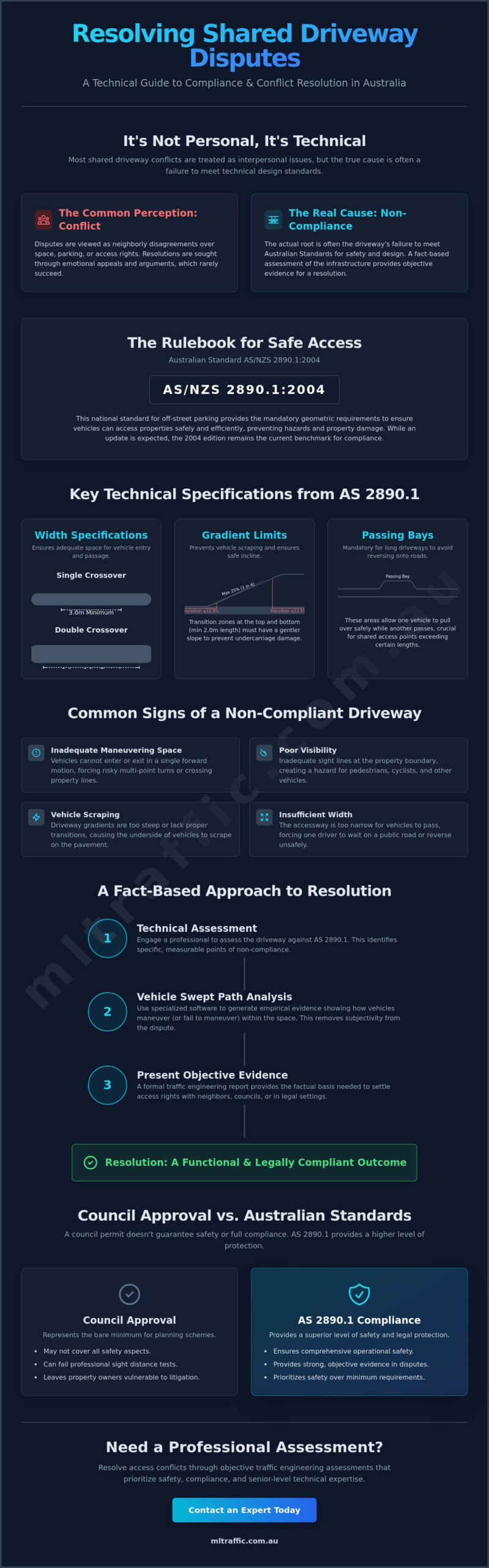
- Width Specifications: Single residential crossovers typically require a minimum width of 3.0 metres at the property boundary. Double crossovers generally range between 5.4 and 6.0 metres depending on local council specifications.
- Passing Bays: For driveways exceeding specific lengths, passing bays are mandatory. These prevent vehicles from being forced to reverse onto public roads when encountering oncoming traffic.
- Gradient Limits: The maximum allowable gradient for a residential driveway is 25% (1 in 4). Transition zones at the top and bottom of the ramp must not exceed 12.5% for a minimum length of 2.0 metres to prevent vehicle scraping.
Council Compliance vs. Australian Standards
Local councils maintain their own technical specifications and fee structures. For example, Brisbane City Council residential application fees range from $20.30 for self-assessment to $293.40 for full assessments. However, council codes often represent the bare minimum. A design that satisfies a local planning scheme might still fail a professional Sight Distance Assessment or a Vehicle Swept Path Analysis. Relying solely on council approval without professional traffic engineering certification often leaves property owners vulnerable to safety-related litigation. Technical compliance with AS 2890.1 provides a higher level of protection in a dispute than basic council permits.
Identifying Technical Roots of Shared Access Disputes
Shared driveway conflicts often stem from physical design failures rather than simple neighborly disagreements. When a driveway fails to meet the shared driveway design guidelines australia, operational friction becomes inevitable. These technical shortcomings usually manifest as vehicles being unable to pass one another, scraping on steep ramps, or lacking the necessary clearance to enter a property in a single forward motion. Identifying these specific failure points is the first step toward a data-driven resolution.
Width is the most common point of contention. While AS/NZS 2890.1 provides specific dimensions for crossovers, the internal shared access often narrows significantly. This forces residents to wait on public roads for oncoming traffic to clear or, worse, attempt high-risk maneuvers that result in property damage. In strata-titled developments, these issues frequently escalate, requiring formal intervention. Understanding the process for resolving strata disputes is essential when technical non-compliance affects multiple owners within a shared scheme.
Ramp gradients also trigger significant disputes. Australian Standards mandate a maximum residential gradient of 25%, with 12.5% transition zones for at least 2.0 metres. If these transitions are absent, modern vehicles with lower ground clearance will “ground” or scrape. This is a design breach, not a driver error. If you suspect your access point is non-compliant, a professional Driveway Ramp Grade Assessment can provide the empirical data needed to demand rectification.
Swept Path Failures and Maneuverability
Maneuverability disputes are best settled through objective modeling. Using industry-standard software like AutoTURN, traffic engineers simulate the movement of B85 or B99 vehicles (representing the 85th and 99th percentile car sizes in Australia). A swept path analysis identifies exactly where a vehicle’s body and wheels travel during a turn. If the analysis shows a standard vehicle cannot navigate the shared space without encroaching on private areas or requiring multiple “shunts,” the design is fundamentally flawed. This evidence is often the deciding factor in legal or Council reviews.
Sight Distance and Pedestrian Safety
Safety-based disputes often revolve around sight distance failures. AS 2890.1 Clause 3.2.4 requires specific “sight triangles” at the property boundary, typically measuring 2.0 metres by 2.5 metres. These zones must remain clear of obstructions higher than 1.1 metres to ensure drivers can see pedestrians on the footpath. Common causes of conflict include:
- Illegal landscaping or overgrown hedges within the sight triangle.
- Solid fences built to the boundary line without required splays.
- On-street parking that obscures the view of approaching traffic.
Failure to maintain these sightlines creates a significant liability for property owners. A professional assessment can determine if a structure or plant is legally an obstruction under Australian Standards.
A Step-by-Step Guide to Managing Shared Driveway Disputes
Resolving a conflict over shared access requires shifting the conversation from personal grievances to technical non-compliance. Subjective claims about “difficult” turns or “steep” ramps rarely succeed in a legal or Council setting. You must rely on empirical data that demonstrates a breach of the shared driveway design guidelines australia. This structured approach ensures your case is built on professional traffic engineering benchmarks rather than neighborly sentiment.
Follow these steps to establish a technical basis for your dispute:
- Document the Conflict: Record specific instances where access was denied or safety was compromised. Note vehicle types, times, and exact maneuverability failures.
- Commission a Technical Assessment: Engage a qualified professional to perform a Vehicle Swept Path Analysis. This provides a digital simulation proving whether a standard vehicle can physically navigate the space.
- Verify Vertical Compliance: Conduct a formal Driveway Ramp Grade Assessment. This determines if the driveway’s slope and transition zones meet the 25% and 12.5% limits set by AS 2890.1.
- Analyze Sight Lines: Perform a Sight Distance Assessment to verify if fences, walls, or vegetation create illegal obstructions at the property boundary.
- Present Findings: Submit the finalized Traffic Engineering Report to the relevant parties, Council, or legal counsel as objective evidence of non-compliance.
The Role of the Technical Audit
An independent traffic engineer’s report carries significantly more weight than personal testimony. A compliant audit must detail the specific clauses of AS 2890.1 that are being breached. It shouldn’t just identify problems; it should propose design modifications. For instance, if a swept path analysis shows a vehicle cannot turn without hitting a wall, the report can recommend specific widening or splay requirements to restore access. This turns a dispute into a technical problem with a clear engineering solution.
Mediation and Expert Witness Services
If a dispute reaches a formal tribunal or court, a traffic engineer often serves as an expert witness. Their role is to translate complex shared driveway design guidelines australia into plain English for mediators or judges. There is a critical difference between a ‘statement of effect’ and a full traffic impact report. A statement of effect is a concise summary of how a design fails current standards, whereas a full report provides the exhaustive data sets required for high-stakes litigation. Choosing the right level of documentation is vital for a cost-effective resolution.
Council Compliance and Planning Implications for Shared Access
Shared driveway disputes often escalate to local government authorities when physical access issues interfere with the public domain or breach original planning permits. Councils utilize shared driveway design guidelines australia to evaluate the legality of an existing structure during a dispute or a new Development Application (DA). If a conflict reveals that a driveway was constructed without proper permits or deviates from approved plans, the Council has the authority to issue enforcement orders. These orders can mandate the complete removal or significant redesign of the access point at the owner’s expense.
For developers and property owners, ensuring shared access is “fit for purpose” is a prerequisite for successful subdivision. This technical justification is typically documented in the Statement of Environmental Effects (SEE). If the SEE fails to address how vehicles will maneuver within the shared space, the DA may be delayed or refused. Retrospective compliance is significantly more expensive than ensuring the design meets national standards during the initial planning phase. Councils are increasingly vigilant regarding ‘illegal’ modifications, such as unauthorized widening or the installation of non-compliant gates that obstruct sightlines.
DA Approvals and Traffic Impact
Local councils frequently require a Traffic Impact Assessment (TIA) for multi-dwelling residential sites. This report must prove that the shared driveway can handle the anticipated parking demand without causing congestion on the adjacent public road. A critical, yet often overlooked, requirement is waste collection access. If a garbage truck or emergency vehicle cannot safely enter and exit the shared space in a forward direction, the design fails fundamental safety benchmarks. Professional modeling ensures that every vehicle type is accounted for, preventing future operational disputes between residents.
Safety Audits and Risk Mitigation
Complex shared driveways with high vehicle volumes or restricted visibility may require a formal Road Safety Audit. This process identifies potential hazards that standard compliance checks might miss, such as pedestrian conflict points or inadequate lighting. Liability is a central concern in access disputes. If a non-compliant driveway is the primary cause of a collision, the property owner or the original developer may be held legally responsible for damages. Councils have the power to mandate redesigns for safety compliance years after a project is completed. To ensure your site meets all regulatory benchmarks and avoids costly enforcement, contact our senior principals for a professional compliance assessment.
Professional Traffic Engineering Solutions for Access Disputes
Access disputes often reach a stalemate when parties rely on subjective observations rather than empirical data. ML Traffic Engineers Australia resolves these conflicts by providing the objective evidence required by the shared driveway design guidelines australia. We don’t just identify non-compliance; we provide the technical roadmaps required to rectify structural failures. Our assessments turn heated disagreements into manageable engineering projects with clear, data-driven outcomes.
Every site assessment we conduct involves senior leadership. This ensures that complex maneuvering constraints or non-compliant ramp grades are evaluated with decades of professional experience. We focus on custom redesign solutions that satisfy AS 2890.1 while maximizing the utility of the existing property. This meticulous approach provides developers and owners with the technical certainty required for long-term peace of mind. By grounding every recommendation in national regulatory standards, we remove the guesswork from dispute resolution.
Our Specialized Assessment Services
We offer a comprehensive suite of technical services designed to provide objective clarity for property owners and legal representatives. Our specialized assessments include:
- Vehicle Swept Path Analysis: Using AutoTURN software to simulate movements for all vehicle classes, ensuring B85 and B99 vehicles can navigate shared spaces safely.
- Driveway Ramp Grade Certification: Detailed measurements to verify compliance with the 25% maximum gradient and mandatory 12.5% transition zones.
- Sight Distance Assessments: Verifying the 2.0m x 2.5m sight triangles required by AS 2890.1 to ensure pedestrian safety at property boundaries.
- Car Park Design: Optimizing layout and parking demand to reduce operational pressure on shared driveway thoroughfares.
Direct Access to Expertise
Working with seasoned traffic engineering consultants at ML Traffic Engineers Australia removes the bureaucratic delays common in larger, more impersonal firms. Our “no-gatekeepers” approach means you have direct contact with the senior principals performing the technical work. This personnel continuity ensures that the expert who initiates the project is the one responsible for the final certification. We bring extensive national experience across diverse project environments and specific council requirements to every assessment. If you require a professional Traffic Impact Assessment or a technical audit to settle an access conflict, contact our senior team directly to discuss your site requirements.
Securing Technical Compliance for Shared Access
Resolving access disputes requires a shift from emotional arguments to technical evidence. Adhering to the shared driveway design guidelines australia ensures that every property owner maintains safe and functional ingress. By identifying specific breaches in AS 2890.1, such as non-compliant ramp grades or failed sight distance triangles, you establish a factual basis for mediation or Council intervention. Objective data from professional traffic engineers removes the ambiguity that typically prolongs these disagreements and provides a clear path toward structural rectification.
ML Traffic Engineers Australia brings over 15 years of specialized experience to every site assessment. We provide direct access to senior principals who manage your project from initiation to final certification, ensuring accountability at every stage. Our team specializes in AS 2890.1 and local Council compliance, providing the technical certainty required for a successful outcome. Whether you’re navigating a complex Development Application or settling a neighbor dispute, our experts deliver the data needed to protect your property rights. Contact ML Traffic Engineers Australia for a Professional Access Assessment today to secure a compliant and functional resolution.
Frequently Asked Questions
What is the minimum width for a shared driveway in Australia?
The standard minimum width for a single residential crossover is 3.0 metres at the property boundary. For double crossovers or shared access points, the width typically ranges between 5.4 and 6.0 metres depending on specific local council technical specifications. These dimensions ensure that vehicles can enter and exit without encroaching on footpaths or neighboring property. Exact requirements are dictated by the shared driveway design guidelines australia and AS 2890.1.
Can a neighbour block my access to a shared driveway?
No, a neighbour cannot legally block access if an easement or common property title exists. Blocking access is generally a breach of property law and the specific terms of the easement. However, resolving these conflicts often requires a technical assessment to prove that the obstruction prevents safe vehicle movement. If an obstruction makes the driveway non-compliant with Australian Standards, the offending party may be required to remove it immediately.
Is AS 2890.1 legally binding for residential driveways?
Yes, AS 2890.1 is the primary regulatory benchmark used by local councils to assess Development Applications. While it is a technical standard, its incorporation into local planning schemes makes it the legal basis for compliance. Failure to adhere to these standards during construction can lead to council enforcement orders. In legal disputes, courts rely on AS 2890.1 to determine if a shared access point is fit for purpose and safe for use.
How do I prove a shared driveway is unsafe for my vehicle?
Proving a driveway is unsafe requires a formal Sight Distance Assessment or a Vehicle Swept Path Analysis. These reports provide empirical data showing where a vehicle’s body travels during a turn and whether visibility at the boundary is obstructed. By applying the shared driveway design guidelines australia, a traffic engineer can identify specific safety failures. This objective evidence is significantly more effective than personal testimony in settling disputes with neighbours or councils.
What happens if a driveway does not meet council design guidelines?
Councils have the power to issue enforcement orders requiring the property owner to redesign or remove non-compliant structures. This often occurs when a driveway is found to be “illegal” or was built without adhering to the approved planning permit. Furthermore, a non-compliant driveway creates a significant liability risk. If an accident occurs on a driveway that doesn’t meet national safety standards, the owner may be held legally responsible for damages.
Who pays for a traffic engineering report in a shared access dispute?
The party initiating the assessment or the property owner seeking to prove compliance is responsible for the costs. In the context of a Development Application, the developer pays for the report as part of the submission process. In legal disputes or strata disagreements, the costs may be shared between parties or awarded as part of a settlement. Professional reports are essential for providing the technical certainty needed to resolve high-stakes access conflicts.
Can a swept path analysis help resolve a legal dispute over access?
Yes, a swept path analysis provides digital proof of whether a vehicle can physically navigate a shared space. It uses industry-standard software to simulate the turning circles of B85 or B99 vehicle classes. This analysis removes subjectivity from a dispute by showing exactly where a vehicle must travel to enter or exit safely. It is frequently used as expert evidence in tribunals to settle disagreements regarding narrow access or maneuvering constraints.
What is the maximum allowable grade for a shared residential driveway?
The maximum allowable gradient for a residential driveway ramp is 25%, or a 1 in 4 slope. Additionally, AS 2890.1 requires transition zones at the top and bottom of the ramp that do not exceed 12.5%. These transition zones must be at least 2.0 metres long to prevent vehicles from grounding or scraping. If a shared driveway exceeds these limits without proper transitions, it is considered technically non-compliant and potentially hazardous for modern vehicles.

Disclaimer
The content on www.mltraffic.com.au, including all technical articles, guides, and resources, is provided for general informational and educational purposes only. It is not intended to constitute professional advice in traffic engineering, transportation planning, development approvals, or any other technical or legal field.
While ML Traffic Engineers makes every reasonable effort to ensure the accuracy, completeness, and timeliness of the information published, we do not provide any warranties or representations (express or implied) regarding its reliability, suitability, or availability for any particular purpose. Any reliance you place on the content is strictly at your own risk.
In no event shall ML Traffic Engineers, its directors, employees, authors, or affiliates be liable for any direct, indirect, incidental, special, consequential, or punitive damages (including, without limitation, loss of profits, data, or business opportunities) arising out of or in connection with the use of, or inability to use, any information provided on this website.
The articles and guides on this site are not a substitute for engaging a qualified, registered professional traffic engineer (such as an NPER or RPEQ engineer) to assess your specific project requirements. For tailored advice, compliance assessments, or traffic engineering services, please contact a competent professional.
This disclaimer may be updated from time to time without notice. By accessing or using this website, you agree to be bound by the most current version of this disclaimer.
