
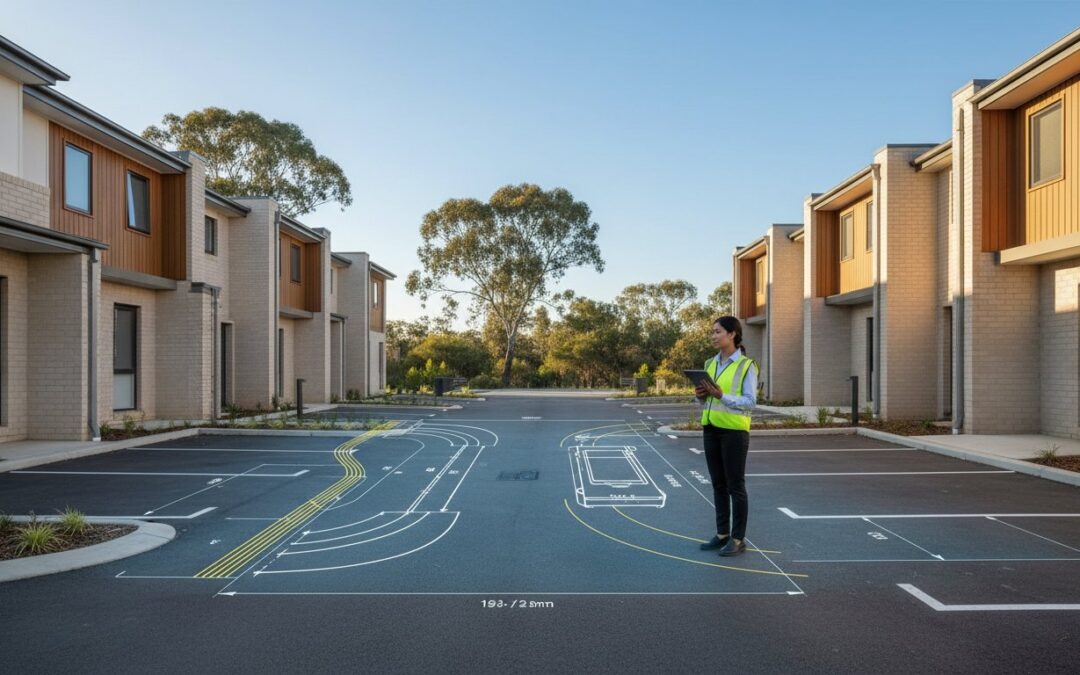
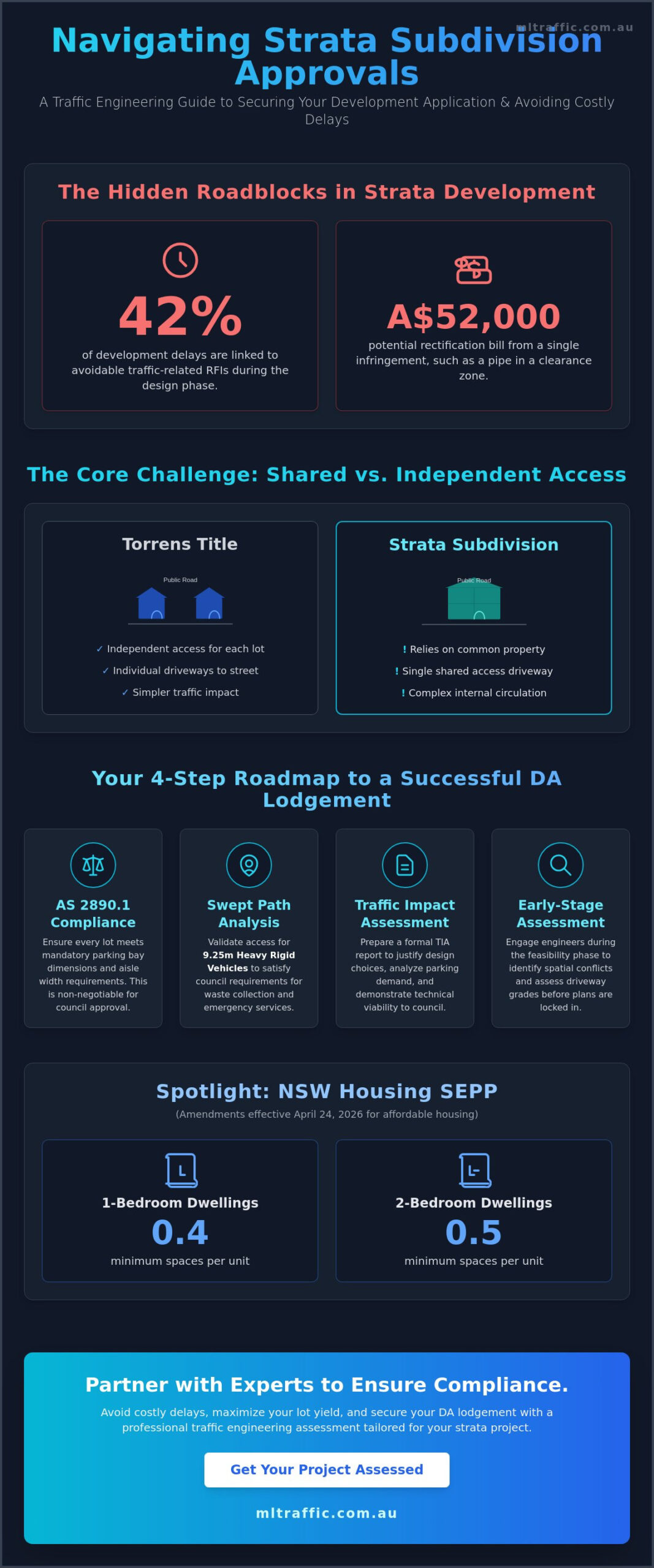
Did you know that 42% of development delays are directly linked to traffic-related Requests for Information (RFIs) that could have been avoided during the initial design phase? For many developers, the path to a Strata Certificate is often blocked by non-compliant parking layouts or driveway redesigns that surface far too late in the process. Effectively managing traffic for strata subdivision projects requires more than just drawing lines on a plan; it demands a rigorous adherence to technical standards to avoid the heavy costs of non-compliance. A single fire sprinkler pipe infringing on a 2.2-metre clearance zone can result in a A$52,000 rectification bill, proving that precision is a non-negotiable requirement for project viability.
You likely understand that securing council approval depends on demonstrating the technical viability of shared access and parking rather than just the legal division of space. This guide provides the essential traffic engineering requirements and compliance steps needed to secure a successful Development Application (DA) lodgement. We will examine the mandatory specifications of AS/NZS 2890.1:2021, the impact of the April 2026 NSW Housing SEPP amendments, and how technical assessments like vehicle swept path analysis ensure your project maintains its maximum lot yield without risking council rejection.
Key Takeaways
- Ensure full compliance with AS 2890.1:2021 standards to meet mandatory parking bay dimensions and aisle width requirements for every strata lot.
- Utilize Vehicle Swept Path Analysis for 9.25m Heavy Rigid Vehicles to satisfy council requirements for waste collection and emergency service access.
- Follow a structured data collection and analysis process when managing traffic for strata subdivision projects to secure a formal Traffic Impact Assessment (TIA).
- Identify potential spatial conflicts early through professional car park design and driveway ramp grade assessments to avoid expensive post-construction rectifications.
Table of Contents
-
Understanding Traffic Engineering Requirements for Strata Subdivisions
-
How to Prepare a Traffic Impact Assessment for Strata Approval
-
Partnering with ML Traffic Engineers for National Strata Projects
Understanding Traffic Engineering Requirements for Strata Subdivisions
Traffic engineering for strata subdivisions involves the technical assessment of how increased dwelling density impacts site access, internal circulation, and parking availability. Unlike a standard single-dwelling site, a strata subdivision creates multiple legal titles within a single property boundary, which inherently changes the traffic intensity. Traffic engineering principles are applied to ensure that the transition from a single-lot usage to a multi-dwelling environment doesn’t compromise the safety of the public road network or the functionality of the site itself. Effectively managing traffic for strata subdivision projects is critical to meeting local planning requirements and ensuring long-term operational success.
Councils mandate traffic reports for strata conversions of existing buildings because the change in use often triggers higher parking demand and more frequent vehicle movements. These requirements are codified within Local Environment Plans (LEPs) and Development Control Plans (DCPs), which set the baseline for permissible density and required infrastructure. Failure to address these frameworks early in the design process often leads to council rejection or expensive redesigns of shared infrastructure.
To better understand the technical design challenges involved in these projects, watch this helpful video:
The Difference Between Torrens and Strata Traffic Impacts
The primary distinction lies in how vehicles enter and exit the property. Torrens title subdivisions often involve independent access points for each new lot, allowing for individual driveways that connect directly to the street. Strata subdivision, however, relies heavily on common property and shared access ways. This creates a complex engineering environment where multiple residents share a single driveway and communal parking area. Managing traffic for strata subdivision projects requires solving the spatial constraints of these shared zones. Engineers must ensure that two-way traffic flow is maintained or that passing bays are appropriately spaced to prevent congestion at the site entry.
When to Engage a Traffic Engineer for Your Project
Engagement should begin at the early-stage feasibility phase. Identifying access constraints before finalizing the strata plan prevents costly redesigns after the layout is locked in. A qualified engineer will prepare the Traffic Impact Assessment required for your Development Application (DA) submission. This report justifies your design choices to the council, covering everything from intersection analysis to parking demand. If the council issues a Request for Information (RFI) regarding parking non-compliance or driveway safety, the engineer provides the technical justification or design amendments needed to maintain project momentum.
Analyzing Car Parking Demand and AS 2890.1 Compliance
Managing traffic for strata subdivision projects requires a precise calculation of parking yield based on specific land-use categories and projected lot yields. Every proposed strata lot must be supported by a designated number of spaces that satisfy both local Development Control Plans (DCPs) and state-level mandates. For example, under the NSW Housing SEPP amendments effective April 24, 2026, affordable housing developments must provide at least 0.4 spaces for 1-bedroom dwellings and 0.5 spaces for 2-bedroom dwellings. Engineering a layout that accommodates these rates while maximizing the number of saleable lots is a primary challenge in high-density strata design.
Compliance is not merely about the number of spaces but their physical configuration. For ‘adaptive reuse’ strata projects, where developers convert existing industrial or commercial shells into residential units, space is often at a premium. Fitting modern parking requirements into legacy structures requires meticulous Car Park Design to ensure every bay is functional and compliant. Failure to meet these standards often results in council rejection or expensive structural rectifications during the Strata Certificate stage.
Key Dimensions for Off-Street Parking (AS 2890.1)
The governing standard for residential and commercial parking is AS/NZS 2890.1:2021. This document specifies the minimum physical requirements for all off-street facilities. Key metrics include:
-
Standard Parking Bay: Must measure 2.4 metres wide by 5.4 metres long.
-
Aisle Widths: For 90-degree parking with two-way traffic, a minimum aisle width of 6.2 metres is required to allow safe manoeuvring.
-
Headroom Clearance: A minimum of 2.1 metres is required for residential car parks, though 2.2 metres is the industry recommendation to avoid conflicts with overhead services.
-
Blind Aisle Extensions: Councils require a 1-metre extension at the end of blind aisles to ensure vehicles can complete a three-point turn without multiple shunts.
Parking Demand Assessments for Reduced Provision
In certain scenarios, developers may seek to provide fewer parking spaces than the local DCP mandates. This is common in areas with high Public Transport Accessibility Levels (PTAL). For instance, Victoria’s December 2025 reforms moved toward mandatory maximum parking limits in high-accessibility zones (Categories 3 and 4) to reduce housing costs. To justify these variations, a technical Traffic Impact Analysis or empirical demand assessment is necessary. These reports use local census data and car ownership statistics to prove that a reduced parking provision will not result in adverse overspill onto public streets. If you are facing a parking shortfall, conducting Car Parking Demand Assessments early in the design phase can provide the evidence needed to secure council support.
Swept Path Analysis for Waste and Emergency Access
Councils require technical proof that service vehicles can safely navigate shared spaces. For most strata developments, this means demonstrating that a 9.25m Heavy Rigid Vehicle (HRV) can enter, circulate, and exit the site in a forward direction. Managing traffic for strata subdivision projects is often compromised by "dead-end" layouts that force dangerous reversing manoeuvres onto public roads. A professional Swept Path Analysis identifies these constraints during the design phase, ensuring waste collection and emergency services maintain access to all proposed lots.
Waste collection points are a frequent point of contention in strata approvals. If a council’s waste vehicle cannot access the site, developers may be forced to implement private collection, which adds ongoing costs for future lot owners. Similarly, fire trucks must have unobstructed access to every building on the strata plan. These requirements often align with broader Transportation Impact Analysis Guidelines, which emphasize the need for functional site geometry that supports heavy vehicle movements without compromising safety.
Operational Manoeuvrability in Shared Spaces
Precise accuracy is achieved by simulating vehicle movements using AutoTURN software. This technical assessment evaluates whether ‘turn-around’ areas, such as T-heads or L-heads, provide sufficient radius for service vehicles to turn. Beyond horizontal movement, vertical clearance is a critical compliance factor. While standard residential car parks require 2.1 metres of headroom, accessible parking areas must maintain 2.5 metres to accommodate B99 vehicles. Identifying these clearance requirements early prevents structural conflicts with fire sprinkler systems or structural beams that can lead to expensive rectifications.
Driveway Ramps and Sight Distance
Managing traffic for strata subdivision projects also involves the technical calculation of driveway ramp grades. Compliance with AS 2890.1 ensures that vehicles do not scrape their undercarriages when transitioning between different floor levels. Engineers must also verify sight distance at the strata boundary. Adequate visibility is mandatory to ensure that drivers exiting the private driveway can see pedestrians on the public footpath. This interface is governed by Austroads guidelines, which were updated in April 2026 to place a higher emphasis on human factors in road system design. Providing a clear line of sight at the property boundary is a non-negotiable step for obtaining council approval.
How to Prepare a Traffic Impact Assessment for Strata Approval
Preparing a formal report for council submission requires a systematic methodology. Managing traffic for strata subdivision projects involves a five-step technical process that synthesizes site-specific data with regulatory requirements. This is not a generic summary; it’s a technical justification designed to withstand council scrutiny. The report must demonstrate that the proposed lot yield doesn’t exceed the capacity of the local road network or the physical constraints of the site access.
The technical workflow for a strata-focused TIA includes:
-
Step 1: Data Collection. We record existing traffic volumes and perform a detailed audit of the site geometry, including current driveway widths and boundary conditions.
-
Step 2: Generation Analysis. We calculate projected trip generation based on the final strata lot yield, prioritizing peak hour data over average daily traffic.
-
Step 3: Compliance Assessment. Every parking space and access way is audited against AS 2890.1:2021 standards.
-
Step 4: Swept Path Simulation. We run AutoTURN simulations for all relevant vehicle classes, including 9.25m HRVs for waste and B99 vehicles for accessible bays.
-
Step 5: Mitigation Strategy. If the analysis identifies safety or capacity gaps, we develop engineering solutions, such as widened passing bays or adjusted sight lines, to ensure compliance.
Essential Components of the TIA Report
A compliant TIA report must be structured for easy digestion by council planning officers. It begins with an executive summary that highlights the project’s adherence to the local Development Control Plan. The core of the document features detailed site plans that clearly label every parking space, visitor bay, and shared access way. Technical appendices are mandatory. These include the full AutoTURN diagrams and the specific parking demand calculations used to justify the lot yield. Precision in these documents prevents the common 50mm dimension errors that frequently lead to project delays.
Addressing Council Objections and RFIs
Council objections often center on concerns of ‘over-development’ or perceived safety risks to pedestrians. Since 42% of development delays are linked to traffic-related Requests for Information (RFIs), providing evidence-based responses is critical. Your report must use granular data to prove that the strata subdivision won’t result in parking overspill. Having a Professional Traffic Engineer sign off on the report adds the necessary level of accountability. This certification tells the council that the design is safe, functional, and compliant with national standards. For expert assistance with your TIA report, contact ML Traffic Engineers to discuss your project requirements with our senior principals.
Partnering with ML Traffic Engineers for National Strata Projects
ML Traffic Engineers provides specialized consultancy for developers managing traffic for strata subdivision projects across Australia. With over 15 years of industry experience, we understand the technicalities and bureaucratic requirements necessary to secure council approval. Our firm distinguishes itself through a commitment to personnel continuity. Every project receives the direct attention of our senior principals, ensuring that technical assessments are performed by seasoned experts rather than junior staff. This "no-gatekeepers" approach fosters accountability and ensures that complex engineering challenges are solved with precision.
Our results-oriented methodology focuses on maximizing project yield while maintaining strict adherence to safety standards. We recognize that the technical viability of shared access is what ultimately determines the success of a strata subdivision. By providing authoritative reports and data-driven assessments, we help our clients navigate the complexities of urban planning with confidence and reliability.
Our Technical Capabilities for Strata Developers
We maintain an exhaustive knowledge of regulatory frameworks, including AS 2890.1, AS 2890.2, and specific local government specifications. Our team uses advanced AutoTURN modelling to perform Vehicle Swept Path Analysis for complex multi-level strata sites. This level of technical rigor is essential for verifying that waste collection vehicles and emergency services can navigate shared property boundaries without conflict. Our project history includes a vast range of environments, encompassing residential townhouses, mixed-use developments, and commercial strata conversions. We provide a comprehensive suite of services, including:
-
Traffic Impact Assessment (TIA) Reports
-
Car Parking Demand Assessments
-
Driveway Ramp Grade Assessments
-
Sight Distance Assessments
-
Detailed Car Park Design
-
Intersection Analysis
Streamline Your DA Approval Process
Securing a Development Application (DA) for a strata project requires more than just meeting minimum standards; it requires a proactive engineering strategy. Early intervention identifies potential access constraints before they become structural liabilities. By integrating our Car Park Design expertise at the feasibility stage, we help developers maximize lot yield while ensuring full compliance with current standards like the April 2026 NSW Housing SEPP. Our reports are direct, authoritative, and trusted by councils nationwide. We focus on providing the technical evidence needed to minimize Requests for Information (RFIs) and prevent the delays that often plague non-compliant submissions. To discuss the specific requirements of your next project, contact our senior leadership team for direct professional advice.
Secure Your Strata Approval with Technical Precision
Successful strata subdivision depends on the technical viability of shared access and parking layouts. Adhering to AS 2890.1:2021 standards and conducting precise vehicle swept path analysis ensures your site remains functional and compliant with local council requirements. By addressing these engineering challenges during the initial design phase, you avoid the Requests for Information (RFIs) that frequently cause significant development delays. Precision in car park design and driveway ramp grades is a non-negotiable requirement for securing a Strata Certificate without expensive post-construction rectifications.
Effectively managing traffic for strata subdivision projects requires an authoritative approach to technical reporting and data-driven analysis. ML Traffic Engineers offers over 15 years of experience and national service coverage to support your specific development goals. Our clients benefit from direct access to senior principals who perform the technical work personally, ensuring accountability and results-oriented outcomes for every project. We provide the expertise needed to navigate complex regulatory frameworks and maximize your project’s lot yield.
Contact ML Traffic Engineers to discuss your strata subdivision project today. We are ready to assist you in achieving a seamless and compliant approval process.
Frequently Asked Questions
Do I need a traffic report for a 2-lot strata subdivision?
Yes, most local councils require a technical report even for small-scale subdivisions to verify that shared access and parking meet AS 2890.1 standards. While the traffic volume is low, the engineering requirement for safe vehicle entry and exit remains mandatory. Providing a professional assessment during the DA stage prevents the common 50mm dimension errors that lead to project delays and costly redesigns.
What is the difference between a Traffic Guidance Scheme and a Traffic Impact Assessment for strata?
A Traffic Impact Assessment (TIA) focuses on the permanent impact of the development, including parking compliance and site access. A Traffic Guidance Scheme (TGS) relates to the temporary management of vehicles and pedestrians during the construction phase. For strata approval, the TIA is the primary document required to justify the site layout and ensure the long-term functionality of common property.
How much parking must I provide for a new strata development?
Parking rates are determined by local Development Control Plans and state-level policies. As of April 2026, NSW affordable housing mandates at least 0.4 spaces for 1-bedroom and 0.5 spaces for 2-bedroom dwellings. In Victoria, developments in high public transport accessibility areas (PTAL Categories 3 and 4) may now face maximum parking limits instead of minimums to reduce construction costs and promote sustainable transport.
Can I use a portable swept path template instead of AutoTURN?
No, councils typically mandate computer-based simulations using software like AutoTURN for modern strata applications. Portable templates lack the precision required for complex layouts involving tight turning circles and multi-level ramps. Managing traffic for strata subdivision projects requires digital accuracy to avoid the A$52,000 rectification costs often associated with clearance errors or non-compliant heavy vehicle access points.
What happens if my strata driveway does not meet AS 2890.1 standards?
Non-compliance usually triggers a formal Request for Information (RFI) or a rejection of the Development Application. If the deficiency is identified after construction, it can prevent the issuance of a Strata Certificate, stalling the sale of individual lots. Conducting a Driveway Ramp Grade Assessment during the design phase ensures that transitions are safe and that vehicles don’t scrape their undercarriages.
Does a strata subdivision require a Road Safety Audit?
Standard strata subdivisions generally don’t require a formal Road Safety Audit unless they involve significant modifications to public intersections. However, councils will always insist on technical certification for sight distance and swept path compliance. If your project involves complex interaction with the public road network, you should check with your local council to see if they require an audit from an independent third party.
How long does it take to prepare a Traffic Impact Assessment for a strata project?
The preparation of a TIA typically requires one to three weeks depending on the project complexity and site geometry. This timeframe allows for detailed data collection, parking demand analysis, and the execution of AutoTURN simulations. Engaging an expert early in the process ensures the report is ready for DA lodgement, helping to mitigate the 42% of development delays linked to traffic-related RFIs.
Who is responsible for traffic management on common property after the strata plan is registered?
The Owners Corporation assumes full responsibility for managing traffic for strata subdivision projects within the common property boundaries once the plan is registered. This includes the ongoing maintenance of line marking, signage, and visitor parking bays. All management must remain consistent with the conditions of consent and the technical specifications outlined in the original Traffic Impact Assessment approved by the council.
Which areas do you cover?
We are traffic engineers servicing Melbourne, Sydney, Brisbane, Gold Coast, Hobart, Perth, Adelaide, Darwin, Canberra and surrounding areas.

Disclaimer
The content on www.mltraffic.com.au, including all technical articles, guides, and resources, is provided for general informational and educational purposes only. It is not intended to constitute professional advice in traffic engineering, transportation planning, development approvals, or any other technical or legal field.
While ML Traffic Engineers makes every reasonable effort to ensure the accuracy, completeness, and timeliness of the information published, we do not provide any warranties or representations (express or implied) regarding its reliability, suitability, or availability for any particular purpose. Any reliance you place on the content is strictly at your own risk.
In no event shall ML Traffic Engineers, its directors, employees, authors, or affiliates be liable for any direct, indirect, incidental, special, consequential, or punitive damages (including, without limitation, loss of profits, data, or business opportunities) arising out of or in connection with the use of, or inability to use, any information provided on this website.
The articles and guides on this site are not a substitute for engaging a qualified, registered professional traffic engineer (such as an NPER or RPEQ engineer) to assess your specific project requirements. For tailored advice, compliance assessments, or traffic engineering services, please contact a competent professional.
This disclaimer may be updated from time to time without notice. By accessing or using this website, you agree to be bound by the most current version of this disclaimer.
