

Most developers lose more time to council rejections over outdated staging data than to the actual construction itself. It’s a frustrating cycle where every minor site change triggers a costly, time-consuming revision of your traffic documentation. Designing a master traffic plan for multi-stage projects shouldn’t feel like starting from scratch every time a new phase begins. You already know that managing the transition from excavation to final fit-out requires more than just a few signs; it demands a living strategic framework that anticipates council requirements months in advance.
This guide will show you how to coordinate complex traffic requirements across every phase of your development to ensure safety, compliance, and uninterrupted approvals. We’ll break down the critical distinction between high-level strategy and daily traffic control, helping you reduce liability through professional documentation. You’ll gain a clear roadmap for site access that keeps your project moving, supported by the assurance that the senior expertise applied at the start of your project remains consistent until the final sign-off. Learn how to navigate the approval process without the burden of constant, expensive plan updates or the friction of unnecessary bureaucratic delays.
Key Takeaways
- Understand why a strategic umbrella framework is essential for satisfying Australian road authorities and preventing frequent council rejections during long-term developments.
- Learn to integrate Traffic Impact Assessments (TIA) with AS 2890.1 and AS 2890.2 standards to ensure compliant parking and access across every project phase.
- Differentiate between strategic Master TMPs and tactical Traffic Guidance Schemes (TGS) to maintain operational safety without exceeding approved site limits.
- Discover how a master traffic plan for multi-stage projects allows for site evolution and milestones without the need to restart the entire approval process.
- Recognise the value of direct access to senior principal engineers for navigating the technical complexities of high-density, multi-stage urban developments.
Defining the Master Traffic Plan for Multi-Stage Projects
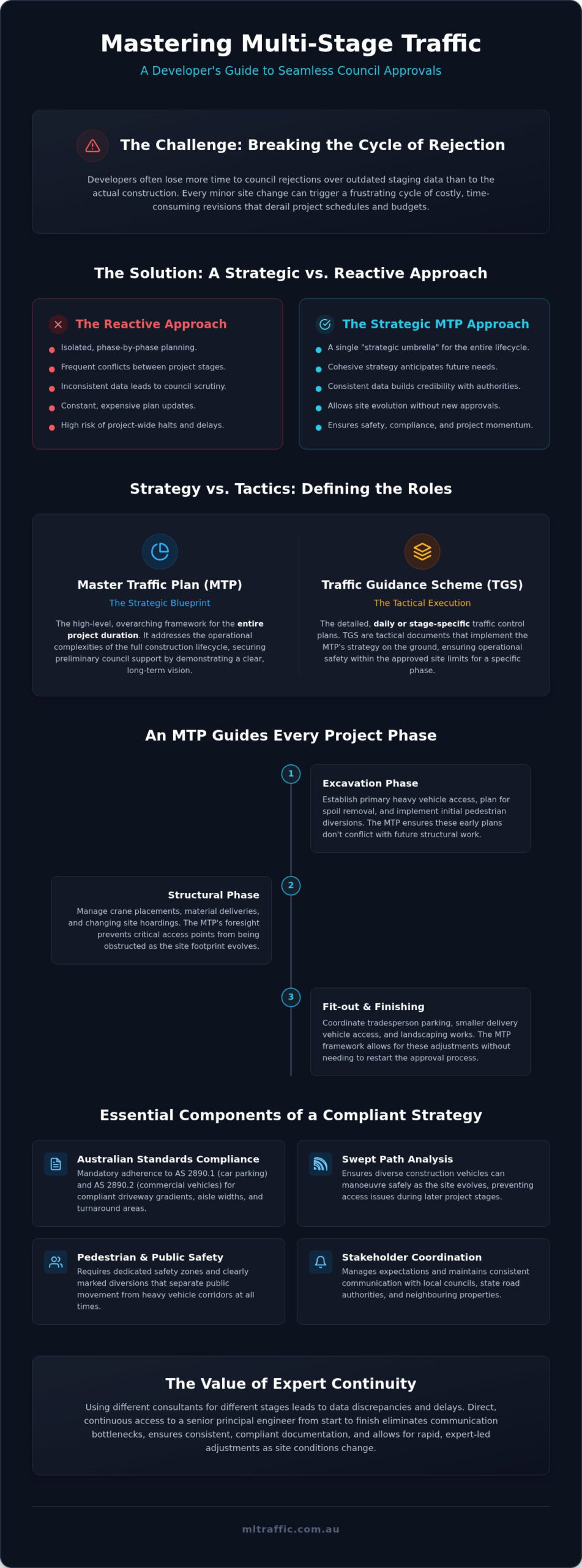
A master traffic plan for multi-stage projects serves as the primary strategic umbrella for large-scale, long-term developments. While a standard Traffic Impact Assessment (TIA) focuses on the projected impact of a completed development on the surrounding road network, the Master Traffic Plan (MTP) addresses the operational complexities of the entire construction lifecycle. Australian road authorities require this overarching framework to ensure that safety and efficiency are maintained as a site evolves. Without a cohesive strategy, developers often face project-wide halts during stage transitions because previous traffic arrangements conflict with new site requirements.
The MTP provides a high-level view of maintenance of traffic across the entire project duration. It ensures that temporary road closures, heavy vehicle access, and pedestrian diversions are planned as a continuous sequence rather than isolated events. This foresight reduces the risk of expensive site modifications or eleventh-hour council rejections that can derail a construction schedule. By defining the strategy early, you establish a compliant baseline that accommodates the shifting needs of a live site.
The Strategic Importance of Early-Phase Planning
Identifying long-term site access challenges before the first shovel hits the ground is the most effective way to control costs. A master traffic plan for multi-stage projects allows developers to secure preliminary Council support for the entire project lifecycle by demonstrating a clear understanding of future constraints. The Master Traffic Plan is the blueprint for all subsequent site movements. By addressing excavation, structural, and fit-out phases simultaneously, engineers can identify where vehicle swept paths might fail as site hoardings move or where crane placements could obstruct critical arterial roads.
Stakeholder Coordination Across the Project Lifecycle
Effective traffic management requires managing the expectations of local Councils, state road authorities, and neighbouring property owners. Consistency in traffic data is vital across different Development Application (DA) phases to maintain credibility with regulators. Discrepancies between Stage 1 and Stage 3 data often lead to intense scrutiny and delayed approvals. Such inconsistencies usually stem from using different consultants for different stages, which is why continuity of expertise is a significant project advantage.
To build a reliable foundation, the senior principals at ML Traffic Engineers Australia organise site audits that capture real-world conditions from the outset. This direct involvement ensures that the technical documentation remains compliant with AS 2890.1 and AS 2890.2 throughout the project. Working with a dedicated expert who remains on the project from start to finish eliminates the gatekeeper effect, allowing for rapid adjustments when site conditions change. This continuity is essential for high-density projects where site access is restricted and stakeholder scrutiny is high.
Essential Components of a Compliant Multi-Stage Traffic Strategy
A compliant master traffic plan for multi-stage projects must bridge the gap between high-level traffic impact assessments and the granular reality of a construction site. Integrating the initial Traffic Impact Assessment (TIA) with stage-specific requirements ensures that the project’s long-term traffic generation remains within the limits approved by road authorities. Adherence to Australian Standards AS 2890.1 (off-street car parking) and AS 2890.2 (off-street commercial vehicle facilities) is mandatory for all multi-stage developments. These standards provide the technical framework for driveway gradients, aisle widths, and turnaround areas. Incorporating the essential elements of a traffic management plan ensures that safety protocols remain robust even as the site footprint changes. Pedestrian management is equally critical, requiring dedicated safety zones and clearly marked diversions that separate public movement from heavy vehicle corridors.
Swept Path Analysis for Diverse Construction Phases
Vehicle manoeuvrability requirements shift significantly as a project matures. During the excavation phase, the site must accommodate large articulated dump trucks and piling rigs. These vehicles have wide turning circles and require substantial clearance. Conversely, the final fit-out stage often involves smaller delivery vans and light rigid vehicles. A single swept path diagram is insufficient for a master traffic plan for multi-stage projects. Each phase requires specific analysis to verify that the largest anticipated vehicle can enter and exit the site in a forward direction without compromising safety. This avoids the risk of vehicles reversing onto public roads, which is a major compliance violation. For a deeper look at these technical requirements, consult our Swept Path Analysis guide.
Parking Demand and Capacity Management
Managing the transition from temporary construction parking to operational car parks is a frequent point of failure in council applications. Developers must evaluate the peak parking demand of large construction crews, which often exceeds the capacity of the permanent car park being built. Failure to account for this leads to illegal street parking and subsequent council fines. Permanent car park design must meet AS 2890.1 compliance to ensure long-term functionality. A successful strategy manages this transition by identifying off-site parking solutions or staging the car park delivery to accommodate workers. Our senior engineers remain involved throughout this evolution, ensuring the same expert who designed the initial strategy manages the transition to operational use. If your project involves complex access requirements, we can provide a Car Parking Demand Assessment to satisfy regulatory scrutiny.
Master Traffic Plans vs. Tactical Traffic Guidance Schemes (TGS)
A master traffic plan for multi-stage projects functions as the strategic framework, while a Traffic Guidance Scheme (TGS) acts as the tactical execution. The Master Plan defines the project’s overall constraints, vehicle volumes, and access points over months or years. In contrast, a TGS is a specific diagram showing the placement of traffic control devices for a single shift or task. For high-density developments, implementing Active Traffic Management (ATM) strategies within the Master Plan allows for a more responsive approach to daily site changes. Every TGS must remain a subset of the approved Master Plan. If a daily scheme contradicts the overarching strategy, the project faces immediate legal liability and potential site shutdowns by road authorities.
Operating with an outdated or non-compliant TGS is a significant safety risk. The Master Plan provides the “rules of engagement,” ensuring that daily activities like concrete pours or crane lifts don’t compromise the safety protocols established during the DA phase. This hierarchy of documentation ensures that site supervisors and traffic controllers work within a verified safety envelope. Using a consistent engineering principal throughout the project’s life prevents the disconnect that often occurs when tactical schemes are developed in isolation from the strategic master plan.
The Anatomy of a Compliant TGS
A TGS is a tactical diagram while the Master Plan is a strategic report. A compliant TGS must include precise locations for temporary signage, barriers, and traffic controller stations. It visualises the physical setup required to manage a specific task, such as a lane closure or pedestrian diversion. These daily schemes must align with the broader site access strategy to ensure that temporary measures don’t create bottlenecks elsewhere in the network. Meticulous TGS design prevents driver confusion and maintains the site’s professional reputation with the local council.
When to Update Your Tactical Schemes
Specific “trigger points” necessitate the creation of a new TGS. Major milestones like the installation of a tower crane, significant road closures, or changes to site egress points require fresh tactical modelling. The process for getting these stage-specific schemes approved involves submitting the TGS to the relevant local authority or state road body for a permit. Ensuring these schemes meet current documentation standards is essential for rapid approval. For more information on these requirements, refer to our Traffic Management Plan guide. Consistent engineering oversight ensures that every TGS update remains compliant with the original master traffic plan for multi-stage projects.
Managing Evolution: Updating Traffic Plans Across Project Milestones
A master traffic plan for multi-stage projects requires periodic reviews to remain valid as site conditions change. Treating the plan as a static document is a common mistake that leads to compliance failures when the physical environment no longer matches the initial assessment. Establishing a formal review schedule at major project milestones ensures that traffic data remains accurate. Site conditions change quickly. These updates often incorporate data-driven insights from SCATS or recent local traffic counts to reflect shifts in the surrounding road network. Handling unforeseen site changes, such as unexpected utility works or changes in public transport routes, requires immediate adjustments to the overarching strategy. Proactive coordination with utility providers and transport authorities prevents these external factors from invalidating the entire Master Plan. It’s essential to document these changes to maintain a clear audit trail for council inspectors and road authorities who may perform spot checks.
Transitioning from Excavation to Structure
The shift from excavation to the structural phase represents a significant change in site logistics. Heavy earthmoving equipment is replaced by concrete agitators, pump trucks, and tower crane deliveries. This transition necessitates an update to the master traffic plan for multi-stage projects to reflect new vehicle types and frequency. Precision saves time. Sight distance assessments must be re-verified as site hoardings and gantries are erected, ensuring that drivers and pedestrians maintain clear lines of sight. Maintaining compliant driveway ramp grades is essential during these temporary works to prevent vehicle scraping or access blockages. Senior engineering oversight ensures these transitions occur without compromising the initial safety approvals. We don’t just plan for the current phase; we anticipate the next three months of site movement to avoid reactive planning that could lead to costly stop-work orders.
Final Stage: Transitioning to Operational Traffic
As construction nears completion, the focus shifts from managing work zones to preparing for permanent use. Securing an Occupation Certificate requires a final Traffic Impact Statement that confirms the development functions as intended. This phase involves verifying that the built car park meets all AS 2890.1 design certifications and operational requirements. Discrepancies between the original design and the final build can delay project handover, making final certification a critical milestone. ML Traffic Engineers Australia’s principals remain on the project from the first TIA to the final sign-off, ensuring total continuity of documentation. For expert assistance with final certifications, contact our team for Car Park Design services today.
Securing Council Approval with Expert Traffic Engineering
Senior engineering involvement is the primary differentiator when securing approvals for high-density developments. The technical complexity of coordinating multiple construction phases necessitates a level of documentation that standard traffic control firms simply cannot produce. Professional engineers navigate the inherent friction of Australian Council bureaucracy by preparing reports that address potential regulatory objections before they are raised. A master traffic plan for multi-stage projects must be technically robust to withstand intense scrutiny while remaining operational for site teams. Meticulous documentation reduces project liability by ensuring every movement adheres to the legal requirements set out by road authorities.
Working directly with a principal engineer provides a “no-gatekeepers” advantage that speeds up the approval timeline. When a Council officer identifies a technical concern, having direct access to the expert who performed the analysis allows for immediate resolution. This level of accountability is essential for maintaining the project schedule and avoiding the “requests for further information” cycle that often plagues complex developments. By removing the layers of communication typical in larger firms, we ensure that technical queries are answered with precision and authority.
The ML Traffic Engineers Australia Continuity Promise
We ensure that the senior expert who initiates your traffic strategy remains the lead engineer until the final sign-off. This continuity promise is a core pillar of our consultancy, providing a single point of accountability for your entire development. Leveraging over 15 years of Australian consultancy experience allows our principals to anticipate common objections regarding vehicle swept paths or heavy vehicle access. Building a robust Traffic Engineering foundation at the start of your project simplifies the approval process for every subsequent phase. This consistency ensures that the strategic intent of the original master plan is never compromised by the tactical requirements of a specific construction milestone.
Next Steps for Your Multi-Stage Project
Commencing a master traffic plan for multi-stage projects begins with a comprehensive site audit to capture real-world conditions and potential infrastructure constraints. To ensure your project remains on schedule and compliant, we recommend the following sequence:
- Request a Detailed Quote: Obtain a transparent fee structure that accounts for all anticipated project milestones and reporting requirements.
- Initial Site Audit: Schedule a formal assessment to identify long-term access challenges and sight distance constraints.
- Direct Consultation: Speak with a senior principal to align your traffic strategy with current Council expectations and road authority standards.
Direct access to leadership ensures your project receives the meticulous attention to detail required for complex urban environments. You can contact our senior principals directly to arrange a preliminary consultation. We provide the technical certainty needed to move your project from the initial planning stages through to final completion without unnecessary bureaucratic delays.
Streamline Your Development with Strategic Traffic Oversight
Managing a large-scale project requires a proactive approach to traffic logistics. A master traffic plan for multi-stage projects ensures that your site remains compliant from the initial excavation through to final fit-out. By maintaining a clear distinction between strategic master planning and tactical traffic guidance schemes, you reduce the risk of site shutdowns and council friction. Success depends on professional documentation that adheres strictly to AS 2890.1 and AS 2890.2 standards. Meticulous planning at the outset prevents the need for costly, reactive revisions as the project matures.
ML Traffic Engineers provides over 15 years of specialised consultancy experience. You gain direct access to senior principals who manage the technical work from start to finish. This “no-gatekeepers” approach eliminates unnecessary bureaucracy and ensures your project meets national regulatory standards without delay. Our commitment to personnel continuity means the same expert handles your project from the DA phase to final certification. Speak directly with a senior principal about your Master Traffic Plan today. You can move forward with confidence knowing your site access and safety requirements are in expert hands.
Frequently Asked Questions
What is the difference between a Master Traffic Plan and a standard TMP?
A Master Traffic Plan (MTP) serves as a strategic umbrella framework for long-term developments, whereas a standard Traffic Management Plan (TMP) or Traffic Guidance Scheme (TGS) typically focuses on specific, short-term work zones. The MTP coordinates traffic requirements across the entire project lifecycle. It provides the “rules of engagement” for all subsequent tactical schemes. This ensures that daily traffic control measures remain consistent with the high-level safety and access strategy approved during the initial planning phases.
When should I begin the traffic planning process for a multi-stage project?
Traffic planning should commence during the preliminary design or early Development Application (DA) phase. Engaging an engineer before the first shovel hits the ground allows you to identify long-term site access challenges and secure council support for the entire project lifecycle. Early involvement ensures that the master traffic plan for multi-stage projects accounts for excavation, structural, and fit-out requirements simultaneously so site teams don’t face unexpected delays. This proactive approach prevents expensive site modifications or eleventh-hour rejections.
Do I need a new Swept Path Analysis for every stage of construction?
Yes, you generally require distinct swept path diagrams for different project phases because vehicle types and site layouts evolve significantly. The excavation phase might involve large articulated dump trucks with wide turning circles, while the fit-out stage typically uses smaller delivery vans. Each milestone requires a specific analysis to verify that the largest anticipated vehicle can enter and exit in a forward direction. This technical verification is essential for maintaining compliance with Australian safety standards and AS 2890.2 requirements.
How often does a Master Traffic Plan for multi-stage projects need to be updated?
Updates are typically required at major project milestones, such as transitioning from excavation to the structural phase. You should also review the plan if unforeseen site changes occur, such as new utility works or adjustments to public transport routes. Establishing a formal review schedule ensures that your master traffic plan for multi-stage projects remains accurate and reflects the current surrounding road network. Regular updates prevent your documentation from becoming outdated, which is a common cause of council compliance failures and subsequent site shutdowns.
Can a Master Traffic Plan help reduce my overall project costs?
A well-structured master traffic plan for multi-stage projects reduces costs by preventing project-wide halts and council rejections. By anticipating access constraints early, you avoid the high costs of revising traffic plans for every minor site change. Compliant documentation also reduces liability and the risk of fines from road authorities. Having a clear roadmap for site access from start to finish minimises the downtime caused by inefficient vehicle movements or blocked arterial roads, ensuring your project stays on budget.
What Australian Standards must my multi-stage traffic plan comply with?
Multi-stage traffic plans must adhere to AS 2890.1 for off-street car parking and AS 2890.2 for off-street commercial vehicle facilities. These standards dictate the technical requirements for driveway gradients, aisle widths, and heavy vehicle turnaround areas. Compliance with these national standards is mandatory for securing council approval and ensuring long-term site safety. Professional traffic engineers use these benchmarks to verify that every stage of your development meets the rigorous safety criteria required by road authorities and state regulators.
What happens if my project changes significantly after the Master Plan is approved?
Significant changes to site footprint, access points, or project timelines require a formal revision of the Master Plan to remain valid. Operating under an outdated plan can invalidate your council approvals and lead to immediate site shutdowns so you don’t risk project-wide halts. You must coordinate with your principal engineer to update the strategy and ensure it reflects the new site realities. This process typically involves revising the Traffic Impact Assessment (TIA) data to maintain consistency with the latest development application requirements.
Is a Master Traffic Plan required for all Australian developments?
While not mandatory for small-scale residential builds, a Master Traffic Plan is standard for high-density, multi-stage developments or projects with significant road network impact. Local councils and state road authorities often mandate these plans for commercial, industrial, and large-scale residential projects to manage long-term congestion and safety. If your project involves multiple construction phases or complex heavy vehicle requirements, road authorities will likely require a comprehensive strategic framework to grant approval and ensure public safety is maintained.

Disclaimer
The content on www.mltraffic.com.au, including all technical articles, guides, and resources, is provided for general informational and educational purposes only. It is not intended to constitute professional advice in traffic engineering, transportation planning, development approvals, or any other technical or legal field.
While ML Traffic Engineers makes every reasonable effort to ensure the accuracy, completeness, and timeliness of the information published, we do not provide any warranties or representations (express or implied) regarding its reliability, suitability, or availability for any particular purpose. Any reliance you place on the content is strictly at your own risk.
In no event shall ML Traffic Engineers, its directors, employees, authors, or affiliates be liable for any direct, indirect, incidental, special, consequential, or punitive damages (including, without limitation, loss of profits, data, or business opportunities) arising out of or in connection with the use of, or inability to use, any information provided on this website.
The articles and guides on this site are not a substitute for engaging a qualified, registered professional traffic engineer (such as an NPER or RPEQ engineer) to assess your specific project requirements. For tailored advice, compliance assessments, or traffic engineering services, please contact a competent professional.
This disclaimer may be updated from time to time without notice. By accessing or using this website, you agree to be bound by the most current version of this disclaimer.
