

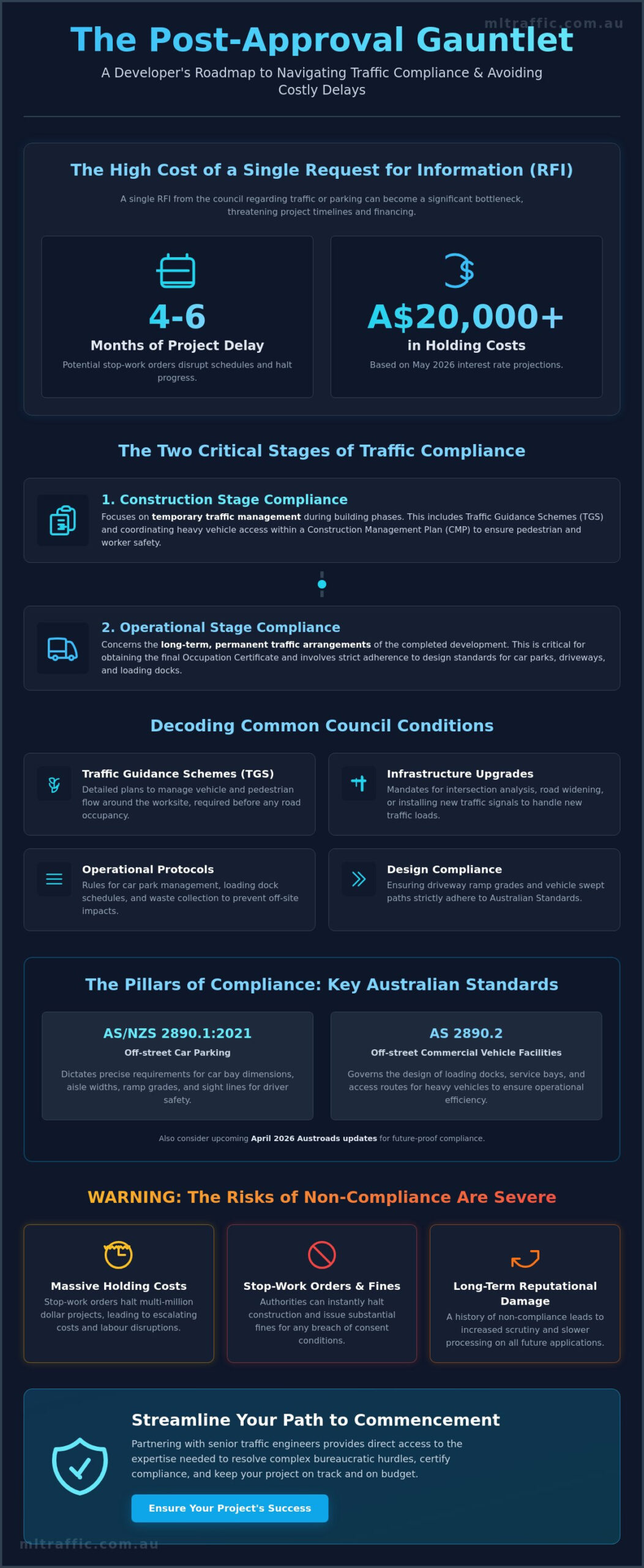
A single Request for Further Information (RFI) regarding traffic or parking can delay an Australian development project by four to six months, potentially costing more than A$20,000 in holding costs based on May 2026 interest rates. For many developers, the technical burden of addressing council traffic conditions in a development application becomes a significant bottleneck that threatens project timelines and financing. We understand that the transition from planning approval to construction is often the most volatile phase of the project lifecycle, where bureaucratic confusion can lead to expensive stop-work orders.
This article provides a technical roadmap to help you navigate onerous post-approval requirements and ensure your project remains compliant with the latest regulatory frameworks. You’ll learn how to satisfy complex conditions of consent while avoiding the common pitfalls that lead to RFIs or project delays. We’ll examine the specific requirements of the AS/NZS 2890.1:2021 standards and the April 2026 Austroads updates, providing a clear distinction between DA-stage reporting and construction-stage traffic management to streamline your path to commencement and ensure cost-effective compliance management.
Key Takeaways
- Understand that traffic conditions in your Notice of Determination are mandatory technical requirements that must be cleared before construction begins.
- Learn a structured framework for addressing council traffic conditions in a development application to avoid costly RFIs and project delays.
- Ensure your physical car park assets and driveway designs strictly adhere to AS 2890.1:2021 and AS 2890.2 standards to maintain compliance.
- Identify the critical differences between temporary construction traffic management and long-term operational parking requirements for your site.
- Discover how direct access to senior traffic engineers can streamline the compliance schedule and resolve complex bureaucratic hurdles.
Table of Contents
What is Post-Approval Traffic Condition Compliance?
Post-approval traffic condition compliance is the technical process of satisfying the specific mandates listed within a development’s Notice of Determination. While the initial planning phase focuses on broad impacts, the post-approval stage demands precise execution of engineering requirements. This transition marks the shift from theoretical modelling to practical, on-site traffic management. Addressing council traffic conditions in a development application isn’t a voluntary exercise; it’s a statutory obligation under various state planning and environment acts across Australia.
To better understand why these conditions are scrutinized and how they impact project approval, watch this brief overview of development application challenges:
A qualified traffic engineer acts as the technical liaison between the developer and the consent authority. Their role involves certifying that every condition, whether it concerns physical infrastructure or operational management, meets the rigorous standards of the council. This certification often involves detailed technical documentation, such as a Traffic Impact Assessment (TIA) Report or a specific Road traffic control strategy for construction phases. A traffic engineer’s involvement ensures that the technical nuances of addressing council traffic conditions in a development application are handled with professional precision, which is critical for fulfilling operational requirements before an Occupation Certificate is issued.
Common Traffic Conditions of Consent
Councils impose a variety of conditions based on the scale and location of the project. These often include:
-
Traffic Guidance Schemes (TGS): Detailed plans required prior to any road occupancy to manage vehicle and pedestrian flow around the site.
-
Infrastructure Upgrades: Mandates for specific intersection analysis, road widening, or the installation of new signalling equipment.
-
Operational Protocols: Requirements for car park management plans, loading dock schedules, and waste collection logistics to prevent off-site impacts.
-
Design Compliance: Specific assessments for driveway ramp grades and vehicle swept paths to ensure adherence to AS/NZS 2890.1:2021.
The Consequences of Non-Compliance
Ignoring or mismanaging traffic conditions carries significant risk. Local authorities have the power to issue substantial fines for breaches of consent conditions. Even more damaging are stop-work orders, which can halt multi-million dollar construction programmes instantly. This leads to massive holding costs and disrupts labour schedules. Beyond the immediate financial loss, non-compliance creates long-term reputational damage. Planning departments maintain records of developer performance, and a history of non-compliance can lead to increased scrutiny and slower processing times for all your future development applications.
The Anatomy of Traffic Compliance Requirements
Technical compliance is not a subjective exercise. It relies on a rigid framework of Australian Standards and state-specific regulations. When addressing council traffic conditions in a development application, developers must ensure that physical car park assets and access points align perfectly with AS 2890.1 (Off-street car parking) and AS 2890.2 (Off-street commercial vehicle facilities). These standards dictate everything from bay dimensions to ramp grades. Any deviation during the construction phase can lead to a refusal of the Occupation Certificate, necessitating expensive remedial works.
Effective compliance management also involves the seamless integration of a Traffic Management Plan (TMP) within the broader Construction Management Plan (CMP). This coordination is vital for managing the high-risk intersection between pedestrian safety and heavy vehicle access. Councils often require technical reports to be certified by a Registered Professional Engineer of Queensland (RPEQ) or a Chartered Professional Engineer (CPEng) to guarantee the accuracy of the proposed mitigations. If you require expert guidance on these technical certifications, our team provides comprehensive traffic engineering services tailored to complex Australian developments.
Australian Standards and Regulatory Frameworks
AS 2890.1:2021 governs the post-construction certification of off-street parking. It’s the benchmark councils use to verify that the as-built environment matches the approved design. A critical component of this verification is Vehicle Swept Path Analysis. This analysis uses specialized software to simulate vehicle movements, ensuring that heavy vehicles or emergency services can navigate the site without impacting physical structures or pedestrian zones. State-specific variations, such as Road Occupancy Licensing (ROL) in New South Wales or Memorandum of Consent (MoC) in Victoria, add further layers of complexity to these national standards.
Jurisdictional Overlap: Council vs. State Authorities
A frequent source of project friction is the overlap between local councils and state road authorities like Transport for NSW or Victoria’s Department of Transport and Planning. While a council might approve the internal site layout, the state authority often holds final say over works affecting classified roads. Navigating conflicting conditions between these bodies requires a unified traffic engineering strategy. You must identify which authority has jurisdiction over specific assets early in the process. Failure to synchronize these requirements often results in contradictory mandates that can stall a project indefinitely during the post-approval phase.
Construction vs. Operational Stage Compliance
A common misconception among developers is that a single Traffic Impact Assessment (TIA) submitted during the initial planning phase satisfies all future obligations. In reality, addressing council traffic conditions in a development application is a multi-stage commitment that requires distinct technical deliverables for construction and operational environments. A DA-stage report focuses on broad network impacts; however, it lacks the granularity required to manage a live construction site or certify a completed asset for an Occupation Certificate (OC).
The construction stage focuses on mitigating temporary disruptions. This requires a dynamic Traffic Guidance Scheme (TGS) that must be updated as the site evolves. For example, the traffic profile of a site during deep excavation, involving heavy haulage and frequent truck movements, differs significantly from the fit-out stage. Failing to provide updated TGS documentation can lead to immediate compliance breaches and site shutdowns. One report is never enough because the risks and physical constraints change as the building rises.
Managing Construction Traffic Impacts
Construction-stage compliance focuses on the safe integration of heavy vehicles into the existing road network. Developers must provide robust plans for site access and egress to prevent queuing on public roads. This often involves coordinating heavy vehicle movements to occur outside of local peak-hour periods to minimize congestion. Pedestrian management is equally critical. You must implement clear strategies to maintain safe passage around active construction zones, ensuring that temporary hoardings or site entries don’t obstruct visibility or create hazards for the public.
Ensuring Long-Term Operational Compliance
Operational compliance relates to the permanent functionality of the development. Before an OC is issued, councils often require a final Driveway Ramp Grade Assessment and a Sight Distance Assessment to verify that the as-built infrastructure meets AS/NZS 2890.1:2021 standards. This phase often includes a post-construction Car Parking Demand Assessment to confirm that the actual building usage aligns with the initial projections. In some jurisdictions, annual traffic safety audits are mandated as a condition of ongoing operation, ensuring that the site remains safe and functional throughout its entire lifecycle.
A Framework for Managing Traffic Condition Compliance
Technical compliance is a risk management priority that requires a systematic methodology. Addressing council traffic conditions in a development application isn’t a task for the end of the project; it’s a continuous process that begins the moment the Notice of Determination is issued. Developers who fail to implement a structured framework often face significant delays when seeking an Occupation Certificate. Follow these five steps to maintain compliance throughout the project lifecycle.
-
Step 1: Audit the Notice of Determination. Extract every condition related to traffic, parking, and access. Identify specific triggers such as "prior to the issue of a Construction Certificate" or "prior to the commencement of works" to avoid missed deadlines.
-
Step 2: Appoint a lead traffic engineer. Accountability is essential. Appointing a lead expert ensures personnel continuity and provides a single point of contact for all regulatory authorities.
-
Step 3: Implement evidence collection. Don’t wait for a council inspection to gather data. Collect time-stamped evidence during every phase of construction to prove that traffic control measures were active and effective.
-
Step 4: Conduct independent audits. Periodic technical audits verify that as-built structures, such as driveway ramps and loading docks, align with the approved plans. This prevents expensive remedial works after the concrete has set.
-
Step 5: Submit formal Compliance Reports. Structure your final reports with clear engineering data to satisfy the consent authority’s requirements for project close-out.
If you need a professional audit of your project’s traffic conditions, contact our senior engineering team for a direct consultation with our principals.
Evidence Collection and Monitoring
Effective monitoring fills the gap between planning and execution. Use site photos to document the correct installation of traffic control devices and signage according to the approved Traffic Guidance Scheme (TGS). GPS data from heavy vehicle fleets serves as undeniable proof of route compliance, ensuring trucks don’t deviate onto restricted local roads. You should also maintain a detailed log of any traffic-related complaints from the public. Documenting these complaints and their resolutions demonstrates a proactive approach to site management, which is viewed favourably by council planning officers during the final review.
Reporting and Documentation Standards
A Compliance Report must be more than a summary of activities; it must be a technical verification document. Structure the report with clear-cut claims supported by engineering data, such as a final Vehicle Swept Path Analysis or sight distance measurements. This level of detail reduces the likelihood of a Request for Information (RFI) from the council. When an RFI does occur, having a lead traffic engineer manage the response process ensures that technical queries are resolved quickly without stalling the project’s progress.
Partnering with ML Traffic for Post-Approval Success
ML Traffic Engineers Australia leverages over 15 years of practical experience in Australian traffic engineering and transport planning. We specialize in the technical nuances of addressing council traffic conditions in a development application, ensuring that your project moves from approval to construction without regulatory friction. Our firm operates with a national footprint, providing consistent and reliable compliance advice across every Australian state and territory. We understand that post-approval compliance is a strategic risk management tool, not just a bureaucratic hurdle.
A core signature of our service is the "No Gatekeepers" approach. You receive direct access to senior principals who manage the technical work personally. This ensures high-level accountability for complex compliance issues that junior staff might overlook. We offer a comprehensive suite of services, managing everything from initial Swept Path Analysis and Driveway Ramp Grade Assessments to final operational certification. Our involvement guarantees that your Intersection Analysis and Sight Distance Assessments meet the precise standards required by local consent authorities.
Our Approach to Compliance Engineering
We bridge the gap between planning and execution by integrating preliminary Traffic Impact Assessments with active post-approval management. Our team possesses deep expertise in AS 2890.1 compliance, ensuring your car park design meets all regulatory benchmarks. We also focus on streamlining the approval of Traffic Management Plans for construction stages. This involves coordinating Vehicle Swept Path Analysis and Car Parking Demand Assessments to provide a clear roadmap for addressing council traffic conditions in a development application.
Secure Your Development Timeline
Meticulous reporting is the most effective tool for reducing the risk of council-imposed delays. Our technical documentation is designed to withstand rigorous scrutiny, minimizing the need for repetitive Requests for Information. We promise personnel continuity throughout the project lifecycle. The same senior expert who initiates the relationship will perform the technical work, providing a stable foundation from the DA stage through to the final Occupation Certificate. This hands-on approach eliminates the communication gaps common in larger, impersonal firms. Contact our senior engineers today to discuss your post-approval conditions and secure your project’s timeline.
Secure Your Development Timeline and Compliance
Successful project delivery depends on technical precision at every stage of the development lifecycle. You must distinguish between temporary construction impacts and long-term operational requirements to avoid regulatory bottlenecks. Technical adherence to AS 2890.1 and AS 2890.2 standards remains the non-negotiable baseline for securing an Occupation Certificate and avoiding stop-work orders.
ML Traffic simplifies the process of addressing council traffic conditions in a development application through a structured, evidence-based approach. We offer over 15 years of Australian traffic engineering experience and provide direct access to senior principals on every project. Our comprehensive expertise ensures that your technical reports satisfy council planning officers and mitigate the risk of expensive project delays.
Ensure your project remains compliant; speak with an ML Traffic expert today. Your project’s success is built on reliable engineering and meticulous compliance management.
Frequently Asked Questions
What is the difference between a DA-stage traffic report and post-approval compliance?
A DA-stage traffic report focuses on the theoretical impact of a development on the surrounding road network. Post-approval compliance involves the technical execution of specific mandates listed in the Notice of Determination. This transition requires detailed documentation, such as a Traffic Guidance Scheme (TGS) and physical asset certification, to ensure the as-built environment matches the approved design and safety standards.
Who is responsible for monitoring traffic condition compliance on a construction site?
The developer or head contractor holds primary responsibility for monitoring traffic condition compliance on a construction site. They must ensure all activities align with the approved Construction Traffic Management Plan (CTMP). Appointing a lead traffic engineer provides a formal mechanism for evidence collection and technical oversight, which is essential for addressing council traffic conditions in a development application during active works.
Can a planning authority revoke an approval if traffic conditions are not met?
Planning authorities have the power to issue stop-work orders or substantial fines if traffic conditions of consent are ignored. While total revocation of an approval is a last resort, persistent non-compliance can lead to legal action under state planning acts. These enforcement actions result in significant project delays and increased holding costs, making proactive compliance management a critical risk mitigation strategy.
Do I need a new Swept Path Analysis if the site layout changes after approval?
You must conduct a new Vehicle Swept Path Analysis if any changes occur to the site layout, driveway locations, or internal circulation paths after the initial approval. Councils require this analysis to verify that the modified design still accommodates the design vehicle specified in AS 2890.1 or AS 2890.2. Failure to update this technical analysis can result in the refusal of an Occupation Certificate.
How often do I need to submit compliance reports to the council?
Reporting frequency is determined by the specific triggers listed in your Notice of Determination. Some projects require monthly audits during the construction phase, while others only mandate a final report prior to the issue of an Occupation Certificate. You must audit your approval document early to identify these reporting milestones and avoid administrative delays that could halt your construction programme.
What happens if a traffic condition of consent is impossible to meet?
If a condition is technically impossible to satisfy, you must apply for a formal modification to the development consent, such as a Section 4.55 application in New South Wales. A traffic engineer must provide a technical justification for the change. This process involves proving that the alternative solution maintains safety and operational efficiency while adhering to relevant Australian Standards and council objectives.
Does a Traffic Guidance Scheme (TGS) require council approval every time it changes?
A Traffic Guidance Scheme (TGS) typically requires new council or road authority approval if the changes impact public road occupancy or pedestrian flow. Minor internal site adjustments might not require formal re-submission, but any modification affecting classified roads or public safety must be certified. Maintaining an up-to-date TGS is vital for addressing council traffic conditions in a development application during shifting construction phases.
How can a traffic engineer help in securing an Occupation Certificate?
A traffic engineer facilitates the Occupation Certificate (OC) by providing final certification of all traffic-related infrastructure. This includes conducting a Driveway Ramp Grade Assessment and a Sight Distance Assessment to verify that the as-built project complies with AS/NZS 2890.1:2021. Their formal report provides the technical evidence council planning officers require to close out the development consent conditions and allow for building occupancy.
Which areas do you cover?
We are traffic engineers servicing Melbourne, Sydney, Brisbane, Gold Coast, Hobart, Perth, Adelaide, Darwin, Canberra and surrounding areas.

Disclaimer
The content on www.mltraffic.com.au, including all technical articles, guides, and resources, is provided for general informational and educational purposes only. It is not intended to constitute professional advice in traffic engineering, transportation planning, development approvals, or any other technical or legal field.
While ML Traffic Engineers makes every reasonable effort to ensure the accuracy, completeness, and timeliness of the information published, we do not provide any warranties or representations (express or implied) regarding its reliability, suitability, or availability for any particular purpose. Any reliance you place on the content is strictly at your own risk.
In no event shall ML Traffic Engineers, its directors, employees, authors, or affiliates be liable for any direct, indirect, incidental, special, consequential, or punitive damages (including, without limitation, loss of profits, data, or business opportunities) arising out of or in connection with the use of, or inability to use, any information provided on this website.
The articles and guides on this site are not a substitute for engaging a qualified, registered professional traffic engineer (such as an NPER or RPEQ engineer) to assess your specific project requirements. For tailored advice, compliance assessments, or traffic engineering services, please contact a competent professional.
This disclaimer may be updated from time to time without notice. By accessing or using this website, you agree to be bound by the most current version of this disclaimer.
