

For every dollar invested in the Melbourne Airport Rail link, the state expects a return of $2.10 in economic benefits, yet the projected opening date has now been pushed back to 2033. This Melbourne Airport Rail, Cost versus Benefits and Construction Timeline – May 2026 Update clarifies the current status of the $4.1 billion Stage 1 works, including the West Footscray to Albion upgrade. You’re likely managing the reality of shifting traffic flow patterns and the strict council requirements that come with developing near major infrastructure. Uncertainty regarding construction disruptions shouldn’t stall your project’s progress or affect your site’s accessibility.
We understand that maintaining compliant site access is critical while the Sunshine Super Hub begins construction and Tottenham Station preparations loom for 2027. This guide provides a technical analysis of the project’s progress and a professional framework for preparing a Traffic Impact Assessment (TIA) that meets national standards. We’ll examine the cost-benefit ratio, the updated 2030 completion target for Stage 1, and the specific engineering steps required to ensure your development remains viable. With community feedback on station designs closing on 14 June 2026, now is the time to align your traffic engineering strategy with the latest infrastructure shifts.
Key Takeaways
- Review the current $13 billion funding landscape and the $4.1 billion Stage 1 works to understand how budgetary shifts impact local transport infrastructure.
- Analyze the Melbourne Airport Rail, Cost versus Benefits and Construction Timeline – May 2026 Update to align your development schedule with the revised 2033 project opening.
- Identify critical disruption zones for 2026 and 2027, specifically regarding the Sunshine Super Hub commencement and upcoming Tottenham Station upgrades.
- Learn how to establish baseline traffic data for a Traffic Impact Assessment (TIA) that accounts for shifting traffic gravity near active rail construction.
- Discover the engineering requirements for Vehicle Swept Path Analysis and Intersection Analysis to maintain site access compliance under strict council oversight.
The Current Trajectory of the Rail Link Infrastructure (May 2026 Update)
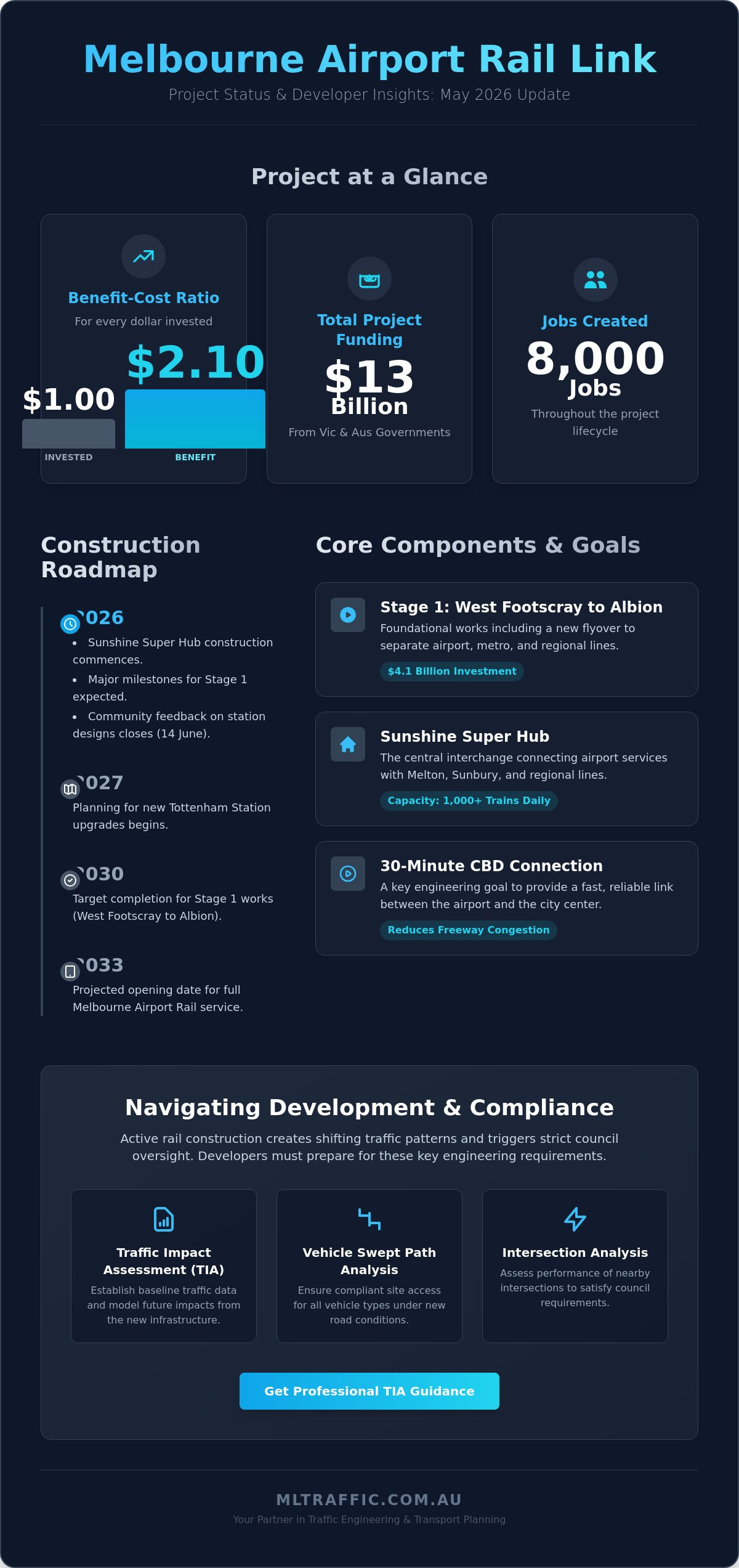
The Melbourne Airport Rail project has reached a pivotal construction phase. As of May 2026, the project is supported by a $13 billion funding commitment shared between the Victorian and Australian governments. This Melbourne Airport Rail, Cost versus Benefits and Construction Timeline – May 2026 Update highlights that while the total project opening is scheduled for 2033, Stage 1 works are currently the primary focus of civil activity. The project follows a decade of planning and a critical agreement reached in July 2024 to utilize an above-ground station at the airport, ending years of location disputes. The primary rail corridor spans from the CBD through the Sunshine precinct, necessitating substantial junction upgrades to integrate airport services with the metropolitan and regional networks.
A central component of this trajectory is the Memorandum of Understanding (MoU) regarding land use and infrastructure integration. This agreement dictates how surrounding developments must interface with the rail corridor. For developers, this means that site access and internal circulation must align with heightened transport standards. Reviewing the Melbourne Airport Rail project history provides context on how these corridor requirements have evolved. Current infrastructure works are designed to minimize long-term freight interference while maximizing passenger throughput.
Phase 1: West Footscray to Albion Progress
The $4.1 billion West Footscray to Albion Rail Upgrade is the most active segment of the project. Technical works on the new flyover at Albion are advancing, which will allow airport trains to cross existing tracks without causing delays to the Sunbury or regional lines. This phase is critical for maintaining freight corridor integrity. The project team expects to hit major milestones by the end of the 2026 calendar year, including the completion of several bridge piers and track realignments. Stage 1 is on track for completion in 2030, providing the foundational infrastructure required for the eventual airport connection.
Future Stages and Station Planning
Construction on the Sunshine Super Hub officially began in early 2026. This precinct will serve as the gateway to the airport, connecting the Melton, Sunbury, and regional lines. Future capacity is estimated at more than 1,000 trains per day, which will fundamentally shift local traffic patterns. Planning for the new Tottenham Station is slated for 2027. Community feedback on early designs for these stations remains open until 14 June 2026. These developments necessitate rigorous technical assessments to ensure that surrounding road networks can handle the projected increase in commuter density and multi-modal transfers.
Economic and Engineering Analysis: Cost versus Long-Term Benefits
The $13 billion investment in the Melbourne Airport Rail project is predicated on a significant benefit-cost ratio. Current data from the Melbourne Airport Rail, Cost versus Benefits and Construction Timeline – May 2026 Update indicates that for every $1 spent, the state expects to receive $2.10 in economic benefits. This return is largely driven by the creation of 8,000 jobs and the long-term productivity gains associated with reduced travel times. A central engineering goal is the 30-minute CBD connection. This reliable transit link serves as a catalyst for commercial development, particularly in the Sunshine and Footscray precincts where transport gravity is shifting.
The Official construction timeline and updates confirm that the project will eventually support over 1,000 trains daily through the Sunshine Station hub. For the 20,000 plus workers in the airport precinct, this infrastructure provides a viable alternative to the heavily congested Tullamarine Freeway. From an engineering perspective, the transition from road-dependent commuting to high-capacity rail reduces the pressure on existing arterial networks. This shift allows for more efficient freight movement and improved logistics performance across the western corridor.
Development Value and Transport Gravity
High-capacity rail infrastructure increases the feasibility of high-density residential and commercial projects. As transport accessibility improves, councils often allow for a reduction in traditional parking requirements. Developers can capitalize on this by commissioning a professional Car Parking Demand Assessment to justify lower provision rates based on proximity to the new rail hubs. Travel time savings also enhance the value of commercial tenancies, as businesses prioritize locations with predictable access for staff and clients.
Mitigating Local Road Congestion
The project is designed to remove thousands of private vehicle trips from the primary airport freeway every day. This redistribution of traffic will significantly alter the performance of key interchanges and arterial intersections. To maintain compliance with national standards, developers in these zones must ensure their site access remains functional amidst these network shifts. We recommend performing a detailed Intersection Analysis to model how new traffic patterns will impact your property’s entry and exit points. Reducing passenger vehicle volume on major routes also benefits heavy vehicle operators by improving freight efficiency and overall road safety through less crowded intersections.
The Construction Roadmap: Managing Disruption and Traffic Flow
The construction roadmap for the Melbourne Airport Rail project is entering a phase of high intensity. Current schedules indicate that Stage 1, focusing on the West Footscray to Albion upgrades, will conclude in 2030. This Melbourne Airport Rail, Cost versus Benefits and Construction Timeline – May 2026 Update identifies the 2026 to 2027 period as a critical window for infrastructure-driven disruptions. Major works at the Sunshine Super Hub began in early 2026, while construction for the new Tottenham Station is scheduled for 2027. These projects require precise coordination between public works and private development timelines to maintain regional accessibility.
Managing these disruptions requires the implementation of a professional Traffic Guidance Scheme (TGS). A TGS is essential for maintaining site safety during temporary lane closures or road realignments. According to the Melbourne Airport Rail Project Overview, substantial track and bridge works will occur throughout the Albion corridor. Developers must ensure that their construction schedules don’t conflict with these major rail milestones. Failure to account for public infrastructure shifts can lead to significant delays in site access approvals and logistics planning.
Swept Path Analysis During Construction
Road narrowing is a common byproduct of major rail works, often reducing available lane widths for heavy vehicles. We utilize specialized software to perform a Vehicle Swept Path Analysis, ensuring that trucks and machinery can still navigate temporary construction access points. This modeling is vital for compliance with national standards, especially when temporary vehicle maneuvers are required near active rail corridors. Modeling these paths early prevents operational bottlenecks and ensures that heavy vehicle access remains safe and efficient despite reduced road space. It’s a technical requirement that councils scrutinize heavily during major infrastructure transitions.
Traffic Management Plans for Site Managers
Site managers must develop robust plans to handle pedestrian and vehicle diversions. These diversions are necessary to minimize disruption to surrounding commercial operations while maintaining safety. The involvement of a professional traffic engineer in developments is critical during this period. They provide the technical oversight needed to manage complex interactions between site traffic and public network shifts. Data-driven reporting ensures that your traffic management strategy meets council requirements and remains functional throughout the entire construction lifecycle. Proactive planning helps avoid the penalties associated with non-compliant site access.
How to Prepare a Traffic Impact Assessment Near Major Rail Corridors
Preparing a comprehensive Traffic Impact Assessment (TIA) Report for sites adjacent to the Melbourne Airport Rail corridor requires a nuanced understanding of both permanent and temporary network conditions. This Melbourne Airport Rail, Cost versus Benefits and Construction Timeline – May 2026 Update emphasizes that baseline data must reflect current construction-related diversions while forecasting for the eventual 2033 full operational state. Developers need to coordinate with relevant authorities like the Department of Transport and Planning to define the study area accurately. Council scrutiny remains high regarding intersection capacity and the safety of site access points during this transition period. Each assessment must be meticulous to ensure that development approvals aren’t jeopardized by shifting traffic gravity.
A successful TIA integrates data-driven modeling with a clear understanding of regional growth. Modeling post-project traffic generation isn’t just about counting cars. It’s about understanding how the redistribution of traffic at major interchanges affects your property’s specific entry and exit points. Proactive engineering allows you to address council concerns before they become roadblocks to your application. Integrating the traffic impact assessment into the wider development application provides a technical foundation that supports long-term site viability.
Step 1: Scoping and Data Collection
Determining peak hour volumes is the first technical step. You must identify existing network constraints that might be exacerbated by ongoing rail construction. A reliable baseline model accounts for temporary construction traffic, ensuring the TIA doesn’t underestimate delays. Consulting with experienced traffic consultants for scope definition helps define a project boundary that satisfies regulatory requirements without unnecessary rework. Our senior principals oversee every assessment to ensure technical accuracy and personnel continuity throughout the process.
Step 2: Impact Modeling and Mitigation
Impact modeling must analyze how changed road geometry affects your site entry and exit. If a new station precinct or flyover alters the local flow, you might need to propose mitigation measures. These often include signal adjustments or lane reconfigurations to maintain an acceptable level of service. Ensuring your designs accommodate future public transport usage shifts is critical for compliance. We use advanced software to simulate these scenarios, providing a reliable evidence base for council negotiations.
Step 3: Parking and Access Compliance
Parking and access compliance is non-negotiable for development approval. We validate all car park designs against AS 2890.1 standards to ensure safety and functionality. This process involves conducting a Vehicle Swept Path Analysis for all anticipated vehicle types, from passenger cars to heavy delivery trucks. We also certify driveway ramp grades and sight distance requirements to guarantee your site meets national standards. If you need to secure council approval for a complex site, request a TIA report from our technical experts today.
Strategic Engineering for Development Approval and Compliance
Senior-led technical work is non-negotiable for developments located within major infrastructure zones. The complexity of the Melbourne Airport Rail project requires more than just general oversight; it demands a precise engineering response. Achieving council approval depends on data-driven reporting that aligns with current network constraints and future capacity. This Melbourne Airport Rail, Cost versus Benefits and Construction Timeline – May 2026 Update confirms that while the broader project benefits are clear, individual site compliance remains the developer’s responsibility. Professional traffic statements act as a safeguard against planning delays by providing authorities with the exact technical evidence they require. This approach ensures long-term site viability by accounting for the adaptive transport planning necessitated by the 2033 project completion date.
Meticulous engineering ensures that your project doesn’t become a casualty of shifting transport gravity. Councils and state authorities prioritize applications that demonstrate a clear understanding of the Melbourne Airport Rail, Cost versus Benefits and Construction Timeline – May 2026 Update. By utilizing senior expertise, you ensure that the technical work submitted is both accurate and compliant with national standards. This level of detail is essential for securing approvals in high-traffic corridors where road geometry and signal timings are subject to change.
Direct Access to Engineering Expertise
Working with consultants who handle the technical analysis personally provides a significant advantage. It eliminates the communication gaps often found in larger firms where senior principals aren’t hands-on. Navigating the bureaucratic requirements of various road and rail authorities like Victoria’s Big Build is a core part of the approval process. We reduce project risk through meticulous swept path analysis. This ensures that every vehicle maneuver on your site complies with national regulatory standards. Direct access to leadership means your project benefits from decades of experience in civil engineering and urban planning without unnecessary gatekeepers.
Finalizing Your Development Application
Finalizing a development application requires a structured approach to traffic engineering. Your submission should include a finalized TIA, parking demand assessments, and intersection modeling. Addressing feedback from local planning authorities effectively is the final hurdle. Clear, technical responses to council queries can expedite the approval timeline and prevent costly redesigns. Use this checklist to ensure your submission is ready:
- Verify all car park designs against current AS 2890.1 standards.
- Confirm driveway ramp grades and sight distances meet regulatory requirements.
- Ensure swept path analysis covers the largest anticipated vehicle types.
- Align your construction traffic management with the 2026-2027 disruption window.
For those requiring specialized traffic services, our senior experts provide the accountability and technical depth needed for success. We ensure the same expert who initiates the relationship performs the technical work, maintaining personnel continuity throughout your project’s lifecycle.
Securing Development Approval Amidst Infrastructure Shifts
The $13 billion investment in the Melbourne Airport Rail project creates significant opportunities for regional growth, yet it demands rigorous technical compliance for nearby developments. This Melbourne Airport Rail, Cost versus Benefits and Construction Timeline – May 2026 Update highlights that Stage 1 works are already reshaping the western corridor’s transport gravity. Success in this environment requires a data-driven approach that accounts for shifting traffic patterns and construction-related diversions. Ensuring your site access remains functional and compliant with Australian Standards is essential for achieving council approval without unnecessary delays. A professional assessment doesn’t just fulfill a requirement; it protects your project’s long-term viability.
Our team brings over 15 years of traffic engineering experience to every project. We guarantee the direct involvement of senior principals in every report, ensuring your development meets all council requirements and national regulatory standards. We understand the technicalities of major rail corridors and the bureaucratic expectations of planning authorities. Contact our senior traffic engineers for a project-specific assessment to secure your site’s operational viability. We look forward to helping you manage these complex infrastructure shifts with confidence.
Frequently Asked Questions
When will the airport rail construction be finished?
The Melbourne Airport Rail is scheduled for a full operational opening in 2033. Stage 1 works, which include the West Footscray to Albion Rail Upgrade, are expected to be completed by 2030. These dates depend on the progress of major milestones like the Sunshine Super Hub and the new Tottenham Station. Developers should monitor these timelines to align their project delivery with the updated infrastructure capacity.
Do I need a new TIA if my development is near the rail link?
You’ll likely require a revised Traffic Impact Assessment (TIA) Report if your development is within the influence zone of the new rail corridor. Major infrastructure projects fundamentally alter local traffic gravity and network performance. A new assessment ensures your site access remains compliant with the shifts detailed in the Melbourne Airport Rail, Cost versus Benefits and Construction Timeline – May 2026 Update. Councils require updated data to verify intersection capacity.
How does the project affect parking requirements for new developments?
High-capacity rail proximity typically allows for a reduction in statutory parking rates through a Car Parking Demand Assessment. As transport accessibility increases, the reliance on private vehicles decreases. Developers can justify lower parking provision by demonstrating that the site is well-served by the new Sunshine or Tottenham hubs. This can increase the developable area of a site while maintaining compliance with council expectations.
Will construction traffic impact my site access during the 2026 phase?
Construction traffic will impact site access, particularly for developments near the Sunshine Super Hub where works commenced in early 2026. Road narrowing and temporary diversions are common during the Albion corridor upgrades. We use specialized modeling to ensure your site remains accessible for heavy vehicles and machinery. Proactive planning helps avoid bottlenecks and ensures that temporary construction access meets all national safety standards.
What is the difference between a TIA and a Traffic Management Plan?
A TIA Report is a strategic document used to secure planning approval by analyzing long-term traffic generation. In contrast, a Traffic Guidance Scheme (TGS) is an operational document used to manage short-term vehicle and pedestrian flow during construction. Both are essential for developments near the rail link. While the TIA addresses permanent impacts, the TGS ensures site safety while public road networks are under heavy construction.
How can swept path analysis help my development application?
Vehicle Swept Path Analysis provides technical proof that your site can accommodate the turning movements of specific vehicle types. This is critical when rail infrastructure works reduce available road space or alter intersection geometry. By modeling these maneuvers, you demonstrate to the council that site entries, loading bays, and internal roads are functional. This reduces the risk of planning delays and ensures your design meets Australian Standards.
What are the primary benefits of the rail project for commercial property?
The primary benefits include a reliable 30-minute CBD connection and a projected 2.10 benefit-cost ratio. This infrastructure increases the commercial value of nearby land by improving worker access and logistics efficiency. The Melbourne Airport Rail, Cost versus Benefits and Construction Timeline – May 2026 Update indicates that reducing congestion on the Tullamarine Freeway will improve freight movement. These factors create a high-demand environment for commercial projects.
Who is responsible for traffic management during the rail construction?
Government contractors manage broad network diversions, but developers are responsible for managing traffic at their specific site boundaries. This involves a site-specific Traffic Guidance Scheme (TGS) to coordinate with the wider rail construction roadmap. You must ensure your traffic management doesn’t conflict with public works. Consulting with senior traffic engineers ensures that your management strategy is compliant and minimizes disruption to both your site and the public network.

Disclaimer
The content on www.mltraffic.com.au, including all technical articles, guides, and resources, is provided for general informational and educational purposes only. It is not intended to constitute professional advice in traffic engineering, transportation planning, development approvals, or any other technical or legal field.
While ML Traffic Engineers makes every reasonable effort to ensure the accuracy, completeness, and timeliness of the information published, we do not provide any warranties or representations (express or implied) regarding its reliability, suitability, or availability for any particular purpose. Any reliance you place on the content is strictly at your own risk.
In no event shall ML Traffic Engineers, its directors, employees, authors, or affiliates be liable for any direct, indirect, incidental, special, consequential, or punitive damages (including, without limitation, loss of profits, data, or business opportunities) arising out of or in connection with the use of, or inability to use, any information provided on this website.
The articles and guides on this site are not a substitute for engaging a qualified, registered professional traffic engineer (such as an NPER or RPEQ engineer) to assess your specific project requirements. For tailored advice, compliance assessments, or traffic engineering services, please contact a competent professional.
This disclaimer may be updated from time to time without notice. By accessing or using this website, you agree to be bound by the most current version of this disclaimer.
