
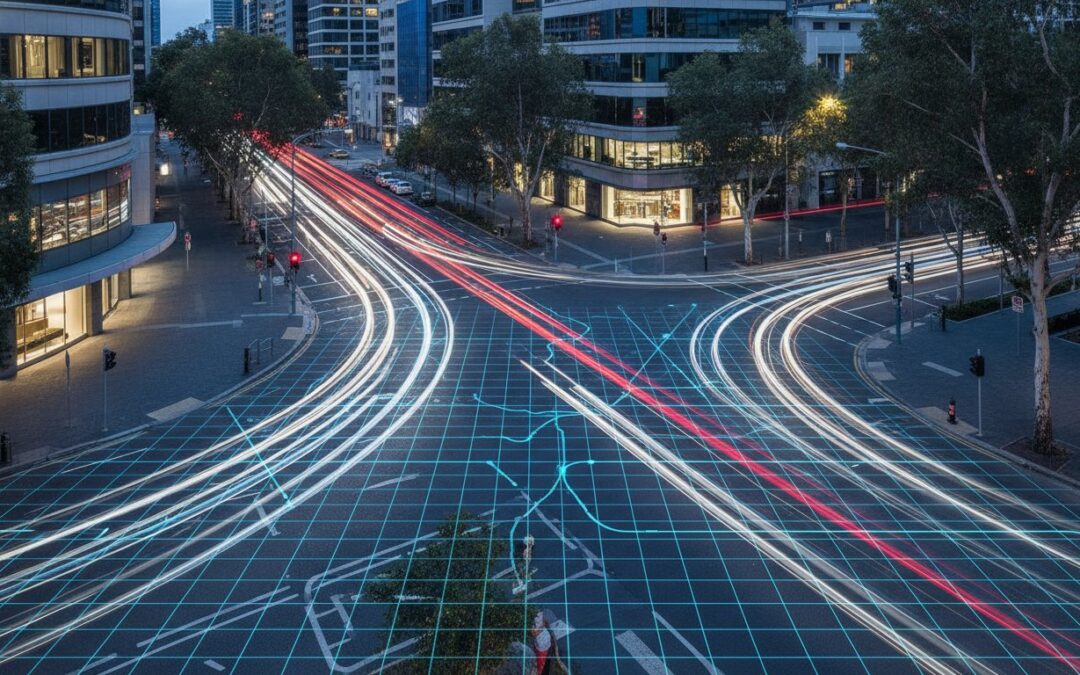
A standard traffic report is often the fastest way to have your development application stalled by a sceptical council. Traditional static modelling fails to capture the intricate nuances of real-world driver behaviour, making microsimulation traffic modelling for complex intersections essential for modern Australian developments. You understand the frustration of proposing a functional design only to be met with demands for multi-million dollar road upgrades that are technically unnecessary. This lack of granular detail leaves your project vulnerable to subjective objections and costly delays during the planning process.
This guide demonstrates how high-fidelity simulation provides the technical evidence required to overcome these bureaucratic hurdles and secure your DA approval. By using advanced modelling, you can present data-driven arguments that counter council objections and prove the viability of your specific design. We will examine how current 2026 software standards enable developers to justify non-standard layouts, avoid redundant infrastructure costs, and ensure a clear, predictable path to project commencement.
Key Takeaways
- Understand why standard SIDRA reports often fall short and when dynamic modelling is required to accurately represent queuing and delays in high-traffic environments.
- Learn how microsimulation traffic modelling for complex intersections uses vehicle-by-vehicle analysis to track individual driver behaviour and lane-changing patterns.
- Discover how to use high-quality visual outputs to communicate complex engineering solutions and secure DA approval from non-technical council members.
- Identify how testing “What-If” scenarios allows you to optimise intersection design and avoid the high costs of unnecessary road upgrades.
- Follow the technical process from rigorous data collection to model calibration to ensure your traffic evidence is irrefutable during the planning process.
What is Microsimulation Traffic Modelling for Complex Intersections?
Microscopic traffic modelling is a high-fidelity analytical method that simulates road networks on a vehicle-by-vehicle basis. Unlike broad-scale models, it treats every car, bus, and cyclist as an individual agent with unique parameters. This includes specific values for acceleration, deceleration, lane changing, and gap acceptance. By replicating these granular interactions, Traffic simulation provides a realistic representation of how a proposed development will impact the surrounding road network. It allows engineers to observe the ripple effect of a single vehicle’s decision across an entire corridor.
Standard calculations often struggle to account for the chaotic interactions found at multi-leg junctions, roundabouts, or signalised interchanges. For high-density Australian developments, microsimulation traffic modelling for complex intersections is the only reliable way to demonstrate that a design can handle peak loads without failing. It forms a critical component of a professional Traffic Impact Assessment (TIA), providing the technical weight needed to satisfy council engineering departments. Without this data, developers risk being saddled with expensive, unnecessary road upgrades based on overly conservative static estimates.
To better understand how these models function in a real-world environment, watch this helpful video:
The Core Difference: Micro vs. Macro Modelling
Macroscopic modelling serves as a high-level tool for planning entire suburbs or regional highway networks. It treats traffic as a fluid, focusing on volume and capacity across large areas. Microscopic modelling is far more precise. It focuses on individual intersections and site-specific access points. This level of detail is essential when conducting microsimulation traffic modelling for complex intersections because it identifies specific bottlenecks, such as short turn bays or blocked driveways, that macro models simply cannot detect. It allows for the testing of site-specific geometry that influences how drivers interact with property boundaries and internal road networks.
Key Software Standards in Australia
Australian practitioners rely on industry-standard tools such as VISSIM, AIMSUN, and Paramics. These platforms are calibrated to align with Austroads standards for traffic management and infrastructure design. Using software that local councils and state road authorities recognise is non-negotiable. It ensures that the model’s outputs are considered credible and compliant with state-specific regulatory frameworks. Professional firms use these tools to build base models of existing conditions, which are then used to forecast how new traffic volumes will integrate with the current environment. This rigorous approach minimises the risk of council rejection during the DA process.
Microsimulation vs. SIDRA: Choosing the Right Tool for Your Project
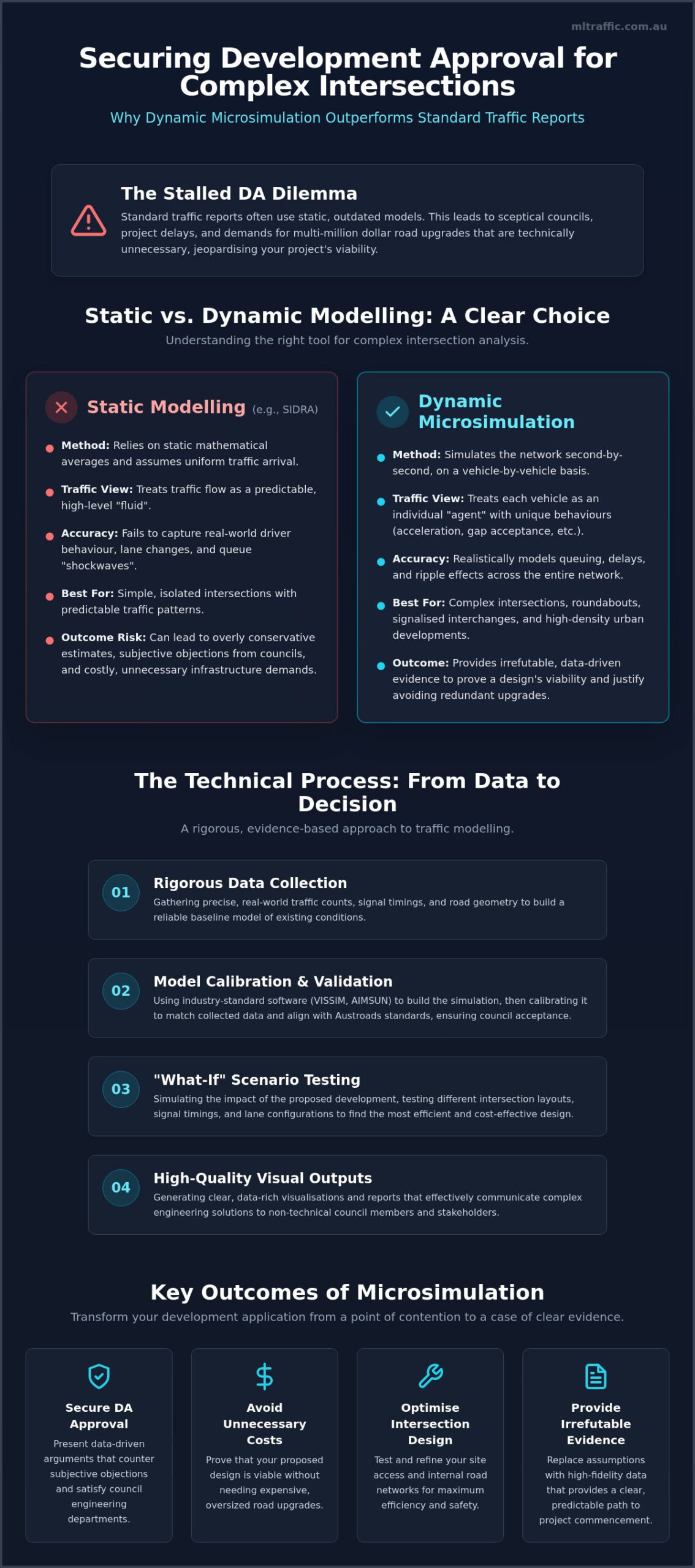
A common misconception in the development industry is that a standard SIDRA report is sufficient for every intersection analysis. While SIDRA is a powerful analytical tool, it relies on static mathematical averages to predict performance. It assumes traffic arrives at a uniform rate and processes through a junction in a predictable manner. This works well for isolated, simple junctions, but it fails to capture the stochastic nature of microsimulation traffic modelling for complex intersections. When you’re dealing with high-volume urban environments, relying on static averages can lead to results that don’t reflect the reality of peak-hour congestion.
The fundamental difference lies in static versus dynamic modelling. Dynamic microsimulation tracks every vehicle’s movement second-by-second, allowing for the observation of “shockwaves” and queuing that builds up over time. If a queue from one set of traffic lights blocks the exit of a preceding roundabout, a static model will likely miss it. Microsimulation identifies these interactions, acting as a surrogate safety measure by highlighting potential conflict points and lane-starvation issues that numerical data alone hides. This level of detail is often what stands between a project’s approval and a lengthy request for further information from the council.
From a commercial perspective, developers must balance the higher initial investment of microsimulation against the catastrophic risk of a DA refusal. While a standard report is cheaper, it offers no protection against a council engineer who believes your design won’t work. Microsimulation provides a visual and data-driven proof of concept that is much harder to challenge in a professional setting or at a planning panel. Consulting with an expert for a detailed Intersection Analysis early in the design phase can prevent these issues before they become terminal for your project timeline.
When SIDRA is Sufficient
SIDRA is the appropriate choice for isolated intersections where traffic flow is predictable and uniform. It’s ideal for small-scale developments, such as a minor subdivision or a local retail outlet, where the impact on the broader road network is negligible. We typically recommend this for initial feasibility studies or when the council has already indicated that a high-level assessment will satisfy their requirements for a straightforward site access point.
When Microsimulation is Non-Negotiable
You cannot avoid microsimulation traffic modelling for complex intersections when junctions are closely spaced. The “knock-on” effect, where queuing from one junction impacts the capacity of another, can only be accurately modelled in a dynamic environment. It’s also essential for proposals involving non-standard lane configurations, complex signal phasing, or high-pedestrian areas where the interaction between vehicles and vulnerable road users must be prioritised to ensure safety and functional flow.
How Microsimulation Solves Complex Intersection Challenges
Numerical data in a spreadsheet rarely tells the full story of an intersection’s failure. While traditional models output a single value for delay, microsimulation traffic modelling for complex intersections provides a visual representation of the exact moment a bottleneck forms. This allows developers to identify whether a queue is caused by poor signal timing, insufficient lane length, or a specific conflict point that static analysis would simply overlook. By seeing the traffic flow in a 2D or 3D environment, you can pinpoint the physical cause of congestion and adjust your design before submitting a DA.
Testing “What-If” scenarios is perhaps the most valuable application of this technology. Developers are often caught between council demands for a roundabout and their own preference for signalised junctions or priority turns. Microsimulation allows for a direct, evidence-based comparison between these options. You can demonstrate exactly how each design handles peak volumes, proving which solution offers the best balance between construction cost and traffic flow. This objective data removes the guesswork from the negotiation process with road authorities.
Council engineers prioritising “Level of Service” (LoS) require assurance that a new development won’t degrade existing conditions. Microsimulation provides a robust proof of LoS by integrating Vehicle Swept Path Analysis into the broader dynamic model. It’s not enough to show that a heavy vehicle can physically make a turn. You must show how that vehicle’s slower turning speed and wider arc impact the clearance times for every other car in the junction. This integrated approach ensures that your Intersection Analysis is grounded in physical reality.
Capturing Real-World Driver Behaviour
Models account for human variables such as gap acceptance at busy roundabouts and unsignalised turns. Unlike static models that assume uniform driver reactions, microsimulation reflects the hesitation and decision-making processes of real people. It also simulates the significant impact that heavy vehicles and buses have on intersection clearance. Static models often underestimate the disruption caused by frequent lane-changing and merging in high-traffic corridors. Microsimulation captures these movements, ensuring the predicted delays are accurate and defensible.
Managing Pedestrian and Cyclist Interactions
Modern urban developments must account for multimodal transport, especially in high-density areas. Microsimulation allows for the detailed modelling of shared zones and pedestrian crossings near complex junctions. It proves that your design maintains safety for vulnerable road users without causing gridlock for vehicles. This evidence is a mandatory requirement for any Traffic Impact Assessment involving urban infill projects where pedestrian volumes are high. Proving efficiency for all transport modes is often the key to overcoming community and council objections.
The Technical Process: From Data Collection to Model Calibration
A reliable model is built on a foundation of empirical evidence. The process of microsimulation traffic modelling for complex intersections begins with comprehensive data collection. This stage involves capturing peak hour vehicle counts, pedestrian volumes, and existing queue lengths at the subject site. We also conduct travel time surveys to understand current delays. This raw data serves as the baseline for every subsequent calculation, ensuring the simulation reflects the specific operational characteristics of the Australian road network being studied.
- Step 1: Data Collection – Gathering site-specific metrics including turn counts, vehicle classifications, and saturation flows.
- Step 2: Base Model Development – Constructing a digital twin of the existing infrastructure, including lane widths, gradients, and signal timings.
- Step 3: Calibration and Validation – Adjusting model parameters until the simulation’s outputs match observed real-world traffic patterns within statistically acceptable margins.
- Step 4: Scenario Testing – Layering the development’s predicted traffic onto the validated base model to assess future performance.
- Step 5: Sensitivity Analysis – Stress-testing the intersection by increasing volumes to identify the “breaking point” of the proposed design.
This systematic approach ensures that the traffic evidence provided to authorities is both robust and defensible. If your project requires a detailed Intersection Analysis, our senior principals provide direct oversight to ensure every model meets the highest technical standards.
The Importance of Model Calibration
A model is only as credible as the data used to build it. The industry principle of “Garbage In, Garbage Out” is particularly relevant here. Without rigorous calibration, a simulation might show a perfectly functioning intersection that, in reality, is prone to gridlock. An experienced traffic engineer meticulously adjusts driver behaviour parameters to meet the strict validation criteria set by transport authorities. This ensures the model is “council-ready” and capable of withstanding intense scrutiny from government reviewers during the assessment phase.
Future-Proofing the Analysis
Planning for microsimulation traffic modelling for complex intersections must account for long-term growth. We incorporate 10-year forecasts and planned regional infrastructure changes to ensure the development remains viable as the surrounding area evolves. For large-scale projects, testing different construction staging options is essential to prevent temporary traffic failures. By proving that a development’s impact is manageable through high-fidelity modelling, developers can often justify a reduction in mandatory infrastructure contributions, directly improving project feasibility and margins.
Securing DA Approval with Evidence-Based Modelling
The final hurdle for any development is often the subjective interpretation of traffic data by local authorities. While engineers understand the technicalities of a report, the decision-makers on planning panels and councils are often non-technical. High-quality visual outputs from microsimulation traffic modelling for complex intersections bridge this communication gap. By presenting a clear, animated representation of future traffic flow, you provide a level of transparency that static spreadsheets cannot match. This visual evidence makes it significantly harder for authorities to maintain objections based on perceived, rather than actual, traffic impacts.
Securing a Development Application (DA) requires hard evidence to challenge unreasonable conditions or demands for excessive road upgrades. Microsimulation allows you to prove that a proposed development will not break the local road network. It demonstrates that the existing or proposed geometry can handle the additional load during the most critical peak periods. Having a senior traffic consultant who can defend the model’s parameters and results during council meetings or planning panels is essential. This authoritative representation ensures that the technical integrity of your proposal is maintained under scrutiny.
Negotiating with Councils and Road Authorities
Simulation videos are a powerful tool for community consultation and formal council presentations. They allow stakeholders to see exactly how the site will operate, which often defuses emotive arguments about congestion. We use this data to negotiate “Work-in-Kind” agreements, where specific intersection improvements are performed instead of making large, generic cash contributions. This approach keeps your infrastructure spend targeted and relevant to your site. Additionally, the model ensures your project remains compliant with the necessary Traffic Management Plan during the construction phase, preventing operational failures before the site even opens.
The ML Traffic Engineers Australia Approach
At ML Traffic Engineers Australia, we provide a direct line to senior principals who perform the technical modelling and analysis themselves. We don’t use gatekeepers. This ensures that the expert who builds your model is the same person who defends it to the council. With over 15 years of experience navigating the Australian planning and regulatory landscape, we understand the specific requirements of state road authorities and local municipalities. Our commitment to meticulous, results-oriented reporting ensures that your traffic evidence stands up to the most rigorous professional scrutiny. Contact our team for a Traffic Impact Assessment tailored to the requirements of your complex site.
Securing Project Viability through Technical Excellence
Securing approval for high-density Australian developments requires a shift from static estimates to dynamic, evidence-based reporting. By utilising microsimulation traffic modelling for complex intersections, you move beyond the limitations of standard averages to provide a realistic, vehicle-by-vehicle analysis of road performance. This granular approach identifies and solves potential bottlenecks before they cause delays. It also provides the visual proof required to satisfy non-technical council members and planning panels during the assessment process.
At ML Traffic Engineers Australia, we bring over 15 years of experience in Australian traffic engineering to every project. Our senior principals are directly involved in every technical report, ensuring your traffic evidence is irrefutable and aligned with nationwide regulatory standards. This hands-on expertise is the most effective way to counter unreasonable council conditions and justify your intersection design. Discuss your complex intersection modelling needs with our senior engineers today. We look forward to helping you achieve a successful DA outcome and a streamlined path to construction.
Frequently Asked Questions
Is microsimulation traffic modelling required for every development?
No, microsimulation is not a mandatory requirement for every project. Most standard developments only require a basic Traffic Impact Assessment using static models like SIDRA. However, road authorities often request microscopic modelling for high-density sites, multi-leg junctions, or when proposed designs deviate from standard Austroads guidelines. It’s essential when static analysis cannot accurately predict queuing or interactions between adjacent intersections.
How long does it take to build a microsimulation model for an intersection?
Building a robust model typically requires two to four weeks. This timeline accounts for initial data collection, base model construction, and the rigorous calibration process required to match real-world observations. More complex networks involving multiple junctions or multimodal interactions may take longer. Ensuring the model is validated against current peak-hour data is a time-consuming but necessary step for council acceptance.
What is the difference between VISSIM and SIDRA for traffic modelling?
SIDRA is an analytical tool that uses mathematical averages to predict intersection performance at a single point in time. VISSIM is a microscopic simulation platform that tracks individual vehicle movements second-by-second. While SIDRA is suitable for isolated junctions, microsimulation traffic modelling for complex intersections using VISSIM captures the dynamic interactions, lane-changing behaviour, and shockwave effects that static models ignore.
Can microsimulation help reduce the cost of road upgrades required by council?
Yes, microsimulation frequently identifies that expensive road upgrades are technically redundant. Static models often use conservative assumptions that overestimate delays, leading councils to demand costly infrastructure contributions. By providing high-fidelity data, you can demonstrate that a more modest, optimised design maintains the required Level of Service. This evidence allows for the negotiation of Work-in-Kind agreements that are more cost-effective for the developer.
Does council accept microsimulation models from any traffic engineer?
Councils and state road authorities generally only accept models prepared by qualified traffic engineers with demonstrated experience in simulation software. The technical requirements for calibration and validation are strict. If a model does not meet specific statistical thresholds, it will be rejected during the assessment process. Engaging a firm with senior principal oversight ensures the model is defensible and meets all regulatory standards.
How accurate are traffic simulation models in predicting future congestion?
These models are highly accurate provided they are calibrated against observed real-world data. The accuracy depends on the quality of input metrics, such as turn counts and queue lengths. By using stochastic modelling, the simulation accounts for the variability in driver behaviour. This makes it far more reliable than static calculations for predicting how a network will perform under increased future loads.
What data do I need to provide for a microsimulation study?
Developers must provide detailed site plans, including access points and internal road geometry. We also require the proposed land-use schedule to calculate trip generation rates. While we conduct the necessary peak-hour traffic counts and queue observations, any existing survey data or previous traffic reports for the site should be shared. This ensures the model reflects the most accurate baseline conditions available.
Can microsimulation be used for pedestrian-only or shared-zone developments?
Yes, microsimulation traffic modelling for complex intersections is an effective tool for analysing pedestrian-only and shared-zone environments. Modern software allows us to model individual pedestrian agents, cyclists, and their interactions with vehicles. This is particularly useful for urban infill projects and transport hubs where safety and the efficiency of non-vehicular movements are primary concerns for the assessing authority.

Disclaimer
The content on www.mltraffic.com.au, including all technical articles, guides, and resources, is provided for general informational and educational purposes only. It is not intended to constitute professional advice in traffic engineering, transportation planning, development approvals, or any other technical or legal field. While ML Traffic Engineers makes every reasonable effort to ensure the accuracy, completeness, and timeliness of the information published, we do not provide any warranties or representations (express or implied) regarding its reliability, suitability, or availability for any particular purpose. Any reliance you place on the content is strictly at your own risk. In no event shall ML Traffic Engineers, its directors, employees, authors, or affiliates be liable for any direct, indirect, incidental, special, consequential, or punitive damages (including, without limitation, loss of profits, data, or business opportunities) arising out of or in connection with the use of, or inability to use, any information provided on this website. The articles and guides on this site are not a substitute for engaging a qualified, registered professional traffic engineer (such as an NPER or RPEQ engineer) to assess your specific project requirements. For tailored advice, compliance assessments, or traffic engineering services, please contact a competent professional. This disclaimer may be updated from time to time without notice. By accessing or using this website, you agree to be bound by the most current version of this disclaimer.
