

A single missing swept path analysis or an outdated reference to parking standards can stall your development application for months, costing you thousands in holding costs and unnecessary revisions. We know the frustration of receiving a Request for Further Information (RFI) simply because the technical data didn’t meet local expectations. Understanding the minimum requirements for a council traffic statement is essential for any developer or project manager looking to bypass bureaucratic bottlenecks. It’s the difference between a project that’s ready to build and one that’s stuck in a perpetual cycle of Council feedback.
You’ll gain the expertise needed to master the technical and regulatory components required to secure Council approval for your development application traffic statement. This article provides a definitive checklist of mandatory inclusions, from vehicle manoeuvring diagrams to compliance with the latest AS 2890.1 specifications. We’ll examine the specific data points Councils demand, helping you distinguish between a statement and a full TIA while ensuring your documentation is professionally certified and ready for submission. By following this structured approach, you can streamline the approval process and maintain your project timeline.
Key Takeaways
- Learn to distinguish between a concise Traffic Statement and a comprehensive TIA to ensure your documentation matches the specific scale and impact of your development.
- Identify the minimum requirements for a council traffic statement, including essential land-use data and the surrounding road hierarchy analysis needed for a successful application.
- Master technical compliance with AS 2890.1 and find out why professional swept path analysis is critical for verifying vehicle manoeuvrability before submission.
- Uncover the common reporting pitfalls, such as missing bicycle parking or end-of-trip data, that frequently lead to Council delays and Requests for Further Information.
- Understand the advantage of senior engineering certification in streamlining the DA process and minimising the likelihood of technical objections from Council planners.
Traffic Statement vs. Traffic Impact Assessment: Defining the Scope
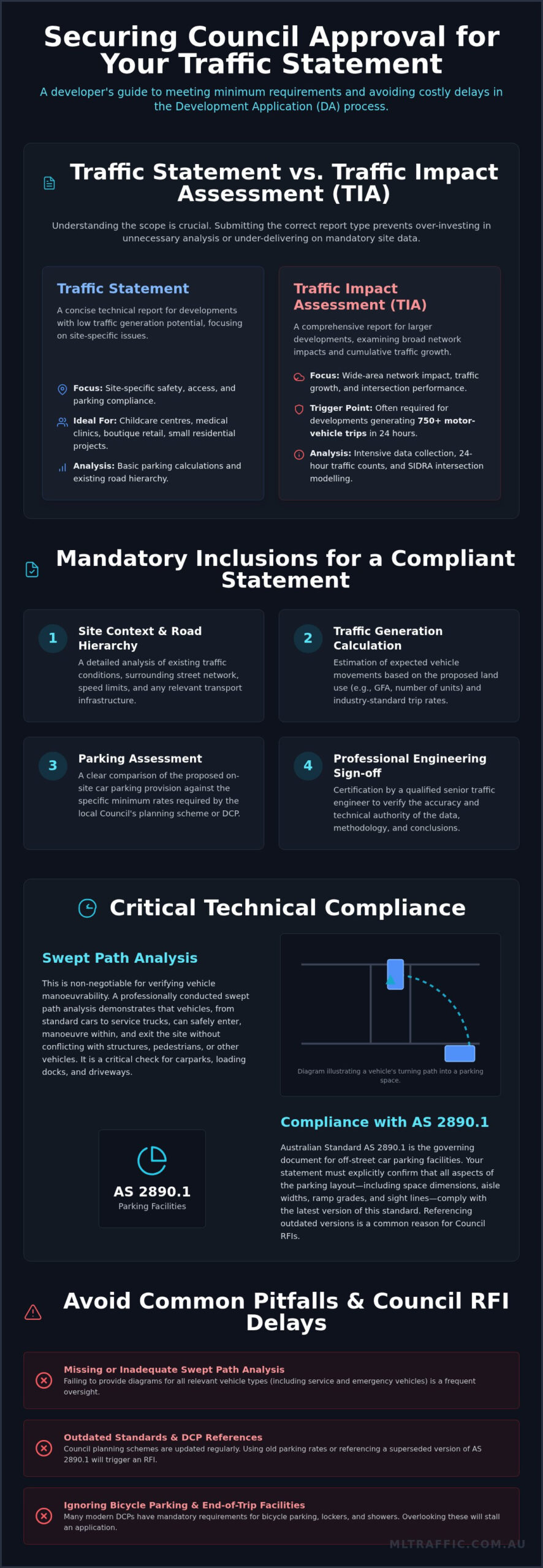
A Traffic Statement is a concise technical report designed for developments with low traffic generation potential. It differs significantly from a full Traffic Impact Assessment (TIA) in both depth and scope. While a TIA examines broad network impacts and cumulative traffic growth, a statement focuses on site-specific issues like access safety and parking provision. For many smaller projects, meeting the minimum requirements for a council traffic statement is the only technical hurdle needed to satisfy transport-related planning conditions. Understanding this distinction is critical for project timelines and budget management.
The core difference lies in the level of analysis. A statement typically covers the existing road hierarchy, proposed land use, and basic parking calculations. In contrast, a TIA requires intensive data collection, including 24-hour traffic counts and complex intersection modelling using software like SIDRA. Both documents are based on fundamental Traffic engineering principles, but the statement serves as a streamlined compliance tool for the Development Application (DA) process.
The Scalability of Traffic Reports
Reporting requirements scale with the intensity of the proposed land use. Councils often use specific “trigger points” to determine which report type is necessary. A common threshold for a full TIA is the generation of 750 or more motor-vehicle trips in a 24-hour period. However, even if your project falls below this volume, Council may still request a statement based on the land-use category. Childcare centres, medical clinics, and boutique retail outlets often require professional statements to address high-peak turnover. Scoping the report correctly at the start of your project prevents you from over-investing in unnecessary network analysis or under-delivering on mandatory site data.
Why Council Requests a Traffic Statement
Councils demand a Traffic Statement to verify that a development is safe and functional within its immediate context. The assessment focuses on three primary areas:
- Access Safety: Ensuring the proposed driveway location provides adequate sight distances for exiting vehicles and passing pedestrians.
- Parking Compliance: Verifying that the number of on-site spaces aligns with the rates specified in the local Development Control Plan (DCP).
- Local Amenity: Confirming that the additional vehicle movements don’t negatively impact the safety of the local street network.
At ML Traffic Engineers Australia, we ensure these reports are prepared by senior principals. This direct involvement provides the technical authority needed to satisfy Council planners and avoid the delays associated with multiple revisions. You can view our full range of technical capabilities on our services page.
The Essential Checklist: Minimum Requirements for a Council Traffic Statement
A compliant submission requires more than a basic site plan. It must serve as a rigorous technical justification for the proposed development. Meeting the minimum requirements for a council traffic statement ensures that Council assessment officers have the specific data needed to approve your application without requesting further information. Every report must include a detailed description of the proposed land use, such as the total number of residential units or the Gross Floor Area (GFA) for commercial projects. This scale directly informs the subsequent traffic and parking calculations.
The following technical components form the mandatory baseline for a professional statement:
- Site Context: Detailed analysis of existing traffic conditions and the road hierarchy surrounding the site.
- Traffic Generation: Calculation of expected vehicle movements based on industry-standard rates.
- Parking Assessment: Comparison of on-site car parking provision against the specific requirements of the Council planning scheme.
- Professional Sign-off: Certification by a qualified traffic engineer to verify the accuracy of the data.
Traffic Generation and Distribution
State-based trip generation rates, specifically those provided by Transport for NSW (TfNSW), are the recognised benchmark used nationally. We calculate “peak hour” impacts by applying these rates to your specific land use to predict the maximum number of vehicle movements during the busiest times of the day. Mapping how this new traffic distributes across the local network allows Council to verify that nearby intersections will continue to operate safely. Our engineers ensure that ingress and egress patterns are clearly defined to avoid confusion during the assessment phase.
Parking Demand and Supply Analysis
Councils rarely approve developments that fail to meet their minimum parking rates without a robust technical justification. A Car Parking Demand Assessment is often required to support parking shortfalls through empirical data or local parking surveys. We distinguish between the unique requirements of residents, visitors, and staff to ensure the supply matches the actual demand. If you require a certified assessment to support your DA, the senior principals at ML Traffic Engineers Australia can review your site plans to ensure full compliance with the minimum requirements for a council traffic statement.
Professional certification by a registered NPER or RPEQ engineer provides the accountability Councils expect. This oversight ensures that every technical claim is backed by engineering standards, significantly reducing the risk of a project being delayed by technical objections or bureaucratic pushback.
Technical Compliance: AS 2890 and Swept Path Analysis
Technical compliance forms the backbone of any successful DA. To satisfy the minimum requirements for a council traffic statement, every parking space, aisle width, and column placement must strictly adhere to Australian Standard AS 2890.1. This standard categorises parking facilities by User Class based on the intended frequency of use and the required level of convenience. For instance, User Class 1 is designated for residential or long-term employee parking, whereas User Class 3A is reserved for high-turnover retail environments. Failing to identify and apply these specific classes in your technical report often leads to immediate Council rejection or costly requests for redesign.
Integrating Swept Path Analysis (AutoTURN)
Swept Path Analysis is a mandatory technical inclusion for verifying vehicle manoeuvrability within constrained site layouts. By utilising industry-standard software like AutoTURN, our engineers model the physical footprint of design vehicles, specifically the B85 (85th percentile) or B99 (99th percentile) vehicle, as they navigate your proposed car park. Council requires these diagrams to demonstrate that every vehicle can enter and exit the property in a single forward motion. This requirement is fundamental to maintaining road safety by eliminating the need for hazardous reversing manoeuvres onto public thoroughfares. For a deeper look at this process, see our Swept Path Analysis: A Developer’s Guide to Council Approval.
Driveway and Access Design Requirements
Driveway design must address more than just basic entry widths. AS 2890.1 dictates precise ramp grades and vertical transitions to prevent vehicle scraping on steep inclines or changes in level. A professional statement must also verify sight distance requirements at the property boundary. This assessment ensures drivers have an unobstructed view of pedestrians on the footpath and oncoming traffic on the street before merging. For commercial or industrial projects, we apply AS 2890.2 standards to ensure driveway widths and turning radii accommodate heavy rigid vehicles (HRV) or waste collection trucks. These technical assessments are essential components that complete the minimum requirements for a council traffic statement. Ensuring these details are handled by a senior engineer ensures your project meets national standards without the need for multiple Council revisions.
Common Pitfalls and How to Avoid Council RFI Delays
A Request for Further Information (RFI) from Council can halt your project for months. These delays often stem from a failure to address the technical minimum requirements for a council traffic statement during the initial design phase. Assessment officers look for specific, data-backed justifications. When a report lacks precision, the DA process becomes stalled, leading to increased holding costs and potential project fatigue. Ensuring your documentation is prepared by a registered NPER or RPEQ engineer is the first step in avoiding these bureaucratic hurdles. Professional certification provides Council with the assurance that the safety and efficiency of the local road network have been meticulously considered.
Several recurring errors lead to technical objections during the assessment phase:
- Inaccurate Land-Use Data: Using generic traffic rates that do not reflect the specific intensity of the development, such as applying standard residential rates to high-turnover student accommodation.
- Missing Active Transport Provisions: Failing to include bicycle parking or end-of-trip facilities as mandated by the local Development Control Plan (DCP), which is now a standard requirement for most urban councils.
- Internal Connectivity Gaps: Overlooking pedestrian safety and the physical links between parking areas and building entries, creating potential conflict points between vehicles and residents.
- Technical Signature Requirements: Submitting reports without the formal certification of a qualified traffic professional, which leads to immediate rejection in many jurisdictions.
Failing to meet the minimum requirements for a council traffic statement often results in immediate Council pushback and costly delays.
The Impact of Incomplete Documentation
Inconsistency between architectural plans and the traffic statement is a leading cause of Council pushback. If your architect modifies a driveway width or column placement after the traffic report is finalised, the technical data becomes obsolete. This mismatch triggers an RFI, adding months to the approval timeline. Redesigning a basement car park after DA lodgement is significantly more expensive than getting the design right the first time. Meticulous coordination between your consultants ensures the final submission is cohesive and compliant.
Addressing Sight Distance Issues
Sight distance errors are frequently cited in Council refusals. Landscaping, boundary fencing, and even signage can inadvertently block critical sight lines at driveway exits. Stopping Intersection Sight Distance (SISD) is the distance required for a driver on a major road to perceive an object on the road and stop before colliding with it, according to Austroads guidelines. To ensure your project meets every technical benchmark, contact our senior engineers for a comprehensive review of your site plans before you lodge your application.
Engaging a Professional Traffic Engineer for Your Statement
Securing Council approval involves more than just assembling a checklist. It requires a level of technical authority that only comes from experienced certification. When you engage a professional firm, you ensure that every technical component, from parking demand to swept path analysis, is handled by experts who understand the nuances of the planning system. Professional certification by registered NPER and RPEQ engineers significantly reduces the risk of Council objections. This technical sign-off serves as a guarantee that the development meets the minimum requirements for a council traffic statement and adheres to national safety standards. Meticulous preparation at this stage prevents the need for costly redesigns later in the project lifecycle.
ML Traffic Engineers Australia brings a national track record of over 10,000 successful site assessments to every project. This volume of experience allows our team to anticipate Council concerns before they are raised. By integrating swept path analysis and parking assessments into a single, cohesive report, we streamline the DA process and minimise the potential for conflicting technical data. This integrated approach ensures that your submission is robust, professional, and ready for immediate assessment.
Why ML Traffic Engineers Australia is the Preferred Choice
With over 15 years of experience, we have navigated the diverse and often complex requirements of local Councils across Australia. A key distinction of our firm is the “no-gatekeepers” approach. Every client has direct access to our senior leadership. Unlike larger, impersonal consultancies where work is often delegated to junior staff, the same expert who initiates your project performs the technical work. This ensures accountability and meticulous attention to detail from start to finish. Learn more about our Traffic Engineering expertise and our commitment to professional excellence.
Next Steps for Your Development Application
The process of securing your Council Traffic Statement begins with a clear understanding of your site’s specific parameters. To provide an accurate quote and begin the assessment, our engineers typically require the following documentation:
- Detailed architectural site plans and basement layouts.
- Proposed Gross Floor Area (GFA) or total unit counts.
- Current land-use details and any existing site access points.
- Any previous Council correspondence or pre-lodgement minutes.
Once these details are provided, our senior principals can conduct a preliminary review to identify any immediate technical challenges. This proactive strategy ensures your report addresses the minimum requirements for a council traffic statement while highlighting the merits of your design. Contact our team today for a confidential discussion regarding your project requirements and to ensure your submission is compliant and professional.
Securing Your Development Approval with Technical Precision
Successful DA navigation requires rigorous alignment with national standards and a proactive approach to traffic impacts. Mastering the minimum requirements for a council traffic statement ensures your project remains on schedule and avoids the costly delays associated with technical RFIs. This involves precise car park design, verified swept path analysis, and strict adherence to AS 2890.1 specifications. Professional certification is not a mere formality; it’s a strategic asset that builds confidence with Council assessment officers through demonstrated technical compliance and meticulous documentation.
ML Traffic Engineers provides the technical authority needed to streamline your application. Since 2005, we’ve assessed over 10,000 sites across Australia. Our NPER and RPEQ registered engineers provide direct access to senior principals, ensuring the expert who starts your project is the one performing the technical work. Don’t let bureaucratic hurdles stall your development progress. Contact ML Traffic Engineers for a Professional Traffic Statement Quote and leverage our multi-decade expertise to secure your approval. We look forward to ensuring your project meets every technical benchmark with absolute reliability.
Frequently Asked Questions
Is a traffic statement required for every development application?
A traffic statement isn’t mandatory for every development application, but it’s generally required for any project that alters vehicle access, parking demand, or traffic generation. While minor internal renovations might be exempt, new residential units, commercial fit-outs, and childcare centres typically trigger this requirement. Consulting the local Development Control Plan (DCP) is necessary to confirm if your specific land-use category necessitates professional documentation for Council approval.
What is the difference between a Traffic Statement and a Traffic Impact Assessment?
The primary difference lies in the scale of analysis and the volume of traffic generated by the site. A Traffic Statement is a concise report for low-impact developments, focusing on site-specific access and parking compliance. In contrast, a Traffic Impact Assessment (TIA) is a comprehensive study for larger projects, requiring detailed intersection modelling and network analysis. Most Councils mandate a full TIA when a development generates 750 or more daily vehicle trips.
How much does a professional council traffic statement cost?
The cost of a professional traffic statement varies based on the complexity of the site, the number of land-use categories, and the specific technical requirements of the Council. Factors such as the need for swept path analysis or empirical parking surveys will influence the final technical fee. We recommend providing detailed architectural plans to receive a tailored quote that reflects the technical work required for your specific development application and site constraints.
Can an architect prepare a traffic statement for Council?
Architects can design site layouts, but they generally cannot certify a traffic statement. Councils typically require these reports to be prepared and signed off by a qualified traffic engineer with NPER or RPEQ registration. This ensures that the technical data, such as sight distance assessments and ramp grade calculations, adheres to Australian Standards. Professional engineering certification provides the level of accountability that Council assessment officers demand for planning approvals and safety compliance.
How long does it take to prepare a compliant traffic statement?
Preparation times vary depending on the project scale, but a compliant report usually takes between one and two weeks to complete. This timeline includes the analysis of the minimum requirements for a council traffic statement, such as calculating trip generation and conducting parking demand assessments. Delays can occur if architectural plans are incomplete or if site-specific traffic counts are required, so providing finalised drawings early is essential for a streamlined engineering process.
What happens if my development doesn’t meet the minimum parking requirements?
If a development doesn’t meet the minimum parking rates specified in the DCP, a Car Parking Demand Assessment is required to justify the shortfall. This involves using empirical data, such as parking surveys or proximity to public transport, to prove that the proposed supply will satisfy actual demand. Our senior principals specialise in providing these technical justifications to help clients avoid Council objections and secure approval despite parking deficiencies in the architectural design.
What is Swept Path Analysis and is it mandatory for my statement?
Swept Path Analysis is a computer-simulated model used to verify that vehicles can safely manoeuvre into and out of a site. It’s almost always mandatory for a traffic statement if the development involves new parking layouts or constrained access points. Using software like AutoTURN, we demonstrate that design vehicles, such as the B85 or B99 car, can enter and exit the property in a single forward motion as per Australian Standards for safety.
Which Australian Standards are most important for a traffic statement?
The most critical standards are the AS 2890 series, which govern parking facilities across Australia. AS 2890.1 covers off-street car parking, while AS 2890.2 focuses on commercial vehicle facilities like loading docks. AS 2890.6 is also vital for off-street parking for people with disabilities. Ensuring your project meets the minimum requirements for a council traffic statement involves strict adherence to these technical specifications to prevent vehicle scraping and ensure pedestrian safety within the site.

Disclaimer
The content on www.mltraffic.com.au, including all technical articles, guides, and resources, is provided for general informational and educational purposes only. It is not intended to constitute professional advice in traffic engineering, transportation planning, development approvals, or any other technical or legal field.
While ML Traffic Engineers makes every reasonable effort to ensure the accuracy, completeness, and timeliness of the information published, we do not provide any warranties or representations (express or implied) regarding its reliability, suitability, or availability for any particular purpose. Any reliance you place on the content is strictly at your own risk.
In no event shall ML Traffic Engineers, its directors, employees, authors, or affiliates be liable for any direct, indirect, incidental, special, consequential, or punitive damages (including, without limitation, loss of profits, data, or business opportunities) arising out of or in connection with the use of, or inability to use, any information provided on this website.
The articles and guides on this site are not a substitute for engaging a qualified, registered professional traffic engineer (such as an NPER or RPEQ engineer) to assess your specific project requirements. For tailored advice, compliance assessments, or traffic engineering services, please contact a competent professional.
This disclaimer may be updated from time to time without notice. By accessing or using this website, you agree to be bound by the most current version of this disclaimer.
