
Why does a simple driveway modification or small-scale commercial fit-out frequently trigger a Request for Further Information (RFI) that stalls a project for months? Most developers and property owners assume that small-scale projects bypass rigorous scrutiny, yet the reality is that an inadequate traffic statement for minor works application is one of the most common reasons for council rejection. It’s frustrating when technical terminology feels like a moving target and you’re left guessing which Australian Standards, such as AS 2890.1, actually apply to your specific site.
You deserve a clear path to approval without the stress of bureaucratic delays. This guide provides the technical clarity you need to understand exactly what a traffic statement requires for minor works and how to secure council approval efficiently. We’ll examine the essential components of a compliant report, including vehicle swept path analysis and sight distance assessments. By the end of this article, you’ll know how to present a professional justification that de-risks your application and meets every regulatory benchmark, ensuring your project moves forward without unnecessary technical hurdles.
Key Takeaways
- Identify the specific project thresholds that determine when a development qualifies for a simplified traffic statement rather than a comprehensive Traffic Impact Assessment.
- Master the essential technical components of a traffic statement for minor works application, including detailed assessments of existing road environments and proposed work durations.
- Utilise vehicle swept path analysis and sight distance assessments to provide definitive, software-backed proof of safe site access for B85 and B99 vehicles.
- Ensure strict adherence to Australian Standards, specifically AS 2890.1, to eliminate common technical errors that lead to council rejection or costly delays.
- De-risk your development application by securing a professional engineering report that provides the technical justification required to satisfy council planners and engineers.
What is a Traffic Statement for Minor Works Applications?
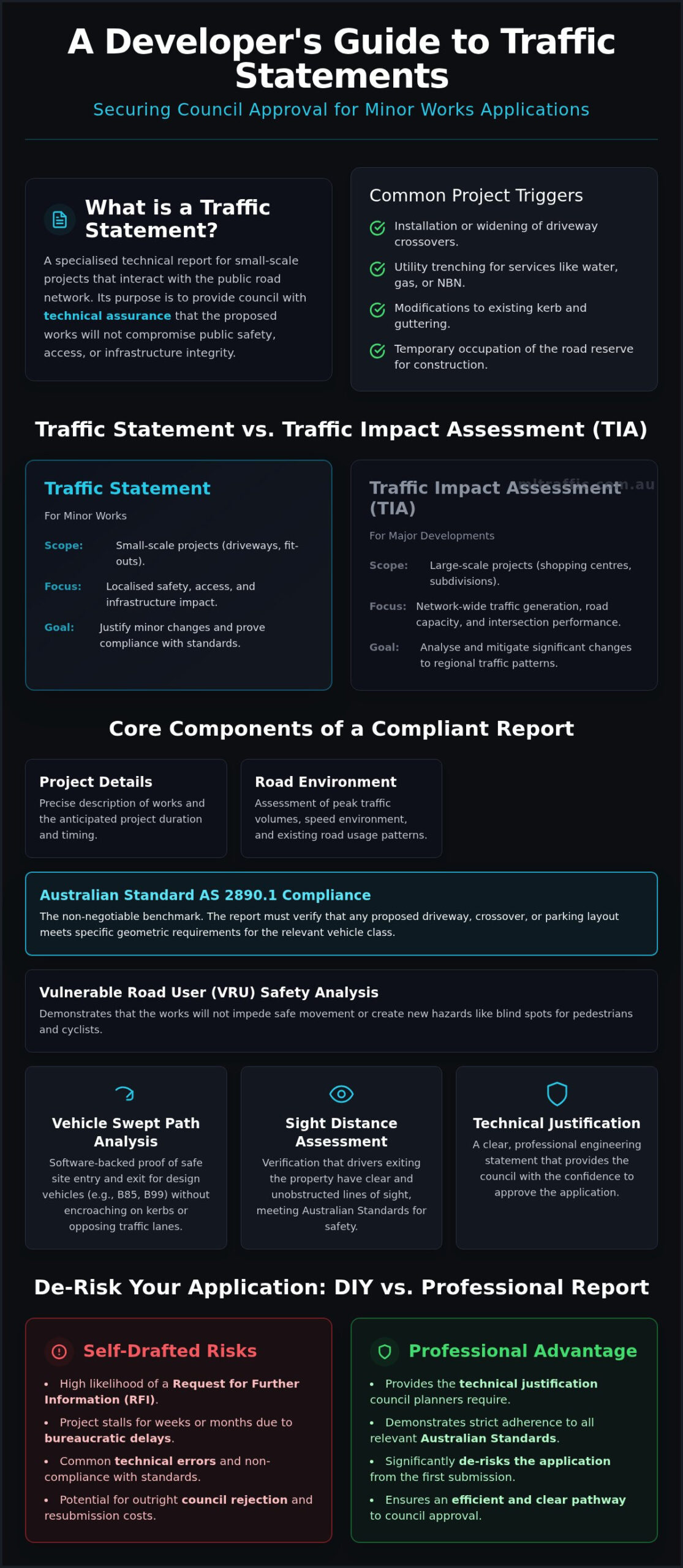
A traffic statement for minor works application is a specialised technical report designed for small-scale projects that interact with the public road network. Unlike a full Traffic Impact Assessment (TIA), which covers major commercial or residential developments, a traffic statement focuses on the specific local impacts of minor construction or modifications. These reports are mandatory when a project involves works within the road reserve or on the nature strip. It’s the professional mechanism used to prove that a small change won’t cause a large-scale safety issue.
The legal basis for these requirements often stems from Section 138 of the Roads Act 1993 in New South Wales, or equivalent interstate legislation. This framework gives local councils the authority to regulate any activity that alters the surface of a public road or impacts the safety of its users. Common triggers for requiring this statement include:
- Installation or widening of driveway crossovers.
- Utility trenching for water, gas, or telecommunications.
- Modifications to existing kerb and guttering.
- Temporary occupation of the road reserve for construction access.
The Purpose of the Statement
The primary objective of the statement is to provide council with technical assurance that the proposed works won’t compromise public safety or infrastructure integrity. It integrates principles of transportation planning to ensure that even small changes don’t create long-term hazards. These reports validate that the proposed access meets specific local planning schemes and protects council assets like footpaths and drainage systems from damage. By addressing sight distances and vehicle clearance early, the statement helps prevent future liability issues for the property owner.
Who Can Prepare a Traffic Statement?
While some property owners attempt to submit a self-drafted letter, councils rarely accept them for anything beyond the most basic residential repairs. A professional engineering report carries significantly more weight because it’s backed by technical data and regulatory knowledge. Councils prefer reports from a professional traffic engineer who understands the intricacies of Australian Standards. Engaging an expert to draft a traffic statement for minor works application ensures that the report is compliant from the first submission, reducing the risk of a project being stalled by an RFI. Our engineers provide the meticulous documentation required to de-risk the DA process and satisfy council’s technical requirements.
Core Components of a Compliant Traffic Statement
A compliant traffic statement for minor works application requires more than a cursory overview of the project site. Council engineers look for a technical document that quantifies risks and demonstrates adherence to rigorous safety standards. Every statement must include a precise description of the works, the anticipated duration of the project, and a detailed assessment of the existing road environment. This includes:
- Quantifying peak traffic volumes on the adjacent road network.
- Identifying current road usage patterns and speed environments.
- Documenting the exact timing and duration of the proposed construction phases.
Compliance with AS 2890.1 (Off-street car parking) is the non-negotiable benchmark for a traffic statement for minor works application involving driveway modifications. The report must verify that the proposed crossover or parking layout meets the specific geometric requirements for the relevant vehicle class. Additionally, a safety analysis for pedestrians, cyclists, and other vulnerable road users is essential. This analysis proves that the works won’t impede safe movement or create blind spots. While generic Traffic Impact Analysis Guidelines provide a broad framework, your submission must be site-specific and data-driven. For projects requiring technical precision, our comprehensive range of traffic engineering services ensures every component meets council expectations.
Site Access and Manoeuvrability
Safe entry and exit movements are the foundation of any minor works approval. The statement must detail how vehicles will transition from the public road to the private property without disrupting traffic flow. This involves identifying and mitigating potential conflicts with existing street furniture, power poles, or drainage pits. Access compliance is the primary technical barrier that determines whether a minor works project is deemed safe for the public road network. We use software-backed analysis to confirm that vehicles can navigate the site without encroaching on restricted areas or damaging council assets.
Sight Distance Requirements
Visibility is a critical safety metric that councils scrutinise heavily. The statement must calculate both Stopping Sight Distance (SSD) and Safe Intersection Sight Distance (SISD) to ensure motorists have adequate time to react to hazards. This assessment is not just about the road itself; it includes ensuring visibility for exiting vehicles across the footpath to protect pedestrians. If obstructions like high fences, dense vegetation, or neighbouring structures exist, the report must propose engineering solutions to maintain clear lines of sight. Failure to accurately document these distances is a leading cause of application rejection.
Traffic Statement vs. Traffic Impact Assessment (TIA)
A traffic statement for minor works application serves a specific, limited purpose. It’s not a substitute for a comprehensive assessment when project scale increases. While a statement focuses on site-specific access and immediate safety, a Traffic Impact Assessment (TIA) evaluates the cumulative impact on the broader road network. Understanding this distinction is vital to avoid over-investing in technical reporting or, conversely, facing an immediate rejection for under-reporting. Minor works generally include single dwelling driveway crossovers, kerb modifications, or utility trenching that doesn’t alter long-term traffic flow.
Complexity and cost vary significantly between these two reporting styles. A TIA requires sophisticated junction modelling and intersection analysis, often using SIDRA software to predict delays. In contrast, a traffic statement is a targeted document justifying that a small-scale change meets safety standards without requiring massive infrastructure upgrades. Standard industry thresholds for a full TIA often involve projects generating more than 30 to 50 vehicle movements during peak hours. Residential developments under 50 units or commercial offices under 1,000 square metres typically qualify for the simpler statement path, provided the residual cumulative impacts aren’t severe.
Determining Your Reporting Path
You must review your specific council “Traffic Impact Assessment Guidelines” before commissioning a report. These documents outline the exact trip generation rates that trigger a major assessment. Assessing the number of daily vehicle trips generated by your proposal is the first step in this process. Consulting with a traffic engineer early helps you avoid over-scoping the project. We identify the correct reporting path immediately, ensuring you don’t waste resources on a TIA when a traffic statement for minor works application is sufficient for approval.
Case Studies: Minor vs. Major
Practical examples help clarify these technical boundaries. A residential driveway crossing is a classic minor statement project; it focuses on sight distances and crossover geometry. In contrast, a new childcare centre or a multi-deck car park generates high volumes of “stop-and-start” traffic during peak hours, necessitating a full TIA to assess local intersection capacity. Categorising your project incorrectly leads to council RFIs (Requests for Further Information). This stalls your application at the validation stage, often adding weeks of delay and thousands of dollars in additional technical reporting costs if you’re forced to upgrade your assessment mid-process.
Technical Requirements: Swept Paths and Sight Distances
Technical diagrams provide the empirical evidence council engineers require to approve a driveway or access point. A traffic statement for minor works application must demonstrate that the proposed design is physically viable for the intended vehicle class. While many applicants rely on generic templates, these often fail to account for the unique topography or constraints of a specific site. We use sophisticated swept path analysis to eliminate guesswork and prove that vehicles can navigate the proposed layout without encroaching on footpaths or opposing traffic lanes.
Most Australian councils require simulations using AutoTURN software to verify access for a B85 (85th percentile) or B99 (large car) vehicle. This is particularly critical for “tight” urban sites where traditional driveway designs frequently fail due to narrow road widths or steep gradients. Our reports ensure strict compliance with AS 2890.1:2004, providing the geometric proof needed to bypass common technical objections. If your project involves a challenging entry point, you can request a vehicle swept path analysis to secure the data required for approval.
The Swept Path Process
Our engineers follow a rigorous three-step digital modelling process to validate site access:
- Step 1: We create a precise digital model of the proposed driveway, including the existing road kerb and any fixed obstructions.
- Step 2: We simulate realistic vehicle movements for both entry and exit manoeuvres, accounting for steering lock and overhang.
- Step 3: We identify “pinch points” where tyre scraping or bodywork conflict might occur, allowing for design adjustments before the application is lodged.
Sight Distance Assessment
Safe sight lines are the most scrutinised safety metric in any minor works submission. The assessment must measure clear visibility for drivers exiting the property to ensure they can see oncoming motorists and pedestrians in time to react. Compliance with pedestrian safety zones, specifically AS 2890.1 Clause 3.2.4, is mandatory. This clause requires a clear 2.0m by 2.5m triangular area at the property boundary to protect people using the footpath. When standard distances cannot be met due to existing structures, we provide the technical justification and mitigation strategies necessary to satisfy council safety requirements. A robust traffic statement for minor works application addresses these constraints directly rather than ignoring them.
Securing Council Approval with Professional Engineering
Securing a “yes” from a council engineering department requires more than just submitting a form and paying a fee. It requires a technical justification that speaks the council’s language and addresses their specific safety concerns. A traffic statement for minor works application signed by an experienced consultant acts as a professional guarantee of quality. It signals to the assessor that the proposal has been vetted against national standards by a qualified expert. This level of authority is often the deciding factor in whether an application is approved on the first pass or deferred for further clarification.
ML Traffic Engineers Australia ensures AS 2890.1 compliance is integrated into every design from the outset. This isn’t just about ticking boxes; it’s about identifying potential council objections before they’re even raised. By addressing sight lines, gradients, and swept paths proactively, we de-risk the entire development application process. Our “no-gatekeepers” approach ensures you deal directly with the senior engineers who perform the technical work. This direct line of communication leads to rapid project turnaround and ensures that the expert who starts your project is the one who finishes the report. This continuity provides a level of accountability and deep-seated expertise that larger, more impersonal firms often lack.
Why Certification Matters
Professional certification is your primary defence against the dreaded Request for Further Information (RFI). Australian councils are increasingly risk-averse and demand high levels of accountability for any works within the road reserve. A certified report provides a robust technical defence if neighbour disputes arise regarding site access or safety. It also ensures the design is actually constructible. There’s no value in an approved plan that can’t be safely built or used by a standard B85 vehicle in the long term. Meticulous documentation prevents these technical failures and protects your investment.
Next Steps for Your Application
The path to approval begins with preparation. Start by gathering your current site plans and any recent correspondence you’ve received from the council. These documents provide the necessary context for an accurate traffic statement for minor works application. Once you have these materials ready, you should request a detailed fee proposal for a professional engineering statement. For direct assistance and technical advice on your specific site constraints, you can contact the senior principals at ML Traffic Engineers Australia. We provide the technical certainty needed to navigate council requirements and keep your project on schedule.
Secure Your Project Approval with Technical Certainty
Navigating local government requirements doesn’t have to be a source of project delays. A professional traffic statement for minor works application provides the empirical evidence councils demand, from software-backed swept path analysis to meticulous sight distance assessments. By addressing geometric constraints and AS 2890.1 compliance early, you eliminate the technical ambiguity that often triggers a Request for Further Information. This proactive approach ensures your driveway modification or crossover project remains on schedule and within budget.
ML Traffic Engineers Australia brings 15+ years of specialist experience to every assessment, providing national coverage across all Australian councils. Our unique service model ensures direct principal involvement in every report, meaning the expert who starts your project is the one who delivers the final technical justification. We remove the bureaucratic hurdles by providing reports that are constructible, safe, and fully compliant with regulatory standards. Don’t leave your development application to chance or risk costly revisions.
Contact our senior engineers for a compliant Traffic Statement today and secure the expert documentation your project requires. We look forward to assisting with your next successful council submission.
Frequently Asked Questions
How much does a traffic statement for minor works cost?
Professional fees for these reports vary based on site complexity and specific council requirements. Factors such as the necessity for vehicle swept path analysis or complex sight distance measurements influence the final cost. While industry averages fluctuate, engaging a specialist ensures your report is compliant the first time. This prevents expensive project delays or the need for multiple technical revisions during the assessment phase of your development application.
Do I really need a traffic engineer for a simple driveway application?
Most Australian councils require a qualified engineer’s signature to validate that a driveway meets rigorous safety and geometric standards. A professional traffic engineer provides technical proof through AutoTURN simulations and sight distance calculations that a layperson cannot produce. This technical justification is essential for a traffic statement for minor works application, as it directly addresses council liability concerns and ensures the crossover is safe for all road users.
How long does it take to prepare a traffic statement?
Preparation typically takes between five to ten business days once all necessary site plans and council correspondence are received. This timeframe allows for a detailed site assessment, digital modelling of vehicle movements, and the drafting of the technical justification. Providing clear, accurate architectural drawings at the start of the process is the most effective way to ensure a rapid turnaround and avoid delays during the engineering review.
What is the difference between a Traffic Statement and a Traffic Management Plan (TMP)?
A Traffic Statement focuses on the permanent design and long-term impact of a development, such as driveway access safety and parking compliance. A Traffic Management Plan (TMP) manages the temporary safety measures required during the construction phase. While the statement justifies the final state of the project to council planners, the TMP and associated Traffic Guidance Schemes protect workers and the public while construction is active on the road reserve.
What happens if my minor works application is rejected by council?
Rejection usually stems from technical non-compliance or insufficient data, leading to a Request for Further Information (RFI). If your application is flagged, our engineers review the council’s specific objections and provide the technical amendments or justifications required to address their concerns. This often involves refining a vehicle swept path or providing additional sight line data to prove the design meets the safety benchmarks required for approval.
Does a traffic statement guarantee council approval?
No report can guarantee approval, as the final decision rests with the council’s planning and engineering departments. However, a professionally drafted traffic statement for minor works application significantly de-risks the process by ensuring every technical requirement meets Australian Standards. It provides a robust, data-driven justification that makes it difficult for a council to refuse an application on traffic grounds, provided the design adheres to local planning schemes.
Can a traffic statement be used for Section 138 Roads Act applications?
Yes, a traffic statement is a primary requirement for Section 138 applications in New South Wales and equivalent interstate permits. These applications are mandatory for any works impacting a public road reserve, such as installing a new crossover or modifying a kerb. The statement provides the technical assurance that the proposed road opening or modification won’t compromise the structural integrity of the road or the safety of its users.
What Australian Standards are most relevant to minor traffic works?
The most critical standard is AS 2890.1:2004, which governs off-street car parking and residential driveway design. For projects involving larger vehicles or commercial crossovers, AS 2890.2 for commercial vehicle facilities applies. Other relevant benchmarks include national standards for sight distance and pedestrian safety zones. Adhering to these regulations ensures the project is safe, constructible, and meets the technical expectations of council engineers across all Australian jurisdictions.

Disclaimer
The content on www.mltraffic.com.au, including all technical articles, guides, and resources, is provided for general informational and educational purposes only. It is not intended to constitute professional advice in traffic engineering, transportation planning, development approvals, or any other technical or legal field.
While ML Traffic Engineers makes every reasonable effort to ensure the accuracy, completeness, and timeliness of the information published, we do not provide any warranties or representations (express or implied) regarding its reliability, suitability, or availability for any particular purpose. Any reliance you place on the content is strictly at your own risk.
In no event shall ML Traffic Engineers, its directors, employees, authors, or affiliates be liable for any direct, indirect, incidental, special, consequential, or punitive damages (including, without limitation, loss of profits, data, or business opportunities) arising out of or in connection with the use of, or inability to use, any information provided on this website.
The articles and guides on this site are not a substitute for engaging a qualified, registered professional traffic engineer (such as an NPER or RPEQ engineer) to assess your specific project requirements. For tailored advice, compliance assessments, or traffic engineering services, please contact a competent professional.
This disclaimer may be updated from time to time without notice. By accessing or using this website, you agree to be bound by the most current version of this disclaimer.
