

What if a resident complaint could reveal a traffic issue before it becomes a recurring problem? Reports about truck movements, parking, queues, noise or blocked access can point to impacts that need a practical response. Mitigating resident complaints about construction traffic starts with understanding what is happening on the ground, not simply repeating a plan that no longer fits the project.
Residents reasonably expect clear information and access to their homes and businesses. Traffic conditions can also change as construction stages progress. Without a clear process, project teams may be unsure who should respond, what to record and when traffic arrangements need review.
This guide explains how to anticipate construction traffic impacts, communicate changes clearly and assess complaints consistently. It shows how to connect each concern to an observable traffic issue, assign responsibility for follow-up and adapt project-specific measures as site conditions change. It also explains how traffic impact assessment and planning can help developers identify effects on the surrounding road network and inform practical mitigation.
Key Takeaways
- Match each complaint to its location, timing and likely traffic cause before choosing a response.
- Use delivery schedules, site access details and construction-stage records to identify patterns behind recurring concerns.
- Select measures that address the reported impact, weighing options such as routing, delivery coordination and access arrangements against operational trade-offs.
- Apply a consistent process to acknowledge, record, assess and follow up complaints, with clear responsibility for each response.
- Mitigating resident complaints about construction traffic is more effective when traffic impact analysis and project-specific planning inform reviews as site conditions change.
Why construction traffic complaints arise, and why early mitigation matters
Construction can change how people travel, reach their homes or businesses, and use nearby streets. Heavy vehicles take up more road space than cars. Queues, parking pressure or a blocked driveway can disrupt a routine trip, while vehicle movements near a worksite may feel unsafe to pedestrians and other road users. Even temporary impacts can affect local amenity.
Mitigating resident complaints about construction traffic means identifying project-related traffic effects and applying practical measures to reduce avoidable disruption. Some impacts are inherent to a construction stage. Others may be reduced through better timing, routing or coordination. A complaint is a prompt to investigate, but it does not by itself prove that a traffic control has failed.
For a general overview of managing traffic around temporary work zones, see Maintenance of Traffic (MOT).
For a visual example of community concerns around construction, watch this report:
Which construction traffic impacts most often affect residents?
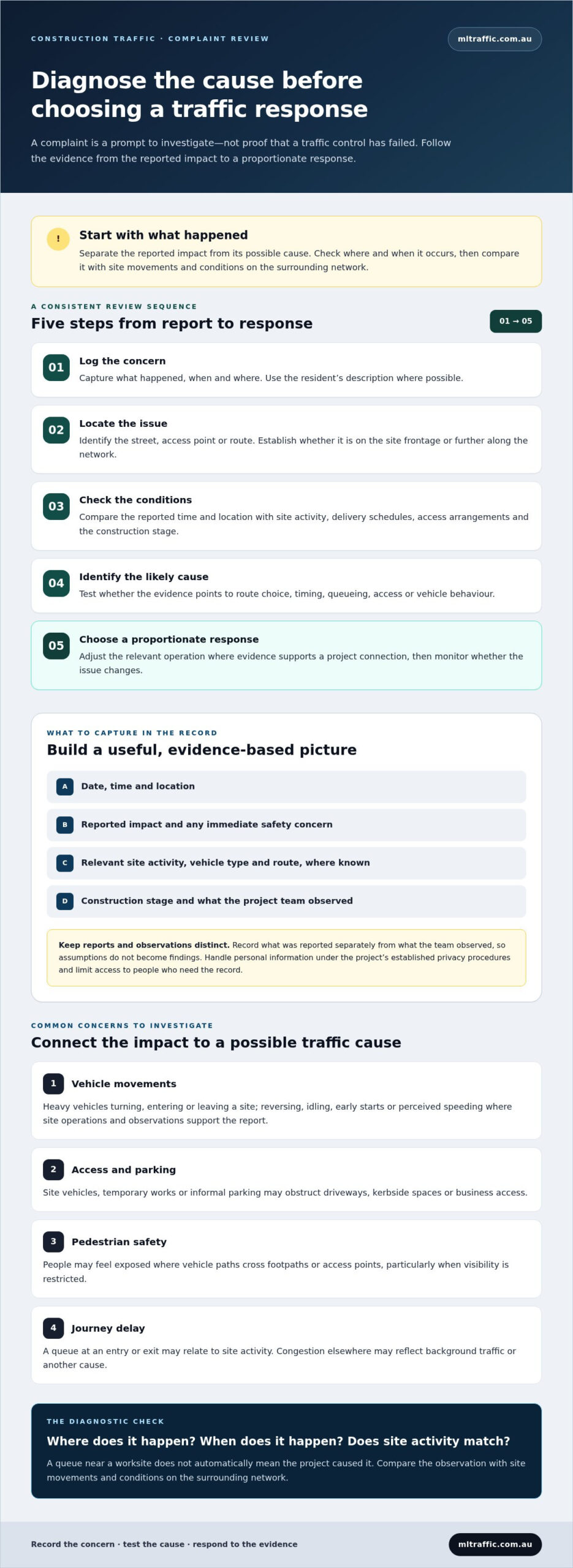
Concerns usually relate to a particular movement, location or time. Separate the reported impact from its possible cause, and distinguish activity generated by the site from broader traffic conditions.
- Vehicle movements: Heavy vehicles turning, entering or leaving a site can cause concern. Reversing, idling, early starts or perceived speeding are relevant where site operations and observations support the report.
- Access and parking: Site vehicles, temporary works or informal parking may obstruct driveways, kerbside spaces or business access.
- Pedestrian safety: People may feel exposed where vehicle paths cross footpaths or access points, particularly when visibility is restricted.
- Journey delay: Queues at an entry or exit may be linked to site activity. Congestion elsewhere may instead reflect background traffic or another cause.
These distinctions matter. A queue near a worksite does not automatically mean the project caused it. Check where and when it occurs, then compare the observation with site movements and conditions on the surrounding network.
Why should a project respond before complaints escalate?
Unanswered concerns can weaken trust and create repeated work for project teams. Early review may expose a gap between planned operations and actual conditions, such as deliveries arriving together or a construction-stage change affecting access. The response can then target the cause instead of relying on generic reassurance.
Record what was reported, what was observed and what action followed. This creates a clearer basis for identifying recurring issues and deciding whether a project-specific adjustment is warranted. ML Traffic Engineers Australia brings over 15 years of traffic engineering and transport planning experience. Its traffic engineering consultancy background supports evidence-led assessment of project impacts.
Success does not mean every complaint disappears. It means reducing avoidable impacts, setting realistic expectations and responding consistently as site conditions change.
How to identify the traffic cause before choosing a mitigation
A useful response starts with diagnosis, not a preselected control. A report of “traffic chaos” might refer to a queue at the site entrance, vehicles using an unexpected route or unrelated congestion nearby. Treat each report as a lead to test against site activity and observed conditions. This makes mitigating resident complaints about construction traffic more targeted and helps avoid measures that address a symptom while leaving its cause unchanged.
Use the same sequence for each concern:
- Log the concern. Capture what happened, when and where, using the resident’s description where possible.
- Locate the issue. Identify the street, access point or route, and whether it appears to be on the site frontage or further along the network.
- Check conditions. Compare the reported time and location with site activity, delivery schedules, access arrangements and the construction stage.
- Identify the likely cause. Test whether the evidence points to route choice, timing, queueing, access or vehicle behaviour.
- Select a proportionate response. Adjust the relevant operation where the evidence supports a project connection, then monitor whether the issue changes.
What information should a traffic complaint record capture?
Record the date, time, location, reported impact and any immediate safety concern. Add relevant site activity, vehicle type, route and construction stage where known. Keep what was reported separate from what the project team observed, so assumptions do not become findings. Handle names, contact details and other personal information under the project’s established privacy procedures, and limit access to people who need the record.
How can project teams distinguish causes from symptoms?
Look for patterns. If reports occur around a particular delivery period, compare them with the schedule and actual arrivals. If a queue is reported, check where it begins, whether vehicles are waiting to enter, and whether similar congestion occurs without site activity. Compare current arrangements with relevant approved plans, and check whether site operations have changed as construction progresses.
Use available observations or traffic data to test a claim rather than treating one account as proof of cause. For example, if a resident reports that construction vehicles are delaying a junction, observations at the reported time can help establish whether project vehicles are contributing or whether the queue forms independently of site movements. The FHWA Work Zone Operations Best Practices Guidebook is a United States reference for work-zone operations and mobility and safety considerations, not Australian project guidance.
Where a concern involves wider network effects, a suitably scoped Traffic Impact Assessment can examine development-related traffic against the surrounding road network. It can help identify where project traffic may interact with existing conditions, rather than assuming every nearby delay is site-related. ML Traffic Engineers prepares Traffic Impact Assessment reports to support development applications across Australia. Connecting complaint records with a technical assessment gives project teams a clearer basis for selecting and reviewing practical responses.
Which construction traffic mitigation measures suit each complaint?
A control should address the cause identified in the project review, not just the wording of a complaint. A delivery queue may call for coordination at the gate, while vehicles using an unsuitable route may need clearer instructions. Each option has trade-offs. A change that reduces pressure on one street could affect another road or constrain site operations, so assess the full movement before settling on a response.
The table provides a starting point. Confirm that any proposed arrangement maintains safe movements, emergency access and applicable authority requirements. Routes and delivery arrangements must suit the project, vehicle types, road conditions and current network conditions. There is no universal delivery window or route that works for every site.
| Reported impact | Possible cause | Potential control | Operational trade-off |
|---|---|---|---|
| Heavy vehicles on a local street | Route choice or unclear directions | Review the designated approach and departure routes; provide drivers with clear instructions | A preferred route may add distance or interact with different road constraints |
| Queues near site access | Overlapping arrivals or limited space to wait | Coordinate delivery bookings and check whether site access arrangements can reduce vehicle overlap | Rescheduling can affect work sequencing and supplier coordination |
| Parking pressure | Workers or contractors using nearby kerbside spaces | Review site parking arrangements and communicate where project vehicles should park | Alternative parking arrangements may require additional planning or travel |
| Blocked property access | Vehicle manoeuvres, waiting or temporary works | Plan movements around access needs and give affected occupants advance information | Maintaining access may constrain the timing or sequence of a delivery |
| Changed or unclear pedestrian access | A construction-stage change or reduced visibility | Identify affected walking routes and crossing points; communicate changes clearly and in advance | A temporary route may be less direct and needs to remain suitable for its users |
What can reduce heavy-vehicle, queueing and parking concerns?
Start by checking arrival patterns, site capacity and the route vehicles actually use. If deliveries bunch together, coordination may reduce overlap, but timing needs to work with the construction sequence and surrounding traffic. Assess routes against vehicle movements, road conditions and relevant restrictions rather than choosing a route solely to move traffic away from one frontage. Where worker or contractor parking contributes to access pressure, review the project’s parking arrangements too.
How should pedestrian access and changing site layouts be managed?
Map the walking routes and crossing points affected by each construction stage, including places where vehicle paths intersect them or visibility changes. Before arrangements change, provide clear information about what is moving, when it changes and how people can reach key access points. A traffic management plan guide offers broader context for planning and coordinating project traffic measures.
Review the selected measure against observed conditions after it is introduced. If queues, access issues or pedestrian concerns continue, reassess whether the cause was correctly identified or site operations have changed. ML Traffic Engineers provides project-specific traffic engineering input to connect reported impacts with practical planning. Its traffic engineering services include assessment of project-related traffic needs.
Managing resident complaints from intake to follow-up
A consistent complaint process gives residents a clear way to raise concerns and helps the project team make accountable decisions. It also prevents reports from sitting in an inbox without an owner. For mitigating resident complaints about construction traffic, each concern needs a recorded response, even when an investigation finds no clear link to site activity or no change is warranted.
Assign a project contact to receive concerns and a response owner to investigate and coordinate action. These roles may sit with different team members, but residents should know how to submit an issue and who will manage it. Escalate immediate safety concerns promptly through the project’s established procedures.
Use a repeatable workflow:
- Acknowledge: Confirm receipt and restate the concern so the resident knows it has been understood.
- Record: Log the date, location, reported impact, relevant details and assigned owner in the project’s complaint register.
- Assess: Review the information alongside site operations, construction stage and available observations or records.
- Act or explain: Make a proportionate change where evidence supports it, or explain the findings and why another response is appropriate.
- Follow up: Tell the resident what was done or concluded, then record whether the issue has changed or remains unresolved.
What should a useful response to a resident include?
Be specific and plain-spoken. A useful response acknowledges the reported issue, explains what the project reviewed and separates verified facts from details that remain unclear. If a measure changes, describe the action and its purpose. If another control is more suitable, explain why without dismissing the concern. Avoid promising a fixed response timeframe; set expectations in line with the project’s established process.
How can teams close the feedback loop and maintain records?
For each report, record the decision, responsible person, action status and follow-up outcome. Share relevant updates through established project communication channels, using information that helps residents understand any change affecting them. Keep records accessible to the people responsible for review, and handle personal details under the project’s privacy procedures.
Review the register for repeat themes across locations, times and construction stages. Separate a recurring operational issue from multiple reports about one isolated event. For example, repeated access concerns during the same type of site activity may indicate a pattern worth reviewing, while a single report may need a different response. Tracking the distinction helps the team prioritise investigations and check whether actions addressed the reported problem.
Where a complaint pattern points to wider network effects or calls for technical planning input, traffic engineering services can support project-specific assessment. A documented process from intake to follow-up gives those reviews a clearer record of reported impacts and actions already taken.
How traffic engineering can support ongoing complaint mitigation
Complaint records become more useful when they inform traffic planning as a project develops. A pattern of reports, observed traffic conditions or a change in site access may indicate that previous assumptions no longer reflect current operations. Reviewing these together helps the project team decide whether an existing arrangement remains suitable or needs further assessment.
A Traffic Impact Assessment examines development-related effects on the surrounding road network. It can help assess how project traffic interacts with existing conditions. Project controls, by contrast, address specific risks and operating arrangements, such as site access, vehicle movements or temporary changes to local routes. One does not replace the other. The appropriate response depends on the issue, project stage and relevant authority requirements.
When should traffic arrangements be reviewed?
Review arrangements when site access, work stages, delivery patterns or surrounding conditions change materially. Revisit them if observations or repeated complaints suggest an impact remains unresolved. Record what changed, the evidence considered, the decision made and any resulting updates. Communicate relevant changes to affected stakeholders so project information keeps pace with site conditions.
Requirements and approval processes can vary by project and jurisdiction. Confirm current requirements with the relevant state, territory and local authorities rather than assuming an arrangement suitable for one project applies elsewhere. This keeps traffic planning specific to the site and its context.
What can a traffic engineering consultant contribute?
Traffic engineering input can help interpret complaint patterns alongside observed conditions and construction-stage changes. A consultant can assess development-related network effects, identify traffic planning considerations and prepare relevant traffic reports. This gives project teams a technical basis for reviewing whether an issue relates to the wider network, a particular site operation or both.
For projects in NSW, relevant planning work may include Traffic Guidance Schemes or Traffic Management Plans. These are planning documents, not physical traffic control. The project team must still ensure operational arrangements reflect current conditions and applicable authority requirements. ML Traffic Engineers has over 15 years of experience in traffic engineering and transport planning, including Traffic Impact Assessments and Statements that support development applications across Australia. Further detail is available in its overview of traffic engineering experience.
For mitigating resident complaints about construction traffic, technical input connects reported impacts with project-specific assessment and planning. It does not promise that complaints will stop. Clear records, considered reviews and updated arrangements support a consistent response as work progresses.
If your project needs traffic assessment or planning input, discuss your project requirements with ML Traffic Engineers.
Make the next project stage easier to manage
Set a review point before each significant change to site access, delivery activity or local movement arrangements. This gives the project team a chance to consider likely impacts before they become established frustrations. Keep the process practical: decide what conditions to monitor, who will review new information and how changes will be communicated.
Effective mitigating resident complaints about construction traffic is an ongoing part of project planning, not a one-off response. Resident feedback can show where assumptions need another look as work progresses. Pairing that feedback with traffic engineering advice supports decisions tailored to the site, its construction stage and the surrounding network.
ML Traffic Engineers brings traffic assessment and planning expertise to development projects, including Traffic Impact Assessments and Statements across Australia and Traffic Guidance Schemes and Management Plans for NSW projects. For a practical discussion about your project, Discuss your construction traffic requirements.
Frequently Asked Questions
What is the best way to reduce resident complaints about construction traffic?
First identify the project activity linked to the concern, then choose a control suited to that cause. For example, if a delivery queue blocks a driveway, check whether arrival coordination or a revised access arrangement is practical. If residents report vehicles on an unsuitable street, review route instructions and constraints. Mitigating resident complaints about construction traffic depends on site conditions, work stages and applicable requirements. The aim is to reduce preventable disruption, not guarantee that complaints will stop.
How should a construction project respond to a resident traffic complaint?
Acknowledge the concern, record the relevant details and investigate whether project activity contributed. Then explain the findings or take a proportionate action, and follow up through the project’s usual communication channel. A clear contact point helps residents know where to direct reports, while an assigned owner ensures each issue is reviewed. Keep a record of the decision and its basis. For an urgent safety issue, use the project’s established escalation process rather than waiting for routine review.
Can construction traffic be restricted to certain hours?
Possibly, but allowable work or delivery hours depend on project approvals, relevant authority requirements, site logistics and other conditions that apply to the work. Check the requirements for the specific project before changing schedules. If timing is driving complaints, consider whether deliveries can be coordinated within permitted operating arrangements, or whether clearer notice would help residents plan. Do not assume one operating window applies nationally; requirements and conditions can differ between projects and jurisdictions.
What should a construction traffic complaint log include?
Record the date, time, location and reported impact, then note relevant site activity, the person responsible for investigation, actions taken and the outcome. A simple location reference, such as a site access point or street segment, can help reveal whether separate reports concern the same area. Consistent entries make it easier to distinguish an isolated event from a repeated pattern. Collect only information needed to manage the issue and follow the project’s privacy procedures.
Do construction projects need a traffic management plan to address resident complaints?
Not every project has the same planning requirements. Traffic planning can document expected movements, risks and proposed controls, but whether a particular plan is needed depends on the project and jurisdiction. Check current requirements with the relevant authority and consider any project approvals or conditions. A plan is not a substitute for listening to residents: compare planned arrangements with actual site conditions, especially after a change in access, work stage or delivery activity.
Who is responsible for managing construction traffic complaints?
Responsibility depends on the project’s assigned roles, contracts, approvals and the nature of the concern. The project should make its reporting channel and response owner clear to residents and workers, so a report reaches someone able to assess it. Site delivery and operational decisions remain with the relevant project parties. A traffic engineer can contribute technical assessment and planning advice, but that role is distinct from managing day-to-day site operations.
When should a traffic engineer review construction traffic concerns?
Consider technical input when concerns recur, observed movements differ from planned arrangements, a new work stage changes site access, or the project’s effect on the surrounding road network is unclear. A traffic engineer can assess relevant impacts and identify planning options within the project scope. A single report may be addressed through the project’s normal review process; not every complaint needs a formal assessment. The need for specialist input depends on the issue and available evidence.

Disclaimer
The content on www.mltraffic.com.au, including all technical articles, guides, and resources, is provided for general informational and educational purposes only. It is not intended to constitute professional advice in traffic engineering, transportation planning, development approvals, or any other technical or legal field.
While ML Traffic Engineers makes every reasonable effort to ensure the accuracy, completeness, and timeliness of the information published, we do not provide any warranties or representations (express or implied) regarding its reliability, suitability, or availability for any particular purpose. Any reliance you place on the content is strictly at your own risk.
In no event shall ML Traffic Engineers, its directors, employees, authors, or affiliates be liable for any direct, indirect, incidental, special, consequential, or punitive damages (including, without limitation, loss of profits, data, or business opportunities) arising out of or in connection with the use of, or inability to use, any information provided on this website.
The articles and guides on this site are not a substitute for engaging a qualified, registered professional traffic engineer (such as an NPER or RPEQ engineer) to assess your specific project requirements. For tailored advice, compliance assessments, or traffic engineering services, please contact a competent professional.
This disclaimer may be updated from time to time without notice. By accessing or using this website, you agree to be bound by the most current version of this disclaimer.
