

A single ‘unacceptable’ traffic rating in your development application can stall a multi-million dollar project for months, regardless of the architectural quality of the build. You’ve likely experienced the frustration of council delays or the shock of being asked to fund expensive road upgrades that weren’t in the initial budget. Successfully mitigating traffic impact of a new development requires more than just meeting basic requirements; it demands a proactive approach to engineering and site design.
This guide outlines the essential assessment frameworks and technical strategies needed to manage traffic volume and secure planning approval for your Australian development. We’ll detail how expert Traffic Impact Assessment (TIA) reports and strict adherence to AS2890 standards can help you navigate the DA process with confidence and avoid costly refusals. By focusing on evidence-based demand management and intelligent site planning, you can provide the technical reliability councils demand while protecting your project’s financial viability.
Key Takeaways
- Understand how Australian councils prioritise “Level of Service” (LoS) to ensure your development proposal aligns with local road capacity and safety requirements.
- Implement demand management and intersection upgrades as primary strategies for mitigating traffic impact of a new development.
- Ensure internal site efficiency and compliance with AS 2890 standards through precise vehicle swept path analysis to prevent queuing on public roads.
- Utilise data-driven Traffic Impact Assessment (TIA) reports and SIDRA modelling to provide the technical evidence necessary for council approval.
- Secure site-specific engineering solutions by working directly with senior principals who understand the complexities of the DA process.
Understanding Traffic Impact and Council Approval Requirements
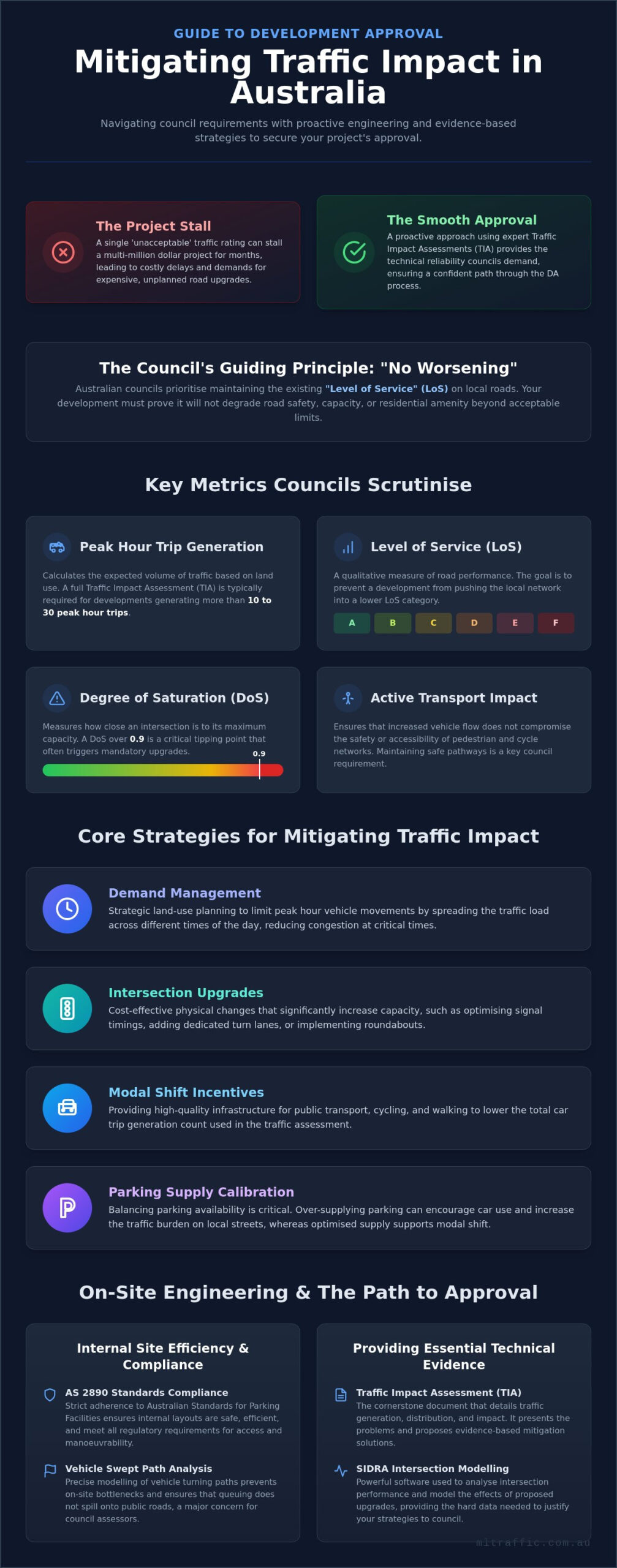
Traffic impact is the measurable change in road safety, capacity, and residential amenity resulting from a new land-use. It’s not merely about the number of cars entering a site; it’s about how those vehicles influence the existing environment. Level of Service is the primary metric for road performance. Australian councils prioritise these assessments to ensure that the “Level of Service” (LoS) on local and collector roads remains within acceptable bounds. If a project threatens to degrade this service level, the developer must provide clear evidence of how they’ll manage the surplus demand.
The first step in forecasting these changes involves Trip generation, which calculates the expected volume of traffic based on the specific type of development. Councils generally operate on a “No-Worsening” principle. This requires you to prove that your project won’t degrade existing road conditions beyond specific limits. When a development is expected to push an intersection near its capacity, mitigating traffic impact of a new development becomes a mandatory condition for planning approval.
To better understand the fundamentals of this process, watch this technical overview:
The scale of your project determines the depth of the required documentation. Small-scale developments might only require a basic traffic statement. However, larger projects move into the territory of a full Traffic Impact Assessment (TIA). This transition usually happens when the project generates more than 10 to 30 peak hour trips, though thresholds vary between local government areas.
Key Metrics Councils Scrutinise
Engineering scrutiny focuses on several technical variables during the DA process. Peak hour trip generation rates are categorised by land-use, ensuring that a high-turnover fast-food outlet is assessed differently than a warehouse. We also measure intersection delay and the “Degree of Saturation” (DoS). A DoS exceeding 0.9 indicates an intersection is reaching its physical limit, which often triggers a demand for upgrades. Additionally, councils look at the impact on “Active Transport” networks, ensuring that increased vehicle flow doesn’t compromise pedestrian or cycle safety.
The Tipping Point: When Mitigation Becomes Mandatory
Infrastructure capacity isn’t infinite. The tipping point occurs when the additional traffic from your site pushes the local network into a lower LoS category. In rapidly developing precincts, you must also consider cumulative impact. Even if your specific project is modest, the combined effect of multiple nearby developments might necessitate shared infrastructure contributions. Successfully mitigating traffic impact of a new development in these areas requires a detailed understanding of both current road volumes and future growth projections.
Core Strategies for Mitigating Traffic Impact
Mitigation is a technical balancing act that involves both physical engineering and behavioural strategy. It’s a common misconception that every project requires expensive road widening or new lanes to gain approval. Instead, developers can often achieve compliance through smarter site management and operational tweaks. Successfully mitigating traffic impact of a new development depends on selecting the right intervention for the specific road environment.
- Demand Management: This involves strategic land-use planning to limit peak hour vehicle movements by spreading the traffic load across different times of the day.
- Intersection Upgrades: Small changes like optimising signal timings, adding dedicated turn lanes, or implementing roundabouts can significantly increase capacity.
- Modal Shift: By providing infrastructure for public transport, cycling, and walking, you can lower the total trip generation count used in your assessment.
- Parking Supply Calibration: Balancing parking availability is critical. Over-supplying parking can actually encourage car use and increase the traffic burden on local streets.
- Construction Traffic Management: Short-term impacts during the build phase are managed through a detailed Traffic Guidance Scheme (TGS) to ensure safety and minimal disruption.
Physical Infrastructure vs. Operational Improvements
Physical road upgrades are high-cost interventions that councils usually reserve for projects where the Degree of Saturation (DoS) cannot be managed through other means. Before committing to widening a road, we look at operational improvements that provide a better cost-benefit ratio. Adjusting signal offsets or implementing intelligent transport systems can improve vehicle flow without the need for additional tarmac. These technological solutions are often preferred by councils as they’re faster to implement and less disruptive to the existing community. If you’re unsure which path fits your project, you can review our full range of traffic engineering services to see how different assessments apply.
The Rise of Green Travel Plans
A Green Travel Plan (GTP) is an increasingly powerful tool in the Australian planning landscape. It provides a legal framework to justify lower parking rates and reduced trip generation by guaranteeing support for non-car travel. Essential components of an effective GTP include high-quality end-of-trip facilities like showers and secure bike storage, car-sharing scheme integration, and public transit subsidies for future occupants. By demonstrating a genuine commitment to modal shift, developers can often mitigate the perceived traffic impact of a new development enough to avoid more expensive infrastructure contributions. This approach is particularly effective in high-density urban centres where road capacity is already at its limit.
Engineering Solutions: Swept Paths and Car Park Design
Internal site efficiency is a critical component of mitigating traffic impact of a new development. If vehicles cannot enter, circulate, and park within the site boundary without delay, they inevitably queue on the public road network. This creates congestion and safety hazards that councils will not accept. Engineering compliance with AS 2890.1 (off-street car parking) and AS 2890.2 (commercial vehicle facilities) ensures that your development manages its own traffic demand internally without burdening the community.
A fundamental tool for achieving this is Vehicle Swept Path Analysis. This technical assessment determines the exact space required for vehicles to manoeuvre through access points and around corners. Designing for waste collection is equally vital; service vehicles must be able to enter and exit the site in a forward direction to prevent trucks from blocking traffic lanes during service hours. Failing to account for these heavy vehicle movements is a common cause of DA refusal.
Optimising Access and Egress
Driveway location must be chosen to minimise conflict points with existing intersections and high-volume traffic flows. We conduct rigorous sight distance assessments to verify that exiting drivers have a clear view of oncoming traffic and pedestrians. AutoTURN software simulates vehicle movements to ensure compliance with Australian Standards. By precisely modelling the turning circles of the largest expected vehicles, we eliminate the risk of vehicles mounting kerbs or encroaching on opposing lanes during entry and exit.
Car Park Design as a Mitigation Tool
Efficient car park design functions as a mitigation strategy by reducing unnecessary circulating traffic. We prioritise “first-time” findability, ensuring drivers can locate parking bays without multiple passes through the facility. Managing the transition from the street is also essential. This involves calculating appropriate driveway ramp grades and providing sufficient queuing spaces within the property boundary to prevent spillover onto the road. For a deeper look at technical requirements, refer to our guide on AS 2890.1 Explained. Proper internal geometry is often the difference between a project that flows smoothly and one that creates an unacceptable external impact. Ensuring every bay is accessible and every aisle is compliant reduces the time vehicles spend on the road looking for access.
The Role of the Traffic Impact Assessment (TIA) Report
A Traffic Impact Assessment (TIA) is the primary technical document used to predict and manage a development’s transport effects. It serves as the bridge between your architectural vision and the council’s regulatory requirements. This report doesn’t just list vehicle numbers; it provides a comprehensive analysis of how those vehicles interact with the existing road network. Successfully mitigating traffic impact of a new development relies on the accuracy of this document to withstand the scrutiny of council engineers and planning panels.
Data collection forms the foundation of every robust TIA. We conduct site-specific traffic counts and observations to understand current peak hour volumes and existing congestion patterns. This data is then processed using SIDRA modelling software, which simulates intersection performance under various load scenarios. Unlike static assessments, a TIA must also predict the future. We apply specific growth factors to model traffic conditions typically 10 years post-completion, ensuring the development remains sustainable as the surrounding precinct evolves. An expert consultant then turns this complex data into actionable mitigation strategies that address identified pinch points.
The Components of a Robust TIA
A high-quality assessment begins with an existing conditions analysis to establish a baseline of current road performance. We then detail the proposed development, calculating trip generation, distribution, and assignment across the local network. The final impact assessment identifies where the added load might push an intersection beyond its capacity. This structured approach allows us to isolate specific issues and propose targeted engineering solutions rather than broad, unnecessary upgrades.
Mitigation Recommendations and Commitments
The TIA informs the traffic-related sections of your Statement of Environmental Effects (SEE). If the assessment identifies a need for infrastructure improvements, it may lead to negotiating Voluntary Planning Agreements (VPAs). These agreements outline your financial or physical contributions to local infrastructure. Under Australian planning law, these recommendations must be proportionate and reasonable. We ensure that any proposed mitigation is directly linked to the impact of your project, protecting you from being forced to solve pre-existing council infrastructure deficits. If you’re preparing a DA, you can contact our team to request a Traffic Impact Assessment (TIA) Report that meets these rigorous standards.
Navigating the Approval Process with Expert Consultancy
Generic engineering advice often leads to DA refusals because it lacks the site-specific nuance required in complex Australian urban environments. Successfully mitigating traffic impact of a new development requires a bespoke approach that addresses the unique constraints of the local road network. ML Traffic Engineers Australia provides a distinct advantage by ensuring every project has direct access to senior principals. This “no-gatekeepers” model means your technical reports are authored and defended by seasoned experts with decades of professional longevity, rather than being outsourced to junior staff. We maintain a strict personnel continuity promise; the expert who initiates your project is the same professional who performs the technical work and manages the council relationship.
Our expertise covers the full spectrum of land-use categories and project environments, including:
- Residential flat buildings and multi-dwelling housing
- Commercial office developments and retail centres
- Industrial warehouses and logistics hubs
- Childcare centres, schools, and educational facilities
- Medical centres and specialised health infrastructure
- Service stations and fast-food outlets
- Mixed-use precincts and urban infill projects
We apply Australian Standards, including AS 2890.1 and AS 2890.2, across all jurisdictions to ensure national compliance. This meticulous attention to detail ensures that every Traffic Impact Assessment (TIA) or Car Parking Demand Assessment we produce is technically sound and ready for council scrutiny.
Collaborating with Council Traffic Engineers
Pre-DA meetings are a vital component of our consultancy process. These sessions allow us to identify potential “deal-breakers” early, saving developers from expensive redesigns later in the cycle. An authoritative Traffic Engineering report builds immediate trust with council officers by demonstrating a commitment to rigorous, evidence-based planning. When councils issue Requests for Further Information (RFIs), we respond with technical precision, providing the SIDRA modelling or swept path data needed to address specific concerns without delay.
Securing Your DA Approval
The final stage of the approval process involves refining the mitigation strategy to gain formal council sign-off. This requires a results-oriented approach that balances the developer’s commercial needs with the council’s infrastructure requirements. Our reporting is designed to be dependable and accountable, providing a clear path to approval through professional status and regulatory certification. We don’t just identify problems; we engineer cost-effective solutions that protect your project’s viability. Contact ML Traffic Engineers Australia to discuss your development’s traffic requirements and secure the expert reporting your project demands.
Streamlining Your Approval Through Engineering Expertise
Securing council approval requires a shift from viewing traffic as a hurdle to treating it as a manageable technical variable. Success depends on high-quality Traffic Impact Assessment reports and precise internal site geometry to prevent external queuing. By prioritising demand management and adhering to AS 2890 standards, you can effectively address council concerns while protecting your project’s commercial viability. Successfully mitigating traffic impact of a new development is achieved when technical evidence meets strategic site planning. This proactive approach reduces the risk of costly project stalls and ensures your development integrates safely into the local network.
ML Traffic Engineers Australia offers over 15 years of industry experience and comprehensive national service coverage. We provide direct access to senior principals on every project, ensuring your DA is supported by seasoned expertise and accountable reporting. Our personnel continuity promise means the expert who starts your project is the one who delivers the final results. Discuss your project with a Senior Traffic Engineer at ML Traffic Engineers Australia today to ensure your development meets all regulatory requirements and proceeds without unnecessary delay. With the right engineering partner, you can navigate the complexities of the planning process with confidence.
Frequently Asked Questions
What is a Traffic Impact Assessment (TIA) and do I need one?
A Traffic Impact Assessment is a technical engineering report that evaluates how a proposed development will affect the surrounding transport network. You generally require a TIA if your project’s trip generation exceeds specific council thresholds, which often start at 10 to 30 peak hour vehicle movements. It is a mandatory requirement for most medium to large-scale development applications in Australia.
How much traffic is considered “too much” for a new development?
Traffic is considered excessive when the additional vehicle movements degrade the Level of Service (LoS) or push the Degree of Saturation (DoS) beyond acceptable limits, typically 0.9 for signalised intersections. Mitigating traffic impact of a new development is required whenever the proposed land-use threatens the safety or functional capacity of existing local and collector roads.
Can a local council refuse my development application based on traffic alone?
Yes, Australian councils have the authority to refuse a DA if the traffic generation is deemed unacceptable or if the site access violates safety standards. Refusal often occurs when a developer cannot prove that the surrounding infrastructure can handle the increased load. Expert reporting is essential to demonstrate that any impacts are manageable through specific engineering solutions.
How long does it typically take to prepare a traffic impact report?
A standard traffic impact report usually takes between two to four weeks to complete from the start of data collection. This timeframe accounts for on-site traffic counts, SIDRA modelling, and the formulation of mitigation strategies. Complex projects involving major intersection analysis or multi-jurisdictional approvals may require a more extended assessment period to ensure technical accuracy.
What is the difference between a Traffic Management Plan and a Traffic Impact Assessment?
A Traffic Impact Assessment predicts the long-term effects of a finished development on the road network to secure planning approval. In contrast, a Traffic Management Plan, often referred to as a Traffic Guidance Scheme (TGS), outlines temporary measures to manage vehicle and pedestrian safety during the construction phase. One focuses on permanent land-use changes while the other manages short-term operational risks.
Do I need a traffic engineer for a small-scale residential development?
Small-scale projects often require a traffic engineer to certify compliance with AS 2890.1 for off-street car parking and driveway design. Even if a full TIA isn’t requested, you must still prove that your site access doesn’t create safety hazards or block public footpaths. Councils frequently request a basic traffic statement to verify these technical details before granting approval.
What happens if my development exceeds the local road capacity?
If your project exceeds capacity, you must propose a formal strategy for mitigating traffic impact of a new development to avoid a DA refusal. This might involve funding intersection upgrades, implementing a Green Travel Plan to reduce vehicle trips, or negotiating a Voluntary Planning Agreement (VPA). These measures ensure the development remains sustainable without placing an unfair burden on existing community infrastructure.
How much do traffic mitigation measures typically cost?
Mitigation costs vary significantly based on the scale of the required intervention. Operational changes like signal timing adjustments are relatively inexpensive, while physical works such as new roundabouts or dedicated turning lanes represent major capital expenditures. It’s critical to identify these requirements early in the design phase to incorporate them into your project’s feasibility study and budget.

Disclaimer
The content on www.mltraffic.com.au, including all technical articles, guides, and resources, is provided for general informational and educational purposes only. It is not intended to constitute professional advice in traffic engineering, transport planning, development approvals, or any other technical or legal field.While ML Traffic Engineers makes every reasonable effort to ensure the accuracy, completeness, and timeliness of the information published, we do not provide any warranties or representations (express or implied) regarding its reliability, suitability, or availability for any particular purpose. Any reliance you place on the content is strictly at your own risk.In no event shall ML Traffic Engineers, its directors, employees, authors, or affiliates be liable for any direct, indirect, incidental, special, consequential, or punitive damages (including, without limitation, loss of profits, data, or business opportunities) arising out of or in connection with the use of, or inability to use, any information provided on this website.The articles and guides on this site are not a substitute for engaging a qualified, registered professional traffic engineer (such as an NPER or RPEQ engineer) to assess your specific project requirements. For tailored advice, compliance assessments, or traffic engineering services, please contact a competent professional.This disclaimer may be updated from time to time without notice. By accessing or using this website, you agree to be bound by the most current version of this disclaimer.
