

We are traffic engineers servicing Brisbane metropolitan area. Navigate Brisbane City Council’s requirements with confidence and secure your Development Application approval with an expert traffic engineering report.
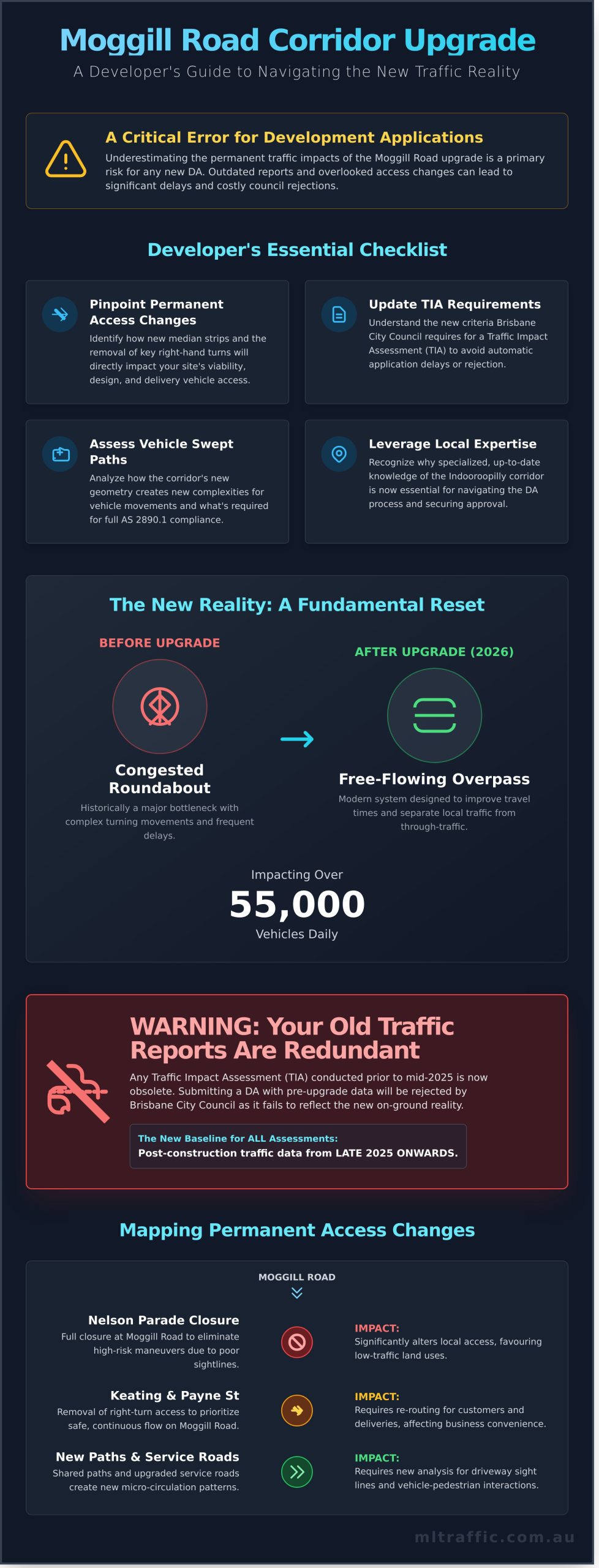
With the Moggill Road Corridor Upgrade now fundamentally altering traffic flow, developers face a new layer of complexity. Are your current traffic reports based on outdated pre-construction data? Are you concerned that new median strips and access restrictions could render your proposed site access non-compliant or unworkable for delivery vehicles? Underestimating the permanent Moggill Road Corridor Upgrade Traffic Impacts is a critical error for any new Development Application, risking significant delays and costly council rejections.
This developer’s guide delivers the essential intelligence required to navigate the corridor’s new standards. We provide a direct assessment of the permanent changes to property access, clarify updated vehicle swept path requirements for the new layout, and offer a clear framework for DA compliance. Secure the insights you need to maintain efficient site access and ensure your next project proceeds without traffic-related obstacles.
Key Takeaways
- Pinpoint exactly how permanent access changes, like the removal of key right-hand turns, will directly affect your site’s viability and design.
- Discover the updated criteria Brisbane City Council now requires for a Traffic Impact Assessment (TIA) to ensure your application isn’t delayed.
- Assess how the Moggill Road Corridor Upgrade Traffic Impacts create new complexities for vehicle swept paths and what it means for achieving AS 2890.1 compliance.
- Understand why specialised local knowledge of the upgraded corridor is now critical for navigating the development application process and securing approval.
Table of Contents
- The New Reality of the Moggill Road Corridor in 2026
- Permanent Access Changes: Is Your Property Affected?
- Navigating Traffic Impact Assessments (TIA) in the Upgraded Corridor
- Future-Proofing Your Development: Swept Path and AS 2890.1
- How ML Traffic Engineers Secures Your Indooroopilly DA
The New Reality of the Moggill Road Corridor in 2026
As of 2026, the operational landscape of the Indooroopilly roundabout is fundamentally altered. The long-awaited upgrade, completed in May 2025, has replaced a historically congested intersection with a modern, free-flowing overpass system. This is a complete reset for how over 55,000 vehicles navigate the junction of Coonan Street and the critical arterial of Moggill Road daily. Consequently, understanding the Moggill Road Corridor Upgrade traffic impacts is no longer an academic exercise-it is a commercial necessity for any property development or business in the vicinity.
To visualise the scale of this transformation, consider the project’s key objectives and outcomes:
For property owners and developers, this ‘new reality’ redefines the term ‘traffic impact’. It is no longer just about vehicle volume; it’s about changed access routes, new pedestrian desire lines, and altered peak-hour behaviours that directly affect site viability, planning applications, and customer access.
What Was Delivered: The Infrastructure Checklist
The key infrastructure changes have created a new set of conditions for any site-specific traffic assessment. The primary components delivered include:
- The Coonan Street Overpass: This structure allows through-traffic on Moggill Road to flow unimpeded over the Coonan Street intersection. This improves travel times but fundamentally changes how local traffic enters, exits, and crosses the corridor.
- New Shared Paths: Dedicated pedestrian and cyclist facilities enhance active transport connectivity. However, their placement can impact property frontage, driveway sight lines, and require updated assessments for safe vehicle-pedestrian interaction.
- Upgraded Service Roads: While designed to preserve local business access, these roads have established new micro-traffic circulation patterns that must be professionally analysed for any development application.
Why Your Old Traffic Reports Are Now Redundant
Any Traffic Impact Assessment (TIA) or report conducted prior to the project’s completion in mid-2025 is now obsolete. The changes to traffic flow, signal phasing, and network hierarchy mean that historical data no longer reflects the on-the-ground reality that Brisbane City Council will use for its assessment criteria. Submitting a development application based on pre-upgrade data is a direct route to delays and potential rejection.
The ‘New Baseline’ for all traffic assessments in Indooroopilly is the post-construction traffic behaviour observed and modelled from late 2025 onwards.
Permanent Access Changes: Is Your Property Affected?
Major infrastructure projects are designed to improve overall network efficiency, but these large-scale benefits often require localised sacrifices. For property owners along the corridor, the most significant and lasting of the Moggill Road Corridor Upgrade Traffic Impacts are the permanent changes to local street access. Understanding how the removal of turning movements and the closure of intersections affects your property is critical for future planning and valuation.
These modifications are not arbitrary; they are calculated decisions based on traffic modelling and safety audits to reduce conflict points and improve flow. However, they can fundamentally alter how customers, residents, and suppliers access a site.
The Nelson Parade Closure: Navigating the Dead End
The permanent closure of Nelson Parade at Moggill Road is a direct result of safety assessments identifying poor sightlines for vehicles entering the arterial road. To eliminate this high-risk manoeuvre, Council opted for a full closure. This forces local traffic onto alternative routes, potentially increasing pressure on neighbouring residential streets. For landowners, this change significantly impacts development potential, making the area less viable for high-turnover commercial uses and favouring land uses that generate less traffic.
Keating and Payne Street: The End of Easy Access?
Similarly, the removal of right-turn access into Keating Street and Payne Street exemplifies the classic trade-off between arterial flow and local convenience. Council has prioritised keeping traffic moving safely on Moggill Road over providing direct access for a small number of properties. For businesses located here, this has immediate consequences:
- Customer Behaviour: Inconvenient access can deter passing trade, as potential customers may not be willing to perform a U-turn or navigate a side-street loop.
- Logistics: Delivery and service vehicles require new, efficient routing strategies to avoid lengthy detours and delays, which may require a formalised traffic management plan.
These access restrictions directly influence a property’s ‘highest and best use’. A site once perfect for a convenience-based retailer may now be better suited for a destination business. A detailed analysis, guided by principles found in resources like the Austroads Guide to Traffic Impact Assessment, is essential to quantify these commercial implications and redefine a property’s strategic value in the post-upgrade landscape.
Navigating Traffic Impact Assessments (TIA) in the Upgraded Corridor
For developers with projects along Moggill Road, the corridor upgrade fundamentally changes the requirements for a successful Development Application (DA). Brisbane City Council’s assessment criteria have evolved, demanding a more sophisticated and forward-looking Traffic Impact Assessment (TIA) that accurately reflects the new road network. A standard TIA based on old traffic patterns is no longer sufficient and is likely to face significant scrutiny.
Understanding the specific Moggill Road Corridor Upgrade Traffic Impacts on your site is now a critical step. A successful TIA must demonstrate a thorough comprehension of the altered traffic dynamics, from major intersection changes to new active transport frontages.
Modeling the New Traffic Flow
Your traffic modeling must now be based on future-state conditions. This involves using projected 2026 traffic volume data to provide Council with a realistic forecast of your development’s impact. The removal of the Coonan Street roundabout and its replacement with a free-flowing overpass is the most significant change. While this creates a ‘free-flow’ environment on Moggill Road itself, it shifts pressure and alters queue lengths at the remaining signalized intersections, such as Keating Street and the Indooroopilly Roundabout. Your TIA must meticulously model these knock-on effects to demonstrate that your site access design will function safely and efficiently within the new system.
Sidewalks and Shared Paths: The New Frontage Challenge
The upgrade introduces extensive shared pedestrian and cycle paths, creating a new challenge for property frontage and access. Your development’s driveway design is no longer just about vehicle movements; it must safely manage interactions with a higher volume of pedestrians and cyclists. Key considerations include:
- Driveway Gradients: Ensuring compliance with Australian Standards (AS 2890.1) where the driveway crosses the shared path.
- Sightlines: Providing clear and unobstructed lines of sight for drivers exiting the property and for path users approaching the crossover point.
- Safety Priority: Demonstrating that the access design prioritises the safety of vulnerable road users, in line with Council’s active transport goals.
Failing to adequately address these interface points can compromise public safety and is a common reason for Council requests for further information, delaying your DA approval. Engaging professional traffic engineering services ensures these complex new requirements are correctly interpreted and integrated into your plans from the outset, significantly improving your prospects for a smooth and successful application process.
Future-Proofing Your Development: Swept Path and AS 2890.1
The Moggill Road upgrade introduces new road geometry, medians, and service roads that significantly alter vehicle access. For developers and architects, this isn’t just about traffic flow; it’s about fundamental site functionality. Failing to account for these changes early in the design phase can lead to costly ‘design-locks’-where a building’s approved layout becomes unworkable because service vehicles physically cannot enter or exit the property. Understanding the full scope of the Moggill Road Corridor Upgrade Traffic Impacts is essential to ensure your project remains viable and compliant.
Swept Path Analysis: Can Trucks Still Make the Turn?
With new service roads and tighter turn radii, access for larger vehicles is now a critical design constraint. Standard delivery trucks, rigid waste collection vehicles, and removalist vans require specific maneuvering space that may no longer exist with the post-upgrade road layout. We use industry-standard AutoTURN software to simulate these vehicle movements, verifying that your loading docks, basement entries, and service bays remain accessible. For any Development Application lodged from now until project completion, a comprehensive swept path analysis is a non-negotiable component for securing council approval.
Parking Design and Demand Assessment
The new corridor configuration directly influences internal site design. Driveway access points may be relocated or have altered entry angles, which has a direct effect on compliant ramp grades and sight lines. It is critical to ensure every aspect of your car park-from aisle widths to individual space dimensions-strictly adheres to Australian Standard AS 2890.1. A professional assessment will also determine the appropriate level of on-site parking, balancing council requirements with the reality of operating on a high-frequency public transport corridor. Getting this balance wrong can jeopardise a project’s commercial success.
Proactive assessment is the only way to mitigate the risks associated with the changing road network. To ensure your development is designed for compliance and long-term functionality, it is vital to engage an experienced traffic engineering consultant early in the process.
How ML Traffic Engineers Secures Your Indooroopilly DA
Navigating a Development Application (DA) in Indooroopilly requires more than just technical skill; it demands intricate local knowledge. With the ongoing Moggill Road upgrade, Brisbane City Council’s scrutiny of traffic and access arrangements is at an all-time high. Our specific expertise within the Walter Taylor Ward provides your project with a critical advantage, ensuring your plans are not just compliant, but practical and approvable.
For over 15 years, ML Traffic Engineers Pty Ltd has successfully managed the complexities of Council requirements. Our promise is direct: the senior engineer who provides your quote is the expert who completes the work. This hands-on, accountable approach is how we transform potential obstacles, including the Moggill Road Corridor Upgrade traffic impacts, from development risks into meticulously planned, Council-approved solutions.
Direct Access to Senior Traffic Consultants
Your project deserves senior-level attention from day one. At ML Traffic Engineers Pty Ltd, you work directly with principals Michael Lee or Benny Chen, bypassing junior gatekeepers. This ensures clear communication and decisive action, from initial site visits to direct negotiations with Council assessment managers. You gain the full benefit of our team’s combined 30+ years of professional experience, dedicated to achieving your project’s approval. Learn more about our senior team’s experience.
Get Started on Your Moggill Road Project
Addressing the Moggill Road Corridor Upgrade traffic impacts early is the key to a streamlined DA process. Engaging a traffic consultant during the initial design phase prevents costly redesigns and delays down the line. We provide fast, accurate quotes for your Traffic Impact Statement (TIS) and other essential reports. Contact us today to discuss your site’s specific access challenges and secure the expert guidance your development requires.
Navigating the Future of Moggill Road with Confidence
The Moggill Road Corridor upgrade is set to permanently redefine vehicle access and traffic flow in Indooroopilly. For developers, this means two things are critical: understanding the permanent access changes that may affect your site and ensuring your Development Application is supported by a robust, compliant Traffic Impact Assessment (TIA). Proactively addressing swept path analysis and other technical requirements is no longer optional-it’s essential for council approval.
Successfully navigating the full scope of the Moggill Road Corridor Upgrade Traffic Impacts requires specialist expertise. At ML Traffic Engineers, our registered RPEQ and NER engineers provide this clarity. With direct principal involvement on every project and a track record of over 10,000 sites assessed nationwide, we ensure your plans meet all necessary standards.
Don’t let traffic compliance derail your development. Request a Traffic Impact Assessment Quote for Your Moggill Road Project today and build with certainty.
Frequently Asked Questions About Moggill Road Traffic Impacts
How does the Moggill Road Corridor Upgrade affect my existing property access?
The upgrade introduces significant changes like new median strips and altered lane configurations. Analysing the Moggill Road Corridor Upgrade traffic impacts on your specific lot is vital. This may restrict turning movements or require your driveway to be redesigned to meet new safety standards. A professional assessment ensures your access remains compliant and functional in the new, higher-volume traffic environment, preventing future access or development issues for your property.
Do I need a new Traffic Impact Assessment if my DA was lodged before 2025?
Generally, a lodged Development Application (DA) is assessed under the rules at the time of lodgement. However, if your DA approval is conditional or if you need to make amendments, Council will likely require an updated Traffic Impact Assessment (TIA). This ensures your development’s access and parking arrangements are compatible with the new road network’s design and operational capacity. We recommend a review of your approval conditions to confirm your obligations.
What happened to the Nelson Parade access point?
The Nelson Parade access was reconfigured as part of the upgrade to enhance safety and improve mainline traffic flow on Moggill Road. Closing or modifying minor access points is a standard traffic management strategy to reduce conflict points where vehicles cross paths. This change prioritises the efficiency and safety of the primary arterial road, redirecting local traffic to signalised intersections where movements can be controlled more safely and effectively.
Can I still turn right into Keating Street from Moggill Road?
No, the right-turn from Moggill Road into Keating Street has been permanently removed. The installation of a new central median barrier prevents this turning movement to improve safety and reduce traffic delays. Drivers travelling inbound will now need to proceed to the next signalised intersection to perform a U-turn or use an alternative local route to access Keating Street. This is a key safety feature of the upgraded corridor design.
What is a Swept Path Analysis and why is it required for my driveway?
A Swept Path Analysis is a technical assessment using CAD software to model the path of a specific design vehicle, such as a council waste truck or a delivery van. It is required to prove that vehicles can enter and exit your property safely and efficiently without mounting kerbs or conflicting with other vehicles or pedestrians. This analysis is critical for ensuring your proposed driveway design is compliant with the new road geometry and meets Council requirements.
How does the new Coonan Street overpass impact local business visibility?
The Coonan Street overpass can have mixed effects on visibility. Businesses located directly under or adjacent to the new structure may experience reduced sightlines from passing Moggill Road traffic. A comprehensive review of the Moggill Road Corridor Upgrade traffic impacts can help businesses develop new signage and access strategies to maintain visibility and ensure customers can still easily find and access their premises in the altered traffic environment.
What are the current traffic volumes on Moggill Road in 2026?
Post-upgrade traffic modelling for 2026 projects average daily traffic volumes to exceed 65,000 vehicles per day in key sections of the Moggill Road corridor. Peak hour volumes are anticipated to be between 5,500 and 6,000 vehicles per hour. These figures represent a significant increase and are the basis for the upgrade’s design, which aims to improve capacity and manage this future demand efficiently and safely for all road users.
How do I ensure my car park design complies with AS 2890.1?
Compliance with Australian Standard AS 2890.1 is mandatory and complex, covering everything from parking space dimensions and aisle widths to ramp grades and sight distances for pedestrian safety. The only reliable method to ensure compliance is to engage an experienced traffic engineering consultant. We conduct a detailed review of your plans against all clauses of the standard, providing certified advice and design recommendations to guarantee your car park receives Council approval.
What suburbs do you cover within Brisbane Metropolitan Area?
We are traffic engineers servicing Brisbane, Brisbane City, Fortitude Valley, New Farm, Teneriffe, Kangaroo Point, East Brisbane, South Brisbane, West End, Highgate Hill, Dutton Park, Woolloongabba, Ascot, Clayfield, Albion, Bowen Hills, Newstead, Bulimba, Hawthorne, Morningside, Balmoral, Indooroopilly, Taringa, Toowong, Auchenflower, Milton, Paddington, Red Hill, Bardon, Ashgrove, The Gap, Enoggera, Mitchelton, Aspley, Chermside, Kedron, Stafford, Everton Park, Gordon Park, Wilston, Grange, Alderley, Kelvin Grove, Herston, Lutwyche, Windsor, Nundah, Wavell Heights, Chermside West, Zillmere, Carseldine, Bald Hills, Bracken Ridge, Brighton, Sandgate, Shorncliffe, Deagon, Taigum, Fitzgibbon, Boondall, Virginia, Banyo, Nudgee, Northgate, Hamilton, Hendra, Eagle Farm, Murarrie, Cannon Hill, Seven Hills, Norman Park, Coorparoo, Camp Hill, Carina, Carindale, Mount Gravatt, Upper Mount Gravatt, Mansfield, MacGregor, Robertson, Sunnybank, Sunnybank Hills, Acacia Ridge, Inala, Oxley, Corinda, Graceville, Sherwood, Yeronga, Annerley, Moorooka, Tarragindi, Holland Park, Holland Park West, Coopers Plains, Greenslopes, Fairfield, Yeerongpilly, Stones Corner, Wynnum, Wynnum West, Manly, Manly West, Tingalpa, Hemmant, Lota, Wakerley, Rochedale, Eight Mile Plains, Runcorn, Calamvale, Parkinson, Algester, Doolandella, Forest Lake, Richlands, Darra, Wacol, Archerfield, Rocklea, Salisbury, Nathan, Mount Gravatt East, Wishart, Karawatha, Stretton, Kuraby, Belmont, Chandler, Gumdale, Lytton, Port of Brisbane, Kenmore, Jindalee, Mount Ommaney, Sinnamon Park, Fig Tree Pocket, Chapel Hill, St Lucia, Petrie Terrace, Spring Hill, Wooloowin, Newmarket, Gaythorne, Keperra, Ferny Grove, Upper Kedron, Bridgeman Downs, McDowall, Stafford Heights, Geebung, Pinkenba, Brisbane Airport, Nudgee Beach, Kalinga, Albion (duplicate avoided), Anstead, Bellbowrie, Brookfield, Chelmer, Chuwar, England Creek, Enoggera Reservoir, Jamboree Heights, Karana Downs, Kenmore Hills, Kholo, Lake Manchester, Middle Park, Moggill, Mount Coot-tha, Mount Crosby, Pinjarra Hills, Pullenvale, Riverhills, Seventeen Mile Rocks, Upper Brookfield, Westlake, Banks Creek, Burbank, Drewvale, Durack, Ellen Grove, Heathwood, Larapinta, Mackenzie, Pallara, Sumner, Tennyson, Willawong, Carina Heights, Ransome, Cannon Hill (duplicate avoided), Carindale, Manly, Moreton Island, Bulwer, Cowan Cowan, Kooringal.
Can you help with developments outside of Brisbane, like the Gold Coast or Sunshine Coast?
Yes. While we have deep expertise in Brisbane, our senior engineers have extensive experience securing DA approvals with councils across Queensland, including the Gold Coast, Sunshine Coast, Moreton Bay, Logan, and Ipswich.
