
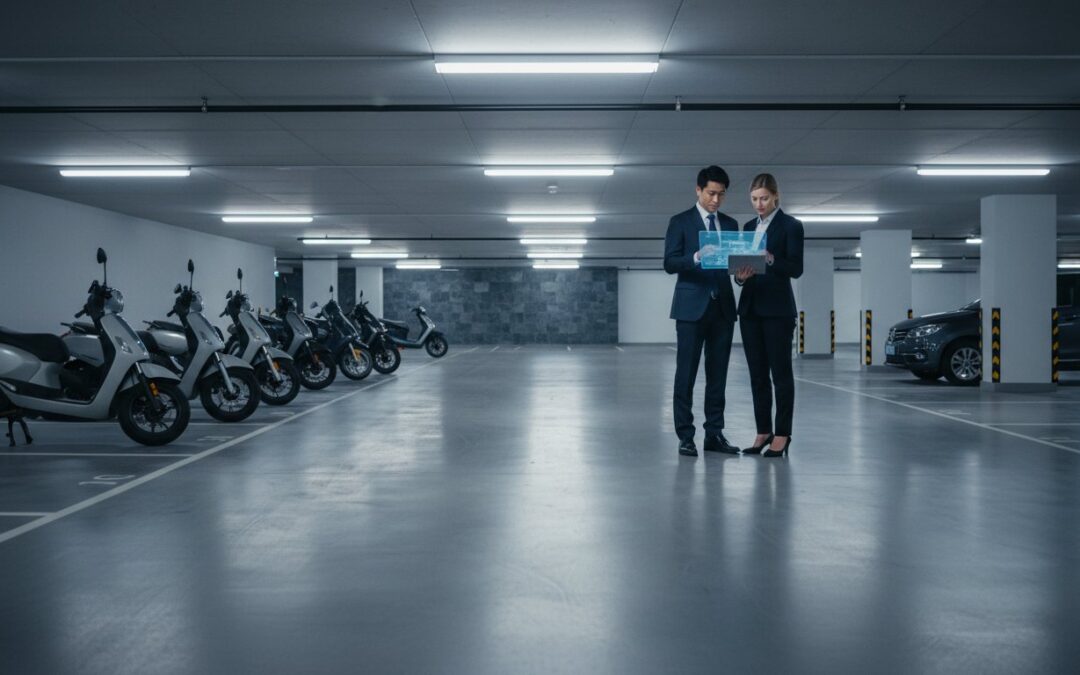
In 2024, approximately 15% of urban development applications faced avoidable delays simply because their layouts failed to meet the specific motorcycle parking standards australia requires. You probably find the conflicting requirements between AS 2890.1 and local Council DCPs both frustrating and counterproductive to your yield targets. It’s a common pain point for developers who want to maximize every square metre of Gross Floor Area while avoiding the risk of a costly DA rejection or a formal Request for Information.
This guide provides the technical clarity you need to master these regulations for 2026. You’ll learn how to ensure your traffic report is fully compliant while using strategic design to protect your project’s bottom line. We will break down the precise dimensions required by national standards, explain how to navigate specific Council variations, and share the exact layout strategies our senior engineers use to fit more bays into tight basement footprints without sacrificing accessibility.
Key Takeaways
-
Understand how modern urban mobility shifts in cities like Sydney and Melbourne make motorcycle quotas a critical factor in avoiding costly DA delays and forced redesigns.
-
Learn the exact motorcycle parking standards australia requires under AS 2890.1, including mandatory space dimensions and aisle widths for safe maneuvering.
-
Identify why your local Council’s Development Control Plan (DCP) often exceeds national standards and how to bridge that compliance gap effectively.
-
Discover strategic design techniques to convert "unusable" car parking zones into high-yield motorcycle bays without sacrificing your project’s overall capacity.
-
Find out how a professional Traffic Impact Statement (TIS) provides the technical weight needed to ensure your application is approved by Council the first time.
Table of Contents
-
Why Motorcycle Parking is No Longer an Afterthought in Australian Developments
-
Strategic Design: Integrating Motorcycle Parking Without Sacrificing Yield
-
Securing Your DA: The Role of Professional Traffic Engineering
Why Motorcycle Parking is No Longer an Afterthought in Australian Developments
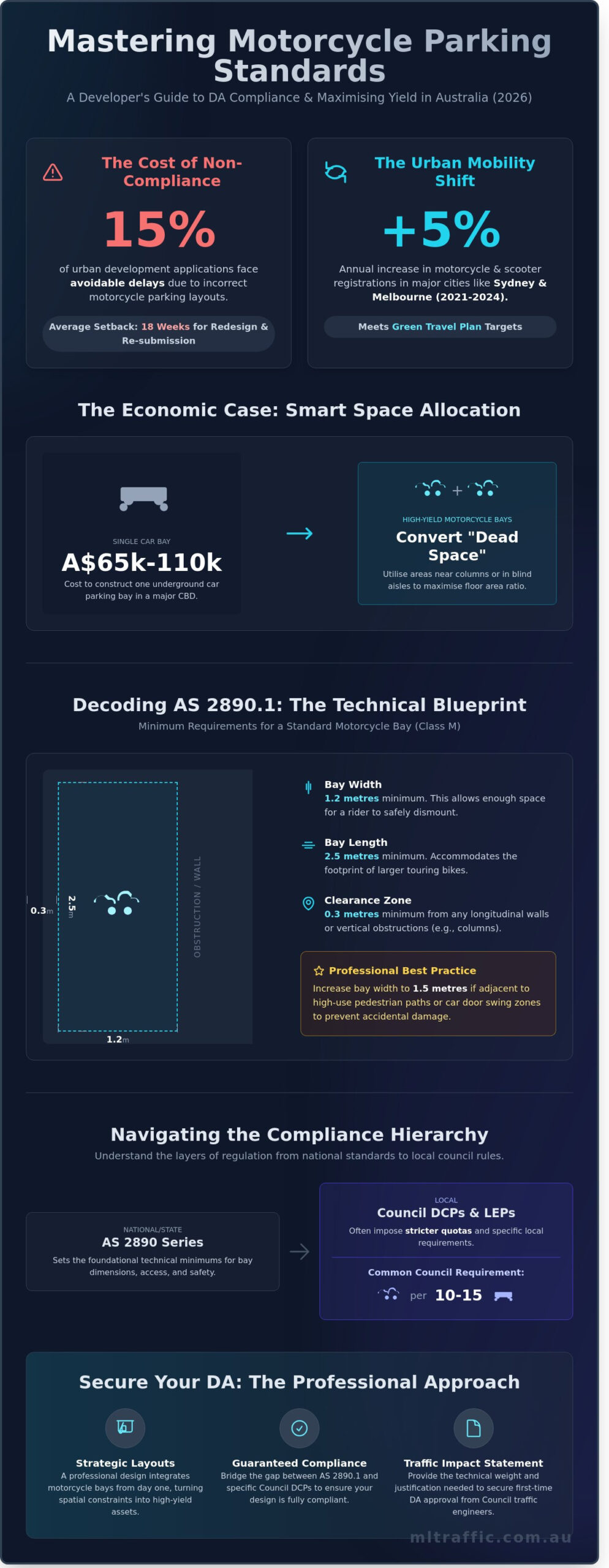
Urban mobility in Australia has shifted. In cities like Sydney and Melbourne, motorcycle and scooter registrations increased by more than 5% annually between 2021 and 2024. Commuters are choosing two wheels to bypass congestion and rising fuel costs. For developers, this means motorcycle parking is no longer a luxury or a space-filler. It’s a core requirement. If you ignore motorcycle parking standards australia during the initial design phase, you risk significant setbacks. We’ve seen projects stalled for 18 weeks because a Development Application (DA) failed to meet the specific motorcycle quotas set by local councils. These delays lead to forced redesigns that are both expensive and frustrating.
Modern developments must also meet ambitious green travel plan targets. Providing dedicated, secure space for motorcycles and scooters helps achieve these goals by encouraging transport modes that take up less road space than single-occupancy cars. Trying to "squeeze them in" at the end of a project rarely works. Compliance checks are rigorous. If a motorcycle bay doesn’t meet the minimum dimensions or lacks the required maneuvering space, it won’t be counted toward your quota. This leaves you short of your legal requirements and potentially liable for non-compliance fines.
The Economic Case for Proper Planning
Car parking is expensive. In major Australian CBDs, constructing a single underground car parking bay can cost between A$65,000 and A$110,000. By providing high-quality motorcycle alternatives, you can often justify a reduction in total car parking demand. This saves significant construction costs. Smart layouts use "dead space" that’s too small for a standard B85 vehicle but perfect for a motorcycle. Professional traffic engineering services turn these spatial constraints into a competitive advantage. We identify areas around structural columns or at the end of blind aisles where a motorcycle bay fits perfectly. This maximizes your floor area ratio and ensures every square metre of your basement generates value.
The Regulatory Landscape in 2026
The rules governing vehicle storage are becoming more complex. In 2026, the hierarchy of regulations starts with the National Construction Code, followed by State Guidelines, and finally, specific Local Environmental Plans (LEPs). Standard Parking lot design principles have evolved to prioritize micro-mobility, reflecting a national push toward sustainable transport. You must adhere to the AS 2890 series, specifically AS 2890.1 (Off-street car parking) and AS 2890.5 (On-street parking), which provide the technical foundations for bay sizes and access.
Most councils now require 1 motorcycle space for every 10 or 15 car spaces. Some high-density zones in inner-city Sydney have even stricter ratios. Don’t assume that what worked on your last project will pass today. The 2026 landscape demands a precise understanding of motorcycle parking standards australia to ensure your project moves from the drawing board to construction without regulatory friction. We focus on getting these technicalities right the first time. It’s about reliability and ensuring your development meets all bureaucratic requirements while remaining functional for the end-user.
Decoding AS 2890.1: Dimensions and Technical Specifications
AS 2890.1 is the technical backbone of off-street car parking in Australia. It provides the exact metrics required to ensure a facility is functional, safe, and legally compliant. While many developers focus on car bays, failing to meet motorcycle parking standards australia can lead to rejected development applications or costly retrofits. Precision is mandatory. A motorcycle isn’t just a smaller car; it has unique stability requirements and a different turning radius that planners must account for from the early design phase.
The Standard Motorcycle Bay (Class M)
Under AS 2890.1, a standard motorcycle parking space, designated as Class M, requires a minimum length of 2.5 metres and a width of 1.2 metres. These dimensions aren’t arbitrary. They accommodate the physical footprint of large touring bikes and allow enough space for a rider to dismount safely. You must maintain a minimum clearance of 0.3 metres from any longitudinal walls or vertical obstructions. If a bay is adjacent to a high-use pedestrian path or a car door swing zone, increasing this width to 1.5 metres is a professional best practice to prevent accidental damage.
Commercial developments now frequently trigger requirements for end-of-trip facilities. In high-density precincts, providing the bay is only half the job. Compliance often involves providing:
-
Secure, ventilated lockers for helmets and riding gear.
-
Proximity to change rooms and showers in office environments.
-
Heavy-duty ground anchors or rails for anti-theft locking.
These features are increasingly mandated by local DCPs (Development Control Plans) to encourage sustainable commuting habits among staff and visitors.
Maneuvering and Aisle Standards
Access is where many designs fail. A motorcycle requires a specific "swept path" to enter and exit a bay without multiple-point turns. For 90-degree parking, the minimum aisle width is typically 3.0 metres. This allows a rider to swing the bike into the spot in one fluid motion. If space is tight, angled parking at 45 or 60 degrees can reduce the required aisle width to approximately 2.2 to 2.5 metres, though this requires more linear curb space. You should always verify these figures against local council parking regulations, as some jurisdictions have stricter requirements for shared zones where pedestrians and riders interact.
Gravity is the primary enemy of a parked motorcycle. AS 2890.1 specifies that the gradient parallel to the direction of parking must not exceed 1:20 (5%). The cross-fall, or the slope across the width of the bay, must also stay under 1:20. If a surface is too steep, a bike’s side stand will either sink or fail to support the weight, leading to tip-overs. Pavement surfaces must be sealed, slip-resistant, and level. Bitumen can soften in 40-degree Australian summers, so reinforced concrete pads are the preferred choice for dedicated motorcycle zones to prevent stands from piercing the surface.
Visibility and markings complete the compliance picture. Each bay needs clear white lines (80mm to 100mm wide) and a non-slip "M" symbol painted on the pavement. Signage should be placed at a height of 1.5 metres to ensure it’s visible over parked vehicles. If you’re unsure if your current basement layout meets these motorcycle parking standards australia, it’s wise to request a professional parking assessment to identify potential risks. Meticulous planning at this stage prevents the 15% increase in construction costs typically associated with fixing non-compliant layouts after the concrete is poured.
Standards vs. Local Councils: Navigating the Compliance Gap
You’ve likely reviewed AS 2890.1 and feel confident about your layout. That’s a common mistake. While the Australian Standard provides the technical dimensions for a single spot, your local Council’s Development Control Plan (DCP) dictates the quantity you must provide. These local rules often demand significantly more than the baseline national guidelines. If you don’t align your project with the specific Local Government Area (LGA) requirements, your Development Application (DA) will likely face delays or rejection.
The City of Sydney and Brisbane City Council offer a clear look at how these rates vary. In the City of Sydney DCP 2012, developers are typically required to provide one motorcycle parking space for every 12 car parking spaces in residential buildings. Conversely, Brisbane City Council often ties requirements to the Gross Floor Area (GFA) or specific land-use categories within their City Plan. These discrepancies mean that a design compliant in one city could be completely illegal in another. You can’t rely on a "standard" approach when the motorcycle parking standards australia are interpreted differently by every local planning authority.
Developers often find themselves in a bind when a Council demands 10 or 15 motorcycle spots for a small commercial build where space is at a premium. This is when you should consider a Parking Demand Assessment. This assessment allows you to present empirical evidence and data-driven arguments to prove that the actual demand for your site doesn’t justify the Council’s high mandated rate. It’s a strategic way to reclaim valuable floor space without compromising the functionality of the development.
Understanding Local Government Area (LGA) Variations
Finding the specific parking rates for your project involves digging through complex DCP documents, usually hidden in sections labeled "Transport and Access" or "Schedule 7." You must also account for "Parking Precincts." If your site is within 400 metres of a major train station or bus interchange, Councils might slash your car parking allowance while simultaneously hiking your motorcycle and bicycle quotas. A major pitfall for developers is assuming the national motorcycle parking standards australia act as a ceiling for requirements; in reality, they’re often just the floor.
Negotiating with Council via Traffic Reports
Council requirements aren’t always set in stone. You can justify a departure from standard rates by submitting a comprehensive Traffic Impact Assessment (TIA). This report uses site-specific data to show why a lower provision of spaces is appropriate for your particular land use. It’s vital to have senior engineer oversight during this process to ensure the arguments are technically sound and persuasive to Council planners. The ML Traffic Engineers team brings over 15 years of direct Council liaison experience to these negotiations. We’ve worked on over 10,000 sites across Australia, ensuring that the traffic consultant who quotes your job is the one who actually does the technical work. This hands-on expertise is the difference between a stalled application and a successful approval.
Strategic Design: Integrating Motorcycle Parking Without Sacrificing Yield
Maximising yield in a development doesn’t mean you have to compromise on compliance. Many developers view dedicated bike spaces as "lost" car bays, but smart engineering turns this perspective around. By identifying areas that are functionally useless for cars, we can meet motorcycle parking standards australia requirements without reducing the total count of profitable car spaces. It’s a matter of technical precision and spatial awareness.
We’ve found that roughly 12% of basement floor area in high-density builds often goes to waste due to structural constraints. These "dead zones" are perfect for motorcycle bays. Instead of leaving a void near a concrete pillar, we design compliant bays that satisfy council requirements while keeping car yield at 100%. Our approach ensures your Traffic Impact Assessment (TIA) looks as good to the council as the bottom line looks to your investors.
Space Optimization Techniques
We use advanced swept path analysis software to prove access in tight corners where a standard passenger vehicle cannot maneuver. Placing motorcycle bays near structural columns or at the end of "blind" aisles utilizes residual space that would otherwise be cordoned off. According to AS 2890.1, a standard motorcycle bay is 2.5 metres long by 1.2 metres wide. We look for these footprints in the "V" shapes created by ramp inclines or behind fire hydrant cupboards. This conversion of residual space into compliant parking often boosts the total vehicle count by 5% or more without changing the building’s footprint.
Security and Amenity Requirements
Security isn’t just a luxury; it’s a requirement for functional high-density residential parking. Developers should provide heavy-duty ground anchors or security rails that allow riders to use a chain lock. A simple A$150 investment per bay in high-quality hardware significantly increases the site’s appeal. We also recommend clustering these bays in well-lit areas covered by CCTV. Grouping bikes together reduces "blind spots" where theft or vandalism occurs. Clear signage and distinct line-marking are essential. Use non-slip paint for markings to prevent rider accidents, especially in basement levels where moisture or oil leaks might be present.
Safety design must account for vehicle-motorcycle conflict zones. We avoid placing motorcycle bays directly behind large SUV spots where visibility is restricted. Instead, we position them where a rider can exit the bay with a clear line of sight to oncoming traffic. It’s also vital to plan for the 2026 mandate regarding EV charging. Current trends suggest that by 2026, at least 15% of new motorcycle bays will require access to a 10A or 15A power outlet for electric scooters and bikes. Integrating this infrastructure now prevents expensive retrofitting costs later. If you’re designing for a new development, we can help you map out these requirements to ensure long-term compliance.
Need a precise layout that maximizes your site's potential? [Contact our senior engineers](https://mltraffic.com.au) for a detailed swept path assessment and parking plan today.
Securing Your DA: The Role of Professional Traffic Engineering
Designing your own car park layout is a high-risk gamble that rarely pays off for developers. Council planners and transport authorities look for specific compliance markers that non-experts often miss. A single error in a motorcycle bay’s dimensions or its proximity to a structural column can trigger a formal Request for Further Information (RFI). This doesn’t just stall your application; it can add four to eight weeks to your timeline and thousands of dollars in holding costs. Professional traffic engineering ensures your plans meet motorcycle parking standards australia before they ever reach a planner’s desk.
A professional Traffic Impact Statement (TIS) provides the technical evidence required for a successful Development Application. It isn’t just a map of lines on a floor. It includes a comprehensive Car Parking Demand Assessment and detailed swept path analysis. We use specialized software like AutoTURN to prove that a motorcycle can safely maneuver into its designated spot without interfering with car movements. Our reports also certify that your driveway ramp grades comply with AS 2890.1, ensuring the transition from the street to the parking level is safe for two-wheeled vehicles.
Our engineers have seen thousands of projects fail at the first hurdle because the developer ignored the nuances of sight-line assessments. We verify that a rider exiting your property has a clear view of pedestrians and oncoming traffic. This level of detail is what separates a rejected application from an approved one. We’ve been trading since 2005 and have applied this expertise to over 10,000 sites nationwide, from small residential subdivisions to massive industrial warehouses.
The ML Traffic Advantage
The ML Traffic Engineers model is built on direct accountability. We operate on a "Principal-Only" promise. The engineer who provides your initial quote is the same senior consultant who performs the technical work and signs off on the final report. You won’t find your project handed off to a junior graduate or an offshore drafting team. Michael Lee and Benny Chen each bring between 30 and 40 years of experience to every assessment.
Working directly with principals means you get instant answers on complex issues like vehicle swept paths and ramp gradients. We’ve successfully navigated the requirements for a vast range of land uses, including childcare centres, medical clinics, and high-density apartments. This deep-seated expertise ensures that your motorcycle parking standards australia compliance is handled with precision, reducing the likelihood of Council pushback.
Next Steps for Your Project
To begin your traffic assessment, you’ll need to provide a set of scaled site plans, typically at 1:100 or 1:200. These plans should show the proposed parking layout, driveway locations, and any existing structures. Once we have your documents, we can identify potential compliance issues early in the design phase. This proactive approach allows you to adjust your plans before the final TIS is drafted, saving you from expensive revisions later in the process.
The timeline for a standard parking compliance report is generally seven to ten business days. We understand that development schedules are tight, so we focus on delivering authoritative, results-oriented documentation that speaks the language of Council engineers. Don’t leave your approval to chance by submitting uncertified plans. Contact ML Traffic Engineers for a project quote today and ensure your development application is backed by decades of professional experience.
Secure Your DA Approval with Precise Parking Design
Achieving compliance in 2026 requires a proactive approach to site layout. You’ve seen how AS 2890.1 sets the technical baseline, yet local council requirements often impose stricter demands that can stall your project. Successful developers don’t just meet these rules; they integrate them strategically to protect their yield. Mastering motorcycle parking standards australia is about more than avoiding fines. It’s about ensuring your development application moves through the system without costly delays or redesigns.
ML Traffic Engineers Pty Ltd offers the technical certainty your project needs. With over 15 years of experience in DA approvals and more than 10,000 sites assessed across Australia, we understand the bureaucratic landscape. You’ll work directly with senior traffic engineers who handle your quote and your assessment personally. We’ve helped thousands of clients navigate complex regulations since 2005, and we’re ready to do the same for you. Your project deserves the reliability that comes from decades of specialized expertise.
Get a Professional Traffic Assessment for Your Development
We look forward to helping you get your development approved and under construction soon.
Frequently Asked Questions
What are the standard dimensions for a motorcycle parking space in Australia?
A standard motorcycle parking space in Australia measures 2.5 metres in length and 1.2 metres in width according to AS 2890.1:2004. These dimensions ensure enough clearance for riders to safely dismount and maneuver their bikes. While these are the base requirements, we often recommend slightly larger envelopes in high-turnover commercial areas to prevent accidental vehicle damage. It’s a simple way to protect both the rider and the property owner.
How many motorcycle parking spaces are required for a new apartment building?
Most local councils require 1 motorcycle space for every 10 to 15 residential car spaces provided in a new development. For a 50-unit apartment building in Sydney or Melbourne, you’ll typically need at least 3 to 5 dedicated motorcycle bays. You must check your specific Local Environmental Plan (LEP) because rates vary between jurisdictions. We’ve seen requirements shift based on proximity to public transport hubs or city centres.
Does AS 2890.1 specify motorcycle parking requirements for all states?
AS 2890.1 is the primary national standard for motorcycle parking standards australia wide, but it doesn’t operate in isolation. State bodies like Transport for NSW or VicRoads often release supplements that modify these requirements for local conditions. Our engineers ensure your design complies with both the national code and any state-specific variations to avoid Council rejection. It’s about meeting the technical benchmarks and the local statutory expectations simultaneously.
Can motorcycle parking spaces be located within a car parking shared zone?
You can’t place motorcycle bays within the shared zone of an accessible car parking space. These zones must remain clear for wheelchair deployment as per AS 2890.6 standards. However, you can often utilize "dead space" at the end of parking rows or near structural columns, provided they don’t obstruct pedestrian paths or sight lines. We look for these efficiencies to help you maximize your available floor area without breaching safety codes.
What is the minimum aisle width required for motorcycle parking?
The minimum aisle width for 90-degree motorcycle parking is 3.0 metres under AS 2890.1:2004. This is significantly narrower than the 5.8 to 6.2 metres required for cars. It’s a great way to maximize your floor plate efficiency in tight basement layouts. We use these tighter requirements to help developers reclaim space that would otherwise be wasted. It makes a big difference when you’re trying to fit a specific number of bays into a small footprint.
Do I need a swept path analysis for motorcycle parking bays?
You don’t usually need a swept path analysis for the motorcycles themselves, but you’ll need one for the cars navigating around them. We use software like Autoturn to prove that a B85 or B99 vehicle can still circulate safely when motorcycle bays are occupied. This assessment is a standard requirement for most Development Applications in Australia. It’s how we prove to Council that your layout is functional and safe for all users.
Are there specific requirements for motorcycle parking in commercial developments vs residential?
Commercial developments usually face higher requirements, often needing 5% of total parking capacity for motorcycles to accommodate staff and visitors. Residential projects focus more on long-term storage for tenants based on unit counts. In a 10,000 square metre office block, you might need 12 spaces, whereas a residential block of the same size might only require 8. The turnover rates in commercial settings demand more accessible and robustly designed bays.
How do I know if my local Council has different parking standards than AS 2890?
You’ll find specific local variations in your Council’s Development Control Plan (DCP). While motorcycle parking standards australia provide a baseline, many urban councils in areas like North Sydney or Brisbane CBD have stricter or more generous quotas. We review these local instruments daily to ensure our clients don’t over-provide or under-provide parking. Getting this right early prevents costly redesigns during the construction certificate phase.
Which areas do you servicer?
We are traffic engineers covering Melbourne, Sydney, Brisbane, Gold Coast, Hobart, Perth, Adelaide, Darwin and surrounding areas.
