

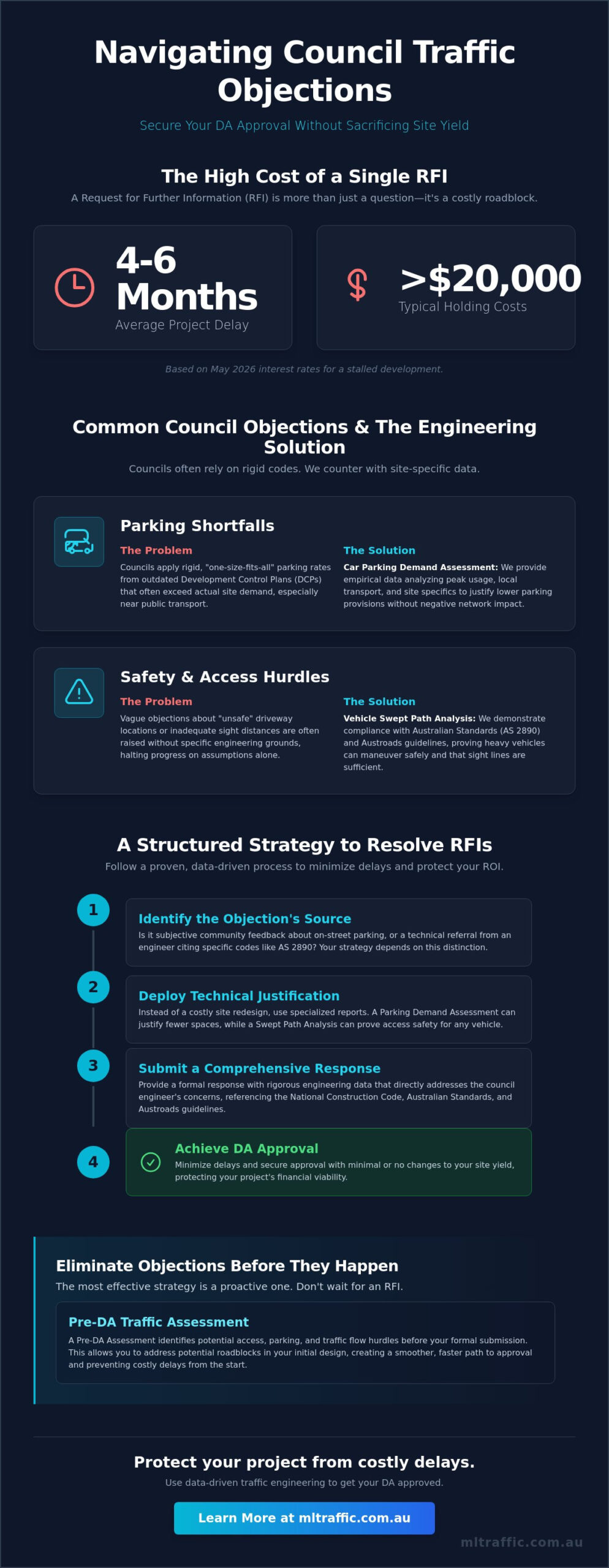
A single Request for Further Information (RFI) regarding intersection capacity can stall your development for 4 to 6 months. At May 2026 interest rates, this delay often costs developers more than $20,000 in holding costs alone. Navigating council traffic objections successfully requires more than just verbal negotiation; it demands rigorous engineering data and a deep understanding of the National Construction Code 2025. You shouldn’t have to sacrifice site yield because of a bureaucratic misunderstanding of traffic flow or parking requirements.
We understand the frustration of receiving council reports filled with technical jargon or demands for more parking than your site can physically accommodate. You need a clear path to resolution that protects your project’s ROI. This guide provides the technical strategies and engineering frameworks necessary to resolve council concerns while maintaining alignment with the latest Austroads guidelines published on 15 April 2026. We’ll show you how to use Vehicle Swept Path Analysis and Car Parking Demand Assessments to counter objections and secure your DA approval with minimal site changes.
Key Takeaways
- Identify the most frequent triggers for council traffic objections and learn to differentiate between subjective community feedback and critical technical engineering referrals.
- Master the technical framework for navigating council traffic objections successfully to secure your DA without resorting to expensive and unnecessary project redesigns.
- Understand how to use specialized reports like Vehicle Swept Path Analysis and Car Parking Demand Assessments to prove compliance with Australian Standards (AS 2890).
- Follow a structured, step-by-step response strategy to Council Requests for Further Information (RFI) to minimize project delays and associated holding costs.
- Discover the value of Pre-DA Traffic Assessments in identifying potential access and parking hurdles before they become formal roadblocks to your development approval.
Common Traffic and Parking Objections in Australian Developments
Council engineering referrals often focus on rigid DCP compliance rather than site-specific logistics. Insufficient parking remains the primary cause of DA delays in 2026. A single Request for Further Information (RFI) regarding parking or access can halt a project for 4 to 6 months. This delay often results in holding costs exceeding $20,000 based on May 2026 interest rates. Navigating council traffic objections successfully requires moving beyond generic arguments and utilizing site-specific technical data. Councils often rely on outdated parking rates that don’t reflect current urban transport trends or the shift toward active transport.
To understand how to approach and eliminate these hurdles, watch this technical overview:
Parking Shortfalls and Demand Assessments
Most councils apply a “one size fits all” approach to parking rates. These rates frequently exceed the actual demand for modern urban developments, especially those near transit hubs. We use empirical data and Impact assessment procedures to justify lower parking provisions. A professional Car Parking Demand Assessment analyzes peak usage periods and local public transport proximity to prove that fewer spaces won’t negatively impact the surrounding road network. This technical justification is often more cost-effective than a full site redesign that sacrifices saleable floor area. Navigating council traffic objections successfully depends on providing this level of detailed, evidence-based reporting.
Safety and Access Hurdles
Safety objections typically center on vehicle entry points and sight distances. Councils frequently flag driveway locations as “unsafe” without providing specific engineering grounds. We address these by applying Australian Standards (AS 2890.1) and the updated Austroads guidelines published on 15 April 2026. These standards provide clear methodologies for Sight-Line Assessments and human factors integration. For commercial or industrial sites, a Vehicle Swept Path Analysis is critical. It demonstrates that heavy vehicles can enter and exit in a forward direction without crossing center lines or hitting kerbs. You can view our full range of traffic engineering services to see how we address these specific technical hurdles. By referencing the Safe System approach, we ensure your access design is forgiving of human error while meeting all regulatory requirements.
Decoding the Council RFI: Why They Object
A Request for Further Information (RFI) is a formal mechanism councils use to pause the assessment clock when technical documentation is insufficient. Navigating council traffic objections successfully requires a clear understanding of who is actually objecting. Your project planner manages the overall process, but the technical roadblocks usually originate from the internal engineering referral department. These engineers use the local Development Control Plan (DCP) as a rigid benchmark for parking rates and access dimensions. If your site borders a major thoroughfare, state authorities like Transport for NSW or the Victorian Department of Transport will also provide a referral. Their focus is strictly on the safety and efficiency of the regional road network rather than local parking convenience.
Distinguishing between neighbor objections and engineering referrals is critical for your strategy. Community members often raise concerns about “amenity” or the loss of on-street parking. While planners must acknowledge these, they carry less weight than a technical engineering objection. An engineer’s refusal is based on perceived violations of safety standards or capacity thresholds. If the referral notes mention “intersection saturation” or “insufficient queuing length,” the objection is data-driven and requires a technical response rather than a simple design compromise.
The Engineering Referral Process
Your DA moves from the planning desk to a specialist traffic engineer who reviews your Traffic Impact Assessment (TIA). Technical non-compliance often leads to an immediate RFI. You must identify whether you’re facing a “soft” objection, such as a request for updated traffic counts, or a “hard” technical refusal. Hard refusals occur when the proposed design fails to meet basic safety criteria, such as sight distance at a driveway. Addressing these early prevents the council from moving toward a formal refusal. If you’ve received complex referral notes, you can contact our team to discuss a technical strategy for your response.
The Importance of Australian Standards (AS 2890)
Local councils often have specific preferences, but AS 2890.1 is the definitive authority for off-street car parking design. Compliance with this standard is your strongest defense during the RFI process. For 2026, developers must also consider the National Construction Code (NCC) 2025, which introduced stricter fire safety and commercial energy efficiency requirements for carparks. We ensure your driveway ramp grades and parking bay dimensions meet these 2026 compliance metrics. When a design aligns with Australian Standards, it becomes difficult for a council to sustain a technical objection based on local DCP guidelines alone.
Technical Justification vs. Site Redesign
Developers often face a critical choice when a council flags traffic concerns: redesign the site or provide a technical defense. Redesigning a basement to accommodate more parking or widening a driveway can cost hundreds of thousands in lost saleable area and increased construction expenses. Navigating council traffic objections successfully often involves proving that the current design is functional through engineering data. Expert reports provide the evidence required to challenge conservative council assumptions about traffic flow and site capacity. We focus on providing the data that allows a project to proceed with minimal physical changes.
Using Swept Path Analysis as a Defense
We use Swept Path Analysis to model vehicle movements in tight urban environments where space is at a premium. Using AutoTURN software, we simulate how specific vehicles navigate the site’s entry and exit points. This analysis often resolves objections regarding narrow driveways or complex basement layouts by proving maneuverability is possible. We demonstrate that waste collection vehicles and emergency services can enter and exit safely in a forward direction. This technical proof often eliminates the need for a total site redesign. It shifts the conversation from a planner’s subjective opinion to a factual engineering demonstration.
Intersection Analysis is another critical tool for defending a design without reducing density. Councils may claim a development will saturate local roads. By analyzing the current Level of Service (LoS) and the degree of saturation, we prove the surrounding network has sufficient capacity for the projected trip generation. We also use “First Principles” to justify parking reductions. This involves looking at actual usage data from similar land uses rather than relying on a generic DCP table. This evidence-based approach is essential for modern developments near transit-oriented corridors where traditional parking rates are no longer applicable.
Traffic Impact Statements (TIS) for Minor Objections
A full Traffic Impact Assessment (TIA) isn’t always necessary for every objection. If a council concern is localized or specific to one aspect of the site, a Traffic Impact Statement (TIS) provides a targeted response. A TIS acts as a technical memo to address a specific hurdle, such as a sight distance issue or a single parking bay’s width. This provides the “missing link” for your DA submission without the cost or time required for a comprehensive regional study. By providing these targeted technical memos, we help developers clear RFIs quickly. You can view our full range of traffic engineering services to determine which report fits your current council requirement.
A Step-by-Step Strategy for Navigating Council Objections
A systematic approach is required to move a stalled DA forward once the initial assessment phase has concluded. Navigating council traffic objections successfully depends on identifying the technical core of the council’s concern and providing a data-led rebuttal. You must move through a structured response process to ensure the assessing officer has no further grounds for delay. We recommend following this five-step strategy to resolve RFIs efficiently:
- Step 1: Thoroughly analyze the council’s technical referral notes to separate factual errors from subjective planning preferences.
- Step 2: Engage a qualified traffic engineer to review the specific objection against current Australian Standards.
- Step 3: Conduct site-specific surveys or data collection to provide empirical evidence that counters generic council assumptions.
- Step 4: Prepare a comprehensive response report referencing AS 2890.1 and the latest Austroads guidelines.
- Step 5: Facilitate a meeting with council engineers to discuss findings and reach a technical consensus.
Analyzing the Council Feedback
Identifying “deal-breakers” is essential for protecting your project timeline. A deal-breaker is typically a technical safety issue, such as a sight distance failure that violates AS 2890.1. Subjective preferences, like specific driveway landscaping or minor aesthetic choices, are secondary and should not stall the engineering approval. You must determine if your existing Traffic Impact Assessment needs a comprehensive update or if a targeted technical memo will suffice. If the council’s objection is based on local intersection capacity, we conduct new site-specific surveys using 2026 data collection methods. This provides real-world evidence that often proves the network can handle the proposed trip generation without the saturation the council fears.
The Expert Response Report
A successful response document is a point-by-point rebuttal of the council’s RFI. It must reference specific clauses in the Australian Standards and the latest Austroads guidelines published on 15 April 2026. This technical rigor prevents the council from issuing a second RFI, which would further extend your approval window. At ML Traffic Engineers Australia, the traffic consultant who provides the quote, does the work. This hands-on model ensures that senior expertise is applied to every technical response. Direct communication between our principals and council engineers often resolves complex objections that would otherwise take months of formal correspondence to settle. If you’ve received a difficult RFI, book a consultation with our senior engineers to start your technical response.
Proactive Traffic Engineering: Eliminating Objections Before Submission
The most efficient method for navigating council traffic objections successfully is to prevent them from being raised in the first place. A reactive approach to development applications often leads to the 4 to 6 month delays previously discussed. Transitioning to a proactive, compliance-first strategy ensures that potential engineering hurdles are identified and resolved before the formal lodgement of your DA. By integrating professional traffic engineering into the early design phase, you align your project with both local requirements and national standards from day one.
Building a compliant application requires strict adherence to the National Construction Code (NCC) 2025, which Australian states and territories began adopting on 1 May 2026. This version introduces enhanced fire safety and energy efficiency requirements for commercial carparks that must be factored into your initial layout. When your car park design and driveway ramp grades are verified against AS 2890.1 during the concept stage, you eliminate the technical errors that trigger automatic engineering referrals and RFIs. This foresight protects your project’s ROI by avoiding the high holding costs associated with stalled approvals.
The Pre-DA Consultation
Engaging in a Pre-DA consultation with council engineers allows you to discuss traffic constraints before your plans are finalized. This meeting serves several critical functions:
- Establishing Scope: You define exactly which traffic studies (TIA or TIS) the council requires, preventing the need for supplementary reports later.
- Parking Rate Buy-In: You can present preliminary data for a Car Parking Demand Assessment to gain early acceptance for proposed parking reductions.
- Identifying Deal-Breakers: Council staff can flag specific access or safety concerns related to the surrounding road network early.
This early dialogue ensures that your final submission is tailored to the specific expectations of the local engineering department. It shifts the project from a position of defense to one of demonstrated compliance.
Choosing the Right Traffic Consultant
Experience is the decisive factor when navigating council traffic objections successfully. At ML Traffic Engineers Australia, we have been trading since 2005 and have completed assessments for over 10,000 sites across Australia. Our senior engineers, Michael Lee and Benny Chen, each possess between 30 and 40 years of experience in the field. This deep-seated expertise ensures that your reports are not only compliant with the latest Austroads guidelines published on 15 April 2026 but are also robust enough to withstand rigorous council scrutiny.
We operate on a direct-access model where the traffic consultant who provides the quote is the one who does the work. This accountability ensures that the technical justifications used in your DA are handled by seasoned experts rather than junior staff. If you are facing difficult council requirements or want to ensure your next submission is RFI-proof, Contact ML Traffic Engineers Australia for expert assistance with your DA objections. Our team provides the authoritative engineering data required to secure your approval with minimal site changes.
Secure Your DA Approval with Technical Engineering Precision
Resolving an RFI is not about compromise; it is about engineering clarity. Navigating council traffic objections successfully requires transitioning from defensive negotiation to technical justification. By leveraging site-specific data and Australian Standards, you protect your project’s floor area and density without succumbing to unnecessary redesign requests. This evidence-based approach ensures that your development application stands up to the most rigorous council engineering referrals while maintaining your commercial objectives.
ML Traffic Engineers Australia offers the specialized knowledge required to overcome these bureaucratic hurdles. With over 15 years of experience and a portfolio of 10,000+ development sites nationwide, we provide the reliability your project demands. You receive direct access to our senior principals, ensuring that every assessment is backed by decades of technical expertise and accountability. Get a technical review of your council traffic objections today. Let us help you move past the RFI stage and toward a successful DA approval with minimal site changes.
Frequently Asked Questions
How long do I have to respond to a council traffic objection?
You typically have 14 to 28 days to respond to a formal Request for Further Information (RFI). This specific timeframe is noted in the council’s correspondence. If the technical requirements are complex, you can request an extension to gather necessary data. Failing to respond within the allocated period can lead to a “deemed refusal.” We recommend engaging a consultant immediately to ensure your response is based on current engineering standards.
Can a neighbor’s objection to traffic stop my development?
A neighbor’s objection alone rarely stops a development if the project meets technical engineering standards. While councils must consider community feedback regarding “amenity,” technical engineering referrals regarding safety and capacity carry significantly more weight. If your design complies with AS 2890.1, subjective concerns about local traffic volume are difficult for a council to sustain as a sole reason for refusal. Engineering data provides the objective defense needed to override these concerns.
What is the difference between a parking shortfall and a traffic impact objection?
A parking shortfall refers to the gap between the council’s DCP requirements and the spaces provided on-site. A traffic impact objection concerns the development’s effect on the external road network, such as intersection saturation. Navigating council traffic objections successfully requires addressing these as separate issues. Shortfalls are resolved through demand assessments, while impacts require detailed intersection analysis and Level of Service modeling to prove network capacity.
Does a Swept Path Analysis guarantee council approval?
No single report guarantees approval, but a Swept Path Analysis provides the technical proof required to dismiss access objections. It uses AutoTURN software to demonstrate that specific vehicles, such as an 8.8-meter medium rigid vehicle (MRV), can navigate the site safely. This moves the discussion from a planner’s opinion to a factual engineering demonstration of compliance with Australian Standards. It is a critical tool for proving maneuverability in tight urban spaces.
How much does a Traffic Impact Assessment (TIA) cost to resolve an objection?
Based on 2026 industry data, a basic TIA for a small development costs between $1,500 and $5,000. For larger or more complex projects requiring extensive intersection modeling, costs can range from $5,000 to over $20,000. These costs are a fraction of the $20,000 in holding costs developers often face when a project is delayed by a single RFI. Investing in a professional report is a standard strategy to minimize long-term financial risk.
Can I appeal a council traffic refusal in court?
You can appeal a refusal through state-specific tribunals like the NSW Land and Environment Court or VCAT in Victoria. These courts rely heavily on expert evidence. A registered traffic engineer provides the technical testimony needed to prove your design meets the “Safe System” approach and Austroads guidelines. Most cases are settled before a final hearing once robust engineering data is presented to the court’s technical assessors.
What happens if I cannot meet the council’s parking requirements?
You must provide a Car Parking Demand Assessment to justify a lower parking provision. This report uses empirical data from similar land uses to prove that the actual parking demand is lower than the generic rates in the local DCP. If your site is within 400 meters of a high-frequency transit hub, councils are increasingly likely to accept these technical justifications. This approach protects your site yield while maintaining compliance.
Do I need a new traffic report if I change my site plan slightly?
You only need a new report if the changes affect vehicle access, parking layout, or the total number of trips generated. A slight shift in a non-structural internal wall doesn’t require a new TIA. However, changing a driveway’s width or moving a parking bay usually requires an updated Swept Path Analysis to ensure the site remains compliant with AS 2890.1. Minor modifications can often be handled via a brief technical memo.

Disclaimer
The content on www.mltraffic.com.au, including all technical articles, guides, and resources, is provided for general informational and educational purposes only. It is not intended to constitute professional advice in traffic engineering, transportation planning, development approvals, or any other technical or legal field.
While ML Traffic Engineers makes every reasonable effort to ensure the accuracy, completeness, and timeliness of the information published, we do not provide any warranties or representations (express or implied) regarding its reliability, suitability, or availability for any particular purpose. Any reliance you place on the content is strictly at your own risk.
In no event shall ML Traffic Engineers, its directors, employees, authors, or affiliates be liable for any direct, indirect, incidental, special, consequential, or punitive damages (including, without limitation, loss of profits, data, or business opportunities) arising out of or in connection with the use of, or inability to use, any information provided on this website.
The articles and guides on this site are not a substitute for engaging a qualified, registered professional traffic engineer (such as an NPER or RPEQ engineer) to assess your specific project requirements. For tailored advice, compliance assessments, or traffic engineering services, please contact a competent professional.
This disclaimer may be updated from time to time without notice. By accessing or using this website, you agree to be bound by the most current version of this disclaimer.
