

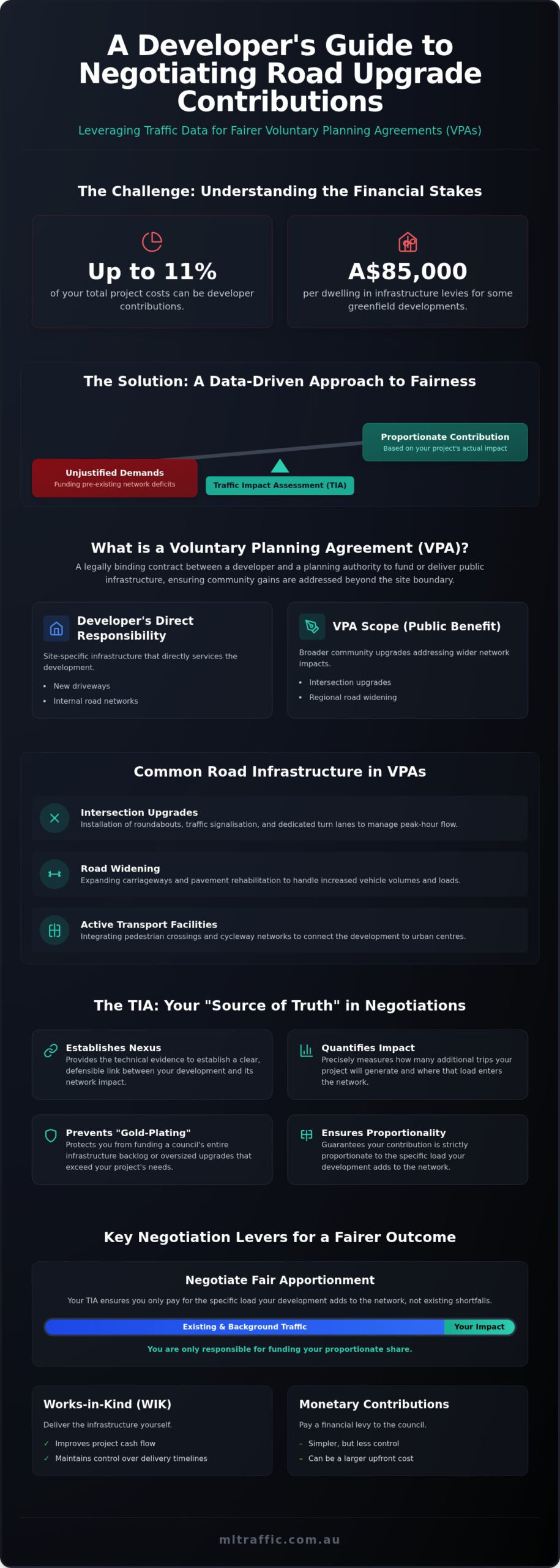
Did you know that developer contributions can account for up to 11% of your total project costs, with some greenfield developments across Australia facing infrastructure levies as high as A$85,000 per dwelling? Negotiating voluntary planning agreements for road upgrades often feels like a high-stakes gamble where the planning authority holds all the cards. You likely understand the frustration of facing “fair” contribution demands that seem anything but fair, especially when these costs threaten to compromise your project’s feasibility or stall your DA approval indefinitely.
This guide provides a professional framework for using technical traffic data as your primary leverage during negotiations. You will learn how to establish an evidentiary baseline that ensures your infrastructure obligations are strictly proportionate to your development’s actual impact. We will examine how Traffic Impact Assessments and Intersection Analysis provide the technical weight needed to secure a legally compliant VPA under the 2025 planning reforms. By following this data-driven approach, you can eliminate uncertainty and achieve a faster path to development consent without over-committing to unnecessary infrastructure costs.
Key Takeaways
- Understand that a VPA is a legally binding contract used to fund or deliver critical infrastructure, such as road widening and intersection upgrades, essential for securing development consent.
- Learn how to use a Traffic Impact Assessment as the evidentiary baseline when negotiating voluntary planning agreements for road upgrades to ensure your contribution is strictly proportionate to your project’s impact.
- Evaluate the strategic advantages of Works-in-Kind (WIK) arrangements over monetary contributions to improve project cash flow and maintain control over infrastructure delivery timelines.
- Discover how to leverage technical data to negotiate fair apportionment, ensuring you only pay for the specific load your development adds to the regional road network.
- Gain direct access to senior engineering principals who can represent your technical traffic data in council meetings, reducing negotiation delays and protecting project feasibility.
What is a Voluntary Planning Agreement (VPA) for Road Upgrades?
A Voluntary Planning Agreement (VPA) is a legally binding contract between a planning authority and a developer. Under Australian planning frameworks, specifically the Planning System Reforms Act 2025 in New South Wales, these agreements allow developers to dedicate land, pay monetary contributions, or provide material public benefits. While similar to the global concept of an impact fee, a VPA is a flexible, negotiated instrument rather than a fixed-rate levy.
The “voluntary” nature of the agreement is a critical legal distinction. Planning authorities cannot mandate a VPA as a strict condition of development consent. However, negotiating voluntary planning agreements for road upgrades is often the most efficient way to resolve infrastructure shortfalls that would otherwise lead to a DA refusal. These agreements provide a transparent mechanism to fund or deliver public infrastructure, such as road widening or intersection upgrades, that supports the increased demand generated by new projects.
Distinguishing between development impact and public benefit is essential for a fair outcome. Site-specific infrastructure, like a new driveway or internal road, is the developer’s direct responsibility. A VPA focuses on broader community gains, addressing the wider network impacts that go beyond the site boundary. This distinction ensures that developers aren’t unfairly burdened with correcting existing regional infrastructure deficits that aren’t of their making.
Common Road Infrastructure Included in VPAs
Most road-related VPAs focus on capacity and safety enhancements that benefit both the development and the surrounding community. Typical works include:
- Intersection upgrades: This includes the installation of roundabouts, traffic signalisation, or the construction of dedicated turn lanes to manage peak-hour flow.
- Road widening: Expanding existing carriage-ways and performing pavement rehabilitation to ensure the road network can handle increased axle loads and vehicle volumes.
- Active transport: Integrating pedestrian crossings and cycleway networks that connect the development to the existing urban centre.
When Road Upgrades Trigger VPA Discussions
Negotiations typically begin when a proposed development exceeds the scope of standard local contribution plans. In Sydney’s growth areas, where contributions can reach A$85,000 per dwelling, a VPA offers a way to manage these costs through Works-in-Kind. Discussions are also triggered by industrial sites requiring specific swept path upgrades for heavy vehicles or when a project is situated in a high-growth corridor where the existing road network is currently operating under-capacity. In these scenarios, the VPA provides the legal certainty needed for the authority to grant consent while the developer secures a predictable infrastructure cost profile.
Using Traffic Impact Assessments to Set the Negotiation Baseline
The Traffic Impact Assessment (TIA) functions as the definitive “source of truth” during the VPA process. It provides the technical evidence required to establish a clear “nexus” between the proposed development and the surrounding road network. Without this data, developers often find themselves in a vulnerable position where planning authorities may demand upgrades that address pre-existing regional deficiencies rather than impacts caused by the site itself. Negotiating voluntary planning agreements for road upgrades requires a precise quantification of how many additional trips your project generates and where that load enters the existing network.
Data-driven TIAs prevent the common issue of “gold-plating,” where authorities request infrastructure specifications that far exceed what is necessary for safety or capacity. By identifying existing network failures versus development-induced requirements, you ensure your contributions remain proportionate. This evidentiary approach protects project feasibility by ensuring you aren’t funding a council’s entire infrastructure backlog under the guise of a planning agreement. Securing an authoritative Traffic Impact Assessment (TIA) Report ensures your negotiation starts with a defensible set of facts.
Intersection Analysis and Capacity Modelling
Intersection Analysis using SIDRA software is essential for demonstrating the current and future Level of Service (LoS) of critical nodes. This modelling determines if a development “breaks” an intersection or if the node is already operating at capacity due to background traffic growth. SIDRA modelling provides a mathematical cap on council infrastructure demands by isolating the project’s specific impact from pre-existing congestion levels. This allows you to argue for a percentage-based contribution rather than funding a full upgrade of an intersection that was already failing before your DA was lodged.
Swept Path Analysis as Evidence for Road Geometry
Authorities often request excessive road widening or land dedication based on generic local standards that may not apply to your specific site use. Technical swept path analysis provides the evidence needed to challenge these requests by demonstrating the minimum road width required for safe vehicle manoeuvres. By simulating the movements of the largest expected design vehicle, you can prove that standard geometries are sufficient. This technical approach ensures compliance with Australian Standards (AS 2890) while minimising the amount of land you must dedicate to the public road reserve, preserving more of your site’s developable area.
Key Levers in Negotiating Road Upgrade Contributions
Success in negotiating voluntary planning agreements for road upgrades depends on more than just technical data. It requires strategic commercial trade-offs that protect your project’s cash flow. One of the most effective levers is the timing of infrastructure delivery. Developers should aim to link the completion of road works to the issuing of an Occupation Certificate (OC) rather than construction commencement. This alignment ensures that significant capital expenditure occurs only when the project is nearing revenue generation, rather than during the high-risk early stages of development.
Maintenance periods are another critical commercial point. Once road assets are handed over to the council, a “defects liability” period typically applies. It’s essential to negotiate a finite duration, usually 12 to 24 months, and establish clear handover criteria. Without these safeguards, developers risk being held responsible for ongoing maintenance costs or network wear-and-tear that isn’t related to their original construction quality. Clear definitions of “completion” and “handover” are vital to limit your long-term liability.
Monetary Contributions vs. Works-in-Kind
Choosing between a monetary payment and a Works-in-Kind (WIK) agreement is a decision based on risk and control. WIK provides the developer with direct oversight of construction costs and delivery timelines. By managing the civil works, you avoid the administrative delays often associated with council-led infrastructure projects. WIK also allows you to negotiate “offsets” against standard Section 7.11 or 7.12 local infrastructure contributions. This means the value of the road works you perform is deducted from the total developer levies you owe the council.
Conversely, monetary contributions transfer the risk of material cost overruns and construction delays to the planning authority. While this simplifies your operational requirements, it often involves a higher upfront cost and less control over when the road upgrade is actually completed. The choice depends on your internal civil capacity and whether the council’s estimated cost for the works is lower than your own projected construction costs.
Apportionment and Cost-Sharing Frameworks
Apportionment ensures you only pay for your “fair share” of a regional road upgrade. This process involves defining the catchment area and using traffic data to determine exactly what percentage of the new road capacity is required by your site. If your development is the first in a precinct to trigger a major upgrade, you may face “pioneer” status. In these cases, you must negotiate clawback provisions within the VPA. These provisions ensure that future developers who benefit from the infrastructure you fund today are legally required to reimburse you for a portion of the costs. This framework prevents a single developer from bearing the full financial burden of regional network improvements that benefit multiple future sites.
The Step-by-Step VPA Negotiation Process
Success in negotiating voluntary planning agreements for road upgrades requires a methodical administrative sequence. This process begins long before a DA is determined and involves both technical and legal workstreams. Following a structured path ensures that the infrastructure scope remains predictable and that the legal obligations are clearly defined before the agreement is registered on the land title.
- Step 1: Pre-lodgement technical assessment. Prepare the TIA and Intersection Analysis to establish the evidentiary baseline for the offer.
- Step 2: Issuing a formal ‘Letter of Offer’. This is the developer’s initial proposal to the planning authority, outlining the specific works or monetary contributions.
- Step 3: Technical review. Council and Transport for NSW (TfNSW) review the technical data to reach an ‘in-principle’ agreement on the infrastructure scope.
- Step 4: Legal drafting and public notification. Once the scope is agreed, the VPA is drafted and must undergo a mandatory 28-day public exhibition period.
- Step 5: Execution and registration. The final document is signed by all parties and registered on the land title to provide security for the planning authority.
Drafting the Letter of Offer
The Letter of Offer is the most critical document in the negotiation. It must be highly specific to avoid future scope creep. Rather than offering general “intersection improvements,” the letter should define the exact treatments, such as the number of turn lanes or specific signalisation hardware. Developers should include technical appendices, such as the TIA and Vehicle Swept Path Analysis, to justify why the offer is proportionate to the site’s impact. It is also vital to set clear triggers for the delivery of works. Linking these triggers to the issuing of an Occupation Certificate (OC) ensures that the infrastructure is delivered when the traffic demand actually materialises, protecting project liquidity during the construction phase.
Managing the Public Exhibition Period
Under the Environmental Planning and Assessment Act 1979, all VPAs must be exhibited for a minimum of 28 days. This period allows the community to review the proposed public benefits. Community concerns often focus on road safety and construction-phase congestion. To mitigate these objections, ensuring your traffic management plan (TMP) aligns with the VPA commitments is essential. You should also review the council’s ‘explanatory note’ that accompanies the exhibition. This note must accurately reflect that the developer’s contribution is resolving specific impacts, preventing the public from viewing the agreement as a generic “pay-to-play” arrangement. For expert support in preparing the technical evidence for your offer, contact our senior engineering principals to discuss your project requirements.
How ML Traffic Engineers Australia Supports Your VPA Strategy
ML Traffic Engineers Australia serves as the lead technical consultant for developers navigating complex infrastructure obligations. We provide the authoritative Traffic Impact Assessment that anchors your position during the formal negotiation process. Our firm brings over 15 years of specialised expertise to every project, ensuring that your road upgrade contributions are both legally compliant and commercially sustainable. We maintain a no-nonsense, fact-based approach that focuses on protecting project feasibility while meeting the rigorous requirements of Australian Standards.
Successfully negotiating voluntary planning agreements for road upgrades requires more than just submitting a report; it demands expert representation. ML Traffic Engineers Australia has a proven record across a vast array of project environments, from large-scale residential subdivisions to complex industrial hubs and commercial centres. Our personnel continuity promise ensures that the senior principal who prepares your technical data is the same expert who represents your interests in front of council planners and state authorities. This direct line of accountability eliminates the communication gaps often found in larger, multi-disciplinary firms.
Technical Advocacy and Council Liaison
We act as your primary technical advocate, translating dense traffic modelling into clear, persuasive negotiation points. Our principals are experienced in defending TIA findings against peer reviews conducted by council engineers or third-party consultants. We ensure that the proposed road designs are functional and safe without being over-engineered. By establishing a rigorous technical baseline early in the process, we help you push back against arbitrary or excessive infrastructure requests that don’t satisfy the legal requirement for a direct nexus to your development.
Get Started with a Technical Site Assessment
Early engagement is the most effective way to identify potential VPA triggers before they stall your DA approval. ML Traffic Engineers Australia offers comprehensive traffic engineering services that identify network constraints during the due diligence phase. This foresight allows you to model infrastructure costs accurately and develop a robust negotiation strategy from day one. You can contact our senior principals directly to discuss your road upgrade requirements and secure the technical weight needed for a successful VPA outcome. We provide a direct line to seasoned experts who understand the bureaucratic requirements of the Australian planning system inside and out.
Secure Your Infrastructure Strategy with Technical Evidence
Success in the infrastructure planning phase requires a transition from passive compliance to active technical advocacy. By establishing a rigorous evidentiary baseline, you ensure that your development’s road upgrade obligations remain strictly proportionate to its specific network impact. Utilising detailed Intersection Analysis and Swept Path data allows you to challenge arbitrary demands and avoid funding regional infrastructure deficits that are not of your making. These strategic levers, combined with intelligent delivery triggers, are essential for protecting project feasibility and maintaining cash flow.
ML Traffic Engineers Australia provides the professional weight needed to anchor your negotiation in Australian Standards. With over 15 years of specialised expertise, our senior principals provide direct accountability for every Traffic Impact Assessment we produce. This personnel continuity ensures the expert who understands your site’s technical constraints is the same one defending the data before council. Negotiating voluntary planning agreements for road upgrades with a data-driven strategy reduces administrative delays and provides a faster path to development consent.
Contact our senior traffic engineers to discuss your VPA technical strategy and ensure your project moves toward approval with predictable infrastructure costs. We look forward to supporting your next development.
Frequently Asked Questions
Is a Voluntary Planning Agreement (VPA) actually mandatory for road upgrades?
No, a VPA is not legally mandatory. It is a voluntary contract between a developer and a planning authority. However, if a development’s traffic impact cannot be mitigated through standard conditions or existing contribution plans, a VPA is often the only viable mechanism to address infrastructure shortfalls. Without one, the authority may determine the development is unsustainable, leading to a refusal of the DA based on unmitigated impacts.
Can a council refuse my DA if I don’t agree to a VPA?
A council cannot legally refuse a DA solely because you declined to enter a VPA. However, they can refuse the application on the grounds that the development results in unacceptable traffic impacts that haven’t been adequately mitigated. In practice, negotiating voluntary planning agreements for road upgrades is the standard method for resolving these technical objections and securing consent for high-impact sites across Australia.
How is the value of a road upgrade calculated in a VPA?
The value is typically based on a quantity surveyor’s estimate of the construction costs or the market value of dedicated land. These values are often indexed to the Consumer Price Index (CPI) or a specific construction cost index to account for inflation between the agreement execution and the delivery of works. The Traffic Impact Assessment provides the technical scope that informs these costings and ensures the value is proportionate.
What happens if the road construction costs exceed the VPA estimate?
Under a Works-in-Kind (WIK) arrangement, the developer generally carries the risk of cost overruns. If the actual construction costs exceed the initial estimate, the developer must still complete the works to the agreed standard to satisfy the VPA triggers. Conversely, if costs are lower than the estimate, the developer retains the savings, provided the infrastructure meets the council’s functional specifications and all relevant Australian Standards.
Can I get a refund on Section 7.11 contributions if I build the road myself?
You don’t receive a cash refund, but you can negotiate “offsets” or “credits.” If the road works you perform are identified in the council’s local infrastructure contribution plan, the value of those works is deducted from the Section 7.11 or 7.12 levies you’d otherwise pay. This must be explicitly documented within the VPA to ensure the credits are legally recognised and applied against your total contribution liability.
How long does it take to negotiate and finalise a VPA for road works?
The process typically takes between six and twelve months. This timeframe includes the initial technical assessments, the drafting of the Letter of Offer, in-principle agreement from council, and the mandatory 28-day public exhibition period required by the Planning System Reforms Act 2025. Delays often occur during the technical review phase, which is why early engagement with a traffic engineer is critical to maintain project timelines.
Do I need a lawyer or a traffic engineer to negotiate a VPA?
You require both. A traffic engineer provides the technical evidence, such as Intersection Analysis and Swept Path Analysis, to define the scope of works. A lawyer is then needed to draft the legal instrument and ensure the terms, such as maintenance periods and security bonds, protect your commercial interests. Technical data is the primary currency used when negotiating voluntary planning agreements for road upgrades.
What is an ‘Explanatory Note’ in the VPA process?
An Explanatory Note is a mandatory plain-English document that accompanies the VPA during its public exhibition. It must describe the proposed agreement, the public benefits provided, and how the agreement promotes the public interest. It serves as a transparent summary for the community, ensuring they understand how the developer’s infrastructure contributions resolve the traffic impacts of the new development without placing a burden on existing ratepayers.

Disclaimer
The content on www.mltraffic.com.au, including all technical articles, guides, and resources, is provided for general informational and educational purposes only. It is not intended to constitute professional advice in traffic engineering, transportation planning, development approvals, or any other technical or legal field.
While ML Traffic Engineers makes every reasonable effort to ensure the accuracy, completeness, and timeliness of the information published, we do not provide any warranties or representations (express or implied) regarding its reliability, suitability, or availability for any particular purpose. Any reliance you place on the content is strictly at your own risk.
In no event shall ML Traffic Engineers, its directors, employees, authors, or affiliates be liable for any direct, indirect, incidental, special, consequential, or punitive damages (including, without limitation, loss of profits, data, or business opportunities) arising out of or in connection with the use of, or inability to use, any information provided on this website.
The articles and guides on this site are not a substitute for engaging a qualified, registered professional traffic engineer (such as an NPER or RPEQ engineer) to assess your specific project requirements. For tailored advice, compliance assessments, or traffic engineering services, please contact a competent professional.
This disclaimer may be updated from time to time without notice. By accessing or using this website, you agree to be bound by the most current version of this disclaimer.
