
A Traffic Impact Assessment Northern Beaches Council submission that gets rejected on first review doesn’t just cost time; it costs real money in redesign fees, extended holding costs, and delayed construction starts. If you’ve received an RFI letter from Council or watched your DA timeline stretch out over traffic concerns, you already know how disruptive non-compliant reports can be.
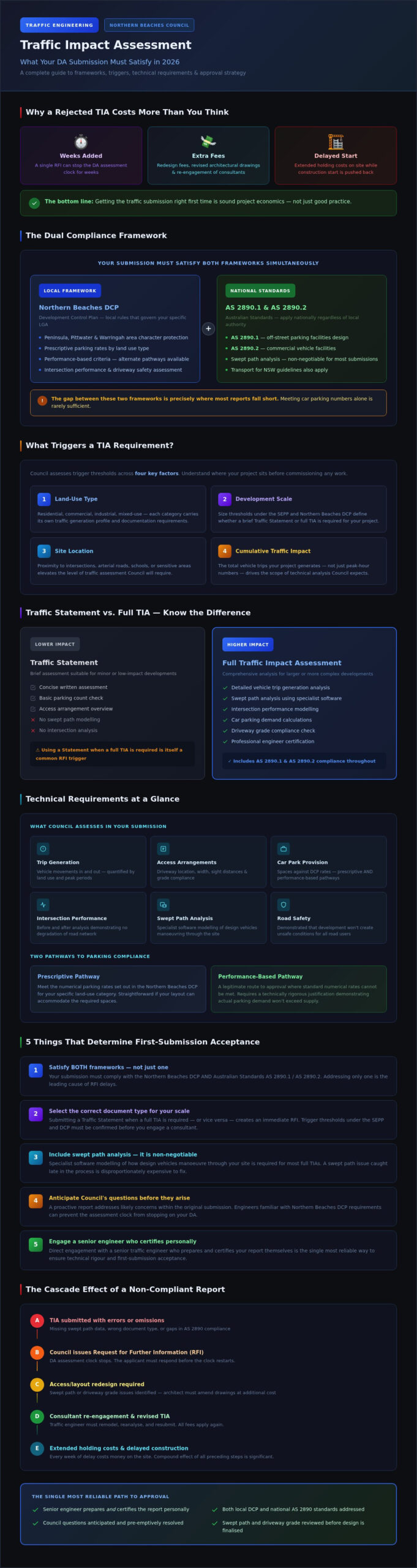
The frustration is entirely understandable. Most applicants assume that meeting the basic car parking numbers is enough. It rarely is. Northern Beaches Council assesses traffic submissions against both its own Development Control Plan and national standards including AS 2890.1 and AS 2890.2, and the gap between those two frameworks is precisely where most reports fall short.
This guide is built to close that gap. You’ll come away with a clear picture of what Council actually expects in 2026, which technical reports are required for your specific development type, and how a properly structured submission, covering everything from swept path analysis to driveway grade compliance, positions your DA for first-submission acceptance. Whether you’re a developer, architect, or project manager, what follows gives you the regulatory framework to move forward with confidence.
Key Takeaways
- A Traffic Impact Assessment Northern Beaches Council submission must satisfy both the local Development Control Plan and national Australian Standards — understanding where these frameworks diverge is critical to avoiding RFI delays.
- Not every development automatically triggers a formal TIA; specific land-use types and scale thresholds under the SEPP and Northern Beaches DCP determine exactly what technical documentation your DA requires.
- AS 2890.1 and AS 2890.2 set the compliance benchmark for off-street parking and commercial vehicle facilities — swept path analysis using specialist software is a non-negotiable component of most submissions.
- Northern Beaches Council assesses parking solutions against both prescriptive requirements and performance-based criteria, meaning there is a legitimate pathway to approval even where standard numerical rates cannot be met.
- Direct engagement with a senior traffic engineer — one who will prepare and certify your report personally — is the single most reliable way to ensure technical rigour and first-submission acceptance.
Why Traffic Impact Assessments are Essential for Northern Beaches Council Approvals
A Traffic Impact Assessment is a formal, engineer-certified analysis of how a proposed development will affect the surrounding road network. It quantifies vehicle trip generation, evaluates access arrangements, assesses car parking provision against applicable standards, and demonstrates that the development won’t compromise road safety or local amenity. For Northern Beaches Council, this document isn’t a formality; it’s a core technical input that planners rely on to make informed decisions about your DA.
Council’s obligation is to protect the character and liveability of the Peninsula, Pittwater, and Warringah areas. Traffic submissions give assessors the data they need to verify that a development won’t degrade intersection performance, create unsafe driveway conditions, or generate parking overflow onto residential streets. Where that data is absent, incomplete, or technically flawed, Council has no choice but to issue a Request for Further Information or, in more serious cases, refuse the application outright.
The consequences are concrete. A single RFI can add weeks to your DA timeline. If the information request requires redesigning access arrangements or revising car park layouts, you’re looking at additional consultant fees, potential amendments to architectural drawings, and extended holding costs on the site. Getting the traffic submission right the first time isn’t just good practice; it’s sound project economics.
While this guide focuses specifically on Traffic Impact Assessment Northern Beaches Council requirements, the underlying technical framework, AS 2890.1, AS 2890.2, and Transport for NSW guidelines, applies nationally. ML Traffic provides consultancy services across Australia, and the principles covered here reflect the same rigorous approach applied to every project regardless of local authority.
The Role of the Traffic Engineer in Your DA
A qualified traffic engineer does more than produce a report; they act as a technical advocate for your development. Their role is to justify the project’s traffic generation, demonstrate compliance with applicable standards, and present solutions to any access or parking constraints that the site presents. There’s an important distinction between a Traffic Statement, which is a brief assessment suitable for minor or low-impact developments, and a comprehensive TIA, which involves detailed intersection analysis, swept path modelling, and parking demand calculations. Selecting the wrong document type for your development scale is itself a common cause of RFI delays. Professional certification by a qualified engineer gives Council the assurance that the analysis is technically sound and defensible.
Protecting Project Timelines and Reducing RFI Risks
A proactive, well-structured report anticipates the questions Council will ask before they ask them. Engineers who understand Northern Beaches DCP requirements can address likely concerns within the original submission, preventing the clock from stopping on your assessment period. Late-stage design revisions are disproportionately expensive; a swept path issue identified after architectural documentation is finalised costs far more to resolve than one caught during the traffic assessment phase. Reviewing ML Traffic’s professional reporting services gives you a clear picture of the technical scope involved in a submission built to withstand Council scrutiny from day one.
Key Triggers: When Does Northern Beaches Council Require a TIA?
Not every development application automatically requires a full Traffic Impact Assessment Northern Beaches Council submission. The requirement is triggered by a combination of factors: land-use type, development scale, site location, and the cumulative traffic impact your project generates. Understanding exactly where those thresholds sit saves you from either under-preparing your submission or commissioning unnecessary work.
The primary legislative trigger comes from State Environmental Planning Policy (Transport and Infrastructure) 2021, which identifies categories of “Traffic Generating Development” that require formal assessment regardless of local controls. Northern Beaches DCP then adds a second layer of requirements specific to the LGA. Your project may be caught by one framework, both, or neither — and the distinction matters enormously for scoping your documentation correctly.
Site location is an independent trigger that many applicants overlook. A development that would ordinarily require only a brief Traffic Statement can be escalated to a full TIA if the access point is within 100 metres of a signalised intersection, if the frontage road is classified as a collector or arterial route, or if the local street network is already operating near capacity. Narrow residential streets in areas like Avalon Beach, Newport, and Mona Vale carry additional scrutiny given their limited capacity to absorb new vehicle movements.
Even modest commercial changes can trigger a formal parking assessment. Replacing a retail tenancy with a food and drink premises, for instance, typically generates significantly higher parking demand per square metre. Council assessors will identify that gap and request supporting analysis if it’s absent from your DA.
Residential and Multi-Dwelling Projects
Dual occupancies generally require a Traffic Statement rather than a full TIA, provided access arrangements are straightforward and the site isn’t located on a busy collector road. The threshold shifts for townhouse developments of five or more dwellings and residential flat buildings, where visitor parking provision, accessible space compliance, and internal circulation geometry all require formal documentation. Visitor parking is a consistent sticking point; Council’s DCP specifies minimum visitor space rates, and demonstrating that those spaces are both numerically sufficient and geometrically functional requires engineer certification. Density targets embedded in Northern Beaches’ housing strategy mean medium-density infill projects are attracting closer scrutiny in 2026, particularly in established residential precincts near Dee Why, Brookvale, and Manly.
Commercial, Industrial, and Mixed-Use Developments
High-demand land uses trigger formal assessment at relatively small floor areas. Childcare centres, medical centres, and food premises are consistently flagged because their peak traffic periods, drop-off activity, and parking turnover rates differ substantially from general retail. The “change of use” trap catches many applicants: a new tenant occupying an existing tenancy may require a parking assessment even where no physical works are proposed, simply because the incoming use generates greater demand than the approved use. Industrial and warehouse projects carry an additional requirement for loading dock assessment, including swept path analysis for the largest design vehicle expected to service the site. That analysis needs to demonstrate that vehicles can enter, manoeuvre, and exit without reversing onto a public road.
If you’re uncertain whether your project crosses any of these thresholds, speaking directly with a senior traffic engineer early in the design phase is the most reliable way to scope your documentation requirements before committing to a full DA preparation programme.
Technical Requirements: AS 2890 Compliance and Swept Path Analysis
Two Australian Standards sit at the core of every Traffic Impact Assessment Northern Beaches Council submission: AS 2890.1, which governs off-street car parking, and AS 2890.2, which covers commercial vehicle facilities. Council planners use these documents as the definitive benchmark for evaluating whether a proposed car park or access arrangement is safe, functional, and fit for purpose. Referencing the standards in your report isn’t sufficient on its own. You need to demonstrate, through annotated technical drawings and engineer-certified diagrams, that the design actually performs to those standards under real operating conditions.
This is the distinction between a report that states compliance and one that proves it. Council assessors are trained to identify the gap, and a submission that relies on assertion rather than technical evidence is a reliable predictor of an RFI.
One area that catches applicants off guard is sight distance. Every driveway access point must provide drivers with adequate sightlines to approaching vehicles before they commit to a manoeuvre. AS 2890.1 specifies minimum sight distance values based on the posted speed limit of the frontage road. On arterial roads in the Northern Beaches LGA, including sections of Pittwater Road and Mona Vale Road, achieving compliant sight distance can be complicated by existing vegetation, fencing, or parked vehicles. A Sight Distance Assessment documents these measurements in the field and demonstrates that safe access is achievable, or proposes design modifications where it isn’t.
Vehicle Swept Path Analysis: Proving Manoeuvrability
A swept path analysis uses specialist software, most commonly AutoTURN, to model the turning arc of a nominated design vehicle through a proposed access or car park layout. The output is a technical diagram overlaid on the site plan, showing the vehicle’s wheel tracks and body envelope through every manoeuvre. For most residential and commercial DAs, Council requires proof that the B99 design vehicle can enter and exit the site in a forward direction without encroaching on opposing traffic lanes or mounting kerbs. For commercial projects with loading requirements, the analysis must extend to heavy rigid vehicles (HRVs), demonstrating that trucks can access the loading dock, complete their manoeuvre, and exit without reversing onto the public road. This is a non-negotiable component of industrial and bulky goods retail submissions. For a detailed breakdown of how this process works in practice, the Swept Path Analysis Guide covers the methodology and common compliance pitfalls.
Car Park Design and Ramp Grade Assessment
Driveway ramp grades are a persistent source of non-compliance. AS 2890.1 sets maximum grade values for ramps and specifies transition lengths at the top and bottom of each change in gradient. Exceed those values and vehicles scrape their undercarriage; miss the transition length and the geometry fails certification. Basement car parks are particularly vulnerable to this issue, especially on constrained urban sites where the architect has minimised the ramp footprint to recover floor area.
AS 2890.6 adds a further compliance layer for accessible parking. Spaces must meet minimum dimensions, be located on grades that don’t exceed prescribed limits, and connect to the building entry via a continuous accessible path. Pedestrian safety zones within the car park, including clearly delineated crossings and sightline requirements at blind corners, are assessed against both the Standard and Council’s own DCP provisions.
ML Traffic Engineers certifies these designs for Council submission, with a senior engineer personally reviewing every dimension, grade calculation, and accessible path arrangement before the report is signed. For a comprehensive reference on what compliant car park geometry actually looks like, the AS 2890.1 Explained guide provides the technical detail your design team needs.
The Assessment Process: Navigating the Northern Beaches DCP
The Northern Beaches Development Control Plan is a substantial document. Its traffic and parking provisions span multiple chapters, cross-referencing land-use tables, access standards, and site-specific overlays that vary across the LGA. For most applicants, the practical challenge isn’t finding the DCP; it’s knowing which sections apply to their project and how those provisions interact with the AS 2890 framework already covered in this guide.
At its core, the DCP operates on two distinct compliance pathways: prescriptive and performance-based. Understanding the difference is critical before you commit to a parking layout.
- Prescriptive solutions satisfy a fixed numerical rate. The DCP specifies, for example, a set number of spaces per dwelling or per 100 square metres of gross floor area. Meet the rate, demonstrate geometric compliance, and the parking provision is approved without further justification.
- Performance-based solutions apply where the prescriptive rate can’t be met. Rather than automatic refusal, Council allows an applicant to demonstrate that the development’s actual parking demand is lower than the standard rate implies, using site-specific evidence such as proximity to public transport, low car ownership data for the area, or a shared parking arrangement with an adjacent land use.
A parking waiver argument follows the performance-based pathway. It requires a parking demand assessment that quantifies the shortfall, explains why the standard rate overstates demand for this specific site, and proposes management measures to prevent overflow onto surrounding streets. Waivers aren’t granted on assertion; they require survey data, documented comparable developments, and a credible mitigation strategy. Council assessors apply genuine scrutiny to these submissions, and a weak argument is more likely to generate an RFI than a straightforward approval.
Before any modelling begins, the data collection phase establishes the baseline. This typically involves classified turning movement counts at nearby intersections during the AM and PM peak periods, parking occupancy surveys of the surrounding street network, and pedestrian and cyclist volume counts where active travel infrastructure is relevant to the site. That field data underpins every calculation that follows.
Traffic Generation and Distribution Modelling
Trip generation quantifies how many vehicle movements a proposed development adds to the road network during peak hours. Engineers use published rate references, including RMS and international transport planning guides, to derive figures based on land-use type and development scale, then validate those figures against local conditions. Once total trip generation is established, distribution modelling assigns those trips to specific roads and intersections based on surrounding land uses, existing travel patterns, and the location of the site’s access points. Where a development’s additional traffic volume materially affects a nearby signalised intersection, SIDRA Intersection software models the resulting delay and level of service under both existing and post-development conditions. That output tells Council precisely how much the development degrades, or in some cases doesn’t degrade, intersection performance.
Sustainable Transport and Green Travel Plans
Northern Beaches Council’s 2026 assessment framework places increasing weight on active transport outcomes. Bicycle parking rates, end-of-trip facilities including showers and lockers for commercial tenancies, and safe pedestrian connections to the street are assessed as part of a Traffic Impact Assessment Northern Beaches Council submission rather than treated as optional extras. Where a development generates high car dependency by nature of its land use or location, Council may require a Green Travel Plan. This document commits the applicant to specific measures that reduce single-occupancy vehicle trips over time, such as subsidised transit passes, carpool coordination, or staged bicycle infrastructure upgrades. ML Traffic integrates these elements directly into the TIA rather than treating them as a separate deliverable, producing a single, cohesive submission that addresses vehicle access, parking provision, and sustainable transport in one certified report.
Getting the data collection scope and modelling methodology right from the outset is the most reliable way to avoid mid-assessment requests for additional information. Review ML Traffic’s full assessment services to understand the technical scope that a properly structured Northern Beaches submission requires.
Securing Your DA Approval with ML Traffic Engineers
Fifteen years of consultancy experience in the NSW planning system produces something that can’t be replicated by generalist engineers working from a template: an instinct for what Council traffic officers will scrutinise, and how to address those concerns before they become formal requests. ML Traffic Engineers has built its practice on exactly that foundation, delivering certified Traffic Impact Assessment Northern Beaches Council submissions that are technically rigorous, precisely scoped, and structured to withstand assessor scrutiny from the first review.
The practice operates on a straightforward principle. The senior principal who takes your brief is the same engineer who prepares your report, certifies the drawings, and signs the submission. There are no juniors handed the file once the engagement is confirmed. That continuity matters because technical judgement compounds across a project. The engineer who understands your site constraints from day one is better positioned to make defensible design decisions, anticipate Council’s likely concerns, and produce analysis that holds up under examination.
This isn’t a minor operational detail. It’s the core differentiator between a firm that produces reports and one that produces approvals.
Our Proven Approach to Council Liaison
Post-submission queries from Council traffic officers are a normal part of the assessment process, but how they’re handled determines whether they’re resolved in days or weeks. ML Traffic manages all technical correspondence directly, providing precise, evidence-based responses that close out queries without generating further rounds of clarification. Where a project’s Statement of Environmental Effects addresses traffic and access considerations, ML Traffic coordinates with the project planner to ensure the SEE and TIA present a consistent, mutually reinforcing technical position. Contradictions between those two documents are a reliable source of unnecessary RFIs; eliminating them is a standard part of the firm’s submission preparation process.
If you’re ready to scope your submission, contact ML Traffic Engineers for a project-specific fee proposal. Early engagement consistently produces better outcomes than commissioning a report after the design is locked in.
Beyond Northern Beaches: National Traffic Engineering Excellence
ML Traffic’s capabilities extend well beyond the Northern Beaches LGA. The practice delivers certified traffic engineering services across all Australian states and territories, applying the same meticulous, compliance-focused methodology regardless of the local authority or planning framework involved. The sectors served span the full development spectrum:
- Residential developments from dual occupancies to large-scale residential flat buildings
- Commercial and retail centres, including mixed-use and transit-oriented developments
- Industrial estates, logistics facilities, and warehouse precincts requiring heavy vehicle access analysis
- Childcare centres, medical facilities, and other high-demand community land uses
- Infrastructure and civil projects requiring intersection analysis and driveway ramp grade assessment
Every report produced by ML Traffic reflects the same commitment: meticulous analysis, reliable certification, and a submission that gives your DA the strongest possible technical foundation. Review the full range of services to understand the scope of what a properly structured assessment involves.
Take the Next Step Towards DA Approval
A Traffic Impact Assessment Northern Beaches Council submission that’s technically rigorous from day one is the most reliable way to protect your project timeline and avoid costly RFI delays. The frameworks covered in this guide, from AS 2890 compliance and swept path analysis through to DCP parking pathways and sustainable transport requirements, represent the full scope of what Council expects in 2026.
Three points are worth carrying forward. First, triggers for a formal TIA are broader than most applicants expect. Second, proving compliance through certified technical evidence is what separates approved submissions from those that stall. Third, early engagement with a qualified engineer consistently produces better outcomes than commissioning a report after the design is locked in.
ML Traffic Engineers brings 15 years of consultancy experience to every submission, with direct access to senior engineers and national compliance expertise across AS 2890.1 and AS 2890.2. Your report is prepared and certified by the same principal who takes your brief.
Request a Traffic Assessment Quote for Your DA and get your project moving with confidence.
Frequently Asked Questions
When is a Traffic Impact Assessment required for a Northern Beaches DA?
A formal Traffic Impact Assessment Northern Beaches Council submission is required when your development meets thresholds set by either the State Environmental Planning Policy (Transport and Infrastructure) 2021 or the Northern Beaches DCP. Triggers include specific high-demand land uses such as childcare centres and medical facilities, residential flat buildings, and any development where the access point is near a busy intersection or classified road.
Smaller projects, including dual occupancies on straightforward sites, typically require a Traffic Statement rather than a full TIA. The distinction matters because submitting the wrong document type is itself a common cause of delays. If you’re uncertain which applies to your project, confirm the scope with a qualified traffic engineer before preparing your DA.
Does Northern Beaches Council allow for parking credits or waivers?
Yes. Northern Beaches Council operates a performance-based pathway that allows applicants to justify a reduced parking provision where the prescriptive DCP rate overstates genuine demand. Approval isn’t automatic; you’ll need a parking demand assessment supported by survey data, documented comparable developments, and a credible strategy to prevent overflow onto surrounding streets.
Common grounds for a waiver include proximity to high-frequency public transport, demonstrated low car ownership in the catchment, or a formal shared parking arrangement with an adjacent land use. Waivers argued without supporting evidence are unlikely to succeed and are more likely to generate a Request for Further Information than a straightforward approval.
What is the difference between a Traffic Report and a Swept Path Analysis?
A Traffic Report, whether a brief Traffic Statement or a comprehensive TIA, is a written assessment covering trip generation, parking provision, access arrangements, and road network impacts. It’s the primary document submitted with your DA. A swept path analysis is a specific technical component within that report, using specialist software such as AutoTURN to model how a nominated design vehicle navigates through a proposed driveway or car park layout.
The swept path analysis produces annotated diagrams overlaid on your site plan, proving that vehicles can enter, manoeuvre, and exit safely. For most commercial and multi-dwelling DAs, Council requires both: the written assessment to justify the traffic and parking position, and the swept path diagrams to demonstrate geometric compliance with AS 2890.1.
How much does a Traffic Impact Assessment cost for a small development?
We don’t publish fee schedules here because costs vary considerably depending on development type, site complexity, access constraints, and the scope of technical analysis required. A straightforward residential flat building on a standard site requires a different level of effort than a mixed-use development on an arterial road with intersection modelling. Quoting a generic figure would be misleading.
The most reliable approach is to contact ML Traffic Engineers directly with your project details for a project-specific fee proposal. What’s consistent across all engagements is that the senior principal who quotes your job is the same engineer who prepares and certifies the report, so the scope you’re quoted reflects the actual work required.
How long does it take to prepare a compliant TIA for Council?
Preparation time depends on the scope of data collection and analysis required. A Traffic Statement for a smaller development can typically be prepared within a few days once site information is confirmed. A full TIA involving intersection turning movement counts, SIDRA modelling, and swept path analysis requires additional time for field surveys and technical drafting, with lead times extending to several weeks depending on project complexity and current workload.
Engaging a traffic engineer early in the design phase is the most effective way to compress overall DA timelines. Reports commissioned after architectural documentation is finalised often require design revisions that cost more to resolve than if the traffic assessment had informed the layout from the outset.
Do I need a traffic engineer for a simple dual occupancy project?
Not always, but it depends on the site. A dual occupancy on a quiet residential street with a standard driveway and straightforward parking layout may only require a brief Traffic Statement rather than a full TIA. However, if the site fronts a collector road, has a constrained driveway geometry, or is within close proximity to a signalised intersection, engineer certification becomes necessary to satisfy Council’s access and safety requirements.
Driveway ramp grades and sight distance are the two areas where even simple dual occupancy projects can run into compliance issues. Getting a qualified engineer to confirm these elements early costs far less than addressing a non-compliance flagged by Council mid-assessment.
What are the common reasons Northern Beaches Council rejects a traffic report?
The most frequent grounds for rejection or RFI include insufficient swept path evidence, missing visitor parking compliance data, driveway grades that exceed AS 2890.1 limits, and inadequate sight distance documentation at the access point. Reports that assert compliance without providing certified technical drawings to support it are consistently flagged by Council assessors.
A Traffic Impact Assessment Northern Beaches Council submission also fails when it doesn’t address the correct development thresholds or omits required elements such as accessible parking compliance under AS 2890.6, bicycle parking rates, or loading dock analysis for commercial uses. Submitting a document scoped for the wrong development category is equally problematic and produces the same outcome: a delayed DA and additional consultant fees.
Can I use an interstate traffic engineer for my NSW development?
Yes. There’s no regulatory requirement that a traffic engineer be based in NSW to prepare or certify a report for a Northern Beaches DA. What matters is that the engineer is qualified, understands the applicable NSW planning framework and Australian Standards, and produces a report that meets Council’s technical expectations.
ML Traffic Engineers operates nationally, delivering certified traffic engineering services across all Australian states and territories. The same compliance-focused methodology applied to Northern Beaches submissions is applied to every project regardless of jurisdiction, with the same commitment to direct principal involvement throughout the engagement.

Disclaimer
The content on www.mltraffic.com.au, including all technical articles, guides, and resources, is provided for general informational and educational purposes only. It is not intended to constitute professional advice in traffic engineering, transportation planning, development approvals, or any other technical or legal field.
While ML Traffic Engineers makes every reasonable effort to ensure the accuracy, completeness, and timeliness of the information published, we do not provide any warranties or representations (express or implied) regarding its reliability, suitability, or availability for any particular purpose. Any reliance you place on the content is strictly at your own risk.
In no event shall ML Traffic Engineers, its directors, employees, authors, or affiliates be liable for any direct, indirect, incidental, special, consequential, or punitive damages (including, without limitation, loss of profits, data, or business opportunities) arising out of or in connection with the use of, or inability to use, any information provided on this website.
The articles and guides on this site are not a substitute for engaging a qualified, registered professional traffic engineer (such as an NPER or RPEQ engineer) to assess your specific project requirements. For tailored advice, compliance assessments, or traffic engineering services, please contact a competent professional.
This disclaimer may be updated from time to time without notice. By accessing or using this website, you agree to be bound by the most current version of this disclaimer.
