
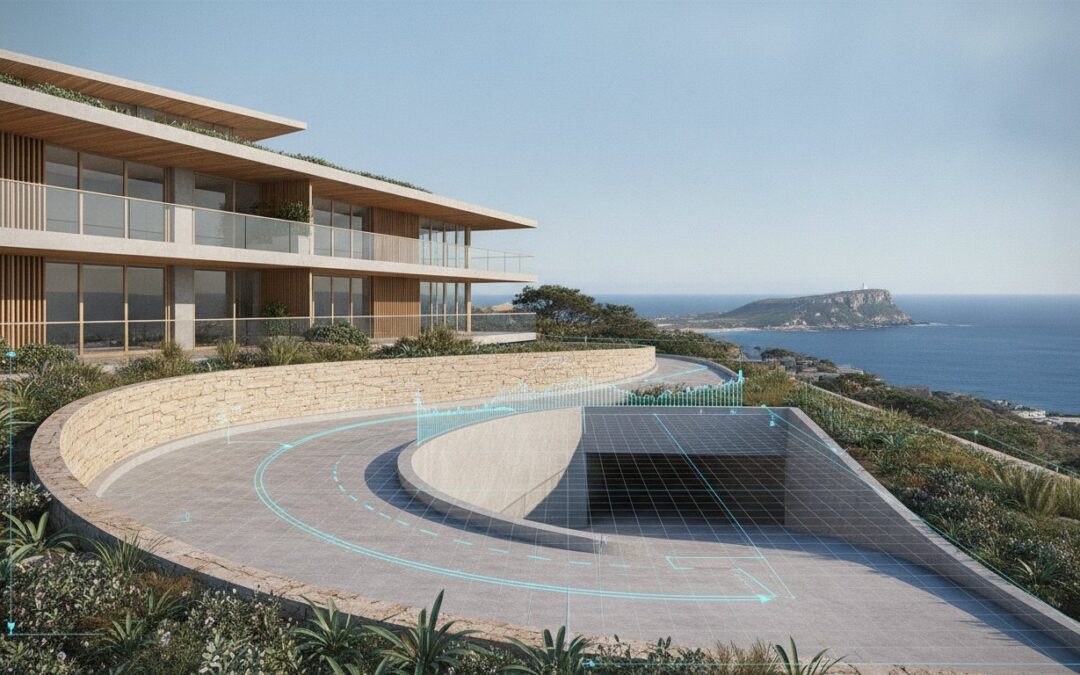
Your Development Application success in the Northern Beaches often hinges on a single technical document that many developers treat as an afterthought. The council’s shift toward a unified Local Environmental Plan has changed the regulatory environment. With the transition from Local Traffic Committees to Local Transport Forums, the requirements for a traffic report northern beaches council are now significantly more rigorous. It’s a common frustration to see a project stalled because a swept path analysis failed to account for a tight coastal site. Driveway ramp grades that don’t strictly adhere to Australian Standards will trigger immediate DA delays.
We understand that the current transitional planning period creates uncertainty. Balancing the legacy controls of Manly, Pittwater, and Warringah against new consolidated expectations is a complex task. This guide provides the engineering clarity you need to manage these requirements and secure a successful DA approval. You’ll learn the essential requirements for AS2890.1 compliance, methods for efficient vehicle access design on challenging terrain, and the specific assessment criteria used by the Local Transport Forum to evaluate your project’s impact. Our focus is on providing the technical precision required to move your development from lodgement to determination without unnecessary friction.
Key Takeaways
- Understand why a professional traffic report northern beaches council is mandatory for validating road safety and securing DA approval.
- Learn to distinguish between a full Traffic Impact Assessment and a simplified statement based on your development’s density and scale.
- Navigate the specific requirements of the Northern Beaches Local Transport Forum when your project involves changes to road infrastructure or signage.
- Identify the critical components of a compliant engineering report, including parking demand assessments that meet AS2890 standards.
- Discover the benefits of direct principal involvement to ensure technical precision and efficient negotiations with council planners.
Why a Professional Traffic Report is Essential for Council Approval
Securing a Development Application (DA) approval requires more than just architectural plans. A professional traffic report northern beaches council acts as a technical verification that a proposed development won’t degrade local road safety or traffic flow. Council planners rely on these documents to determine if parking provisions and vehicle access points meet rigorous safety benchmarks. Without this evidence, applications face immediate scrutiny.
The process involves detailed Transportation planning to ensure that the increased activity from a new site doesn’t create bottlenecks or safety hazards. Providing a qualified engineering report from the outset prevents costly Requests for Information (RFIs). These RFIs often arise when a developer submits substandard documentation, leading to project delays that can last for several months while the council waits for compliant data.
To better understand the council’s broader vision for the region, watch this summary of the transport strategy:
The Purpose of a Traffic Impact Assessment (TIA)
A TIA provides a baseline by defining the existing traffic conditions around the site. Engineers use this data to forecast traffic generation based on the specific land-use, whether it is a high-density residential block or a commercial warehouse. We use specialised software like AutoTURN to conduct vehicle swept path analysis, ensuring that the design can accommodate the required vehicles. Planners look for specific metrics regarding peak hour trip generation and intersection performance to validate the long-term viability of the site. This evaluation determines if the surrounding road network has the residual capacity to absorb new trips without requiring infrastructure upgrades.
Regulatory Compliance and Australian Standards
Technical compliance is non-negotiable. AS2890.1 serves as the mandatory benchmark for off-street car parking design. It specifies everything from bay dimensions to aisle widths. For developments involving delivery docks or heavy vehicle movements, AS2890.2 governs the access requirements for commercial trucks. Additionally, projects must align with Transport for NSW (TfNSW) guidelines to ensure consistency with state-level transport objectives. Failure to meet these standards results in a non-compliant traffic report northern beaches council, which is a common cause for DA refusal.
Every assessment must also strictly follow the Northern Beaches Council Development Control Plan (DCP). The team at ML Traffic Engineers Australia ensures that every design element, from driveway ramp grades to sight distances, meets these exact legal and safety requirements. This meticulous approach minimises the risk of council rejection.
When is a Traffic Impact Assessment (TIA) Required?
Determining the specific requirements for your Development Application is the first step in avoiding project delays. The scale of the development and its location relative to key intersections dictate the depth of the traffic report northern beaches council requires. While high-density residential, commercial, or industrial developments typically require a full Traffic Impact Assessment, smaller developments may only need a simplified Traffic Impact Statement. Identifying which path your project falls under requires an understanding of both local and national frameworks, such as the Austroads Guide to Traffic Management Part 12.
Early consultation with a traffic engineer identifies potential “deal-breakers” before you submit your plans. These issues often involve inadequate sight distances or non-compliant driveway grades that can’t be easily fixed once the design is finalised. Addressing these technical constraints early ensures the design is viable from a transport perspective.
Thresholds for Traffic Studies
Council planners apply different scrutiny levels depending on the project type and the anticipated increase in vehicle movements. Common triggers for a detailed study include:
- Residential flat buildings: Any multi-dwelling housing project usually triggers a TIA to assess the cumulative impact on the local street network and parking capacity.
- High-turnover land uses: Childcare centres, gyms, and medical clinics require rigorous analysis due to high trip generation during peak morning and afternoon periods.
- Change of use: A significant increase in parking demand or a shift in vehicle types; for example, converting a retail space into a warehouse requiring heavy vehicle access; will necessitate a formal report.
The TIA Preparation Process
A compliant traffic report northern beaches council follows a structured methodology to ensure all safety and flow concerns are addressed. This process begins with data collection and a thorough site inspection. This step identifies existing constraints like narrow verges, street furniture, or existing parking restrictions that might impede access.
Next, we perform traffic counts and intersection analysis to model how the local network performs during peak hours. This technical modelling allows us to predict how the development will impact wait times at nearby traffic lights or priority junctions. Finally, we complete a parking demand assessment and vehicle swept path analysis. Using specialised software, we verify that the largest anticipated vehicles can enter and exit the site in a forward direction without crossing onto the wrong side of the road or clipping kerbs.
If you’re unsure about the specific requirements for your site, contacting an expert engineer early in the design phase can save significant time and resources during the DA process.
Navigating the Northern Beaches Local Transport Forum
The transition from the former Local Traffic Committee to the current Local Transport Forum (LTF) represents a critical shift in how the council manages the road network. This forum acts as the primary technical advisory body for all matters involving traffic management devices within the LGA. If your development requires new line marking, parking restrictions, or regulatory signage, your traffic report northern beaches council must satisfy this group’s technical requirements. The forum includes representatives from Transport for NSW (TfNSW), the NSW Police Force, and local Members of Parliament. This structure ensures that every proposal aligns with state-wide safety standards and legal delegations before it reaches the elected Council for a final decision.
A professional report must anticipate the specific concerns of these stakeholders. NSW Police representatives focus heavily on enforcement potential and road safety, particularly regarding sight distances and the prevention of illegal vehicle movements. Simultaneously, TfNSW ensures that any local changes don’t adversely impact the broader state road network or conflict with national engineering standards. Failing to address these specific perspectives in your initial submission often leads to technical objections that can stall an application indefinitely.
The Role of Technical Advisory Committees
The LTF provides technical recommendations rather than final approvals. Because the Northern Beaches Council operates under delegated authority from TfNSW, they cannot legally install regulatory devices without first seeking the forum’s advice. Your traffic engineer must possess a deep understanding of these delegatory powers to draft a submission that is legally sound. Modern assessments must also look beyond vehicle throughput. The forum places high priority on pedestrian and cycling facilities. We ensure your submission includes robust provisions for active transport, as neglecting these elements is a frequent trigger for unfavorable recommendations from the committee.
Impact on Development Timelines
Timing is a critical factor for any commercial or residential developer. The Local Transport Forum generally operates on a monthly meeting cycle. If a traffic report northern beaches council is found to be incomplete or lacks the required swept path analysis for a specific intersection, the item is deferred. This deferral automatically adds a minimum of four weeks to your approval timeline. Ensuring your documentation is comprehensive and technically compliant before the forum reviews it is the only way to maintain project momentum. You can learn about our traffic engineering services to see how we prepare DA-ready reports that anticipate these rigorous technical reviews and keep your project on schedule.
Key Components of a Compliant Traffic Engineering Report
A compliant traffic report northern beaches council must serve as a standalone technical defence of your development’s design. It begins with a comprehensive site description and an analysis of the existing transport environment. This section identifies nearby intersections, public transport availability, and existing parking restrictions that define the site’s operational context. Without this baseline data, the council cannot accurately assess the relative impact of your new land-use. We follow this with a parking demand assessment, ensuring the number of provided spaces aligns with both the Council DCP and AS2890 requirements.
Technical precision in these reports is vital to avoid the “Request for Information” cycle. Every assessment must verify that the proposed access points are safe for all road users, including pedestrians and cyclists. Sight distance assessments at driveways are mandatory to confirm that exiting drivers have a clear view of oncoming traffic and active transport users. If these safety benchmarks are not documented, the DA will likely face technical objections from council planners.
Vehicle Swept Path and Access Assessment
Council planners strictly enforce the requirement that all service vehicles, including waste collection trucks and delivery vans, must enter and exit the site in a forward direction. We use AutoTURN software to perform a Vehicle Swept Path Analysis, providing a digital simulation of these movements. Our assessments apply the B85 and B99 vehicle templates as defined by Australian Standards to verify that there is no conflict with structural elements, such as columns or walls. For a deeper understanding of this technical process, read the complete guide to swept path analysis.
Car Park Design and Ramp Grades
Internal car park design must adhere to AS2890.1 for residential and light commercial use. We verify that every parking bay dimension, aisle width, and column location meets these benchmarks to ensure user safety and accessibility. A critical component of this assessment is the Driveway Ramp Grade Assessment. We model the vertical profile of the driveway to ensure that the transition between the road and the internal parking level does not cause vehicle scraping. Additionally, all designs must incorporate AS2890.6 compliance for disabled parking spaces, ensuring adequate shared zones and head height clearances are maintained throughout the facility.
To ensure your project meets these technical benchmarks, contact our senior engineering team for a compliant traffic report northern beaches council.
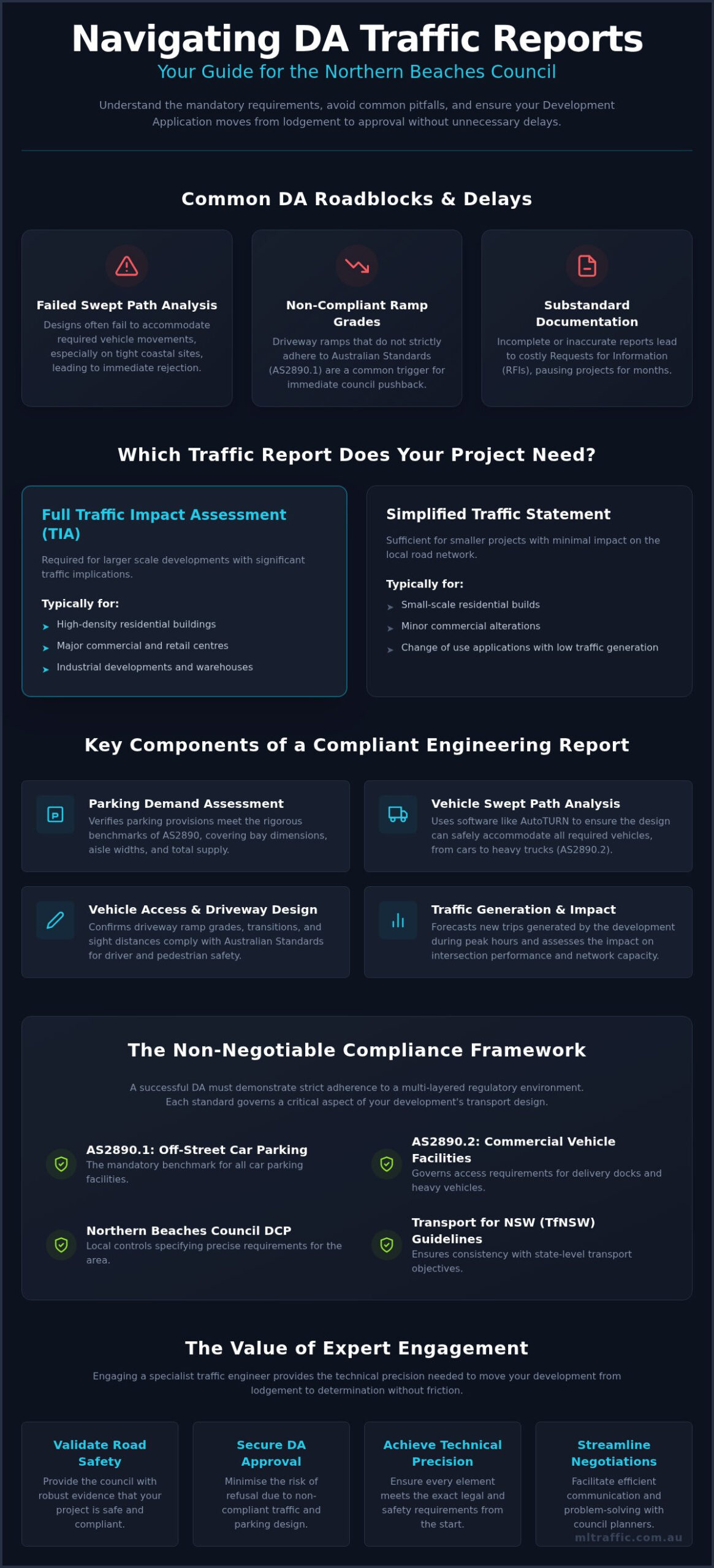
Engaging an Expert Traffic Engineer for Your Project
Securing a DA approval requires technical precision and a deep understanding of local government expectations. Choosing a consultant with extensive experience in council negotiations ensures your project doesn’t stall during the review phase. A well-prepared traffic report northern beaches council minimises project risk by addressing potential safety and compliance issues before they become grounds for refusal. ML Traffic Engineers Australia provides the national expertise required to navigate these local nuances, focusing on rigorous adherence to national standards to accelerate the approval process. This technical design accuracy is essential for high-density and complex commercial projects.
Direct principal involvement is a hallmark of our service. Unlike larger firms where work is often delegated to junior staff, we ensure that senior experts handle the technical analysis from start to finish. This accountability leads to more reliable outcomes and clearer communication with council planners. By integrating expert engineering insights early, you can identify the most efficient vehicle access designs and parking layouts for your specific site. This direct line to leadership removes bureaucratic gatekeepers and ensures your project receives the attention it deserves.
The ML Traffic Engineers Australia Advantage
ML Traffic Engineers Australia brings over 15 years of consultancy experience to every project. We have delivered DA-ready reports for a diverse range of project environments across the country. Our unique personnel continuity promise means the engineer who starts your project will be the same one performing the technical work and finalising the report. This ensures that no technical detail is lost in transition and that the person representing your project has a comprehensive understanding of its constraints. We maintain a focus on meticulous technical design and regulatory certification. Contact our senior principals today to discuss your specific project requirements.
Next Steps for Your Development Application
The path to a successful DA involves several critical technical milestones. We recommend the following steps to ensure your submission is robust:
- Organise a site-specific fee proposal to understand the scope of the required traffic assessment.
- Review your preliminary site plan against AS2890.1 standards to identify any non-compliant grades or aisle widths.
- Conduct a preliminary parking demand assessment to ensure your design meets the minimum requirements of the Council DCP.
Understanding the role of a traffic engineer in developments is essential for coordinating the various technical disciplines involved in a DA. By engaging an expert early, you ensure that your design is both functional and compliant from the outset. This proactive strategy is the most effective way to navigate the complexities of the Northern Beaches Council’s transport requirements. We provide the assurance and reliability needed for complex urban planning projects.
Securing Your Development Approval with Technical Precision
Navigating the complexities of council requirements demands a meticulous approach to technical documentation. A compliant traffic report northern beaches council is the foundation for demonstrating site safety and operational viability. By prioritising adherence to AS2890 standards and addressing the specific technical concerns of the Local Transport Forum, you mitigate the risk of costly design revisions and project stalls. Every assessment we produce is designed to withstand rigorous scrutiny from planners and transport authorities.
Our firm provides the assurance of 15 plus years of specialist experience in civil and transport engineering. We ensure that every project benefits from direct access to senior principals who perform the technical work themselves. This commitment to personnel continuity and rigorous compliance ensures your DA submission is robust and ready for immediate professional review. We focus on delivering results that accelerate your project’s timeline through technical excellence.
Don’t leave your project’s timeline to chance. Get a Professional Traffic Report for Your DA Approval and move forward with confidence in your engineering design. We look forward to assisting with your next successful development application.
Frequently Asked Questions
How long does it take to prepare a traffic report for Northern Beaches Council?
Preparation of a traffic report northern beaches council typically takes between one and two weeks. This timeframe depends on the complexity of the development and the availability of current traffic data. We conduct site inspections and perform technical modelling to ensure accuracy. If your project requires intersection counts or detailed parking surveys, the duration might extend. Early engagement helps us deliver a DA-ready document that aligns with your submission deadlines.
Do I need a swept path analysis for a single residential dwelling?
A swept path analysis isn’t standard for most single residential dwellings. However, it’s often required if the site has challenging topography, a steep driveway, or non-standard access points. Council planners use these diagrams to verify that vehicles can enter and exit without crossing onto the wrong side of the road. We use AutoTURN software to provide these simulations, ensuring your design meets the safety requirements for even the most restricted coastal sites.
What is the difference between a Traffic Impact Assessment and a Traffic Management Plan?
A Traffic Impact Assessment (TIA) focuses on the long-term effect of a completed development on the road network. It evaluates parking demand and trip generation. In contrast, a Traffic Management Plan (or Traffic Guidance Scheme) outlines how traffic and pedestrians are managed during the construction phase. While the TIA supports your Development Application, the management plan is usually a condition of consent required before work begins on the site.
Can ML Traffic Engineers assist with car park design certification?
We provide comprehensive car park design services and certification to ensure compliance with Australian Standards. Our senior engineers verify that bay dimensions, aisle widths, and column placements meet the strict requirements of AS2890.1 and AS2890.2. This certification is a critical component of your traffic report northern beaches council. We identify design flaws early to prevent vehicle scraping or accessibility issues that could lead to a non-compliant assessment from council planners.
What happens if my development doesn’t meet the Council’s parking requirements?
If your project doesn’t meet the numeric parking requirements in the Council DCP, you’ll need a formal Car Parking Demand Assessment. We analyse the specific land-use, proximity to public transport, and peak demand patterns to justify a variation. Our reports provide the evidence needed to show that the shortfall won’t adversely impact the surrounding street network. This technical justification is essential for securing approval when site constraints limit physical parking provision.
Is a traffic report required for a change of use application?
A traffic report is mandatory for change of use applications if the new activity increases parking demand or changes the type of vehicles visiting the site. For example, converting a warehouse into a gym significantly alters the trip generation profile. We assess whether the existing infrastructure can accommodate the new usage. Providing this analysis upfront prevents delays and ensures the council understands the operational impact of your proposed business model.
Does the Northern Beaches Local Transport Forum meet with the public?
The Local Transport Forum is a technical advisory committee and doesn’t hold public meetings for individual development applications. It consists of technical representatives from the Council, NSW Police, and Transport for NSW. Their role is to provide expert advice on safety and compliance. Public feedback regarding your development is managed through the standard council notification and exhibition process, where your engineering report serves as the technical evidence for the proposal.
Why is AS2890.1 compliance so important for DA approval?
Compliance with AS2890.1 is essential because it’s the national benchmark for off-street parking safety and functionality. Council planners use this standard to ensure that every parking facility is accessible and safe for all users. If your design fails to meet these metrics, it triggers a Request for Information or a flat refusal. Our reports verify that your design adheres to these benchmarks, providing the technical assurance required for a smooth approval process.

Disclaimer
The content on www.mltraffic.com.au, including all technical articles, guides, and resources, is provided for general informational and educational purposes only. It is not intended to constitute professional advice in traffic engineering, transportation planning, development approvals, or any other technical or legal field.
While ML Traffic Engineers makes every reasonable effort to ensure the accuracy, completeness, and timeliness of the information published, we do not provide any warranties or representations (express or implied) regarding its reliability, suitability, or availability for any particular purpose. Any reliance you place on the content is strictly at your own risk.
In no event shall ML Traffic Engineers, its directors, employees, authors, or affiliates be liable for any direct, indirect, incidental, special, consequential, or punitive damages (including, without limitation, loss of profits, data, or business opportunities) arising out of or in connection with the use of, or inability to use, any information provided on this website.
The articles and guides on this site are not a substitute for engaging a qualified, registered professional traffic engineer (such as an NPER or RPEQ engineer) to assess your specific project requirements. For tailored advice, compliance assessments, or traffic engineering services, please contact a competent professional.
This disclaimer may be updated from time to time without notice. By accessing or using this website, you agree to be bound by the most current version of this disclaimer.
