

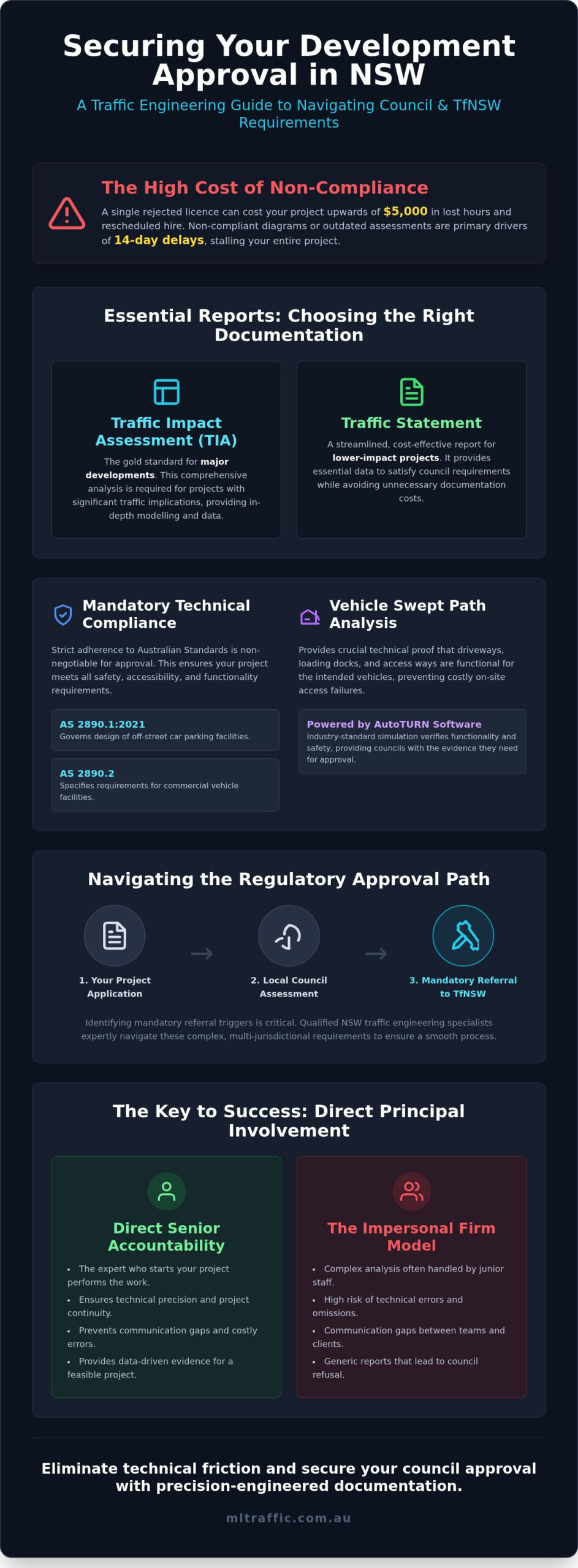
A single rejected Road Occupancy Licence can cost your project upwards of $5,000 in lost crew hours and rescheduled plant hire. You’ve likely found that meeting the rigorous expectations of local councils and Transport for NSW is no longer a simple administrative task. As NSW traffic engineering specialists, transport planners, Sydney, Wollongong, Newcastle, Parramatta, Liverpool, Penrith, Ryde, Bankstown, Hurstville, Chatswood, Bondi, we recognise that non-compliant swept path diagrams or outdated parking assessments are the primary drivers of 14-day delays. You need a clear path to approval that doesn’t involve the high overheads or impersonal service of a massive engineering firm.
This article outlines how expert traffic engineering ensures your development application meets the latest regulatory standards, including the July 2026 TCAWS Technical Standard. We’ll examine the necessity of reports that strictly adhere to AS2890.1:2021 and explain why direct communication with the senior principal performing your technical work is vital for project success. Discover how to eliminate technical friction and secure your council approval with precision-engineered documentation that stands up to the most meticulous scrutiny.
Key Takeaways
- Understand how strict adherence to AS 2890.1 and AS 2890.2 ensures your car park and commercial facility designs meet mandatory NSW safety and accessibility standards.
- Distinguish between a comprehensive Traffic Impact Assessment for major developments and a streamlined Traffic Statement for lower-impact projects to avoid unnecessary documentation costs.
- Identify the mandatory referral triggers for Transport for NSW and how qualified NSW traffic engineering specialists, transport planners, Sydney, Wollongong, Newcastle, Parramatta, Liverpool, Penrith, Ryde, Bankstown, Hurstville, Chatswood, Bondi navigate these complex multi-jurisdictional requirements.
- Discover the role of Vehicle Swept Path Analysis and AutoTURN software in providing the technical proof required for driveway and loading dock functionality.
- Recognise the importance of direct senior accountability, ensuring the expert who initiates your project is the one performing the technical analysis and certification.
What is a Traffic Engineering Specialist in the NSW Context?
A traffic engineering specialist applies scientific principles to the planning, functional design, and operation of transport systems. Traffic engineering ensures that road networks, intersections, and parking facilities facilitate movement while minimising accidents and congestion. In the New South Wales planning environment, developers require these specialists to interpret complex Local Environmental Plans and Development Control Plans. This technical expertise is essential for achieving a Statement of Environmental Effects that addresses traffic and parking requirements with precision.
The core objective of this involvement is to bridge the gap between an architect’s vision and the rigid standards enforced by local councils. Without expert input, a development application often faces immediate rejection due to technical non-compliance or public safety concerns. Professional consultants provide the data-driven evidence required to prove that a project is both feasible and safe for the surrounding community.
To better understand the broader transport strategies that impact these decisions, watch this helpful video:
The Intersection of Engineering and Urban Planning
Traffic engineers collaborate with town planners to ensure site access doesn’t compromise the surrounding road network. This process involves more than just drawing lines on a plan; it requires detailed analysis to provide evidence-based advice. Relying on generic or ‘off-the-shelf’ reports is a common pitfall that leads to council refusal. Councils expect site-specific assessments that account for existing peak-hour volumes and pedestrian movements. NSW traffic engineering specialists, transport planners, Sydney, Wollongong, Newcastle, Parramatta, Liverpool, Penrith, Ryde, Bankstown, Hurstville, Chatswood, Bondi provide the technical proof needed to justify a project’s impact on public infrastructure.
Effective collaboration in the pre-DA phase includes:
- Detailed intersection modelling using industry-standard software.
- Accurate traffic counts to establish current baseline conditions.
- Pedestrian and cyclist safety assessments for the immediate area.
- Strategic advice on driveway placement to maximise safety and efficiency.
When to Engage a Transport Planner
Early engagement identifies traffic ‘deal-breakers’ like inadequate sight distances or excessive driveway gradients before you invest in architectural drawings. Early-stage car park demand assessments are vital for determining if a site can support its intended use without overflowing into local streets. This proactive approach prevents the costly delays associated with non-compliant swept path diagrams or rejected driveway designs. A transport planner acts as a technical mediator between your development goals and public infrastructure safety requirements.
At ML Traffic Engineers Australia, our principals provide direct senior accountability for every project. This hands-on approach ensures that the expert who starts your project is the one performing the technical work. This continuity prevents the communication gaps and technical errors often found in larger, more impersonal firms where junior staff handle the complex analysis.
Essential Reports for DA Approval: TIAs and Traffic Statements
Securing a Development Application (DA) approval requires technical documentation that aligns with both local council Development Control Plans (DCPs) and Transport for NSW (TfNSW) guidelines. The two primary documents used for this purpose are the Traffic Impact Assessment (TIA) and the Traffic Statement. While a TIA is the gold standard for major developments, a Traffic Statement provides a streamlined alternative for lower-impact projects. NSW traffic engineering specialists, transport planners, Sydney, Wollongong, Newcastle, Parramatta, Liverpool, Penrith, Ryde, Bankstown, Hurstville, Chatswood, Bondi understand that choosing the wrong report type can lead to unnecessary costs or immediate rejection by council officers.
A compliant report must include a detailed review of existing conditions, a description of the proposed development, and a rigorous impact analysis. This analysis often hinges on Intersection Analysis and Sight Distance Assessments to ensure that new traffic doesn’t compromise public safety. If your project involves a change of use or a minor extension, a Traffic Statement may suffice; however, larger residential or commercial builds always require the full TIA framework to satisfy regulatory scrutiny.
The Anatomy of a Traffic Impact Assessment (TIA)
The TIA process begins with traffic generation modelling. This step predicts the number of vehicle trips a site will create during peak periods. Once generated, we use distribution and assignment techniques to determine where that traffic flows within the local road network. If the data shows a significant impact on local levels of service, we develop mitigation strategies. These might include physical infrastructure upgrades or refined site design changes to manage the increased demand. This evidence-based approach is what distinguishes a professional submission from a generic report that fails to address site-specific constraints.
Car Parking Demand and Access Assessments
Determining the correct amount of parking is a balance between land-use requirements and council DCPs. A Car Parking Demand Assessment is often necessary to justify parking shortfalls, especially in high-density urban areas. We ensure every design complies with AS 2890.1:2021 for off-street parking and AS 2890.2 for commercial facilities. This level of technical scrutiny ensures that your driveway ramp grades and parking layouts are functional and council-ready. For a comprehensive review of your project’s specific requirements, you can view our full range of traffic engineering services to ensure your submission is compliant from the outset.
Technical Compliance: AS 2890 and Vehicle Swept Path Analysis
Technical compliance is the metric by which councils judge the safety and functionality of your site. It moves beyond high-level planning into the specific dimensions and geometry of the development. Adherence to AS 2890.1:2021 for off-street car parking and AS 2890.2 for commercial vehicle facilities is mandatory. NSW traffic engineering specialists, transport planners, Sydney, Wollongong, Newcastle, Parramatta, Liverpool, Penrith, Ryde, Bankstown, Hurstville, Chatswood, Bondi ensure that every millimetre of a design meets these rigid requirements to prevent costly redesigns after submission.
Vehicle Swept Path Analysis serves as the ‘litmus test’ for driveway and loading dock functionality. We use specialised software like AutoTURN to produce council-ready diagrams that simulate real-world vehicle movements. This technical proof is essential for confirming that vehicles can enter and exit the site in a forward direction without encroaching on opposing lanes or pedestrian paths. Additionally, Driveway Ramp Grade Assessments are conducted to ensure vertical clearances are met, preventing vehicle scraping and ensuring compliance with transition grade standards.
Mastering the Swept Path Analysis
Councils require definitive proof that a B99 vehicle or a Heavy Rigid Vehicle (HRV) can manoeuvre safely within your site. A precise Swept Path Analysis directly impacts loading dock efficiency and waste collection viability. Common design errors, such as inadequate turn radii or poorly positioned structural columns, often lead to DA rejection. We identify these constraints early, allowing for architectural adjustments before the plans are finalised. This level of detail ensures that delivery vehicles and waste trucks can operate without obstructing local traffic or damaging site infrastructure.
Car Park Design and AS 2890 Compliance
Effective car park design requires a meticulous approach to column locations, aisle widths, and the elimination of blind aisles. These elements must satisfy the 85th percentile design vehicle requirements to ensure ease of use for all motorists. We also focus on the technical requirements for accessible parking spaces under AS 2890.6, which represents current best practice for disabled access. A qualified traffic engineer must certify that the design meets these Australian Standards before construction commences. This certification provides the assurance that the finished facility will be both safe and legally compliant.
The NSW Regulatory Path: Navigating TfNSW and Council Standards
The path to DA approval in New South Wales follows a structured 5-step process. This begins with pre-DA consultation to identify site-specific constraints, followed by the preparation of technical reports like a TIA or Traffic Statement. Once submitted to the local council, the application enters a formal assessment phase. If specific triggers are met, the council refers the documentation to Transport for NSW (TfNSW) for concurrence. Finally, the applicant must address any Requests for Information (RFI) to secure the final consent. NSW traffic engineering specialists, transport planners, Sydney, Wollongong, Newcastle, Parramatta, Liverpool, Penrith, Ryde, Bankstown, Hurstville, Chatswood, Bondi provide the technical expertise required to manage this multi-stage interaction without costly delays.
Compliance now requires strict adherence to the TS 05492:1.0 Traffic Control at Work Sites (TCAWS) standard, which became effective on 1 July 2026. Any plans submitted for approval must reference the 7th Edition of the TCAWS Technical Manual published in January 2026. Failure to cite these current standards is a primary cause of 14-day delays in the approval process. A Construction Traffic and Pedestrian Management Plan (CTPMP) is also essential for maintaining site safety and public access during the build phase.
Understanding TfNSW Referral Triggers
Developments impacting ‘State Roads’ or those exceeding size thresholds trigger a referral to TfNSW under the State Environmental Planning Policy (SEPP). We use the ‘Guide to Traffic Generating Developments’ to determine these triggers early in the feasibility phase. Works within 100 metres of traffic signals require a Road Occupancy Licence (ROL), regardless of the road’s classification. Managing the feedback loop between council and state authorities requires a precise understanding of these jurisdictional boundaries to ensure the project remains on schedule.
Construction Traffic Management Plans (TMP)
A comprehensive traffic management plan is mandatory before any construction activity commences. This document outlines how the site will handle heavy vehicle movements while protecting pedestrian safety. It transitions from high-level strategy to specific Traffic Guidance Schemes (TGS). Under the current 2026 standards, a PWZTMP-qualified professional must design and certify these schemes. This ensures minimal disruption to the surrounding community and prevents the financial penalties of upwards of $5,000 in lost crew hours associated with rejected permits. To secure your construction approvals, contact our senior principals for a compliant assessment.
Why Direct Principal Involvement is the Key to DA Success
Many developers encounter technical friction when their reports are handled by junior staff at large, impersonal firms. This ‘big firm’ model often results in communication gaps and technical oversights that lead to preventable council RFIs. At ML Traffic Engineers Australia, we prioritise direct senior accountability for every project. This ensures that the expert you engage at the outset is the one performing the technical modelling and certification. NSW traffic engineering specialists, transport planners, Sydney, Wollongong, Newcastle, Parramatta, Liverpool, Penrith, Ryde, Bankstown, Hurstville, Chatswood, Bondi recognise that this hands-on approach is vital for navigating the complex expectations of local government engineering departments.
Our consultancy brings over 15 years of specialised experience to the planning process. We’ve built a reputation for reliability with councils through a consistent history of high-quality, compliant submissions. This long-standing tenure provides the weight of authority needed when justifying technical variations or parking shortfalls. A principal-led approach doesn’t just provide a report; it provides a defensible strategy that leads to faster approvals and more cost-effective site designs.
The ‘No-Gatekeepers’ Advantage
Direct communication with the engineer performing your swept path and TIA modelling eliminates the ‘lost in translation’ effect common in larger consultancies. You don’t have to wait for an account manager to relay technical feedback. Instead, you speak directly to the professional responsible for the work. This model allows us to identify cost-saving opportunities in car park layouts immediately. For instance, senior expertise often reveals ways to refine aisle widths or column placements to increase parking yield while maintaining strict AS 2890 compliance. This level of meticulous design prevents the need for expensive redesigns after your plans have been lodged.
A Proven Track Record Across Diverse Projects
We apply our deep-seated expertise to a vast range of project environments. Whether you’re developing a boutique childcare centre or a large-scale industrial warehouse, we understand the specific traffic generation rates and access requirements for your land-use category. Our project history includes:
- Child care centres and educational facilities.
- Medical clinics and allied health hubs.
- Industrial warehouses and logistics centres.
- High-rise residential and mixed-use developments.
- Registered clubs, hotels, and hospitality venues.
Partnering with a traffic engineering specialist who understands these nuances ensures your DA documentation is robust and council-ready. Contact our senior principals today to discuss your DA requirements and secure a compliant, professional assessment for your next project.
Secure Your DA Approval with Expert Technical Documentation
Navigating the complex landscape of NSW planning requires technical precision and a deep familiarity with the latest 2026 standards. Our team operates as NSW traffic engineering specialists, transport planners, Sydney, Wollongong, Newcastle, Parramatta, Liverpool, Penrith, Ryde, Bankstown, Hurstville, Chatswood, Bondi, providing the rigorous analysis required to ensure your development application satisfies both local council and Transport for NSW requirements. We bridge the gap between architectural vision and regulatory compliance through data-driven reporting.
By prioritising direct senior principal involvement on every project, we eliminate the technical friction and communication gaps often found in larger firms. We offer over 15 years of specialised NSW experience, focusing on strict adherence to AS 2890 and the production of council-ready Vehicle Swept Path Analysis diagrams. This hands-on approach ensures your reports are compliant from the first lodgement, reducing the risk of costly RFIs and project delays.
Don’t leave your project success to chance with junior staff or generic assessments. Secure your council-ready traffic report from our senior principals to ensure your site design is functional, safe, and fully compliant. We look forward to helping you achieve a clear path to approval.
Frequently Asked Questions
When is a Traffic Impact Assessment (TIA) required for a DA in NSW?
A Traffic Impact Assessment (TIA) is mandatory when a development’s size or land-use category triggers specific traffic generation thresholds defined by the local council or Transport for NSW. These requirements are typically found in the State Environmental Planning Policy (SEPP) or the local Development Control Plan. Major residential flat buildings, large commercial centres, or industrial warehouses almost always necessitate a full TIA to address safety, intersection capacity, and road network efficiency.
What is the difference between a Traffic Management Plan (TMP) and a Traffic Guidance Scheme (TGS)?
A Traffic Management Plan (TMP) is a strategic document outlining the overall approach to managing traffic and pedestrian safety during a project. In contrast, a Traffic Guidance Scheme (TGS) is a technical diagram showing the specific placement of signs, barriers, and cones. Under the July 2026 TCAWS standards, a PWZTMP-qualified professional must design the TGS. While the TMP explains the high-level strategy, the TGS provides the visual instructions for physical implementation on-site.
How much does a traffic report for a development application cost?
The cost of a traffic report varies significantly depending on the project’s scale, the complexity of the site, and specific council requirements. A streamlined Traffic Statement for a minor change of use involves less technical modelling than a comprehensive Traffic Impact Assessment for a high-rise development. Factors such as the need for intersection modelling, AutoTURN swept paths, and car parking demand assessments will influence the final fee. We recommend requesting a site-specific quote.
Do I need a traffic engineer for a small residential subdivision?
Most councils require a traffic engineer to certify that a small residential subdivision provides safe and functional access for residents and service vehicles. This often involves a Sight Distance Assessment and a Vehicle Swept Path Analysis to prove that waste collection trucks can manoeuvre within the site. Even for minor projects, professional certification ensures that driveway gradients and intersection placements comply with AS 2890.1, preventing costly redesigns during the construction phase.
What are the most common reasons for a council to reject a traffic report?
Councils frequently reject reports due to non-compliance with Australian Standards AS 2890 or the use of outdated traffic data. Common technical failures include incorrect vehicle models in swept path diagrams or failing to address the latest 2026 TCAWS standards for construction management. Reports prepared by junior staff without senior oversight often miss critical site-specific constraints, such as inadequate driveway sight lines or non-compliant ramp grades, leading to immediate Requests for Information (RFI) and approval delays.
How long does it take to prepare a council-ready Swept Path Analysis?
The timeframe for preparing a council-ready Swept Path Analysis depends on the number of vehicle types and the complexity of the site layout. A standard assessment for a single driveway and B99 vehicle can often be completed quickly once architectural plans are provided. However, larger commercial sites requiring heavy rigid vehicle (HRV) modelling for loading docks may take longer. Engaging NSW traffic engineering specialists, transport planners, Sydney, Wollongong, Newcastle, Parramatta, Liverpool, Penrith, Ryde, Bankstown, Hurstville, Chatswood, Bondi early ensures these technical diagrams are ready for lodgement.
What is AS 2890 and why is it mandatory for car park design?
AS 2890 is the series of Australian Standards that defines the minimum technical requirements for off-street car parking and commercial vehicle facilities. Compliance is mandatory because these standards ensure that parking spaces, aisles, and ramps are safe for the 85th percentile of the vehicle fleet. Adhering to AS 2890.1:2021 and AS 2890.2 prevents operational failures, such as vehicles scraping on steep ramps or drivers being unable to manoeuvre within tight parking modules or blind aisles.
Can a traffic engineer help reduce the number of required parking spaces?
A traffic engineer can justify a parking shortfall through a formal Car Parking Demand Assessment. This involves analysing the specific land-use, proximity to public transport, and observed parking rates from similar developments. If the data proves that actual demand is lower than the rates prescribed in the council’s Development Control Plan, we can provide the evidence-based justification needed for a variation. This technical approach helps developers maximise site yield while still ensuring sufficient parking is available.

Disclaimer
The content on www.mltraffic.com.au, including all technical articles, guides, and resources, is provided for general informational and educational purposes only. It is not intended to constitute professional advice in traffic engineering, transportation planning, development approvals, or any other technical or legal field.
While ML Traffic Engineers makes every reasonable effort to ensure the accuracy, completeness, and timeliness of the information published, we do not provide any warranties or representations (express or implied) regarding its reliability, suitability, or availability for any particular purpose. Any reliance you place on the content is strictly at your own risk.
In no event shall ML Traffic Engineers, its directors, employees, authors, or affiliates be liable for any direct, indirect, incidental, special, consequential, or punitive damages (including, without limitation, loss of profits, data, or business opportunities) arising out of or in connection with the use of, or inability to use, any information provided on this website.
The articles and guides on this site are not a substitute for engaging a qualified, registered professional traffic engineer (such as an NPER or RPEQ engineer) to assess your specific project requirements. For tailored advice, compliance assessments, or traffic engineering services, please contact a competent professional.
This disclaimer may be updated from time to time without notice. By accessing or using this website, you agree to be bound by the most current version of this disclaimer.
