

A single non-compliant aisle width or a poorly calculated swept path can delay a multi-million dollar Australian development application by up to 12 weeks. You likely recognize the frustration of losing developable square footage to inefficient parking designs that fail to meet local council expectations. It’s a common bottleneck where architectural vision meets the rigid reality of traffic engineering requirements. Balancing a high stall count with seamless vehicle flow is often the difference between a profitable project and a costly redesign.
In this guide, you’ll learn the technical strategies for optimizing car park layout for efficiency while strictly adhering to AS 2890.1 standards. We’ve seen how precise engineering prevents the common council rejections that plague approximately 15% of initial submissions. We’ll examine how to maximize your parking yield, ensure safe vehicle circulation, and prepare documentation that secures faster approvals. This overview covers everything from ramp grades to maneuverability assessments, providing the expert clarity your project needs to move forward without delay.
Key Takeaways
- Align your design with AS 2890.1 to ensure a compliant balance between maximum stall yield and safe vehicle circulation.
- Evaluate the trade-offs between 90-degree high-density layouts and angled configurations to determine the most effective footprint for your specific site.
- Master the technical fundamentals of optimizing car park layout for efficiency by calculating the critical relationship between stall dimensions and aisle widths.
- Utilize dynamic Swept Path Analysis and AutoTURN software to proactively resolve operational bottlenecks before they reach the council.
- Secure faster approvals by integrating your parking design into a principal-led Traffic Impact Assessment (TIA) that prioritizes technical accuracy.
Table of Contents
-
Defining Car Park Efficiency in the Australian Regulatory Framework
-
Geometric Fundamentals: Maximizing Space Without Sacrificing Safety
Defining Car Park Efficiency in the Australian Regulatory Framework
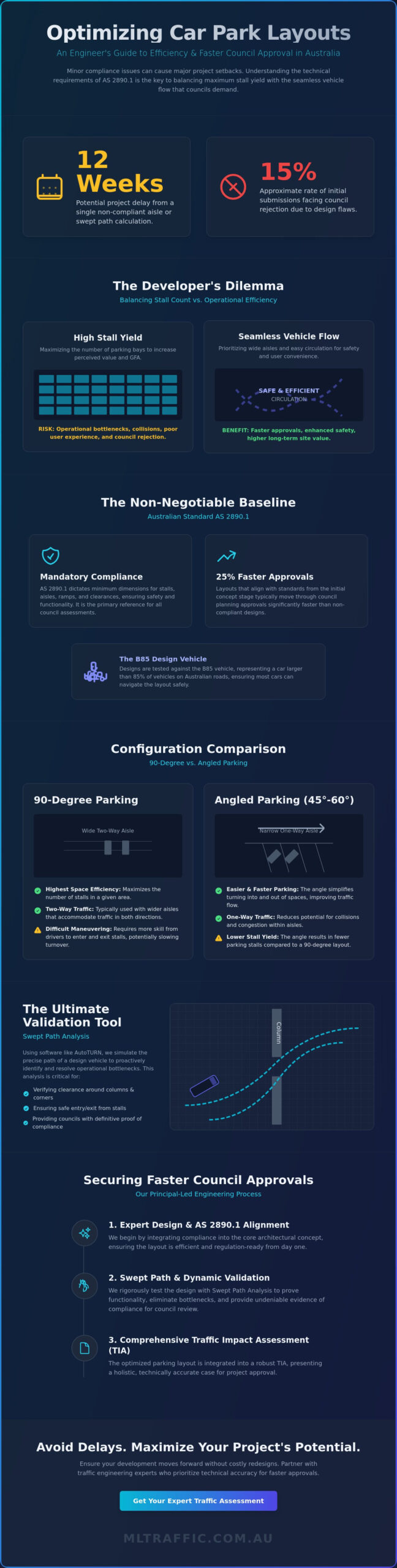
Efficiency in Australian car park design isn’t a subjective measure. It’s the calculated balance between maximum stall yield and compliant vehicle circulation. Professional traffic engineers define this through strict adherence to parking lot design fundamentals and local planning schemes. When developers focus solely on stall numbers, they often compromise the functional flow, leading to bottlenecks that reduce the overall site value. We focus on creating layouts that work for both the developer’s bottom line and the end-user’s experience.
Optimizing car park layout for efficiency ensures that a project meets the non-negotiable baseline of AS 2890.1. Layouts that align with these standards from the initial concept stage typically move through council planning approvals 25% faster than non-compliant designs. Inefficient designs result in hidden costs, particularly through the loss of Gross Floor Area (GFA). When columns are poorly placed or aisles are unnecessarily wide, developers lose valuable square meterage that could’ve been allocated to retail or residential space. Operational congestion also creates long-term maintenance issues and safety risks.
To better understand the technical aspects of layout optimization, watch this helpful video:
Yield vs. Operational Flow: The Developer’s Dilemma
Maximizing stall numbers doesn’t always translate to higher financial gain. In commercial developments, a layout that causes 5-minute delays during peak hours will drive customers away. Dead-end aisles are a primary cause of internal traffic congestion. These configurations force drivers to perform multi-point turns, increasing the risk of collisions and slowing down turnover rates. A high-yield site with poor flow is often worth less than a lower-yield site that functions seamlessly. Our traffic engineering services prioritize a layout that balances these competing interests.
The Role of Australian Standards in Optimization
AS 2890.1 and AS 2890.6 govern the technical requirements for off-street and accessible parking in Australia. These standards dictate minimum aisle widths, which vary based on the stall angle and the specific vehicle class being accommodated. For example, a 90-degree stall requires a wider aisle than a 45-degree angled stall to allow for safe maneuvering. The B85 vehicle is the standard design tool for Australian car parks, representing a vehicle whose physical dimensions are larger than 85% of the cars on the road. Meticulous application of these standards ensures that every square metre of the site is utilized effectively while maintaining safety for all users.
Geometric Fundamentals: Maximizing Space Without Sacrificing Safety
The geometry of a parking facility dictates its commercial viability and operational safety. In Australia, AS 2890.1:2004 provides the mandatory framework for these calculations. Optimizing car park layout for efficiency involves more than just fitting the maximum number of bays into a basement. It requires a precise understanding of vehicle swept paths, user behaviour, and structural constraints. Our experience across 10,000 sites shows that early-stage geometric precision prevents expensive compliance issues during the construction phase.
Stall and Aisle Dimensioning Strategies
Traffic engineers use "User Class" definitions to determine minimum dimensions based on the expected duration of stay and turnover. User Class 1 applies to residential or employee parking where users are familiar with the layout. This allows for narrower 2.4-metre stalls. In contrast, User Class 3 for high-turnover retail environments requires widths of 2.6 metres or 2.7 metres to facilitate easier entry and exit for shoppers with trolleys or children.
There’s a constant trade-off between aisle width and stall width. A wider aisle allows for narrower stalls, whereas a narrow aisle necessitates wider stalls to ensure vehicles can complete the turn into the space. We use the "area per stall" metric to benchmark performance. An efficient 90-degree layout generally achieves 25 to 28 square metres per bay. If a design exceeds 32 square metres per bay, the footprint is likely under-optimized and wasting valuable floor area.
Structural Integration and Column Grid Optimization
The 8.4-metre structural grid is the standard for Australian basement car parks. This spacing comfortably accommodates three stalls while allowing for columns up to 600mm wide. Proper column placement is vital for door swing clearance. We typically position columns between 0.75 metres and 1.5 metres from the aisle. This ensures columns align with the vehicle’s "B-pillar" area, which prevents drivers from hitting their doors against concrete when exiting the car.
Dead-end or "blind" aisles present significant safety risks and operational bottlenecks. AS 2890.1 mandates that any blind aisle serving more than six spaces must include a dedicated turn-around area. This prevents drivers from having to reverse long distances, which is a primary cause of low-speed basement collisions. For complex or tight sites, a Vehicle Swept Path Assessment is essential to verify that the design works for the intended vehicle fleet without compromising structural integrity.
Clear sight-lines are non-negotiable at every intersection and pedestrian crossing point. We ensure that structural elements or signage don’t create "blind spots" for drivers. By integrating these geometric fundamentals early, we provide a layout that’s both compliant and highly functional for the end-user.
Configuration Comparison: 90-Degree vs. Angled Parking
Selecting the correct parking geometry is the most critical decision when optimizing car park layout for efficiency. The choice between 90-degree and angled configurations dictates both total vehicle yield and the functional flow of the site. While 90-degree stalls are the standard for high-density requirements, angled layouts offer distinct operational advantages for specific site constraints and traffic volumes.
90-degree parking is the industry benchmark for maximizing stall count in two-way aisle systems. It’s the most space-efficient layout when land area is at a premium and two-way circulation is required. However, it demands wider aisles to accommodate the 90-degree turn-in maneuver. Angled parking (typically 30, 45, or 60 degrees) excels in narrow sites where a full 6.2m aisle isn’t feasible. While 90-degree stalls offer higher density, angled stalls reduce the time spent searching and parking, which lowers driver frustration in high-pressure environments.
When to Choose 90-Degree Layouts
Residential basements and long-term staff parking represent the best use cases for 90-degree stalls. These users are familiar with the site and can navigate tighter maneuvers comfortably. Compliance with AS 2890.1 is non-negotiable here. Aisle widths must typically range between 5.8m and 6.2m to allow for safe B85 vehicle swept paths. Our engineers link these yield calculations directly to Traffic Impact Assessments to ensure the proposed density doesn’t overwhelm the local road network. If the site allows for two-way traffic, the 90-degree configuration remains the gold standard for yield.
The Advantages of One-Way Angled Systems
One-way angled systems are the superior choice for high-turnover retail environments like shopping centres or quick-service restaurants. They simplify the driver’s task by aligning the stall with the natural direction of travel. This configuration significantly reduces conflict points between entering and exiting vehicles; head-on interactions are virtually eliminated. It’s a safer, more intuitive experience for occasional visitors.
Space-saving is achieved through "interlocking" or herringbone stall patterns. By nesting the front of vehicles in opposing rows, developers can reclaim significant floor area. Key benefits include:
-
Reduced Aisle Width: A 45-degree layout can operate effectively with an aisle as narrow as 3.5m to 3.9m.
-
Faster Turnover: Drivers spend 15% less time maneuvering into angled stalls compared to 90-degree alternatives.
-
Improved Sight-Lines: Angled exits provide better visibility of oncoming aisle traffic, reducing low-speed collisions.
By optimizing car park layout for efficiency through one-way loops and interlocking stalls, developers can maintain steady throughput even during peak Saturday trade. We ensure every design meets the rigorous technical requirements of Australian planning authorities while maximizing the commercial potential of the site.
Swept Path Analysis: The Ultimate Layout Optimization Tool
Designing a car park based on static drawings often leads to operational failure. A layout might look compliant on a 2D CAD file, but real-world vehicle movement is fluid and dynamic. We use AutoTURN software to simulate these movements with precision. This simulation identifies potential bottlenecks before plans reach the council for assessment. It prevents costly redesigns during the construction phase or, worse, after the concrete is poured.
Swept path analysis allows for precise adjustments to ramp grades and driveway entries. By verifying every turn, we ensure the design accommodates the intended vehicles without over-engineering the footprint. This is a critical step for optimizing car park layout for efficiency while maintaining strict safety standards. We focus on the actual path of the vehicle body and the clearance required for the outer wheels.
-
Identify conflict points between opposing traffic flows.
-
Verify that structural columns don’t impede vehicle turning circles.
-
Ensure smooth transitions between different floor levels.
-
Confirm that parking bays are accessible in a single maneuver where possible.
Simulating the B85 and B99 Design Vehicles
AS 2890.1 defines the B85 and B99 design vehicles. The B85 represents the 85th percentile vehicle, while the B99 represents the 99th percentile, typically large SUVs or luxury sedans. Checking the B99 vehicle is essential for ensuring "worst-case" scenarios don’t result in property damage. We identify "scrape points" on steep ramps and tight basement turns where long-wheelbase vehicles might bottom out. For technical specifications, read our detailed guide on Swept Path Analysis.
Service Vehicle Integration (AS 2890.2)
Efficient layouts must account for service vehicle access without disrupting general parking flow. AS 2890.2 governs these requirements for commercial and mixed-use developments. We design loading docks that accommodate Medium Rigid Vehicles (MRV) or Heavy Rigid Vehicles (HRV) based on the specific land-use needs. This ensures that waste collection and deliveries don’t create gridlock for residents or customers. Optimizing car park layout for efficiency requires a clear separation between heavy vehicle paths and standard car spaces.
-
Vertical clearance: We verify minimum head heights, often requiring 3.5 metres for Small Stretch Vehicles or more for HRVs.
-
Turn-in radius: Street-level access must allow entry without the vehicle crossing into opposing traffic lanes on the public road.
-
Reversing maneuvers: We limit the number of points in a turn to improve safety and reduce the time a vehicle spends blocking an aisle.
Our engineers provide the technical verification needed to satisfy council planners and ensure long-term functionality. Contact our experienced traffic consultants to book a swept path assessment for your next development application.
Engineering for Council Approval: The ML Traffic Approach
Achieving council approval requires more than a compliant drawing. It demands a technical integration of the parking design with the broader Traffic Impact Assessment (TIA). At ML Traffic Engineers, we ensure that optimizing car park layout for efficiency occurs at the preliminary stage. This prevents costly redesigns during the Request for Information (RFI) phase. Our firm operates on a principal-led model. The traffic consultant who provides your quote is the person who performs the technical work. This eliminates communication gaps common in larger firms where junior staff handle complex calculations.
We reduce project risk through early-stage parking demand assessments. If a site can’t meet the strict numbers in a Local Environmental Plan (LEP) or Development Control Plan (DCP), we provide the empirical data to justify a variation. This evidence-based approach is critical for high-density developments in Sydney, Melbourne, or Brisbane. Final certification is the last step. We verify that the built car park matches the approved plans and Australian Standards like AS 2890.1. This ensures the developer isn’t left with a non-compliant asset that risks future liability.
-
Integration with TIA and TIS reports
-
Principal-led design for accountability
-
Early-stage risk mitigation through demand assessments
-
Final certification for council compliance
Linking Parking Design to Site Approval
A compliant layout is a core component of a Statement of Environmental Effects. Councils often scrutinize the over-supply of parking as much as under-supply. We navigate these conflicting requirements by utilizing "Green Travel Plans." These plans allow for reduced parking ratios by demonstrating proximity to public transport or providing end-of-trip facilities. Our assessments have successfully justified parking reductions of 20% or more for specific urban sites by optimizing car park layout for efficiency while meeting local planning objectives.
Why Professional Traffic Engineering Matters
Experience is the most valuable asset in negotiations with local authorities. ML Traffic Engineers brings over 15 years of experience to every project. We’ve optimized layouts for over 10,000 sites nationally, ranging from small childcare centers to massive industrial warehouses. This volume of work gives us unique insight into specific council expectations across Australia. Our senior staff are directly involved in every assessment to ensure accuracy and compliance. Contact our senior consultants for a project-specific assessment.
Secure Your Development Approval with Precision Engineering
Achieving a balance between maximum yield and AS 2890.1 compliance is the foundation of a successful Australian development. You’ve seen how technical tools like swept path analysis and strategic configuration choices determine long-term functionality. Optimizing car park layout for efficiency isn’t just about fitting more vehicles into a basement; it’s about ensuring safety and meeting strict Council requirements without delay. It’s a complex process that demands professional oversight.
ML Traffic Engineers brings over 15 years of experience and a track record of more than 10,000 successful site assessments to your project. You’ll work directly with our senior principals, Michael Lee and Benny Chen, ensuring high-level accountability from the initial quote to the final report. We understand the technicalities of the Australian regulatory framework inside and out. The traffic consultant who provides your quote is the one who does the work. Get a compliant and optimized car park design from ML Traffic Engineers. We’re ready to help you move your project forward with confidence.
Frequently Asked Questions
What is the most efficient angle for a parking lot?
90-degree parking is the most space-efficient layout for high-yield developments. It allows for two-way traffic and maximizes the number of bays per square metre compared to 30, 45, or 60-degree angles. While angled parking reduces the required aisle width, the overall vehicle density is lower because of the unusable triangular spaces at the ends of each row.
How many parking spaces can I fit in a 1000 square metre area?
You can typically fit between 30 and 35 parking spaces in a 1000 square metre area, accounting for aisles and circulation. This estimate assumes a standard 90-degree layout with 2.4m to 2.6m bay widths. Actual yield depends on site geometry and the specific requirements of AS 2890.1. Optimizing car park layout for efficiency often involves balancing these dimensions against structural columns or required landscaping buffers.
Is 90-degree parking or angled parking better for narrow sites?
Angled parking is better for narrow sites because it requires significantly narrower aisle widths. For example, a 45-degree layout might only require a 3.5m wide one-way aisle, whereas a 90-degree layout typically requires a 5.8m to 6.2m aisle for two-way movement. This reduction in aisle width can be the difference between fitting a row of parking or having no vehicle access at all.
What are the minimum aisle widths required by AS 2890.1?
AS 2890.1 specifies a minimum aisle width of 5.8 metres for standard 90-degree User Class 1A parking. For User Class 2, which covers long-term parking, this width can increase to 6.2 metres to ensure comfortable maneuvering. These standards are mandatory for compliance in Australian developments. Deviations from these measurements require a formal assessment by a qualified traffic engineer to ensure safety and functionality.
How does Swept Path Analysis improve car park efficiency?
Swept Path Analysis uses software like AutoCAD Vehicle Tracking to simulate the exact movement of vehicles through a site. This process identifies potential pinch points where cars might clip kerbs or walls before construction begins. By verifying that a B85 or B99 vehicle can navigate the layout, we eliminate wasted space and ensure the design meets the tightest possible tolerances allowed by Australian Standards.
Do I need a traffic engineer for a small residential car park?
Local councils in Australia generally require a traffic engineer to certify any development application involving more than 2 or 3 dwellings. We provide the necessary documentation to prove compliance with AS 2890.1 and local planning schemes. Engaging a specialist early prevents costly redesigns if the council’s assessment team identifies non-compliant driveway grades or inadequate sight lines at the property boundary.
How can I increase the parking yield on a constrained development site?
You can increase parking yield by implementing a mix of small car spaces or using mechanical parking systems like car stackers. AS 2890.1 allows up to 25% of spaces to be designated for small cars in certain jurisdictions, which reduces individual bay dimensions to 2.3m by 5.0m. Optimizing car park layout for efficiency through these methods requires a precise balance of user classes to satisfy council requirements while maximizing the available footprint.
What is the difference between Class 1A and Class 3 parking requirements?
Class 1A refers to residential or employee parking where users are familiar with the layout, allowing for a standard 2.4m bay width. Class 3 covers short-term high-turnover parking like shopping centres or hospitals, requiring wider 2.6m bays to accommodate frequent entry and exit. The 0.2m difference per bay adds up quickly across a large site. Choosing the wrong class can lead to significant congestion and vehicle damage.
Which areas do you cover?
We are traffic engineers servicing Melbourne, Sydney, Brisbane, Gold Coast, Hobart, Perth, Adelaide, Darwin, Canberra and surrounding areas.

Disclaimer
The content on www.mltraffic.com.au, including all technical articles, guides, and resources, is provided for general informational and educational purposes only. It is not intended to constitute professional advice in traffic engineering, transportation planning, development approvals, or any other technical or legal field.
While ML Traffic Engineers makes every reasonable effort to ensure the accuracy, completeness, and timeliness of the information published, we do not provide any warranties or representations (express or implied) regarding its reliability, suitability, or availability for any particular purpose. Any reliance you place on the content is strictly at your own risk.
In no event shall ML Traffic Engineers, its directors, employees, authors, or affiliates be liable for any direct, indirect, incidental, special, consequential, or punitive damages (including, without limitation, loss of profits, data, or business opportunities) arising out of or in connection with the use of, or inability to use, any information provided on this website.
The articles and guides on this site are not a substitute for engaging a qualified, registered professional traffic engineer (such as an NPER or RPEQ engineer) to assess your specific project requirements. For tailored advice, compliance assessments, or traffic engineering services, please contact a competent professional.
This disclaimer may be updated from time to time without notice. By accessing or using this website, you agree to be bound by the most current version of this disclaimer.
