

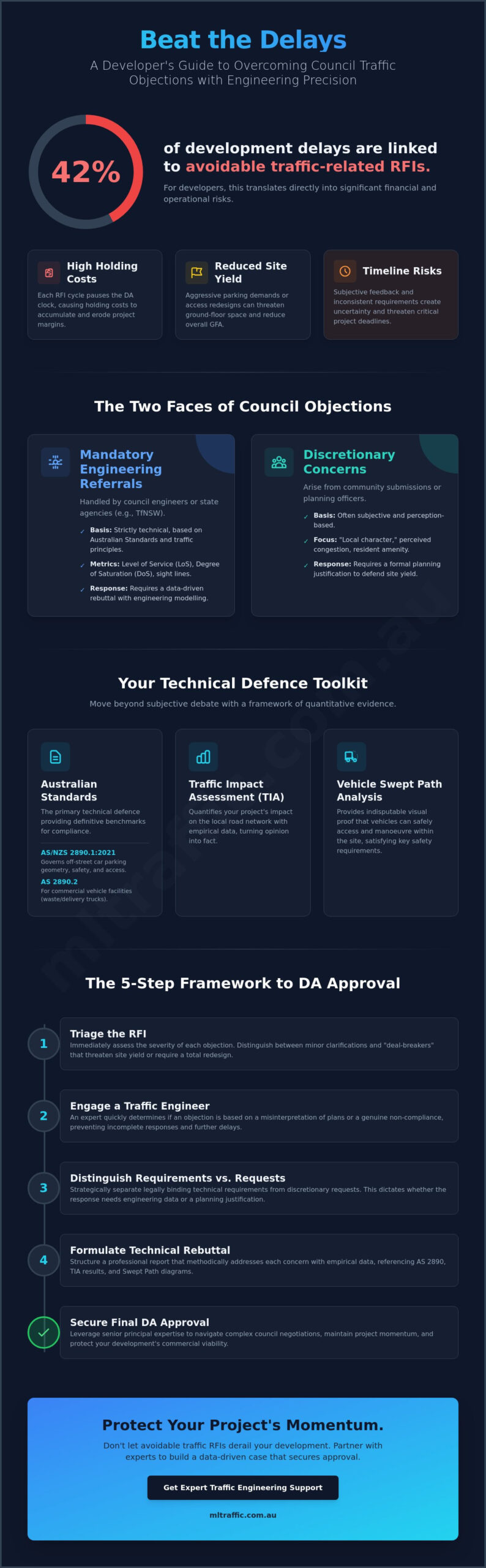
42% of development delays in Australia are linked to traffic-related RFIs that could have been avoided during the initial design phase. For developers, these delays translate directly into high holding costs and the risk of reduced site yield due to aggressive parking demands. You likely feel the frustration of facing subjective community feedback or inconsistent requirements that threaten your project timeline. Successfully overcoming traffic objections from council requires moving beyond generalisations and into the realm of technical precision.
This article provides a strategic engineering framework to dismantle objections using technical compliance and empirical data. You’ll learn how to leverage the latest standards, including AS/NZS 2890.1:2021 and other relevant jurisdictional guidelines, to defend your design. We’ll distinguish between legally binding requirements and discretionary requests, ensuring your response secures DA approval with minimal changes.
We’ll examine how to use a Traffic Impact Assessment (TIA) and Vehicle Swept Path Analysis to turn a subjective debate into a factual negotiation. This guide gives you the tools to maintain project momentum and protect your site’s commercial viability through rigorous engineering evidence.
Key Takeaways
- Identify the technical triggers behind traffic-related Requests for Further Information (RFI) to reduce development delays.
- Use AS 2890.1:2021 and AS 2890.2 as the primary technical benchmarks for defending parking and access designs.
- Apply a strategic framework for overcoming traffic objections from council using empirical engineering data and targeted design modifications.
- Structure a professional technical rebuttal report that addresses planning officer concerns while maintaining site yield.
- Leverage senior principal expertise to navigate complex council negotiations and secure final DA approval.
Understanding Council Traffic Objections and the RFI Process
A Request for Further Information (RFI) is a formal administrative mechanism used by Australian local councils to pause the assessment clock on a Development Application (DA). In the context of transport planning, an RFI indicates that the submitted documentation lacks the technical depth required to satisfy statutory requirements. Effectively overcoming traffic objections from council begins with recognizing that an RFI is a technical negotiation rather than a final refusal. It’s a signal that the council requires specific evidence to justify your project’s impact on the local road network.
Traffic and parking issues represent the most frequent cause of DA delays because they directly impact public safety and existing infrastructure capacity. When a council issues an RFI, it often triggers a 10 to 15 day review cycle that can repeat multiple times if the response is inadequate. For developers, these delays result in substantial holding costs that erode project margins. Addressing these concerns with a professional, data-backed approach is the only way to restart the approval clock.
For a deeper dive into the strategies for effectively addressing council traffic objections and navigating the RFI process, consider this expert insight:
Mandatory Engineering Referrals vs. Discretionary Concerns
Council objections originate from two distinct streams. Mandatory engineering referrals are handled by internal council departments or state agencies like Transport for NSW. These assessments rely on Traffic engineering principles to evaluate safety, intersection performance, and compliance with Australian Standards. These objections are strictly technical and require a data-driven rebuttal based on established metrics like Level of Service (LoS) or Degree of Saturation (DoS).
Discretionary concerns often arise from community submissions or planning officers. These objections frequently focus on “local character,” perceived congestion, or resident amenity. While these feel subjective, they still require a formal response. Distinguishing between a technical safety requirement and a discretionary planning preference is essential. It dictates whether your response should focus on engineering modelling or a broader planning justification to protect your site yield.
The Triage Process: Assessing Objection Severity
Not all objections carry the same weight. Some are minor clarifications, while others are “deal-breakers” that could force a reduction in site yield or a total redesign of access points. Immediately after receiving a council traffic objection, you must triage the items based on their impact on the development footprint. A requirement to increase parking spaces, for example, might threaten the entire ground-floor commercial area.
Engaging a qualified traffic engineer at the RFI stage is a critical step in this process. An expert from a firm like ML Traffic Engineers Australia can quickly determine if an objection is based on a misinterpretation of the plans or a genuine non-compliance issue. Early intervention prevents the submission of incomplete responses that lead to subsequent RFIs and further delays. This proactive approach is the most reliable method for overcoming traffic objections from council while maintaining your project’s commercial objectives.
Technical Compliance Frameworks: AS 2890 and Empirical Data
Successfully overcoming traffic objections from council requires a shift from qualitative arguments to quantitative evidence. The primary technical defence for any residential development is AS/NZS 2890.1:2021. This standard governs off-street car parking and provides the definitive benchmarks for geometry, safety, and accessibility. For industrial or mixed-use projects, AS 2890.2 serves a similar role regarding commercial vehicle facilities, ensuring that heavy vehicle movements, including waste collection and delivery, are handled within the site boundaries without impacting the public road network.
While local Development Control Plans (DCPs) often rely on generic parking rates, these figures can be outdated. We utilize the ITE Trip Generation Manual and modern traffic modelling to predict actual traffic flow based on specific land-use categories. This data-driven approach allows us to challenge conservative council estimates with global and local empirical evidence. Referencing a comprehensive Traffic Assessment Guide can further validate the methodologies used to calculate these impacts. If you require specialized analysis, our team provides comprehensive traffic engineering services to support your DA response.
Leveraging Australian Standards for Parking Design
Compliance with AS 2890.1 is not a suggestion; it’s a technical guarantee of safety and maneuverability. We focus on critical elements such as driveway ramp grades and sight distance requirements as specified in AS 2890.1 Clause 3.2. These standards provide clear, non-negotiable metrics that shut down subjective safety concerns raised by planning officers or community members. When a design meets the precise gradient and clearance requirements of the Australian Standard, the council’s ability to object on safety grounds is significantly diminished. We use these standards to prove that the proposed access points are technically sound and functionally safe.
Using Empirical Data to Reduce Parking Demands
A Car Parking Demand Assessment is the most effective tool for justifying a departure from standard council parking rates. This process involves analyzing site-specific factors such as Public Transport Accessibility Level (PTAL) ratings and Australian Bureau of Statistics (ABS) census data regarding local car ownership. By demonstrating that a site’s proximity to transport hubs or the demographic profile of future residents will result in lower actual demand, we can protect site yield. Empirical data serves as a rigorous technical rebuttal to outdated or overly conservative local council parking policies. This evidence moves the conversation away from “what the DCP says” to “what the data proves.”
Applying these frameworks ensures that your response to an RFI is authoritative and difficult to dismiss. Instead of negotiating based on opinion, we negotiate based on verified engineering standards and site-specific reality.
Strategic Rebuttal Methods: Data vs. Design Adjustments
Choosing the correct strategy for overcoming traffic objections from council depends on the nature of the Request for Further Information (RFI). You must decide whether to stand your ground using rigorous technical modelling or implement minor design adjustments. This decision hinges on the impact each choice has on your site yield and project timeline. A data-driven approach is essential when council demands threaten the commercial viability of the development, whereas design tweaks are often the fastest path to approval for minor compliance issues.
The “Merit-Based” argument is a powerful tool in Australian planning. It allows for non-standard designs provided you can prove they meet the underlying safety and functional objectives of the local Development Control Plan (DCP). We balance your site yield with council engineering requirements by identifying which standards are non-negotiable and which offer flexibility under expert justification. This strategic triage ensures you don’t lose valuable floor space to unnecessary parking or oversized access ways.
When to Defend Your Original Design
You should defend your original design when council objections are “soft” or not supported by Australian Standards. These often include community submissions regarding perceived traffic congestion or vague safety concerns that lack empirical backing. We use intersection modelling and gap acceptance analysis to prove that the current road capacity is sufficient for the proposed development. A comprehensive Traffic Impact Assessment serves as the primary technical evidence in these scenarios. It provides the quantitative proof required to maintain your original footprint and protect the project’s density.
Implementing Minor Design Modifications
Implementing minor modifications can often facilitate a faster approval without significant cost. These “quick wins” might include adjusting driveway widths by small margins or refining car park gradients to better align with AS 2890.1. It is often strategic to concede on non-essential points to win on critical site footprint issues. Negotiating these concessions requires a direct line to council engineers. Our professional traffic engineering services involve these high-level negotiations. We ensure that any design change is functional, compliant, and has the least possible impact on your overall yield.
By categorizing objections as either data-rebuttals or design-fixes, you regain control over the DA process. This dual-track strategy prevents unnecessary delays and ensures the final approved design remains as close to your original vision as possible.
Structuring a Technical Traffic Engineering Response Report
The formal rebuttal report is the primary instrument for overcoming traffic objections from council. This document must be structured with technical precision to satisfy both the internal council engineer and the planning delegate. A successful report follows a strict hierarchy of evidence, placing Australian Standards at the apex, followed by empirical site data, computer-based modelling, and finally, professional expert opinion. This structure ensures that your arguments are grounded in non-negotiable safety requirements before moving into more discretionary areas of transport planning.
While the body of the report is technical, you must include a non-technical executive summary. Planning officers often lack an engineering background and need a clear, concise explanation of why the proposed design is acceptable. This summary should translate complex intersection metrics or parking demand data into a simple statement of compliance. By providing this clarity, you reduce the likelihood of further administrative delays. If you need a formal response drafted to these standards, you can contact our senior principals for immediate assistance.
Essential Components of the Rebuttal Report
A professional rebuttal report must systematically address every point raised in the Council RFI. Ignoring even a minor query can result in the council rejecting the entire response. We reference specific clauses in Australian Standards, such as AS 2890.1 or local planning schemes, to provide a statutory basis for our arguments. Each section should conclude with a clear “Conclusion of Compliance.” This statement explicitly tells the planning delegate that the specific objection has been resolved through technical evidence or design modification, leaving no room for ambiguity in their final assessment.
The Role of Visual Evidence: Swept Paths and Modelling
Visual evidence provides the most compelling proof of accessibility and safety. A detailed swept path analysis is essential for demonstrating that vehicles can enter and exit the site in a forward direction. We use AutoTURN diagrams to provide a 2D or 3D simulation showing that garbage trucks, emergency vehicles, and delivery vans can maneuver safely within the car park and driveway areas. This removes the guesswork for council engineers and proves that the design is functionally sound. SIDRA modelling provides quantitative proof of intersection performance by calculating delays, queue lengths, and levels of service under various traffic scenarios.
By combining rigorous data with clear visual modelling, the rebuttal report transforms a subjective dispute into a settled technical matter. This authoritative approach is the most effective way to secure a recommendation for approval from the council’s engineering department.
Securing Final DA Approval with Expert Advocacy
Senior principal involvement is the final catalyst for overcoming traffic objections from council. While technical reports provide the foundation, complex developments often require direct advocacy to resolve conflicting interpretations of planning schemes. We utilize a “no-gatekeepers” approach to engineering consultancy. This means the senior expert who performs the technical work is the same individual who represents your project in council negotiations. This continuity ensures that every technical nuance of the Traffic Impact Assessment is defended with first-hand knowledge during the critical final review phase.
Professional continuity from project inception to final approval prevents the communication gaps that often occur in larger firms. When a council engineer has follow-up questions regarding the SIDRA modelling or parking demand data, they receive immediate, authoritative answers. This direct line of communication builds professional trust with council staff and accelerates the determination process. By removing administrative layers, we ensure your project remains a priority rather than another file in a queue.
Direct Negotiation with Council Engineers
Post-submission meetings are where the most difficult technical clarifications occur. Having a seasoned expert advocate for your project during these sessions is a significant advantage. We handle these negotiations by focusing on the objective safety and capacity metrics established in previous sections. It is vital that the technical traffic rebuttal aligns perfectly with the project’s overall Statement of Environmental Effects (SEE). We ensure that the traffic engineering response supports the broader planning justification, providing a unified front that makes it difficult for the council to sustain an objection.
Finalising the Rebuttal: Verification and Review
The final submission must be flawless to prevent a second or third RFI. We implement a rigorous senior peer review process to ensure every report is accurate and every council query is addressed systematically. This verification stage checks the integrity of all swept path analyses and driveway ramp grade assessments against the latest Australian Standards. We confirm that all RFI requirements have been met in full before the final documents are lodged. If you are facing delays or complex technical challenges, contact ML Traffic Engineers Australia for expert assistance with overcoming traffic objections from council.
Securing a DA approval is a results-oriented process. By combining high-level technical modelling with senior-led advocacy, we dismantle the bureaucratic barriers that stall developments. This framework ensures your project moves from the RFI stage to a successful determination with your site yield and commercial objectives intact.
Securing DA Success through Technical Precision
Successfully overcoming traffic objections from council requires more than general planning arguments. It demands a rigorous application of Australian Standards like AS 2890 and the use of empirical engineering data to challenge subjective RFI requirements. By prioritizing technical modelling and structured rebuttal reports, you protect your site yield and avoid the escalating holding costs associated with DA delays.
ML Traffic Engineers Australia brings over 15 years of experience in the Australian market to every project. We provide direct access to senior principals, ensuring your project benefits from expert AutoTURN modelling and SIDRA intersection analysis. This no-gatekeepers approach guarantees that the same professional who develops your technical strategy is the one who advocates for your design during council negotiations. Our commitment to personnel continuity and technical precision provides the assurance needed to navigate complex regulatory environments.
Don’t allow a single traffic objection to stall your development. Speak directly to a Senior Traffic Engineer about your Council objection today. We look forward to helping you secure a successful determination.
Frequently Asked Questions
Is a Council traffic objection the same as a DA refusal?
A Council traffic objection is not a DA refusal; it is a Request for Further Information (RFI) that pauses the assessment clock. This process allows developers to provide technical evidence or make design adjustments to satisfy council concerns. Successfully overcoming traffic objections from council during this stage prevents the application from reaching a final refusal or a costly Land and Environment Court appeal.
How long does it take to prepare a technical traffic rebuttal?
The preparation of a technical traffic rebuttal typically takes between five and ten business days, depending on the complexity of the RFI. Complex responses requiring new intersection modelling or extensive parking demand surveys may require additional time for data collection and analysis. Providing a prompt and accurate response is critical to restarting the council’s assessment timeline and minimizing project holding costs.
Can I use a general civil engineer to respond to traffic objections?
While a general civil engineer may have some knowledge of infrastructure, a specialist traffic engineer is required for responses involving complex Australian Standards and transport modelling. Council engineering departments expect specific expertise in AS 2890 compliance and SIDRA modelling. Engaging a specialist ensures that the rebuttal is technically robust and addresses the specific safety and capacity concerns raised by council assessors.
What is a parking demand assessment and when do I need one?
A car parking demand assessment is a technical report that justifies a reduction in the number of parking spaces required by a local Development Control Plan (DCP). You need one when your development cannot meet generic parking rates due to site constraints or proximity to public transport. It uses empirical data and census information to prove that actual demand will be lower than the council’s standard estimates.
What happens if Council still objects after a technical rebuttal is submitted?
If a council maintains its objection after a rebuttal is submitted, the next step involves direct negotiation between your traffic engineer and the council’s engineering department. This often clarifies technical misinterpretations or results in minor, agreed-upon design conditions. If a stalemate persists, senior principal advocacy or a formal merit-based argument within the planning framework may be necessary to secure a recommendation for approval.
How much does it cost to hire a traffic engineer for an RFI response?
The cost of engaging a traffic engineer for an RFI response varies based on the number of objections and the depth of technical modelling required. A simple response addressing driveway grades is less resource-intensive than a full intersection analysis or a multi-day parking survey. We provide tailored fee proposals based on the specific requirements of the council’s request to ensure a cost-effective and compliant outcome.
Will a swept path analysis help if my driveway is too narrow?
A vehicle swept path analysis provides visual proof that the design is functional even if it deviates from standard driveway widths. By using AutoTURN software to simulate the movement of specific vehicles, such as a B99 car or a heavy rigid vehicle (HRV), we can demonstrate that turns can be completed safely. This technical evidence is essential for overcoming traffic objections from council regarding perceived access constraints.
What are the most common traffic objections for small-scale residential developments?
Small-scale residential developments frequently face objections regarding inadequate sight distance at the property boundary and non-compliance with driveway ramp grades under AS 2890.1. Council assessors also closely scrutinize visitor parking shortfalls and the ability of vehicles to enter and exit the site in a forward direction. Addressing these technical details early with a specialized assessment prevents costly design changes during the later stages of the DA phase.

Disclaimer
The content on www.mltraffic.com.au, including all technical articles, guides, and resources, is provided for general informational and educational purposes only. It is not intended to constitute professional advice in traffic engineering, transportation planning, development approvals, or any other technical or legal field.
While ML Traffic Engineers makes every reasonable effort to ensure the accuracy, completeness, and timeliness of the information published, we do not provide any warranties or representations (express or implied) regarding its reliability, suitability, or availability for any particular purpose. Any reliance you place on the content is strictly at your own risk.
In no event shall ML Traffic Engineers, its directors, employees, authors, or affiliates be liable for any direct, indirect, incidental, special, consequential, or punitive damages (including, without limitation, loss of profits, data, or business opportunities) arising out of or in connection with the use of, or inability to use, any information provided on this website.
The articles and guides on this site are not a substitute for engaging a qualified, registered professional traffic engineer (such as an NPER or RPEQ engineer) to assess your specific project requirements. For tailored advice, compliance assessments, or traffic engineering services, please contact a competent professional.
This disclaimer may be updated from time to time without notice. By accessing or using this website, you agree to be bound by the most current version of this disclaimer.
