
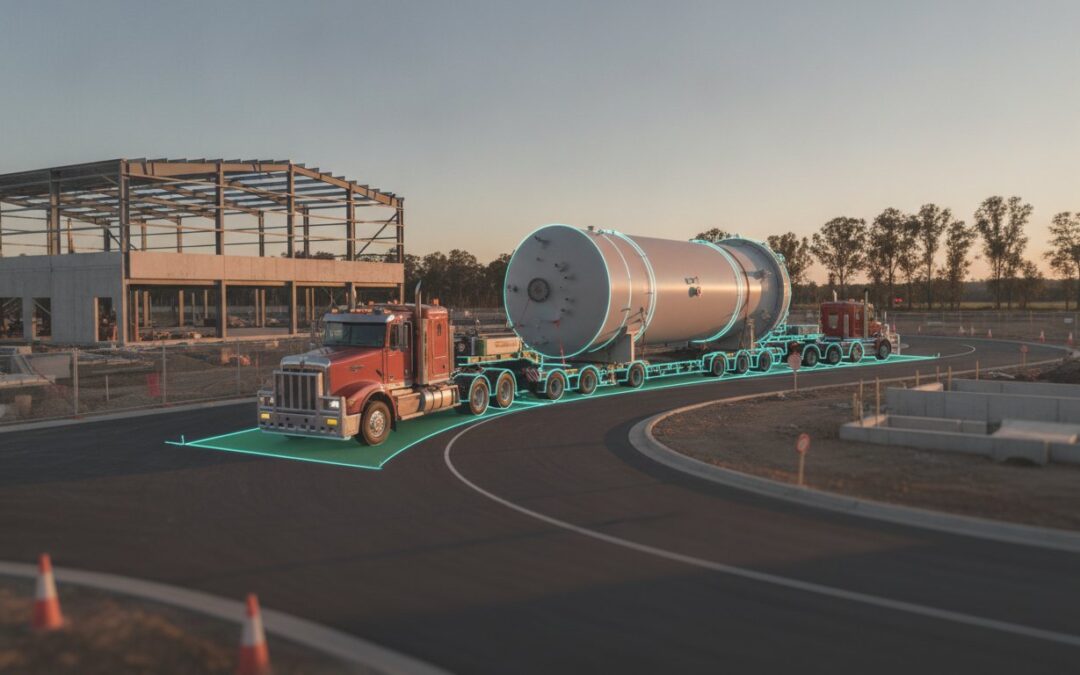
Approximately 35% of industrial development applications face significant delays or rejections due to poor site layouts and inadequate vehicle access. It’s a costly setback that often stems from a fundamental misunderstanding of how large indivisible items must move through a built environment. You likely recognise the frustration of receiving Council feedback demanding an immediate re-design because your proposed loading docks don’t meet the geometric realities of heavy vehicle movements.
Securing a seamless DA approval requires a meticulous oversize vehicle access assessment for development sites conducted during the initial planning stages. This guide provides the technical clarity you need to balance site optimisation with strict regulatory compliance. You’ll learn how to navigate the complexities of AS 2890.2:2018, differentiate between Council design requirements and NHVR permit protocols, and use precise swept path analysis to ensure your site is functional from day one. We’ll outline a clear path to achieving an efficient layout that satisfies road authorities while avoiding the expense of post-submission modifications.
Key Takeaways
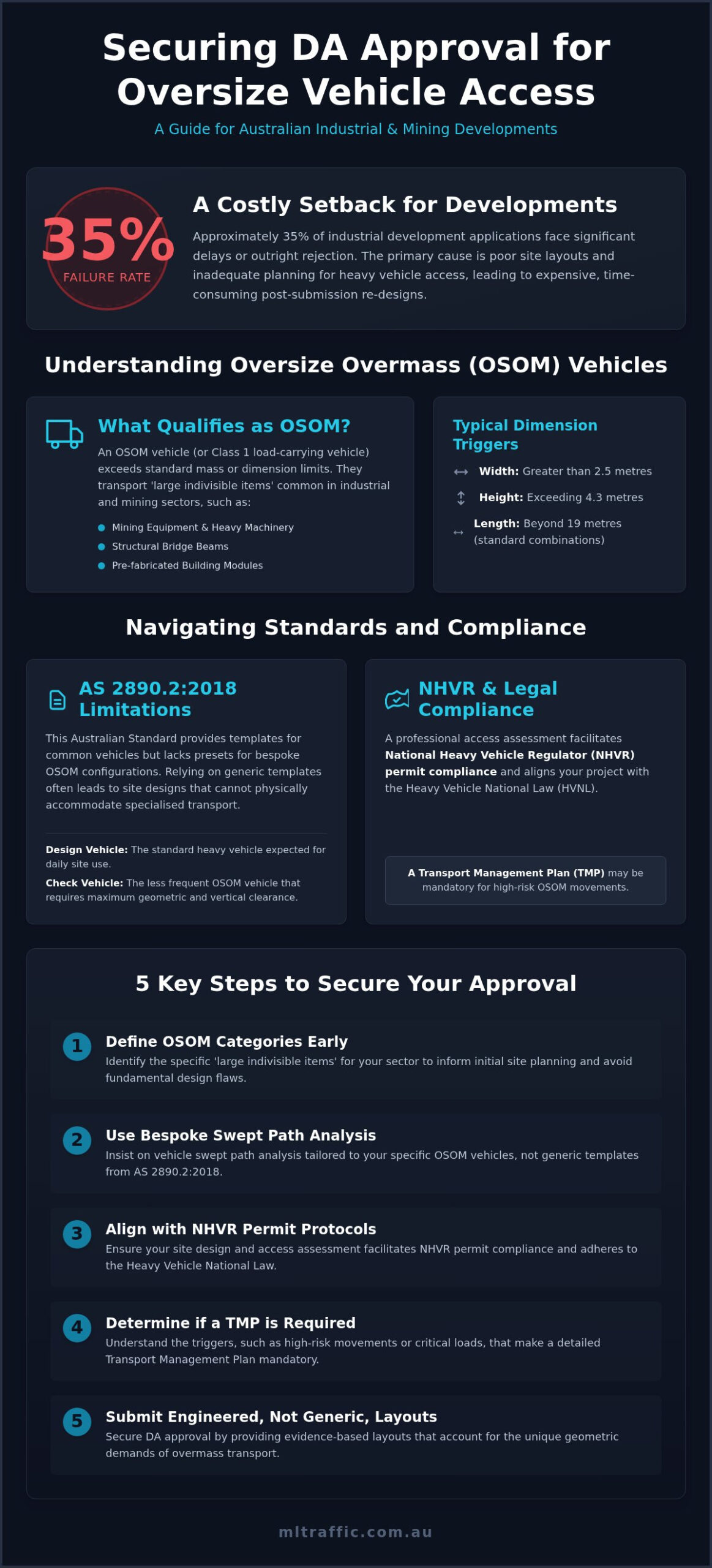
- Define OSOM vehicle categories and identify ‘large indivisible items’ common to industrial and mining sectors to inform initial site planning.
- Recognise the limitations of standard vehicle templates and the necessity of bespoke Vehicle Swept Path Analysis to meet AS 2890.2:2018 requirements.
- Understand how a professional oversize vehicle access assessment for development sites facilitates NHVR permit compliance and aligns with Heavy Vehicle National Law.
- Determine the specific triggers that make a Transport Management Plan (TMP) mandatory for high-risk OSOM movements and critical loads.
- Secure DA approval by replacing generic site designs with engineered layouts that account for the unique geometric demands of overmass transport.
Understanding OSOM Vehicle Access for Australian Development Sites
Industrial and mining developments in Australia frequently require the transport of machinery or structural components that exceed standard regulatory limits. These are classified as Oversize Overmass (OSOM) vehicles, or Class 1 load-carrying vehicles. Unlike standard freight, an Oversize load consists of large indivisible items that cannot be broken down for transport. This includes mining equipment, bridge beams, and pre-fabricated building modules common in complex commercial hubs and industrial warehouses.
To better understand the detection and movement of these vehicles within infrastructure, watch this helpful video:
What Qualifies as an OSOM Vehicle?
An OSOM vehicle is any heavy vehicle combination that exceeds the mass or dimension limits prescribed by the Heavy Vehicle National Law (HVNL). Dimension thresholds typically involve widths greater than 2.5 metres, heights exceeding 4.3 metres, or lengths beyond 19 metres for standard combinations. Mass requirements apply when the gross vehicle mass or individual axle weights exceed standard limits. These configurations often utilize prime movers with extendable trailers or low loader combinations. Because these vehicles require significantly larger turning circles, a standard design approach is insufficient for modern industrial sites.
The Impact of OSOM Access on DA Approvals
Council planners scrutinise industrial site entries and internal roads to ensure heavy vehicle manoeuvres don’t compromise public safety or local infrastructure. Approximately 35% of industrial development applications face significant delays or rejections due to poor site layouts and inadequate vehicle access. Common issues include vehicles mounting kerbs, damaging street furniture, or colliding with overhead structures during entry and exit.
Securing DA approval hinges on a comprehensive oversize vehicle access assessment for development sites. This assessment must be conducted during the initial planning stages to prevent costly re-designs after the initial submission. Engineers must demonstrate that the specific design vehicle can navigate the site boundaries and gate widths safely. This is achieved through specialised Swept Path Analysis, which provides the geometric proof required for road authority approval. At ML Traffic Engineers, our senior principals personally oversee every assessment to ensure your site layout balances space efficiency with strict accessibility requirements.
Navigating AS 2890.2 and Swept Path Analysis for OSOM Loads
Compliance with Australian Standard AS 2890.2:2018 is the baseline for any commercial vehicle facility. While this standard provides templates for common heavy vehicles like B-doubles, it lacks specific presets for the bespoke configurations found in mining or large-scale construction. A professional oversize vehicle access assessment for development sites must bridge this gap by defining the geometric requirements of non-standard load-carrying vehicles. Relying on generic templates often leads to site designs that cannot physically accommodate the turning requirements of specialized transport equipment.
The Role of AS 2890.2 in OSOM Design
In traffic engineering, we distinguish between ‘design vehicles’ and ‘check vehicles’. A design vehicle represents the standard heavy vehicle expected to use the site daily. A check vehicle is often an OSOM combination that accesses the site less frequently but requires maximum geometric clearance. Engineers must ensure minimum radius requirements for turning circles are met without compromising site safety. Vertical clearances are equally critical; many OSOM loads exceed the standard 4.3-metre height, necessitating careful planning of awnings, pipe bridges, and site entries to prevent structural damage.
Visualising Manoeuvrability with AutoTURN
Precise simulation is the only way to satisfy Council requirements for non-standard movements. We use AutoTURN software to generate detailed swept path diagrams that account for the unique dimensions of extendable trailers and low loaders. This process identifies ‘off-tracking’, where the rear wheels follow a different path than the front, and ‘kick-out’, which occurs when the rear of a long trailer swings wide during a turn. Swept path analysis prevents ‘kerb-mounting’ by simulating wheel paths and body overhangs to ensure the vehicle remains within the designated pavement area.
To ensure your development remains compliant and functional, consider these design optimisations:
- Widen driveways to accommodate the increased swept path of 19-metre plus combinations.
- Implement gate offsets to allow vehicles to straighten before entering or exiting the site boundaries.
- Maintain clear sight-lines at exit points, typically requiring 115 metres of visibility for a 60km/h road.
- Verify that internal intersections can support the weight of overmass loads without pavement failure.
Our team leverages over 15 years of experience to ensure your site design is both functional and compliant with national standards. For detailed technical support during the planning phase, you can explore our full range of traffic engineering services to facilitate your project approval.
NHVR Compliance and OSOM Permit Requirements
Achieving project success requires a seamless transition between the public road network and the private development site. While earlier sections focused on internal geometry, the National Heavy Vehicle Regulator (NHVR) governs the legal framework for access. A compliant site design is ineffective if the vehicle cannot legally reach the gate due to road network restrictions. A comprehensive oversize vehicle access assessment for development sites must address ‘first mile/last mile’ connectivity to ensure the Heavy Vehicle National Law (HVNL) requirements are satisfied before construction begins.
Do You Need an OSOM Permit for Your Site?
Most heavy vehicle movements are managed through National Class 1 notices, which allow for standard oversize configurations. If your design vehicle exceeds these dimensions, you must apply for a specific access permit. As of 1 August 2026, the fee for a Class 1 or Class 3 access permit application is $94. For overmass loads, the Heavy Vehicle Structural Assessment Permit System (HVSAPS) is used to verify that infrastructure like bridges can handle the load. These permit applications can take up to 28 days for approval, so early engagement with traffic engineers is essential. Our senior principals handle these technical negotiations directly with road managers to secure the necessary access rights for your development.
Large Indivisible Items and Site Constraints
Specific industries, particularly mining and renewable energy, deal with large indivisible items that cannot be reduced in size. Transporting wind turbine blades or massive excavators requires bespoke assessments that go beyond standard swept paths. One critical factor often missed is the vertical geometry of the site. Low loaders carrying heavy machinery have extremely low ground clearance. Without a precise Driveway Ramp Grade Assessment, these vehicles can bottom out on driveway crests or sag points, causing significant damage and project delays. We assess the vertical profile of the specific trailer combination against your site’s topography to ensure clear passage.
We provide the technical documentation required to bridge the gap between Council planning requirements and NHVR permit protocols. This dual-focus approach ensures your site layout is optimised for space while remaining fully accessible to the heavy vehicles your tenants require. If your project involves complex OSOM logistics, Contact ML Traffic for a site-specific assessment that identifies and mitigates access risks before they become costly DA rejections.
Developing a Transport Management Plan (TMP) for OSOM Transport
A Transport Management Plan (TMP) is a specialised document that records the procedures required to safely execute an OSOM movement. While a standard Traffic Impact Assessment focuses on the long-term operational effects of a development, the TMP addresses the specific risks associated with the delivery of large indivisible items. In jurisdictions like New South Wales, a TMP is mandatory for all OSOM movements classified as high-risk, those travelling on high-risk routes, or those involving critical loads. An oversize vehicle access assessment for development sites must incorporate these operational realities to ensure the project remains viable during the construction and delivery phases.
Key Components of an OSOM TMP
Effective TMPs begin with a detailed route assessment from the point of origin to the development site. This process identifies physical constraints that swept path analysis may not capture on-site, such as roadside furniture or narrow bridge spans. Risk mitigation strategies must be documented for every tight turn or sensitive piece of infrastructure. Communication is the foundation of a successful move. The plan must establish clear protocols between the heavy vehicle driver, pilot drivers, and site managers to coordinate the arrival window. If your project is in Victoria, you must also account for escort service fees, which are $275 per hour per escort vehicle as of 2026. These costs make precise planning essential for budget control.
Managing High-Risk Routes and Infrastructure
Route planning identifies ‘pinch points’ where the vehicle’s dimensions may conflict with existing infrastructure. Common obstacles include roundabouts with high central aprons or low-clearance bridges. Coordination with Rail Infrastructure Managers (RIM) is a legal requirement if the route involves crossing railway lines. This ensures that massive loads don’t risk bottoming out or becoming stranded on level crossings. Travel conditions also vary significantly based on timing. Many road authorities impose strict curfews, requiring moves to occur at night or outside peak hours to minimise public disruption. In the Northern Territory, new 2025 regulations allow eligible vehicles to travel during peak times, but most states maintain rigid restrictions that your TMP must respect.
Our senior principals provide the technical expertise required to develop robust TMPs that satisfy both Council and road authorities. We ensure that the expert you speak with at the start of your project is the one performing the technical work. To secure your project’s logistics, you can request a professional Traffic Guidance Scheme to manage OSOM arrivals safely and efficiently.
To complement these traffic management strategies, high-quality site signage is essential for safety and branding; for more information on custom solutions, click here.
Securing Approval with Expert OSOM Access Assessments
Generic site plans often fail. These ‘cookie-cutter’ designs lack the technical precision required to accommodate the specific turning radii of non-standard heavy vehicle combinations. When a developer submits a layout based on standard templates rather than a bespoke oversize vehicle access assessment for development sites, Council Request for Information (RFI) letters are the inevitable result. These delays stall project timelines and increase costs through necessary site re-designs. Technical accuracy in swept path analysis is not optional; it is the foundation of a successful industrial or commercial Development Application.
The ML Traffic Advantage for Developers
Our firm brings over 15 years of experience in Australian traffic engineering to every project. We operate with a personnel continuity promise. This means the senior principal who initiates your project is the same expert who performs the technical work. This direct access to leadership eliminates the bureaucratic layers found in larger firms and ensures accountability for every swept path diagram and report produced. Our expertise extends across an exhaustive list of project environments, from complex commercial hubs to large-scale industrial warehouses. We provide a comprehensive suite of services, including Traffic Impact Assessments and compliant Car Park Design, ensuring all aspects of your site’s accessibility are engineered to national standards.
Next Steps for Your Development Site
Operational success begins well before the formal DA submission. We recommend a preliminary site layout review to identify potential access conflicts early. This proactive approach allows for the optimisation of driveway widths and internal intersections without the pressure of a Council deadline. Once the design is refined, we act as your technical representative, liaising with Council planners and the NHVR to justify the proposed access arrangements. We provide the geometric proof required to demonstrate that even the most challenging OSOM loads can navigate your site without compromising safety or infrastructure integrity.
Securing DA approval requires more than just a drawing. It requires a detailed oversize vehicle access assessment for development sites that stands up to the scrutiny of road authorities and regulatory bodies. Our results-oriented approach focuses on delivering meticulous assessments that facilitate seamless approvals. If you are preparing a submission for an industrial or commercial development, organise your OSOM access assessment today to ensure your site layout is both functional and fully compliant.
Streamlining Your Industrial DA Approval
Successful site delivery depends on more than just meeting standard codes. It requires a meticulous understanding of how non-standard vehicles interact with your specific site geometry. By integrating specialised swept path analysis and a robust Transport Management Plan early in the design phase, you mitigate the risk of costly Council RFIs and infrastructure damage. A comprehensive oversize vehicle access assessment for development sites ensures that your project remains functional for the most demanding logistics requirements while staying fully compliant with the Heavy Vehicle National Law.
ML Traffic Engineers provides over 15 years of traffic engineering expertise to every client. Our personnel continuity promise ensures direct senior principal involvement on every project, utilising specialised AutoTURN swept path analysis to guarantee technical accuracy. Don’t leave your project’s accessibility to chance or generic templates that fail to account for real-world heavy vehicle movements.
Secure your project approval with a professional OSOM access assessment from ML Traffic Engineers. We look forward to ensuring your next development is both accessible and approved.
Frequently Asked Questions
What is considered an OSOM vehicle in Australia?
An OSOM vehicle is any heavy vehicle combination exceeding the dimensions or mass limits set by the Heavy Vehicle National Law. This typically includes vehicles wider than 2.5 metres, higher than 4.3 metres, or longer than 19 metres. They are officially classified as Class 1 load-carrying vehicles. These vehicles often transport large indivisible items that cannot be easily dismantled for transit.
When do I need a Transport Management Plan (TMP) for my development?
A Transport Management Plan is required for movements classified as high-risk or those involving critical loads. In New South Wales, this is mandatory for vehicles on high-risk routes. The plan documents risk mitigation strategies for tight turns and sensitive infrastructure. It is a critical component of an oversize vehicle access assessment for development sites to ensure operational safety during construction.
Does AS 2890.2 cover all oversize vehicle requirements?
AS 2890.2:2018 is the mandatory standard for off-street commercial vehicle facilities, but it primarily covers standard designs. It provides templates for vehicles up to B-doubles. It does not provide specific geometric presets for bespoke OSOM loads like extendable trailers. Engineers must use specialised software to simulate these non-standard movements and ensure compliance with the spirit of the standard.
How does swept path analysis help with Council approval?
Swept path analysis provides the geometric proof that a specific design vehicle can safely navigate a site. It prevents ‘kerb-mounting’ by simulating wheel paths and body overhangs. Council planners use these diagrams to verify that site entries and internal roads won’t damage public infrastructure. This technical documentation is essential for securing DA approval and avoiding costly re-designs.
What are large indivisible items in a traffic context?
Large indivisible items are loads that cannot be divided without great effort or expense. Examples include wind turbine blades, bridge beams, and heavy mining excavators. Because these items create extreme dimensions, they require a bespoke oversize vehicle access assessment for development sites. Standard freight templates are insufficient for these loads due to their unique off-tracking and kick-out characteristics.
Do I need a pilot vehicle for all oversize movements?
Pilot vehicle requirements depend on the vehicle’s total dimensions and the specific state road authority regulations. While some movements only require warning lights, larger loads necessitate certified pilots or police escorts. In Victoria, escort services cost $275 per hour per vehicle as of 2026. Northern Territory regulations updated in 2025 have also changed peak-hour travel eligibility for certain OSOM combinations.
Can a traffic engineer help reduce the need for OSOM permits through site design?
Strategic site design can often simplify the permit process. By optimising driveway widths, gate offsets, and internal turning circles, an engineer can ensure a site accommodates vehicles within standard National Class 1 notices. This reduces the need for specific, time-consuming access permits. Better geometry often leads to more efficient site use and lower long-term operational costs for tenants.
How long does an oversize vehicle access assessment take?
The technical engineering assessment typically takes a few business days depending on site complexity. However, the external permit process through the National Heavy Vehicle Regulator can take up to 28 days for approval. Engaging a traffic engineer early in the planning phase allows these timelines to be managed concurrently with the broader development application, preventing project bottlenecks.

Disclaimer
The content on www.mltraffic.com.au, including all technical articles, guides, and resources, is provided for general informational and educational purposes only. It is not intended to constitute professional advice in traffic engineering, transportation planning, development approvals, or any other technical or legal field.
While ML Traffic Engineers makes every reasonable effort to ensure the accuracy, completeness, and timeliness of the information published, we do not provide any warranties or representations (express or implied) regarding its reliability, suitability, or availability for any particular purpose. Any reliance you place on the content is strictly at your own risk.
In no event shall ML Traffic Engineers, its directors, employees, authors, or affiliates be liable for any direct, indirect, incidental, special, consequential, or punitive damages (including, without limitation, loss of profits, data, or business opportunities) arising out of or in connection with the use of, or inability to use, any information provided on this website.
The articles and guides on this site are not a substitute for engaging a qualified, registered professional traffic engineer (such as an NPER or RPEQ engineer) to assess your specific project requirements. For tailored advice, compliance assessments, or traffic engineering services, please contact a competent professional.
This disclaimer may be updated from time to time without notice. By accessing or using this website, you agree to be bound by the most current version of this disclaimer.
