

With basement construction costs exceeding $85,000 per bay as of May 2026, a single design oversight can jeopardise your entire investment. Securing council approval for paid parking development requires more than administrative persistence; it demands rigorous technical compliance with shifting regulatory frameworks. Whether you’re navigating the ambiguity between the 2004 edition of AS 2890.1 and the impending 2026 updates or managing the $3,200 annual congestion levy in Category 1 areas, the margin for error is non-existent.
You’re likely aware that bureaucratic delays and DA rejections often stem from poorly integrated traffic flow or non-compliant bay dimensions that fail to account for the rise of larger SUVs. This guide promises to help you master these complexities by applying expert traffic engineering insights to your design process. We’ll preview the essential components of a robust Traffic Impact Assessment, the necessity of precise vehicle swept path analysis, and the technical strategies required to minimise impact on the surrounding road network while ensuring a successful DA outcome.
Key Takeaways
- Understand how Local Environmental Plans (LEPs) and Development Control Plans (DCPs) differentiate between private and commercial paid parking requirements.
- Secure council approval for paid parking development by providing a comprehensive Traffic Impact Assessment (TIA) that addresses surrounding road network capacity.
- Ensure your design meets the rigorous requirements of AS 2890.1 and AS 2890.2 for both passenger vehicles and commercial loading access.
- Use pre-lodgement consultations to identify technical issues early and reduce the risk of costly Development Application (DA) rejections.
- Learn why direct access to senior principals and specialised swept path analysis is vital for compliant car park design.
Understanding the Regulatory Framework for Paid Parking in Australia
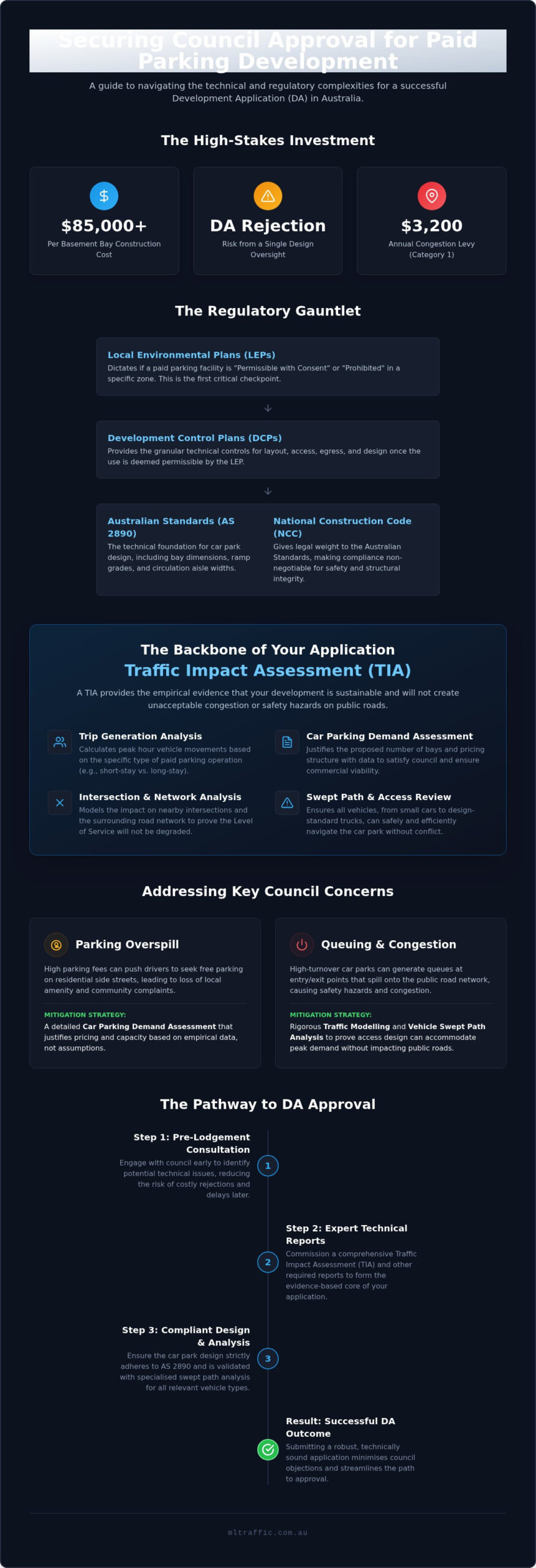
Securing council approval for paid parking development involves a clear distinction between ancillary parking and commercial operations. Private parking is typically approved as a secondary component of a primary land use, such as a residential flat building or a retail centre. Commercial paid parking, however, is often classified as a standalone “car park” land use. This classification triggers specific requirements within Local Environmental Plans (LEPs) and Development Control Plans (DCPs). While LEPs dictate whether the use is permissible in a specific zone, DCPs provide the granular technical controls regarding layout, access, and egress.
Parking regulations across Australia are governed by a hierarchy of controls. While National Australian Standards like AS 2890 provide the technical foundation for design, they don’t override state-specific planning legislation or local council policies. The National Construction Code (NCC) also references these standards, giving them legal weight. Councils scrutinise these applications heavily because commercial parking changes the economic and physical dynamics of a precinct.
The Intersection of Planning Law and Traffic Engineering
Zoning is the primary determinant of project feasibility. You must confirm if a paid parking facility is “Permissible with Consent” or “Prohibited” under the relevant LEP before commissioning technical reports. Every application requires a Statement of Environmental Effects (SEE) to justify the development. This document relies on a professional Traffic Impact Assessment (TIA) to prove that the proposed intensification won’t degrade the level of service at nearby intersections. Our experts ensure the TIA aligns with both the SEE and the specific objectives of the local planning zone.
Council Concerns: Why Paid Parking Triggers High Scrutiny
Councils are particularly wary of “parking overspill.” If the cost of the new facility is perceived as too high, drivers may migrate to free residential side streets. This creates a loss of local amenity and triggers community complaints. To mitigate this risk, a council approval for paid parking development usually requires a detailed Car Parking Demand Assessment. This report justifies the pricing and capacity based on empirical data rather than assumptions.
We also analyse local traffic circulation. High-turnover paid car parks can create queues that extend onto the public road network, causing safety hazards and congestion. If the development is large-scale, councils may mandate community consultation periods. Demonstrating compliance through rigorous traffic modelling and Vehicle Swept Path Analysis is the only way to satisfy these bureaucratic requirements and secure a successful DA. It’s about proving that your commercial interests don’t conflict with the public’s right to safe, efficient road access.
Essential Technical Documentation: The Traffic Impact Assessment (TIA)
A professional traffic impact assessment is the primary technical document required to secure council approval for paid parking development. It functions as the backbone of your Development Application (DA) by providing empirical evidence that the proposed facility is sustainable. A TIA does not simply count cars; it provides a comparative analysis of existing traffic conditions against the projected volumes generated by the new development. This ensures that the intensification of land use doesn’t create safety hazards or unacceptable congestion on public roads.
Key Components of a TIA for Paid Parking
A comprehensive TIA must quantify several technical metrics to satisfy council traffic engineers. Trip generation data is the first priority. This involves calculating peak hour vehicle movements based on the specific land use and the nature of the paid parking operation. For instance, a short-stay car park near a transit hub generates significantly different traffic patterns than a long-stay commercial facility. We also conduct a detailed Car Parking Demand Assessment to justify the specific number of bays provided. Current research on parking requirements suggests that rigid minimums are evolving, making data-backed demand assessments even more critical for commercial viability.
Intersection analysis is another vital component. We use specialised software to model how the additional traffic will affect the performance of nearby junctions. If the modelling predicts a drop in the Level of Service (LoS), the TIA must propose mitigation strategies. These might include revised entry and exit configurations or physical road upgrades to maintain safety and flow.
The Professional Traffic Engineer’s Role
Engaging a specialist for your technical documentation is non-negotiable for commercial projects. Councils frequently issue Requests for Further Information (RFIs) when reports lack technical depth or fail to address specific local DCP clauses. These bureaucratic delays can stall a project for months. Our approach ensures that a senior principal manages the technical work from inception to completion. This provides a level of accountability that generalist civil engineering firms often lack.
Senior-level involvement is particularly valuable when proposing mitigation strategies for identified traffic and safety issues. If an assessment identifies a potential problem, such as restricted sight distances or queuing overspill, we design engineering solutions that satisfy regulatory bodies. This meticulous attention to detail is what streamlines council approval for paid parking development and ensures the long-term viability of your asset. If you need technical certainty for your next project, you can discuss your requirements with our senior engineers to ensure your DA is compliant from the first lodgement.
Complying with Australian Standards: AS 2890 and Car Park Design
Technical compliance with Australian Standards is the most frequent hurdle for developers seeking council approval for paid parking development. While planning policies set the strategic direction, AS 2890.1 provides the mandatory technical specifications for off-street car parking. For paid developments, you must also adhere to AS 2890.2, which governs commercial vehicle access and loading requirements. Failure to align your design with these standards results in immediate DA rejection or costly redesigns after construction has commenced.
Design elements such as aisle widths, bay dimensions, and blind aisle treatments must be meticulously planned. With four in five new cars sold in Australia being SUVs or utes, councils are increasingly strict on bay sizing. While 5.4-metre lengths were standard under the 2004 edition, many jurisdictions now require 5.6-metre bays to accommodate the modern vehicle fleet. Safety for pedestrians and cyclists within the facility is equally critical. This involves clearly defined shared zones, appropriate lighting, and signage that complies with regulatory safety requirements.
Vehicle Swept Path Analysis for Complex Layouts
A static drawing is rarely sufficient for a commercial DA. We use specialised software like AutoTURN to perform a swept path analysis, simulating the movements of B85 and B99 vehicles through your site. This analysis proves that vehicles can navigate tight corners and transition between levels without encroaching on opposing lanes or striking structural elements. It is an essential tool for validating the feasibility of ramps and basement entries, where the margin for error is measured in millimetres.
Driveway and Access Point Compliance
The interface between your private car park and the public road is a high-scrutiny zone. We conduct sight distance assessments to ensure drivers exiting the facility can see oncoming traffic, pedestrians, and cyclists clearly. Additionally, driveway ramp grade assessments are mandatory to prevent vehicle scraping, especially in multi-level basement designs. Our experts verify that transition grades comply with the specific requirements of the current Australian Standards.
For paid facilities, queuing analysis is a critical requirement. We model the time taken for ticket barriers or ALPR systems to process entries. If the model indicates that queues will tail back onto the public road, the council will likely refuse the application. Our engineers design storage areas and entry configurations that absorb these peaks, ensuring your council approval for paid parking development is based on a design that functions safely under real-world conditions.
Navigating the Council Application Process: Step-by-Step
Securing council approval for paid parking development is a methodical process that requires technical precision at every stage. While specific administrative requirements vary between states, the assessment of traffic impacts remains a constant priority for planning authorities. Following a structured path reduces the risk of project stalls and ensures that your technical documentation addresses council concerns before they become formal objections.
- Step 1: Pre-lodgement consultation: Meet with council traffic engineers to identify site-specific constraints and expectations.
- Step 2: Commissioning technical reports: Finalise your TIA, Vehicle Swept Path Analysis, and Car Park Design based on pre-lodgement feedback.
- Step 3: Lodging the DA: Submit all documentation and technical assessments via the relevant state planning portal.
- Step 4: Responding to RFIs: Address technical queries or community submissions regarding traffic flow and local amenity.
- Step 5: Final approval: Receive the notice of determination and review the “Conditions of Consent” for operational requirements.
Pre-lodgement: The Developer’s Best Defence
Engaging with the council early is the most effective way to identify potential “deal-breakers” before you’ve spent significant capital on full design. These might include restricted access points or conflicts with future road widening schemes. A pre-DA meeting allows you to align your parking strategy with the council’s long-term transport goals, such as integrated active transport links. It’s vital to have your traffic engineer present at these meetings. Their presence ensures that technical discussions regarding intersection performance or queuing storage are handled with professional authority, preventing misunderstandings that could delay your application.
Handling RFIs and Post-Lodgement Negotiations
Requests for Further Information (RFIs) are common when a proposal involves complex commercial movements. Typical traffic-related delays stem from perceived safety risks or insufficient data on peak-hour turnover. When these arise, we provide technical justifications for minor design deviations, often using empirical data to prove that the proposed layout functions safely. If a DA faces a refusal and moves to an appeals tribunal, our senior principals act as expert witnesses. This level of seasoned expertise is essential for defending the technical merits of your council approval for paid parking development. To ensure your application is supported by professional technical evidence, you should consult with a senior principal before lodging your documentation.
Why Professional Traffic Engineering is the Key to DA Approval
Relying on general civil engineers for traffic-specific documentation is a common cause of project delays. While generalists handle broad site infrastructure, they often lack the specialised software and regulatory knowledge required for complex council approval for paid parking development. A substandard Traffic Impact Assessment (TIA) leads to repeated Requests for Further Information (RFIs). These delays don’t just stall your timeline; they erode the commercial viability of the project through increased holding costs and consultant fees. Getting the technical design right the first time is a fundamental requirement for project success.
Professional traffic engineering ensures the long-term safety and operational efficiency of your facility. We design for real-world conditions, preventing issues such as vehicle scraping on steep ramps or pedestrian-vehicle conflicts in shared zones. By positioning your project as a well-planned contribution to the local road network rather than a source of congestion, you build credibility with council assessors. This proactive approach facilitates a smoother approval process and reduces the risk of community opposition during the exhibition period.
The ML Traffic Engineers Australia Advantage
We provide 15+ years of experience in navigating the technicalities of Australian Standards and local planning controls. Our expertise spans an exhaustive range of project environments, including retail centres, commercial offices, industrial estates, medical facilities, and residential developments. We don’t use junior staff as gatekeepers. The senior principal who initiates your project is the same expert who performs the technical analysis and signs off on the final report. This continuity ensures that the technical merits of your site are defended with deep-seated expertise and accountability.
Next Steps for Your Paid Parking Development
Your first priority should be a professional review of your preliminary site plan against AS 2890.1 requirements. Identifying non-compliant aisle widths or inadequate sight distances early prevents expensive redesigns during the DA assessment phase. We recommend commissioning a Traffic Impact Assessment and Car Parking Demand Assessment as soon as your site layout is drafted. Our team provides detailed fee proposals tailored to the specific requirements of your local council. You can contact ML Traffic Engineers Australia today for a confidential project review to ensure your council approval for paid parking development meets all regulatory benchmarks from the outset.
Securing Your Project’s Technical Viability
Success in the commercial parking sector depends on the technical precision of your documentation and its alignment with national standards. You’ve seen how rigorous traffic modelling and adherence to AS 2890 metrics provide the necessary evidence to satisfy regulatory bodies. By addressing intersection performance and vehicle swept paths during the design phase, you mitigate the risk of costly redesigns or DA refusals.
Securing council approval for paid parking development requires a partner with deep-seated expertise and a meticulous approach to compliance. ML Traffic Engineers Australia offers over 15 years of traffic engineering excellence with senior principal involvement in every report. Our national coverage ensures that no matter where your project is located, you receive authoritative advice that stands up to council scrutiny. We promise that the same expert who starts your project performs the technical work.
Don’t leave your application to chance with generalist firms. You can Get a Professional Traffic Assessment for Your DA Approval and ensure your development is backed by seasoned experts. We look forward to helping you deliver a compliant, high-performing car park.
Frequently Asked Questions
Do I need a separate permit to charge for parking in an existing car park?
Yes, you typically require a new Development Application (DA) or a modification to your existing consent. Changing a car park from free use to a commercial paid operation is viewed by councils as an intensification of land use. This change affects traffic turnover rates and local street parking demand. You must demonstrate through a Car Parking Demand Assessment that the new fee structure won’t cause parking overspill into nearby residential areas.
What is the minimum bay size for a compliant commercial car park in Australia?
Minimum bay dimensions depend on the specific user class defined in AS 2890.1. While the 2004 standard often cited 5.4 metres by 2.4 metres for standard bays, many councils now require 5.6-metre lengths. This shift accounts for the fact that four in five new cars sold in Australia are now SUVs or utes. Your design must also account for aisle widths, which typically range from 5.8 to 6.6 metres depending on the parking angle.
How much does a Traffic Impact Assessment (TIA) report typically cost?
The cost of a Traffic Impact Assessment (TIA) varies based on development scale and road network complexity. Factors like the number of intersections requiring modelling and the level of community consultation influence the final fee. Because every council approval for paid parking development involves unique site constraints, we recommend requesting a specific fee proposal. This ensures the report scope accurately reflects the technical requirements and expectations of your local council.
Can council refuse a DA based on traffic noise or congestion?
Councils can refuse a DA if the technical evidence suggests the development will cause unacceptable congestion or loss of local amenity. If intersection modelling shows a significant drop in the Level of Service (LoS), the application is at high risk of rejection. While noise is often handled by acoustic consultants, the traffic engineer must prove that vehicle queuing won’t block public roads. A robust TIA provides the technical justification needed to mitigate these specific council concerns.
Is Swept Path Analysis mandatory for all car park developments?
While not strictly mandatory for every minor residential driveway, Vehicle Swept Path Analysis is essential for all commercial paid parking developments. Councils require proof that B85 and B99 vehicles can manoeuvre safely through ramps, corners, and tight entry points. We use AutoTURN software to simulate these movements. Providing these diagrams in your initial lodgement prevents Requests for Further Information (RFIs) and demonstrates that your facility complies with AS 2890.1 and AS 2890.2 requirements.
How long does the council approval process take for a parking development?
The approval timeline for a parking development generally ranges from three to six months, though complex projects can take longer. This period includes the initial pre-lodgement phase, the formal assessment by council traffic engineers, and the mandatory public exhibition period. Delays often occur during the RFI stage if the original technical reports lack sufficient detail. Engaging an expert to provide a compliant TIA from the start is the most effective way to streamline the assessment process.
What happens if my car park design doesn’t strictly meet AS 2890.1?
If a car park design doesn’t strictly meet the “Deemed-to-Satisfy” provisions of AS 2890.1, you must provide a strong technical justification. This is known as a performance-based solution. You’ll need a senior traffic engineer to prove that the deviation doesn’t compromise safety or operational efficiency. Without this expert evidence, councils will likely refuse the application. It’s often more cost-effective to adjust the design to meet the standard rather than defending a non-compliant layout in a tribunal.
Do I need a traffic engineer for a small car park with under 20 spaces?
Yes, most councils require a professional traffic report for any commercial development, regardless of the number of spaces. Even for a small car park with under 20 bays, you must verify sight distances and driveway ramp grades to ensure public safety. A council approval for paid parking development hinges on technical compliance with Australian Standards. Having a qualified professional prepare your documentation ensures that even small-scale facilities meet the rigorous safety requirements expected by local planning authorities.

Disclaimer
The content on www.mltraffic.com.au, including all technical articles, guides, and resources, is provided for general informational and educational purposes only. It is not intended to constitute professional advice in traffic engineering, transportation planning, development approvals, or any other technical or legal field.
While ML Traffic Engineers makes every reasonable effort to ensure the accuracy, completeness, and timeliness of the information published, we do not provide any warranties or representations (express or implied) regarding its reliability, suitability, or availability for any particular purpose. Any reliance you place on the content is strictly at your own risk.
In no event shall ML Traffic Engineers, its directors, employees, authors, or affiliates be liable for any direct, indirect, incidental, special, consequential, or punitive damages (including, without limitation, loss of profits, data, or business opportunities) arising out of or in connection with the use of, or inability to use, any information provided on this website.
The articles and guides on this site are not a substitute for engaging a qualified, registered professional traffic engineer (such as an NPER or RPEQ engineer) to assess your specific project requirements. For tailored advice, compliance assessments, or traffic engineering services, please contact a competent professional.
This disclaimer may be updated from time to time without notice. By accessing or using this website, you agree to be bound by the most current version of this disclaimer.
